Life update: I will join the Pretrain team of ByteDance Seed (based in Beijing) in early July to keep doing research on LLM pre-training. I'm looking forward to collaborating with elite professionals and contributing to social value! 😀🫡
Welcome to have a coffee chat!
Marin 535B-A23B is ~7% done training, and so far things look on track. Next Tuesday (Sept 1 @ 10 PT), we will have a Zoom panel/discussion where the Marin team will talk about the design decisions that went into this run, the tradeoffs made, and our learnings. If you're interested, join the Discord for details (https://t.co/xwJSxd2IxH).
2/2
It explains that hyperball is actually just a special learning rate scheduler. It also explains why this peak-decay shaped learning rate schedule often appears—bias-variance trade-off.
1/2
https://t.co/IY2w6D6Uf4 Lei Wu's new paper, and I would also like to take this opportunity to promote my recently written blog, https://t.co/92vpdxoMsD
This blog post compiles recent research on ELR and hyperball.
https://t.co/B7qdNg62Gw
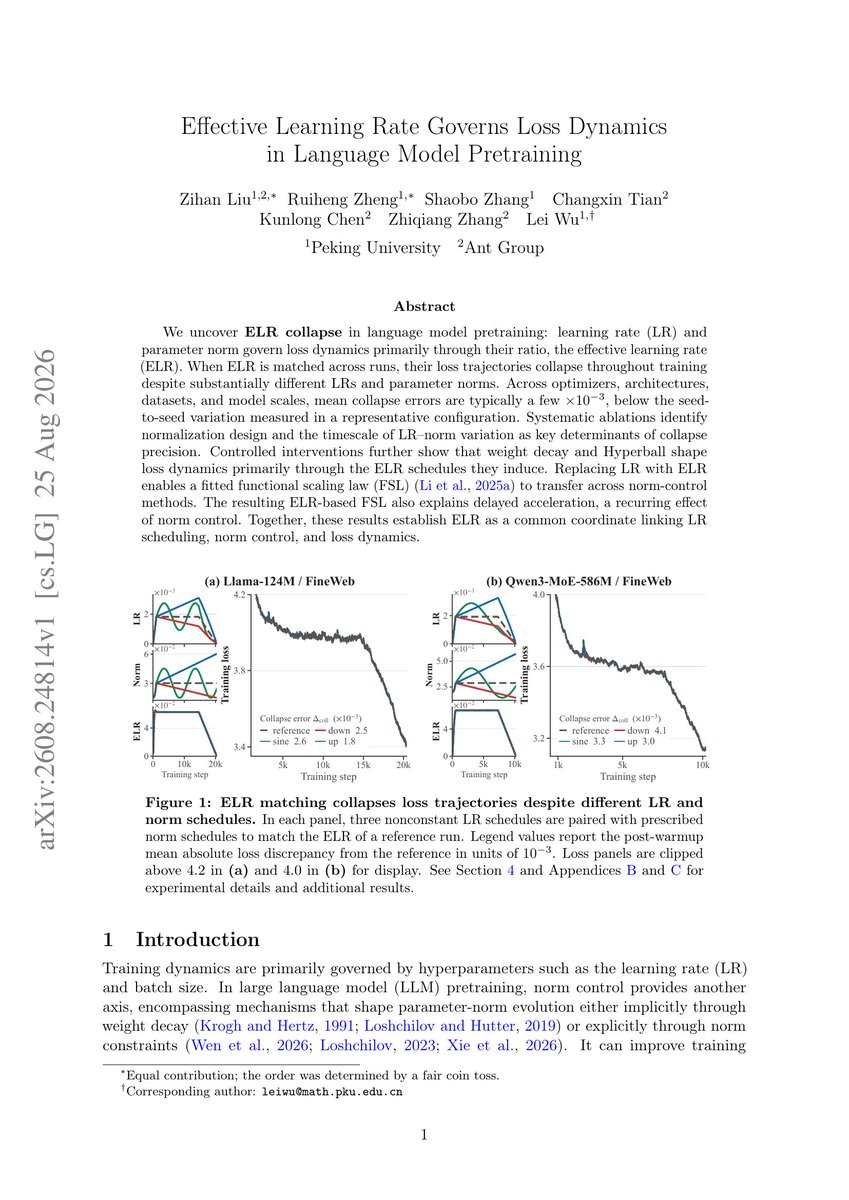
Effective learning rate, the ratio of learning rate and weight norm, governs training dynamics. This could allow transferring the settings across norm control methods (by matching effective learning rate).
Scaling is a methodology, even a scientific outlook. It denotes a scientific way of turning energy into intelligence, and is not confined to LLMs. This work uses Hyperball (Kaiyue et al.) as the optimizer, which has shown more stable scaling behavior across multiple scenarios.
Unlike muon, muon requires performing momentum first, followed by NS iteration. Momentum plays a denoising role at the spectrum level, enabling better convergence of NS iteration.
What if momentum accumulation in Adam is "wrong"? In 2020, we proposed LaProp. It performs momentum accumulation after normalization, which makes training much more stable across all parameter ranges - maybe it could be useful today.
Read it here: https://t.co/fVmzXuGm3a
Last week, Ma and Chen proved the first \omega(n^{-2}) lower bound for (non-anytime) GD with predetermined stepsizes. Soon after, Chung-En Tsai improved it to \Omega(n^{-sqrt{3}). With the help of ChatGPT-5.6 Sol, I further improved it to \Omega(n^{-1.6342}).
Introducing SubQ - a major breakthrough in LLM intelligence.
It is the first model built on a fully sub-quadratic sparse-attention architecture (SSA),
And the first frontier model with a 12 million token context window which is:
- 52x faster than FlashAttention at 1MM tokens
- Less than 5% the cost of Opus
Transformer-based LLMs waste compute by processing every possible relationship between words (standard attention).
Only a small fraction actually matter.
@subquadratic finds and focuses only on the ones that do.
That's nearly 1,000x less compute and a new way for LLMs to scale.
1/n
Watching a recent interview with a frontier-lab researcher left me with a list of questions — not for that one person, but for anyone working on frontier models in industry, myself included. The most important one is at the end. 🧵
marin is the most open model training initiative in the world
you can visualize the exact pre training mixture per domain, look at sampled documents, follow the live training loss, dig into configs, scaling laws
Put differently: do frontier labs possess a "science of models" the outside world doesn't yet know — or do they possess the organizational capability to execute a large body of already-known methods reliably and to the extreme?🧐🧐🧐
8/n — The most important question
How much of today's frontier labs' technical lead comes from scientific understanding that hasn't been made public, and how much comes merely from more compute, internal data, evaluation systems, and engineering infrastructure?