I post the papers I find interesting. There are so many papers published these days, and I frequently miss great papers. I appreciate paper recommendations via DM, but I tend to only post papers I discover on my own to keep my list personally curated.
Introducing GLM-5.4: Generalized Coding with Our First Loop Transformer.
- Loops existing layers in the GLM-5 base model for deeper reasoning
- Pushes beyond traditional coding to video, games, 3D shaders, and CAD modeling
- Adds vision capabilities for stronger visual coding
API access will open after safety evaluation. Model weights will be released responsibly.
Tech Blog: https://t.co/dQrbKoamcN
When machine learning is considered easier than RH then it would be because it is considered as a problem of mathematics, computer science, with some hardware-level engineering.
But one of the important parts of machine learning is that it is dealing with "human" related things like processing human-generated data to generate value for society, and often this is what makes machine learning hard.
As Duncan Watts said, it is easier to send a spaceship to the moon and return from it than predicting bestsellers.
Saying RH is harder than AI research and therefore we should expect AI research to be automated soon is also much too reductionistic. It’s like saying beating the world’s grandmaster at chess is harder than being a good surgeon, and so we should expect surgery to be automated once we “figure out the plumbing”.
We would laugh at the idea that a system like deep blue could be adapted to become a good surgeon, nevermind a great scientist, if only we figured out a few details.
Intellectual difficulty is not one dimensional, and there is not necessarily much transfer from one ability to the next, especially when a system has been exhaustively trained to be strong in a highly specialized setting. That’s not to say there won’t be some transfer in this instance, but we know when in people when someone is smart in one way we wouldn’t expect them to be smart in others, and that’s much more the case with these systems than people. It’s not just plumbing.
To explain the perplexity of GPT-6 or the internal model, should we assume the "hidden" recipes? I think GPT-6 could be explained without it, and the internal model could still be within the range of public knowledge.
@1a3orn It would be hard to know unless we have compute multipliers for each axis, but I think guessing is possible using the published innovations during this period and gpt-oss.
Very interesting plot. For a significant time, ppl did not move much (GPT-4 to o3, except 4.5), and it took, again, a significant time to reach 4.5's ppl. And each minor version is considered a new base model (from scratch or further pretraining?), and the trend is accelerated a lot. (The absolute difference is larger than 3.5 to 4!) Also, gpt-oss was released in Aug 2025.
We decided to provide more transparency into pretraining progress at OpenAI for the sake of moving toward shared safety bars. In “Perplexity and Intelligence” I argue for common limits based on perplexity and other measurements, with progress beyond them gated on our ability to understand AI behavior.
https://t.co/XX35m5vq89
여기에 대해 창작자의 입장에서 반응하는 인용들이 많은데 사실 (여기에서도 암시되어 있지만) AI를 사용한 창작은 창작이 아니라 소비의 경험에 가깝다. 웹소설 독자가 AI 채팅으로 넘어간다는 건 독자에서 창작자가 되는 것이 아니라 여전히 소비자에 가까울 수 있다는 것. 그리고 이미 그 소비의 경험이 다들 생각하는 것보다는 상당히 올라와 있다.
논란 가능한 소신발언 좀 할게요
그림 그릴 줄 모르는 사람, 작곡할 줄 모르는 사람 포함해서 모든 사람이 어떤 비용 부담도 없이 완전히 자기가 원하는 창작물을 순식간에 자급자족할 수 있는 미래사회가 이상향이라고 생각합니다.
물론 그게 무조건 지금의 AI 기술로 성립돼야 한다는 뜻은 아니고요.
But maybe good long context pretraining setup and evaluations with usual good taste on pretraining like emphasis on diversity could do most of the tricks.
I think many groups are trying to do this or actually doing this (like agentic benchmarks during pretraining or Mistral report) but it would be hard in general, considering task scaling laws and long context benchmarks are still open research areas. Especially for post-training it would also depend on data/task composition for it. But I think it could be feasible to establish scaling laws for it.
FineWeb-Edu is built with trafilatura, heuristic filtering and snapshot dedup, which are now a bit previous-generation practices. I recommend checking CuraWeb for what more recent practices look like. (Though I don't know the methods of frontier labs.)
Some unpopular-but-true notes on pretraining research:
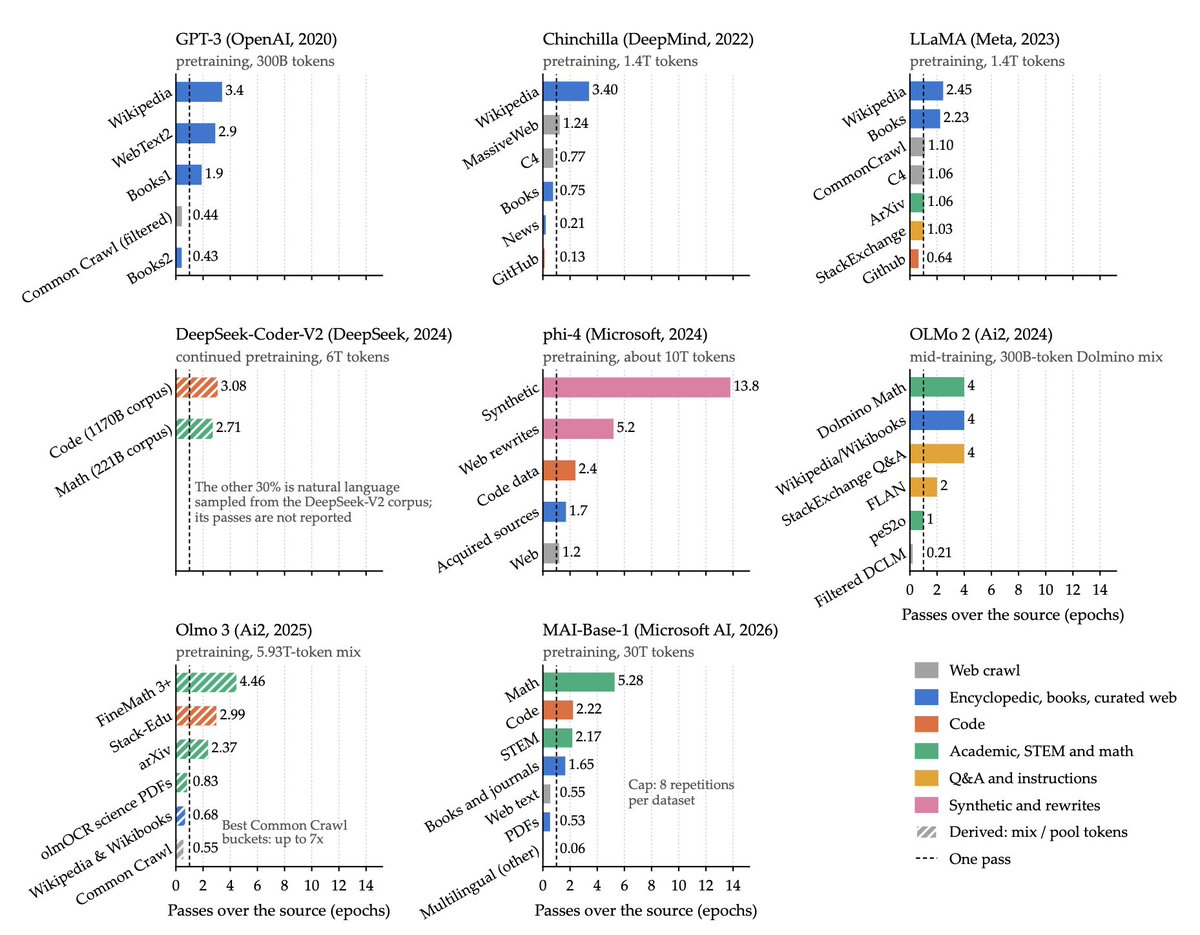
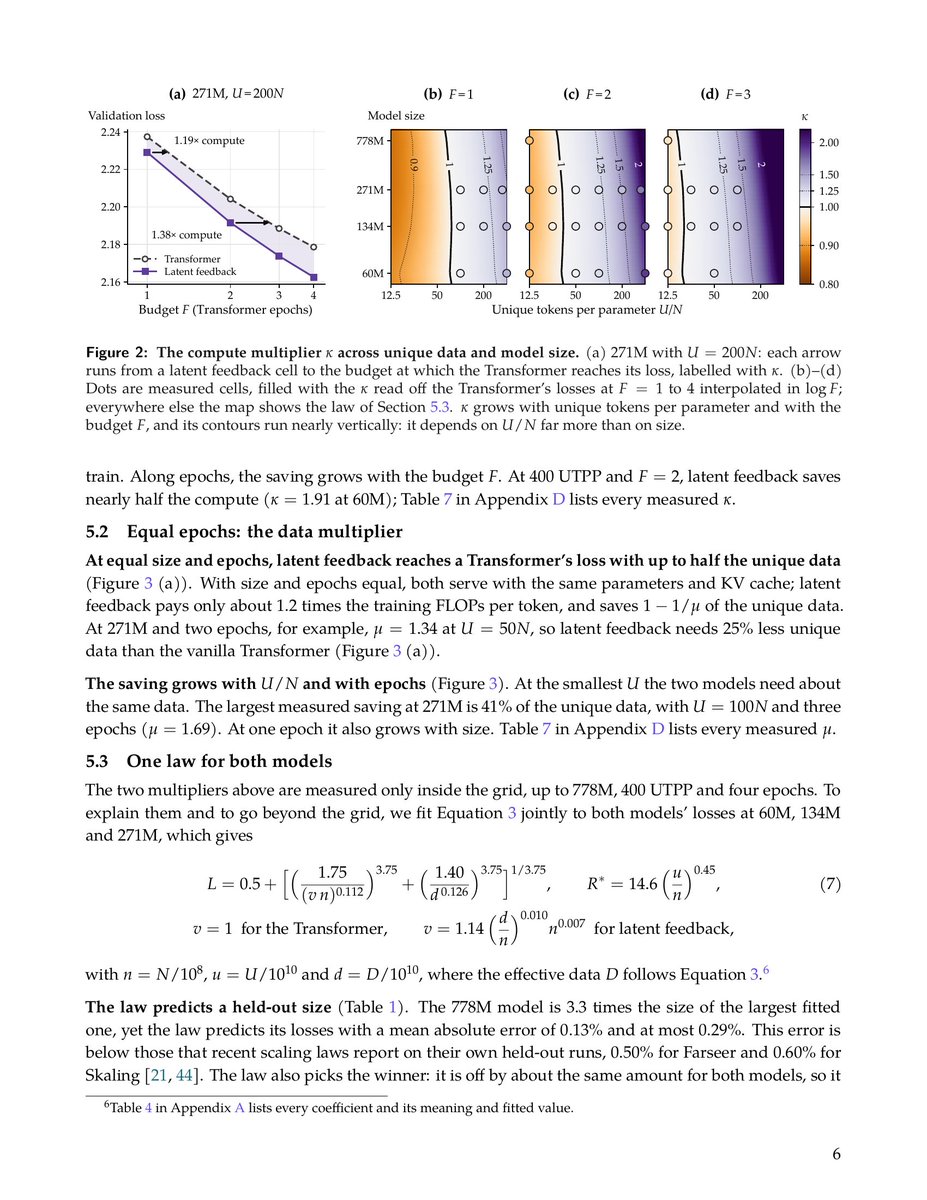
→ 𝗗𝗮𝘁𝗮 𝗿𝗲𝗽𝗲𝘁𝗶𝘁𝗶𝗼𝗻 is a very common practice.
→ 𝗢𝘃𝗲𝗿-𝘁𝗿𝗮𝗶𝗻𝗶𝗻𝗴 (~1000 TPP) is a very common practice.
→ In the long run, 𝗱𝗮𝘁𝗮-𝗲𝗳𝗳𝗶𝗰𝗶𝗲𝗻𝘁 architectures and algorithms will matter more than (currently) 𝗵𝗮𝗿𝗱𝘄𝗮𝗿𝗲-𝗳𝗿𝗶𝗲𝗻𝗱𝗹𝘆 ones.
→ 𝗙𝗶𝗻𝗲𝗪𝗲𝗯-𝗘𝗱𝘂 is a bad dataset for testing architectures; it can be misleading.
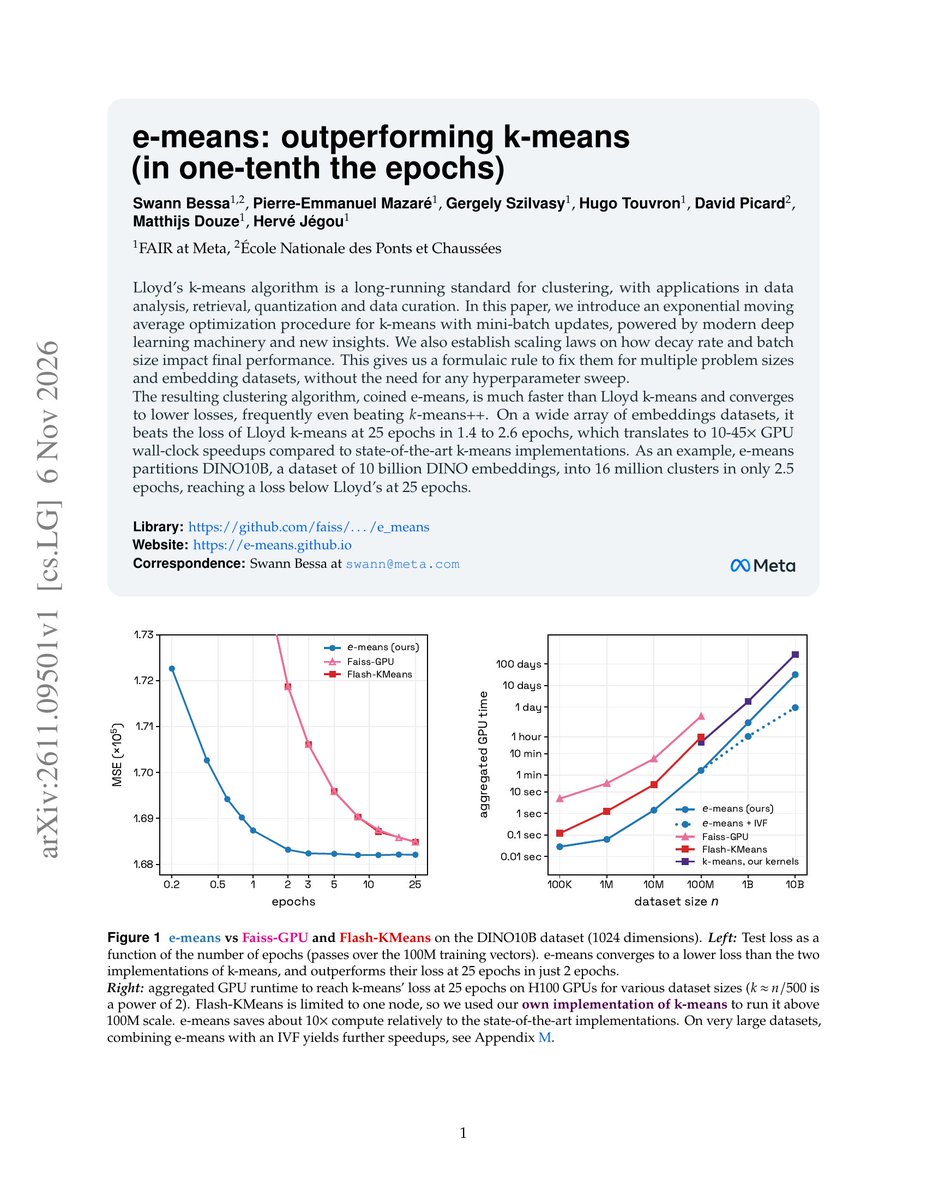
@rosinality Thanks for the share, we are glad Meta let us open-source e-means. If you don't believe our title claim, just try e-means and see.
Play with e-means in your browser at : https://t.co/oFngGZt570
Code released in faiss : https://t.co/ii7kxbpG1b
Blog : https://t.co/47cBlpi5IE
https://t.co/dqElJ6XOqo
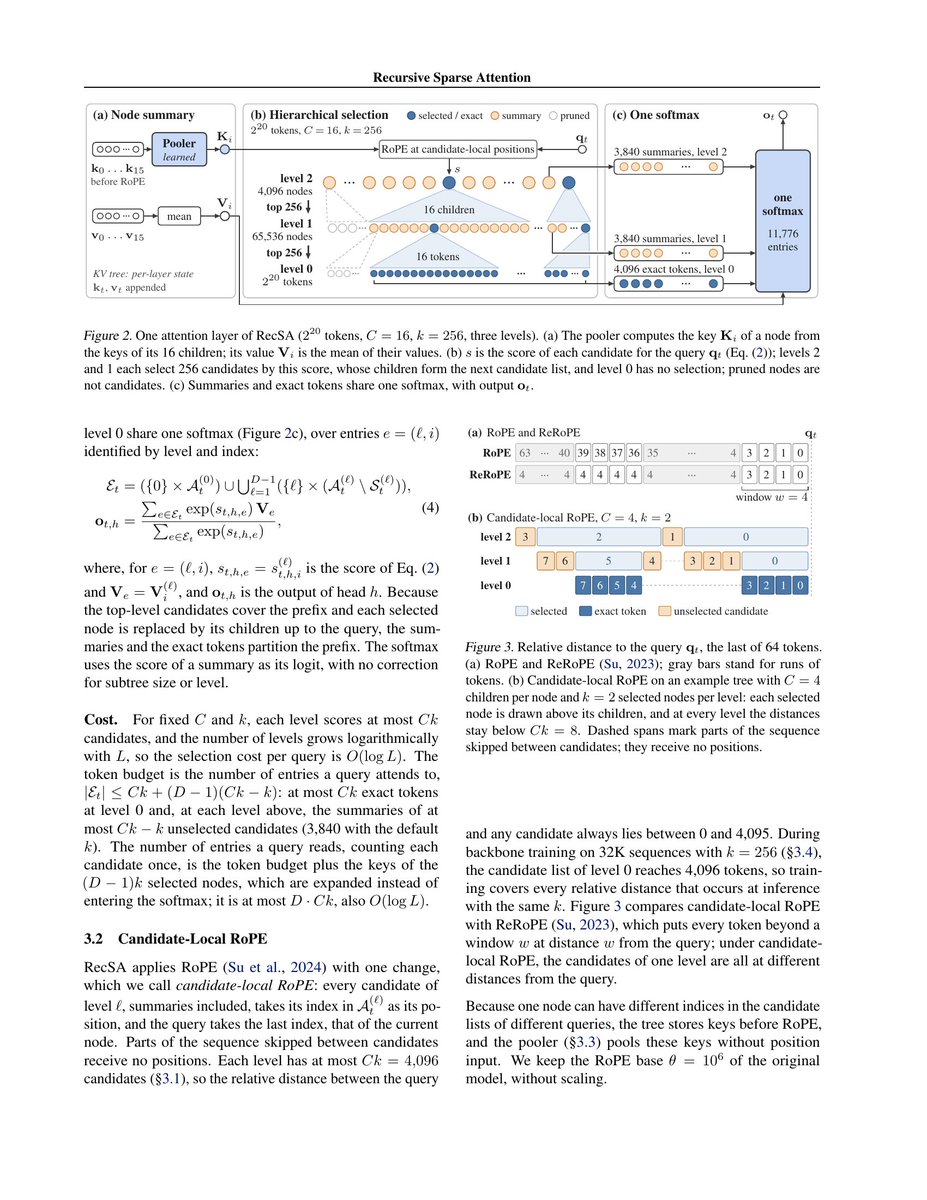
Tree-structured attention is popular now? But I am not sure whether it could support exact retrieval well enough (and potential risk of aliasing!).