A certain private school in Chicago, was facing a unique problem. A number of 12th grade girls were beginning to use lipstick and would put it on in the bathroom. That was fine, but after they put on their lipstick they would press their lips to the mirror leaving dozens of little lip prints. Every night, the maintenance man would remove them and the next day the girls would put them back. Finally,.....
the principal decided that something had to be done. She called all the girls to the bathroom and met them there with the maintenance man. She explained that all these lip prints were causing a major problem for the custodian who had to clean the mirrors every night. To demonstrate.....
I'm becoming more intentional about how I build my presence in Web3.
I don't want this account to be just another place for project announcements, promotional threads and recycled narratives.
I want to investigate projects, understand the technology, identify meaningful developments and share insights people can actually learn from.
More independent research.
More technical explanations.
More ecosystem discoveries.
More meaningful conversations.
I'm interested in what is being built, how it works, what problems it solves and where the unanswered questions remain.
The goal is simple:
Build credibility through consistent proof of work.
Not just followers. Not just impressions.
Real value. Real connections. Real opportunities.
Let's build. 🫡
Most blockchains make developers think about accounts and balances.
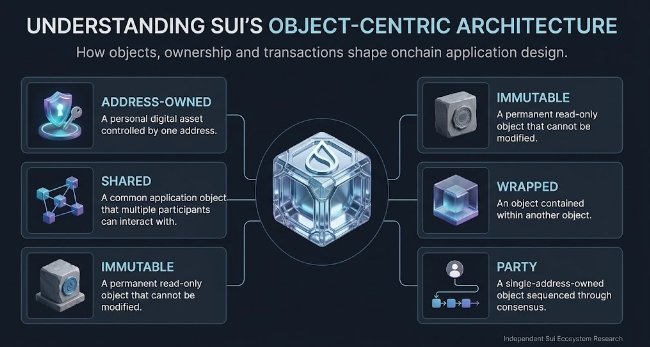
@SuiNetwork introduces a different way to think about onchain state: objects.
An object is an individual unit of data with its own identity, type, ownership and version.
Think about a digital asset:
Instead of viewing it only as a balance inside an account, Sui lets developers represent it as an object with its own lifecycle and rules.
But the interesting part is ownership.
- Address-owned objects give an address control.
- Shared objects allow multiple participants to interact with the same state.
- Immutable objects can be read but not changed.
- Wrapped objects exist inside another object.
- Party objects combine single-address ownership with consensus sequencing.
These choices affect how transactions are processed, how applications manage shared state and how developers design access control.
For example, a personal NFT and a marketplace don't necessarily need the same ownership model.
That's an important architectural decision.
Sui's object model isn't just a different way to store data. It changes how developers think about application state.
@Mysten_labs
Official documentation: https://t.co/CISvaLYAGK