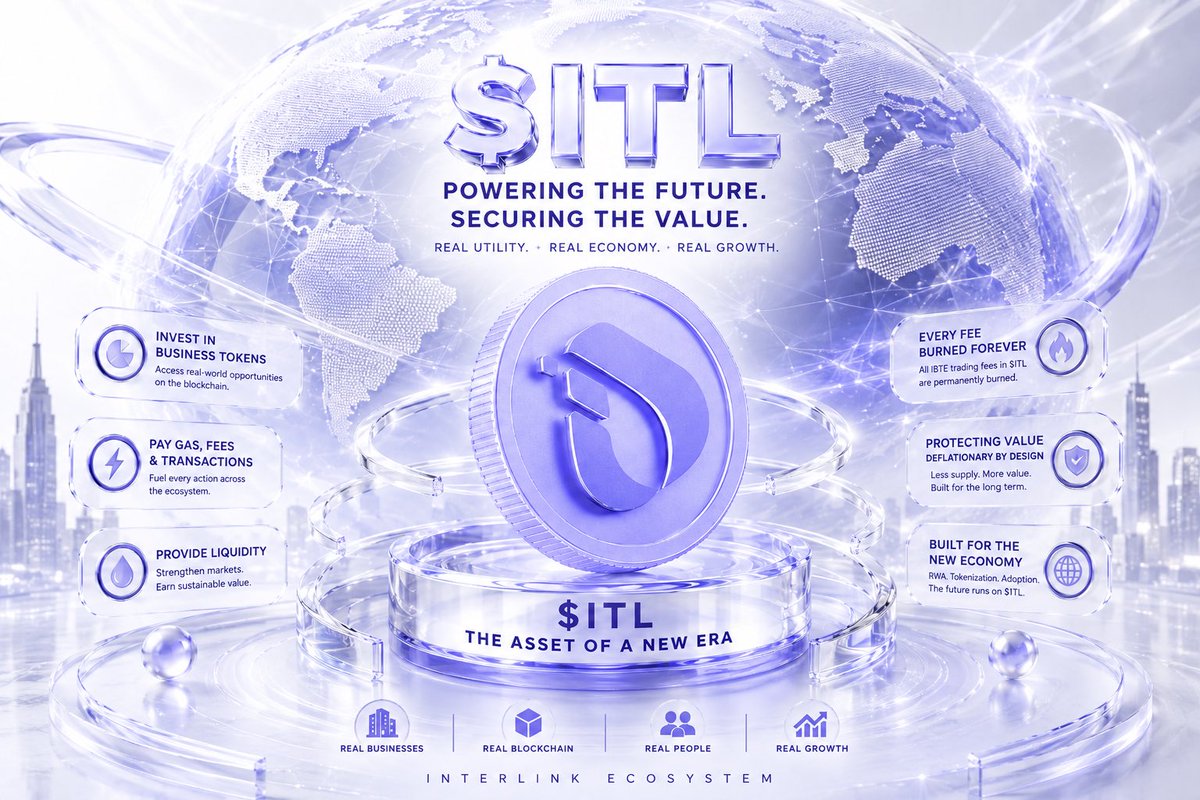
IBTE is not just a platform.
It's a Movement to Bring Every Business on-chain.
🔥 EVERY ITL FEE. BURNED FOREVER.
IBTE is not just an exchange.
It is where real businesses meet the blockchain economy.
Businesses tokenize.
Investors access opportunity.
The ecosystem grows.
And at the center of it all — $ITL.
⚡ Invest in Business Tokens
⚡ Power Transactions
⚡ Provide Liquidity
⚡ Pay Gas & Exchange Fees
🔥 Every ITL collected in IBTE trading fees is BURNED FOREVER.
More Utility.
More Ecosystem.
Less Supply.
$ITL was never built for speculation alone.
ITL WAS BUILT TO POWER AN ECONOMY. 🌐🔥
#InterLink #ITLG #ITL #InterLinkBusinessTokenExchange @inter_link@itl_fdn@itlx_defi@kv_interlink@reina_itl@scott_itlg@miratang16
🚦 What would you do if you encountered a traffic light signal like this? 🤔
Drop your answer in the comments below. Let's see how many people get it right! 👇
#InterLink#ITL#ITLG
IBTE is not just a platform.
It's a Movement to Bring Every Business on-chain.
🔥 EVERY ITL FEE. BURNED FOREVER.
IBTE is not just an exchange.
It is where real businesses meet the blockchain economy.
Businesses tokenize.
Investors access opportunity.
The ecosystem grows.
And at the center of it all — $ITL.
⚡ Invest in Business Tokens
⚡ Power Transactions
⚡ Provide Liquidity
⚡ Pay Gas & Exchange Fees
🔥 Every ITL collected in IBTE trading fees is BURNED FOREVER.
More Utility.
More Ecosystem.
Less Supply.
$ITL was never built for speculation alone.
ITL WAS BUILT TO POWER AN ECONOMY. 🌐🔥
#InterLink #ITLG #ITL #InterLinkBusinessTokenExchange @inter_link@itl_fdn@itlx_defi@kv_interlink@reina_itl@scott_itlg@miratang16
RWA is one of the most sustainable long-term trends of the next decade, alongside AI. According to McKinsey, the RWA market could reach approximately $2 trillion by 2030.
#InterLink#ITLG#ITL
LuckyLinker is live on InterLink Seoul Private Mainnet 🚀
The world's first onchain jackpot platform on @inter_link. You can use your ITL to join.
Head to the DApp section in your ITLX wallet and try it out.
More dApps are coming. The ecosystem is just getting started 🫡
EVERY ITL PAID IN TRADING FEES ON IBTE WILL BE BURNED 🔥
Every fee paid in $ITL on the InterLink Business Token Exchange is permanently removed from supply. No recycling. No redistribution back into circulation. Once burned, gone for good.
Most tokens fight against dilution. $ITL fights back.
Most networks reward growth with more emissions, which means more tokens entering circulation over time. IBTE takes the opposite path. Every trading fee collected in $ITL is destroyed permanently, so growth in trading activity works against supply instead of adding to it.
How the burn works
When a business token is traded on IBTE, the exchange fee is paid in $ITL. That fee never returns to a treasury, a team wallet, or a rewards pool. It is sent straight to a burn address and removed from the total supply forever.
Stacking on top of existing burn mechanisms
This is not $ITL's only burn channel. Base fee burns already remove $ITL with every transaction on the network, and validator slashing burns remove $ITL from any validator that misbehaves. IBTE trading fee burns now add a third channel, directly tied to real economic activity rather than network usage alone.
Why growth compounds the effect
As more businesses list and tokenize on IBTE, trading volume increases. As trading volume increases, more $ITL gets burned. This means the more successful the InterLink Business Token Exchange becomes, the faster $ITL supply compresses. Growth and scarcity move in the same direction, not opposite ones.
From trading asset to store of value
Most tokens ask holders to believe in future demand. $ITL backs that belief with a mechanism. Every fee burned is permanent, every burn is public and verifiable on-chain, and every unit of ITL removed makes the remaining supply scarcer. This is what allows $ITL to be positioned as a long-term store of value, not just an asset to trade in and out of.
The more the InterLink ecosystem grows, the less $ITL there is to go around.
#InterLink #ITLG #ITL
🗒️Note: I will continue doing my best to update the InterLink Foundation and request ITL grants for our teams on a regular basis. However, I cannot guarantee whether every request will be approved or not.
What I can promise is that I will keep trying my best. At the same time, I truly need your cooperation, consistency, and real contribution. Only when our teams grow stronger, create clearer impact, and prove real value to the InterLink ecosystem will we have a better chance to receive more support from the Foundation.
ITL will be the asset used to invest in these business tokens, rather than using stablecoins from Tether, Circle, or any other native token.
ITL will also be used to pay gas fees, invest in business tokens, provide liquidity, and pay exchange fees.
In addition, All FEES COLLECTED by IBTE WILL BE PERMANENTLY BURNED, helping protect ITL against inflation and positioning it as a long-term STORE OF VALUE.
#InterLink #ITLG #ITL
Every ITL Paid in Trading Fees on IBTE Will Be Burned. 🔥
To me, RWA is one of the most sustainable long-term trends of the next decade, alongside AI. According to McKinsey, the RWA market could reach approximately $2 trillion by 2030.
So where does InterLink fit into this picture?
Today, tokenizing a technology company is still extremely difficult, almost impossible for businesses that lack strong legal and regulatory resources. InterLink Business Token Exchange (IBTE) changes that by allowing businesses of any size to tokenize themselves directly on their own blockchain. This is something that very few platforms have been able to offer.
Today, when a company wants to tokenize, it usually relies on someone else’s infrastructure. For example, Ondo Finance tokenizes assets on Ethereum. InterLink, however, aims to provide the entire stack, from business token consulting and deployment to blockchain infrastructure, AMM, and protocol support. Everything is designed as a complete end-to-end workflow, enabling any business to issue and list its token within a single ecosystem.
What about ITL?
ITL will be the asset used to invest in these business tokens, rather than using stablecoins from Tether, Circle, or any other native token. ITL will also be used to pay gas fees, invest in business tokens, provide liquidity, and pay exchange fees. In addition, all fees collected by IBTE will be permanently burned, helping protect ITL against inflation and positioning it as a long-term store of value.
Over the past few days, I’ve noticed that many people on X have been focusing almost entirely on buying and selling ITL. Of course, @itl_fdn cannot prevent this because once the tokens have been distributed, every holder has the freedom to use them as they wish. However, I don’t think the focus should be on speculation alone.
At this stage, ITL still does not fully reflect the vision or the ecosystem that can be built around it in the future. Most OTC trading today is simply based on agreements between buyers and sellers. It does not represent the real value that ITL can create through actual utility.
ITL is meant to power the ecosystem, to be used across dApps, to pay gas fees, to make payments, to invest in business tokens, and even to be staked by validators securing the network. It was never designed to be just another speculative asset.
#InterLink #ITLG #ITL
REAL BUSINESSES.
REAL UTILITY.
ONE POWERFUL ASSET.
$ITL
Powering the business token economy.
EVERY FEE. BURNED FOREVER. 🔥
IBTE — THE FUTURE OF BUSINESS IS ON-CHAIN.
#InterLink#ITLG#ITL
Every ITL Paid in Trading Fees on IBTE Will Be Burned. 🔥
To me, RWA is one of the most sustainable long-term trends of the next decade, alongside AI. According to McKinsey, the RWA market could reach approximately $2 trillion by 2030.
So where does InterLink fit into this picture?
Today, tokenizing a technology company is still extremely difficult, almost impossible for businesses that lack strong legal and regulatory resources. InterLink Business Token Exchange (IBTE) changes that by allowing businesses of any size to tokenize themselves directly on their own blockchain. This is something that very few platforms have been able to offer.
Today, when a company wants to tokenize, it usually relies on someone else’s infrastructure. For example, Ondo Finance tokenizes assets on Ethereum. InterLink, however, aims to provide the entire stack, from business token consulting and deployment to blockchain infrastructure, AMM, and protocol support. Everything is designed as a complete end-to-end workflow, enabling any business to issue and list its token within a single ecosystem.
What about ITL?
ITL will be the asset used to invest in these business tokens, rather than using stablecoins from Tether, Circle, or any other native token. ITL will also be used to pay gas fees, invest in business tokens, provide liquidity, and pay exchange fees. In addition, all fees collected by IBTE will be permanently burned, helping protect ITL against inflation and positioning it as a long-term store of value.
Over the past few days, I’ve noticed that many people on X have been focusing almost entirely on buying and selling ITL. Of course, @itl_fdn cannot prevent this because once the tokens have been distributed, every holder has the freedom to use them as they wish. However, I don’t think the focus should be on speculation alone.
At this stage, ITL still does not fully reflect the vision or the ecosystem that can be built around it in the future. Most OTC trading today is simply based on agreements between buyers and sellers. It does not represent the real value that ITL can create through actual utility.
ITL is meant to power the ecosystem, to be used across dApps, to pay gas fees, to make payments, to invest in business tokens, and even to be staked by validators securing the network. It was never designed to be just another speculative asset.