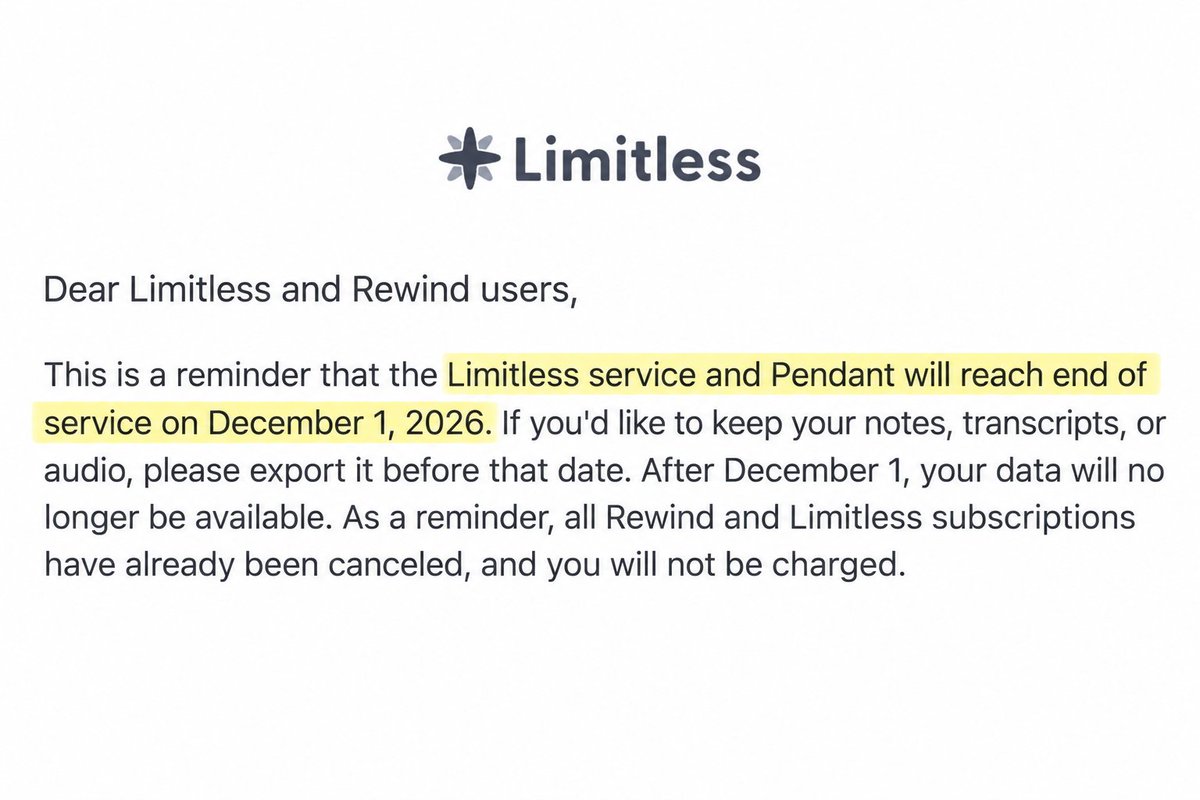
For folks looking to switch from Limitless, try @ThineAI.
No pendant to buy. Works with podcasts or TV playing
in the background, tells you who said what and truly evolves into a co-founder to your life.
we gave a fortune cookie your timeline
and it did its homework 🥠
→ type your handle
→ it reads your posts
→ it tells your future
it’s a little too accurate 👇
https://t.co/6hWiWU0ob5
I think people will generally underestimate how much technological acceleration is directly attributable to deepseek.
Because of them, it is going to proliferate. Really, it's because of them. Thank you, for everything
🚀 Introducing DeepInfer, our in-house inference framework, now fully open source!
Powering DeepSeek-V4.1-Flash at scale with high throughput and low latency. We’re sharing our production stack to help the community lower compute costs, reduce energy use, and make AI more affordable.
🔗 https://t.co/JGAik1kgk0
1/4
New preprint from @ThineAI
Truly great technology has to be invisible in our lives. This is one part of that puzzle. Your assistants need to know who said what, and they need to do that without any crutches. Just by the audio.
Introducing ThyVoice: our state-of-the-art approach to solve "who said what" across conversations at 10x lower cost.
We benchmarked 8 speech systems, built on OpenAI, ElevenLabs, Deepgram, AssemblyAI, pyannoteAI and the academic baselines. ThyVoice made the fewest errors.
We’re releasing a broad range of new mathematical results produced by an internal frontier model.
We’ve been consulting with the independent Advisory Group on Mathematics and Artificial Intelligence at the Institute for Advanced Study, and we have drawn on their advice and public recommendations to inform how we release these results.
https://t.co/7N6TPlft1P
No, but listen, you know this "put the fries in the bag, Terence Tao"'--*sniff, sniff*--already the usual replies concede too much. "If Tao is serving fries, YOU will be in the lithium mines." My God! This is our defense of human dignity? Don’t worry, the correct people will get the terrible jobs!
*Pulls at shirt* You see, everything is up for radical transformation, human intelligence, consciousness, and so on and so on--except that somebody must still have a shitty afternoon so I can enjoy my lunch.
But to say "these people are envious", this is too easy. It allows us, "the educated ones," our own little fantasy: we are disliked only because we are so wonderful.
You know, the more interesting thing is this *sniff* peculiar identification with the machine. When the mathematician discovers something, apparently this was HIS achievement, his privilege, his little secret. When the machine discovers something, suddenly it's "Look what WE can do!" The achievement has become collective precisely at the moment when no human being can claim credit.
See how this "we" functions. For the achievement, I identify with the machine. For the consequences, I identify YOU with the human. "We have surpassed you." Who are we? Well, myself and the thing that has also surpassed me.
There is something almost touching here, really. To escape the humiliation of somebody absorbed in something opaque to you, you appeal to something which knows incomparably more than either of you. And this is supposed to settle the matter in YOUR favor.
You know the old example of canned laughter. Here we have a similar arrangement. The machine achieves something on my behalf. The mathematician suffers the loss of human significance on my behalf. Somebody to be brilliant for me and somebody to be obsolete for me, without me having to be either, so I can remain as I was.
But *pulls on shirt* there is this little difficulty that hides the essential thing: you still need a response from Tao! A correct proof, this Lean slop and so on, is not enough. You need him to certify his own defeat. You need him to say "By god, this is extraordinary! Yes, this is correct, but also this is interesting." Which means--and here comes Hegel--the person you are reducing to an obedient instrument must remain more than an obedient instrument. You need recognition from someone whose authority you are abolishing.
"Your so-called expertise is worthless. Now tell me, in your expert opinion, that I, qua machine representative, was right."
*Touches nose* But I would go a step further. What does this math person actually do to provoke you? In the fantasy, I mean. He need not insult you. He can be generous, mild-mannered, whatever. Something remains irritating: there is something over there which occupies him, which matters to him, and your opinion does not settle what it is worth. Perhaps he is not even looking down on you. This is the really intolerable possibility.
This, you see, is closer to the Lacanian problem of the Other's desire. Not simply "What does he have that I don't?" but "What the hell is going on with him?" Perhaps the answer is: he is thinking about something else.
The fries solve this beautifully. Now you know what you are for him. He needs the money. Your presence creates an obligation.
And this, at last, also explains why the machine can be less threatening than the mathematician. The machine's intelligence may exceed yours unimaginably, but you imagine it arrives in response to your prompt. You can complain about the tone. You have the privileges of an angry customer and so on and so on. The human has this irritating possibility of being interested in something you did not request and cannot order. And please, this includes the person already serving the fries!
*Pulls at shirt* I am almost tempted to say: the dream of unlimited intelligence conceals just this: a the wish that nobody should be doing anything you cannot immediately understand as a service.
MiMo-V3 is getting a new architecture. The core of it, HySparse2, is out today.
Less prefill, a smaller KV cache, better long-context retrieval—and we got all three at once.
Compared with MiMo-V2.6's Hybrid SWA architecture:
• 5.02× lower prefill FLOPs at 1M tokens
• 4.5× smaller KV cache at 1M tokens
• Better MRCRv2 and RULER-v2 scores, plus lower AgentPPL and LongPPL
Why build a new architecture?
Agentic inference is a very different workload. Each round, a short action can return a long observation that needs to be prefilled, while the context keeps growing. That puts prefill cost, KV-cache size, and retrieval accuracy on the critical path at the same time.
HySparse2 tackles all three with two levels of KV sharing:
• KV Bridging: Following YOCO, full-attention layers in the cross-decoder build their K/V from self-decoder hidden states.
• KV Reuse: Within each hybrid block, sparse layers reuse the preceding full-attention layer's KV cache and selection indices.
Two more changes: token-level selection replaces block-level selection, and a forced window of recent tokens replaces the separate SWA branch, so local and global tokens share one KV cache. Since all cross-decoder KV caches now come from the self-decoder, prefill can stop once the self-decoder finishes.
Paper: https://t.co/REeEdd5pL7