I request all those with knowledge, or anyone who lived through that era, to listen to this 1984 interview of BB and guide our new generation.
Have we progressed in terms of democracy, freedom of speech and freedom of association or have we regressed or stIll the same?
Removing barriers placed for route of the @ECB_cricket team led to 10-year sentence to lawyers @ImaanZHazir & @AdvHadiali. I know it’s only a grotesquely absurd legal cover for the naked tyranny of this regime; but I wish we wouldn’t have these damn teams visit Pakistan at all!
time slows down when you break routine, time slows down when you do more things in the day, time slows down when you wake up early and go for a run. suddenly you "feel" like you have more hours in a day when you're on a trip. what you're "feeling" is actually "time" slowing down. time is such a human made up concept, and we made it even weird with clocks. time isn't real anywhere other than the human mind, and it even changes within the human mind, time changes with time. time changes with gravity. time changes with speed. the more you focus on what time is, the less you understand it
A government is not expected to solve every problem overnight.
But it is expected to tell people what the plan is.
In today’s column, I ask ten simple questions that deserve clear answers from our rulers
https://t.co/JapplDimd7
We use certain phrases constantly in Pakistan's tax debate: broaden the tax base. Close the tax gap. Reduce evasion. Document the economy. Build trust in the FBR.
Each phrase carries a precise meaning. In commentary, they are often used interchangeably, making it hard to assess the current reforms without separating them.
This thread unpacks them one by one and explains what the current enforcement measures actually do.
If DHA Karachi is worth as much as the entire Pakistan Stock Exchange, we have built an economy that rewards land more than enterprise.
Spot on, Najam.
DHA Karachi’s extraordinary valuations owe much to its long-standing role as a preferred destination for untaxed wealth, although this phenomenon extends far beyond DHA and has inflated land values across Pakistan.
When direct tax rates become punitive (40 to 60%) and sales tax exceeds 18%, the incentive to evade becomes overwhelming.
Add persistently high interest rates, weak documentation and the scarcity of secure, planned and livable urban land in a country of 250 million people, and DHA’s premium is no mystery.
The other side of the story is more troubling.
Pakistan’s capital market is worth roughly US$70 billion, less than 16% of GDP, compared with much higher levels in healthier emerging markets.
India’s equity market is now close to US$5 trillion, above 120% of GDP.
This is capital misallocation at massive scale.
Savings that should finance businesses, innovation, exports and jobs are instead locked in speculative real estate.
Pakistan needs to drastically cut tax and interest rates bh 50% taxes, and reduce the footprint of an inefficient state (cutting size of governments by 50%) and improve governance.
If incentives are corrected with above steps, there is no reason Pakistan’s capital market cannot potentially double within a few years and support sustained growth of 7–8%.
Pakistan does not lack capital or resources.
It lacks the incentives and governance to deploy them productively.
Until enterprise is rewarded above speculation, we will keep underperforming our own potential.
A country of 250 million people has no reason to accept growth below 7%.
🚨🚨A worth to read piece how Pakistani NGOs, self proclaimed civil society organisations, rights bodies become a million dollar industry, milking donars but on ground they are good for nothing except with diplomats they can speak English in British or American accents and write proposals in fluent English and part of elite which pretends they are leftist/liberals appearing in panel discussions of different so called intellectual/literary festivals funded by the west: 👇
“In 25 years of working in the development sector and managing millions of dollars in civil society funding, I never once saw a donor fund an organisation such as this. That gap between what we funded and what actually existed tells you almost everything about what has gone wrong with international aid’s relationship with civil society. With USAID now dismantled and the entire model of western development assistance under scrutiny, this question has never been more urgent.
We created a parallel universe of professional NGOs – accountable to their donors in Washington or London, but to no one on the ground.
Pakistan was born with a relatively weak civil society, dominated by a powerful military and an efficient civil bureaucracy – both legacies of a colonial past. Colonies do not run on organised populations. Yet societies always find ways to organise themselves. Market associations, religious welfare networks, professional guilds, neighbourhood councils – these exist everywhere in Pakistan, self-financed and genuinely representative of those they serve.
Somehow, donors never found them. Or rather, they looked right past them. What donors funded instead, quite generously, were those groups established specifically to attract their money. Tight deadlines, pressure to disburse quickly and proposal-driven procurement created an entire ecosystem of professional NGOs that had more in common with contractors than with civil society. They had no deep commitment to any specific cause and were accountable not to their members but to their funders. An organisation working on women’s empowerment one year would pivot to disaster response the next – not because of expertise or passion, but because that was where the money was. Genuine civil society rarely appeared on donors’ radar, because it lacked the one thing donors valued: the ability to write a proposal in fluent English.
The accountability gap made this worse. In my experience, donors scrutinise government expenditures forensically – every receipt, every procurement, every budget line. With NGOs, they were consistently more lenient, despite abundant evidence that the problems they feared in government – corruption, misuse of funds, political capture – existed equally in the NGO sector. This leniency was partly ideological: civil society was seen as inherently more virtuous than the state. It was also practical: holding NGOs to the same standard would have disrupted the disbursement machinery everyone depended on.
There is another dimension that rarely gets discussed. When senior officials from Washington or London visited Pakistan, meetings with “civil society representatives” were arranged by embassy and USAID staff – including, for many years, myself. We always invited the same articulate, English-speaking, internationally networked NGOs whose staff knew how to perform civil society for a foreign audience.”
https://t.co/j6eT5CfLoT
Every major economic opportunity in Pakistan was turned into a rent-seeking scheme for the elite.
1. Pakistan borrows billions. Instead of building exports, industry, and skilled human capital, the money disappears into mega-projects loaded with commissions.
Result: Every few years, Pakistan returns to the IMF with a begging bowl — while the elite parks wealth offshore.
2. Pakistan’s industry needed cheap electricity to compete globally. Instead, the system rewarded IPPs and guaranteed capacity payments for a connected few.
Result: IPP owners got richer. Industry got crushed under expensive power. Exports stagnated.
3. Farmers needed affordable fertiliser. Gas subsidies were supposed to support agriculture. Instead, subsidies became a pipeline for elite profits.
Result: Fertiliser cartels thrived. Agricultural productivity and exports barely moved.
4. Pakistan could have become a regional trade corridor linking Afghanistan and Central Asia. Instead, transit trade became a smuggling and money-laundering racket.
Result: Dollar flight, black markets, trade deficits, and a stagnant economy.
5. Pakistan needed world-class education and employable skills. Instead, degree factories multiplied while public universities decayed.
Result: Over 75,000 IT graduates every year — fewer than 5,000 employable.
The tragedy of Pakistan is not lack of opportunity.
It is that every opportunity became a business model for extraction instead of national growth.
We now have another opportunity with Pakistan's new found place at the center of world diplomacy and importance -- let's not squander this!
I served in both NAB and FIA. I have seen investment scams up close. The people crying over “One Constitution” today are not the first victims, and they will not be the last. Here are the lessons I learned that can protect your investment and money. 🧵
What a country !! Took a loan from the IMF, then stopped a potential World War, also attacked Afghanistan, talked ceasefire with China, then became a Global Peacemaker, also stood with Iran, then condemned attack on KSA, then negotiated with Trump while the nation watched PSL.
Speaking of zardari and assets abroad, the rockwood estate and the Swiss accounts are two helpful trips down memory lane.
Zardari post second round in government:
Denies the Rockwood estate (Surrey mansion) after spending millions of pounds on refurbishing it, filled with hundred thousand pound chandeliers that he decried as being unthinkable for a leader from a poor country.
Then when it was about to be auctioned; zardari decided it was his after all and launched a claim to the asset from jail. He explained his earlier denial of ownership on medical ailments and sought a stay of sale proceedings.
During his second tenure, he was involved in the procurement of a digitisation project for the customs and ports. The companies that bid to win were SGS and cotecna. It was alleged that these companies paid hefty bribes to zardari to win the computerisation contracts. These led to prosecutions of the principals in Switzerland.
Zardari was Convicted in Switzerland for graft related to these contracts. Accounts related to him containing 60 million dollars in Switzerland were frozen.
Zardari then applied for access to these 60 million dollars once the freeze on the graft related account was lifted ONLY because Zardari’s legal team presented the NRO law to the Swiss court and argued that thievery was no longer a crime in that period in Pakistan.
As president in his first term, Once the NRO was declared void ab initio, Zardari’s pppp led government ignored SC directions to write to the Swiss asking for a revisit of that earlier NRO based acquittal.
The PPP Sacrificed a Prime Minister to prevent the writing of the letter. That prime minister was later rewarded with a return to the senate and tickets for his family.
Meanwhile, the court record of the entire Swiss proceedings were then taken from the Pakistani consulate in Switzerland. The person overseeing the taking of the record was then Pakistani consul general in the United Kingdom, wajid shamsul Hasan. Geo’s Murtuza from london was present there for the removal and asked wajid sb on camera what he was upto and the latter refused to offer any replies whilst smoking cigars on the sidewalk.
Jeeay Bhutto.
Nestle just lost 413,793 KitKat bars. Someone stole them off a truck heading from their factory in central Italy to Poland, about 1,300 km away. Roughly $1 million in chocolate. The truck, the bars, all of it, just gone.
A European Parliament study puts cargo theft costs across Europe at €8.2 billion a year. That works out to about €2.5 million worth of goods disappearing from trucks and warehouses every 24 hours.
The industry group TAPA tracked 157,421 cargo thefts across 129 countries between 2022 and 2024. Only 6% of those included how much was actually taken, and that 6% alone added up to €2.7 billion. The real number is way bigger.
Germany gets hit the hardest. DHL's own data shows that a truckload is stolen every 20 minutes there, costing roughly €2.2 billion a year. The fastest-growing method is "phantom carriers," where criminal groups register fake trucking companies with forged documents, show up at warehouses with legit-looking paperwork, load the cargo, and drive off. No weapons, no break-ins. Just forged IDs and a clipboard. The German Insurance Association logged 88 phantom carrier cases in the first seven months of 2025, matching the total for the previous year.
Food is the most-stolen category in Europe, accounting for 10-20% of all cargo thefts. Chocolate is a top target because it doesn't spoil, everyone wants it, and it sells fast on unofficial markets. 20 tonnes of Nutella and Kinder Eggs were stolen in Germany in 2017. A crime ring that moved 287 tonnes of Swiss chocolate worth $8 million over the course of 2014. 20 tonnes of Milka were taken from an Austrian factory in 2019 using forged pickup papers.
Timing makes this one sting. Cocoa went from about $2,400 per ton three years ago to over $12,600 in late 2024. Prices have dropped to around $5,000-$6,000 in early 2026, but that's still double the historical average. In Poland, where these bars were headed, chocolate retail prices jumped 32.6% last year according to EU data. The product is worth stealing right now more than at almost any point in the past decade.
Nestlé says each bar has a scannable code that routes back to the company. Decent tracking. But when €2.5 million in cargo disappears from European supply chains every single day, 413,793 KitKat bars are a rounding error.
🚨 Since the name of this journal is The Diplomat, let me correct something for you, and please remember this technicality for future reference:
Pakistan is not a middle power. Pakistan is a nuclear-armed nation and cannot be compared with non-nuclear countries sitting in middle powers category.
It has credible deterrence against India, cross-bloc reach spanning the United States, China, and Iran, and crisis-time relevance (which no other “middle power” has). It is not typical. It is an exceptional, high-tier power.
Pakistan did not engage in deals or opportunistic maneuvering to become a go-between. Its role emerged as a necessity of the hour, shaped by the dynamics of the conflict. It is a natural geopolitical outcome. Such nations do not need to punch beyond their weight.
As a suggestion to The Diplomat, it would be better to engage writers with a basic understanding of international relations and technical jargon in this field…..
Kissinger flew from Islamabad to Beijing on a PIA plane. Pakistan lost East Pakistan the same year.
Zia defeated the Soviets. Pakistan got the Taliban as a parting gift.
Musharraf said yes in 24 hours. Pakistan paid $150 billion for the privilege.
This week the room could be Islamabad again.
Unfortunately, I paid $$$ to sit through 3 hours of Bollywood bashing Pakistan. Dhurandar’s anti-Pakistan propaganda honestly mirrors the Israeli propaganda project targeting the Palestinians. Theater full of ppl cheering as Pakistani bodies are blown apart. Ranveer Singh in promos holding a missile that reads “From India with love”. Pakistani women portrayed as spoils of war. An entire society portrayed as vermin to be eradicated.
And yet, the same film industry that’s celebrating the destruction of the Pakistani state still loooves to consume our dramas and dance to our music. Only recently Priyanka Chopra — who is Modi’s lapdog & told a Pakistani girl to sit down & stop embarrassing herself when questioned abt her problematic positions — posted a video dancing to iconic Pakistani singer Nazia Hassan. Lol. I’m reminded of the segment of American society that’ll love Black music and culture but not Black people.
Dehumanization is always the prelude to mass violence and the India govt — using Bollywood as its medium — seems to be tracking the Israeli govt’s playbook in dehumanizing an entire ppl in order to commit mass atrocities against them more easily.
Today, we mark with respect the birth of Quaid-e-Azam Muhammad Ali Jinnah, founder of Pakistan.
His name lives on not only in our hearts, but also in one of Ankara’s liveliest avenues: “Cinnah Caddesi”. It speaks of the deep bond between our nations, echoing the common pursuit of independence that linked Jinnah and Atatürk.
“With faith, discipline and selfless devotion to duty, there is nothing worthwhile that you cannot achieve.”
In the same spirit, Türkiye and Pakistan will continue to walk the same path side by side, in brotherhood and shared resolve.
(Photos: Jinnah Statue in Ankara & Presentation of the Letter of Credence by the First Turkish Ambassador to Pakistan)
🇹🇷🇵🇰
Bugün, Pakistan’ın kurucu lideri Quaid-e-Azam Muhammed Ali Cinnah’ın doğum gününü saygıyla anıyoruz.
Onun adı yalnızca gönüllerimizde değil, aynı zamanda Ankara’nın en işlek caddelerinden biri olan Cinnah Caddesi’nde de yaşamaktadır. Bu durum, milletlerimiz arasındaki derin bağı ve Cinnah ile Atatürk’ü buluşturan ortak bağımsızlık idealini yansıtmaktadır.
“İman, disiplin ve göreve özverili adanmışlıkla, ulaşamayacağınız hiçbir değerli hedef yoktur.”
Aynı anlayışla Türkiye ve Pakistan, kardeşlik ve ortak kararlılık ruhu içinde, yan yana ve aynı yolda yürümeye devam edecektir.
(Fotoğraflar: Ankara’daki Cinnah Heykeli ve Pakistan’a atanan İlk Türk Büyükelçisinin Güven Mektubunu Sunma Töreni)
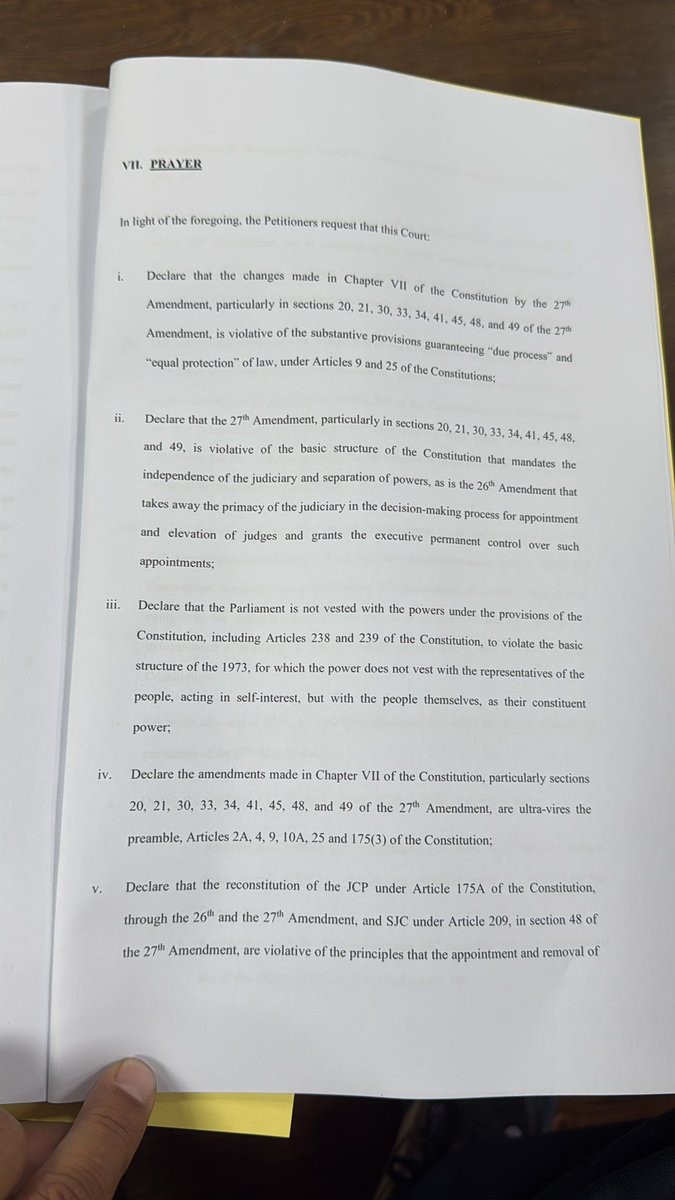
BREAKING NEWS: Four judges of Islamabad High Court challenge 27th constitutional amendment in Supreme Court of Pakistan where the court staff refuses to receive the petitions filed under 184(3).
Justice Mohsin Kiani
Justice Babar Sattar
Justice Sardar Ijaz Ishaq Khan &
Justice Samman Riffat
Pray for restraining JCP from appointing judges, and stopping SJC from proceeding against judges who refuse to comply with transfer orders if any