794 bodies recovered. Thousands still unaccounted for. Tell us, what was their crime?
I am writing this from the Himalayas from a country responsible for only around 0.1% of global greenhouse-gas emissions. Nearly 46% of our land is covered by forests. Around 94% of our installed electricity capacity comes from hydropower. We are rapidly moving away from fossil-fuel vehicles too: EVs accounted for about 74% of Nepal’s four-wheeled passenger vehicle imports in 2025/26. We protect forests. We generate electricity from our rivers. We are embracing electric mobility at a pace few countries in the world have matched. Yet today, our people are digging through mud, searching rivers and waiting beside phones for the names of their loved ones.
The Bhote Koshi flash flood has shown us what it means to live beneath a rapidly changing cryosphere. Our glaciers are retreating, our frozen mountains are becoming increasingly unstable, and the rivers that generate our clean electricity can also carry destruction into communities below. We did not build our prosperity by burning generations of coal and oil. We contributed almost nothing to creating the climate crisis at this scale. But we are being forced to survive its consequences. The people whose bodies are being pulled from rivers did not cause this crisis. The families still waiting for thousands of missing people did not cause it. The children, farmers, workers and mountain communities who lost everything did not cause it.
So from the Himalayas, we ask the industrialised world: how many Himalayan bodies will be enough? How many mothers must wait for children who never return? How many villages must disappear before “climate justice” becomes more than a speech at another conference? Do not come to us only with sympathy after the bodies have been counted. Come with responsibility. Come with climate finance, adaptation, loss-and-damage support and the courage to cut emissions at the scale this emergency demands. We want climate justice. We want the right to survive in our own mountains. We want a world where being born in the Himalayas is not a death sentence for a crisis we did not create.
UPDATE: Of the four bodies recovered following the avalanche below Camp III on Broad Peak (8,047 m), two have been confirmed as Nepali climber Purna Bahadur Gurung, known as “Yukta,” and Omani mountaineer Nadhira Al Harthy. ཨོཾ་མ་ཎི་པདྨེ་ཧཱུྃ!🙏
The Broad Peak tragedy in Pakistan leaves a difficult question: was it simply fate, or have ambition, commercial pressure and human ego pushed climbers further into risks that the mountains have always carried? An avalanche is a natural event, and it would be wrong to blame commercialisation without evidence. But we cannot ignore today’s culture of crowded expeditions, deadlines, records, sponsorships and the pressure to reach the summit at any cost.
Mountains are not trophies. They do not care how much an expedition costs, how many records are at stake or how many people are watching online. When the conditions say no, turning back is not failure, it is good judgment.
We cannot keep taking summits, fame and profit from the mountains without giving something back through protection, restraint and respect. Nature is not asking us to conquer it. It is asking us to listen, and to leave our ego at Base Camp.
JUST IN: The Tourism Times has reported that chances of finding any survivors from the Broad Peak avalanche are now considered almost nil.
According to the climbers coordinating with the search-and-rescue operation, a drone flown from Base Camp spotted what appeared to be the bodies of four climbers, Nirmal Purja "Nimsdai," Kili Pemba Sherpa, Nima Sherpa, and Wang Zhong, just below Camp I on the Concordia side of the mountain.
The search team also reported that all 10 climbers caught in the avalanche are believed to have perished on the Concordia side. Authorities have not yet issued formal confirmation or completed the identification of all victims.
Trekkers at a base camp on Mount Everest were dealt a terrifying blow when a fast-moving avalanche barreled down the world's largest mountain, forcing climbers to take cover. 😱
@VincentRK@UpToDate I think most have already switched to open evidence and chat gpt. Uptodate will be done in couple of years if they do not innovate.
Treating newly diagnosed myeloma
Experts make it overly complicated. It’s not rocket science
Anti-CD38 MAB for all
Revlimid for all (dose reduce for old/renal dz)
Velcade for most (don’t give frail/neuropathy)
Dex for all for few cycles
No role for kyprolis (unless neuropathy)
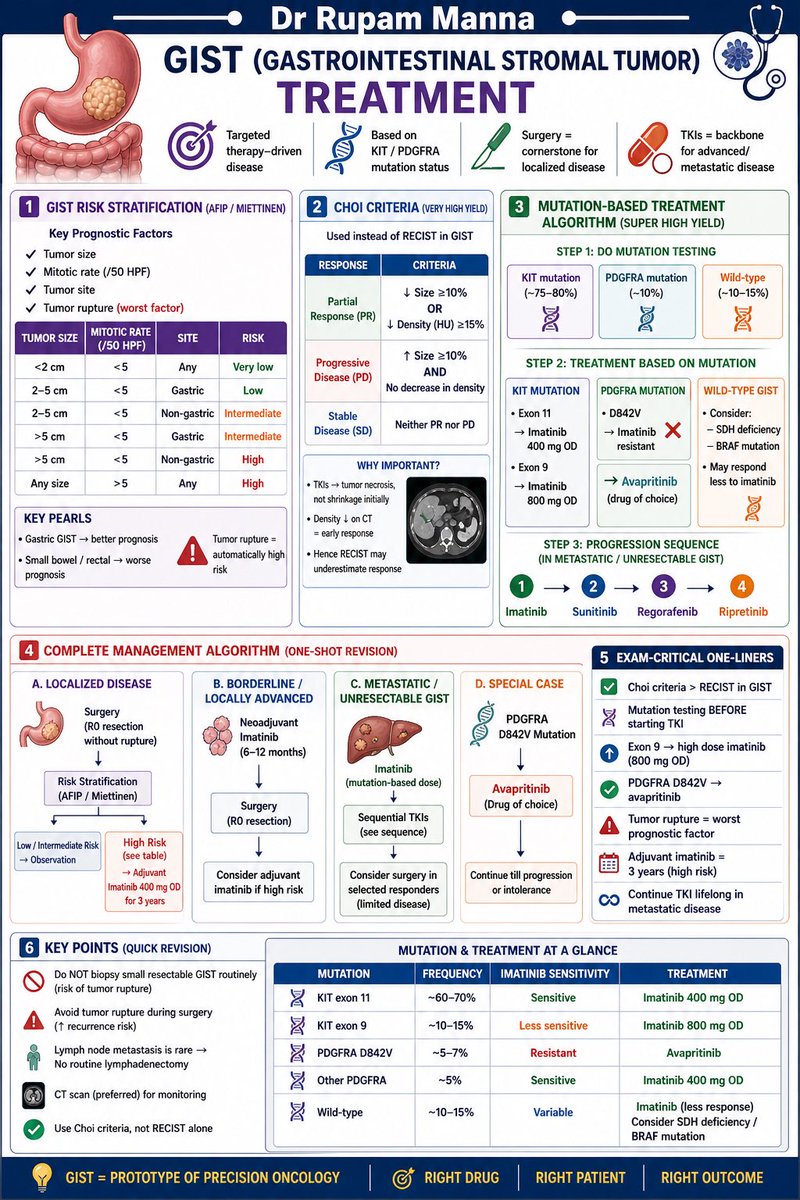
🚨 GIST TREATMENT MASTERCLASS – ULTIMATE EDITION 🔥
The most complete high-yield infographic you’ll ever need:
✅ Risk Stratification (Miettinen/AFIP table) – size, mitotic rate, site & rupture
✅ Choi Criteria (VERY HIGH YIELD) – why density drop beats RECIST in GIST
✅ Mutation-Based Algorithm (SUPER HIGH YIELD) – KIT exon 11/9, PDGFRA D842V → Avapritinib
✅ Complete Management Flow – Localized, Borderline, Metastatic & Special Cases
✅ Exam-critical pearls + Mutation & Treatment at a Glance table
Precision oncology prototype • NCCN-aligned • One-shot revision gold
Save this for rotations, boards & wards 📌
Tag a fellow/resident/fellow who lives on #MedTwitter 👇
RT if this just became your new GIST bible!
#GIST #Oncology #MedEd #HemeOnc #PrecisionOncology #TargetedTherapy #Cancer #MedTwitter