Learning how price moves and where opportunities lie is one thing.
Training your mind to stay calm and execute fearlessly in every situation is another entirely.
You need both skills to make it in this business.
All part of trading. There are no perfect solutions in trading; you have to be satisfied with workable solutions and not constantly keep saying "but" and "what if"
I don’t want to seat in front of of computer and get tempted to push random buttons. First one hour hundred percent attention, then gym and then last one hour full attention.
Every day, try to develop greater clarity about setups. process, entries, exits, stops, sizing, timeframes, and catalysts.
The more you reorganize the knowledge and spend time understanding the setup, the easier it will be to implement.
This requires real dedication to repeatedly revisit a setup, reclarify, and reset your mind.
When you immerse yourself in this, one day it clicks, and then suddenly everything starts working.
Through more reflection and revisiting the same idea, the idea becomes part of you.
And whenever we engage in such purposeful mind-clarity efforts in any field, it always results in significant money.
Depth creates wealth.
The more you simplify your trading process, the better off you’ll be.
There’s way too much information and too many indicators + tools out there nowadays.
Instead of trying to add new things to your process, try to remove things and simplify. The market is already difficult enough.
You don’t need 5 tools, 15 indicators, and 100 different data points to make a decision. Most of the time all that does is make you second guess yourself or freeze.
Price, volume, your simple thesis, key levels, and your risk management rules will tell you most of what you need to know.
The best trade management decision Goverdhan Gajala made on his biggest day was to stop managing the trade.
Goverdhan, a full-time independent trader featured on the TraderLion podcast, held a position in TPST through a move of over 1,000% in a single session. When he felt the urge to micromanage it, he did something most traders never consider — he physically walked out of the room and let the trade work. The result was a six-figure gain he might have otherwise talked himself out of.
Sometimes the edge is not in the analysis. It is in the discipline to do nothing.
People talk about taking profit into strength, or cutting half when it's losing. Remember that these are methods that works for them! Everyone is different. Personally, I don't do partials. I buy and hold onto it until I think the top is in. Then I sell it in one go
EVERYTHING has a trade-off, in trading.
You either sell at R multiples and targets, or you trail your position.
Sometimes you’ll get it right, sometimes the move will go much further than you think.
It all comes down to accepting every single sell rule has a trade-off.
You have to know what suits you and your system, your personality.
This is the supercharger to huge gains. There’s such thing as risking too small when the probability is in your favor as well as the payoff. But the key is to be able to recognize the nuances in the setups. No longer believe in 1% each trade.
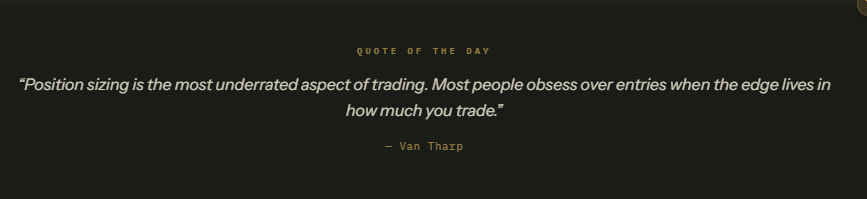
Uncharted Territory Quote of the Day
“Position sizing is the most underrated aspect of trading. Most people obsess over entries when the edge lives in how much you trade.”
-Van Tharp
Deep down, do you expect every trade you put on to work?
Most people do, even if they don’t say it. That expectation quietly shapes decisions, it makes normal pullbacks feel wrong, and small drawdowns feel like something broke.
But trading doesn’t work that way. Good trades can fail, and average ones can work. The edge is not in being right every time, it’s in executing the same process over and over without needing immediate validation.
Once you let go of that expectation, you stop reacting to each trade, and start managing a series of them.
Every year there are maybe a dozen or so opportunities that are so EV skewed that trading these alone can make your year. I'm talking hundreds of % on a dozen trades. All you have to do is WAIT, and then execute according to your ruleset. Easier said than done, but it's absolutely possible, and something I've shifted my system into focusing on over the last few years.
When you realize that, you can very quickly detach yourself from FOMO and the day to day action and hone in on the bigger picture.
It's times like right now while we've endured months of chop, you find yourself in a drawdown maybe deeper than you'd like, and you'll look back and say "Why?".
"Why have I been trying so hard for positioning and marginal gains in a market that isn't conducive, when I could have been focusing on and preparing for the next big opportunity that WILL move the needle?"
Of course the ability to do so only comes with enough reps and experience, but when you have the ability to recognize it, your equity curve will thank you.
Stop clicking buttons everyday like a degenerate and start playbooking/refining/building something that WILL make you money.
A great excerpt from Amrit Sall, the Unicorn Sniper-
@AT09_Trader had 10 no-trade days in a month and STILL made $158,000.
How?
One single day when the right opportunity showed up, he made $80k, half his entire month's profit in one day.
The 10 no-trade days didn't cost him anything. They actually saved him from taking regrettable trades that would have eaten into that $80K winner.
Its cheaper to have a no-trade day than to place a trade you'll regret.
Watch the full episode & share this post:
👉https://t.co/QiRmgE7hhn
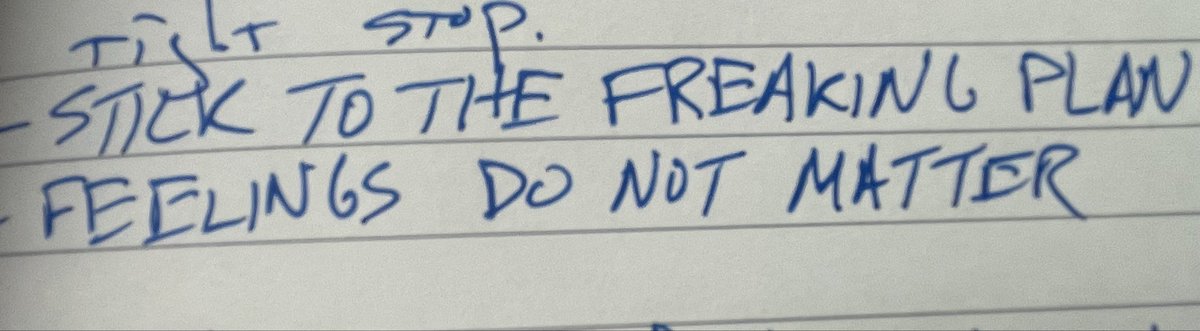
I opened my journal today (something I’ve been trying to do more of) and here’s what I wrote on my last entry!
We often know what we need to do, the challenge is it doesn’t always feel good
I've realized volume only matters when it’s tied to context.
Random volume means nothing to me now. What matters is where it happens, why it happens, and how price responds to it.
My system revolves around understanding the mechanics and behavior of a stock through 3 simple things:
> EMAs
> Price
> Volume
Not 15 different indicators, just behavior. And my view on volume has changed a lot over the years.
Now I focus on:
- Volume anomalies
- Low volume areas/digestion
- How price reacts paired with volume
If I’m looking at a long candidate, one of the clearest tells is low volume on pullbacks and higher volume on advances.
That’s often a sign supply is drying up on the way down, while demand is willing to be aggressive on the way up.
That’s a basic way to identify potential accumulation.
If price is pulling back hard on huge volume… I pay attention. If price is drifting lower on light volume while holding structure… I pay attention.
Those are two very different messages.
Same red candle.
Different story.
When I talk about anomalies, I’m referring to things like:
- HVQ/HVY candles
- High volume closes
- Unusual expansion bars
- Institutional footprints
...etc.
Those are areas on the chart where I know real money was active, and that becomes information I can use to build a trade thesis.
These are nuances that only really make sense after thousands of hours watching charts. You can’t shortcut screen time!
The longer I trade, the less volume has mattered in isolation. I know traders who make a great living watching nothing but price. Volume is a tool, not a requirement.
For me, after I enter a trade, do I want volume confirmation? Sure.
Do I need it? No.
Because once I’m in, my focus shifts to managing risk.
1) Price is primary.
2) Volume is context.
And risk is KING!
You won’t see the traders that dug a 15-20% hole overtrading the past few months.
You won’t see the ones that flipped long to short and back again a dozen times, taking losses in both directions.
You won’t see the ones that tried five times to catch a bottom and then when one finally sticks they scream about it from the hilltops. Or the ones whose nerves were too shot to act when price action turned.
But you also won’t see the traders that quietly execute their simple strategy while the chaos swirls, because they don’t scream about it into the abyss of social media.
You only see what people want you to see. For their own reasons.
Run your own race.
Don’t ever confuse the Social Media popularity contest with real trading.
This is where most of my edge comes from. Holding winners and not getting scared taking profits early. Having precise entries also goes hand in hand with this.
Well said! worth reading a few times as this is the main cause of underperformance for traders and poker pros. Simple in theory, tough to implement in practice, yet very powerful. Bravo!
Trading is a mental game. You have to become the boss of your actions and reactions—which means becoming the boss of your emotions. Then, and only then, does discipline have the opportunity to develop… and consistency drive performance. Without discipline, even the best strategies are rendered useless.