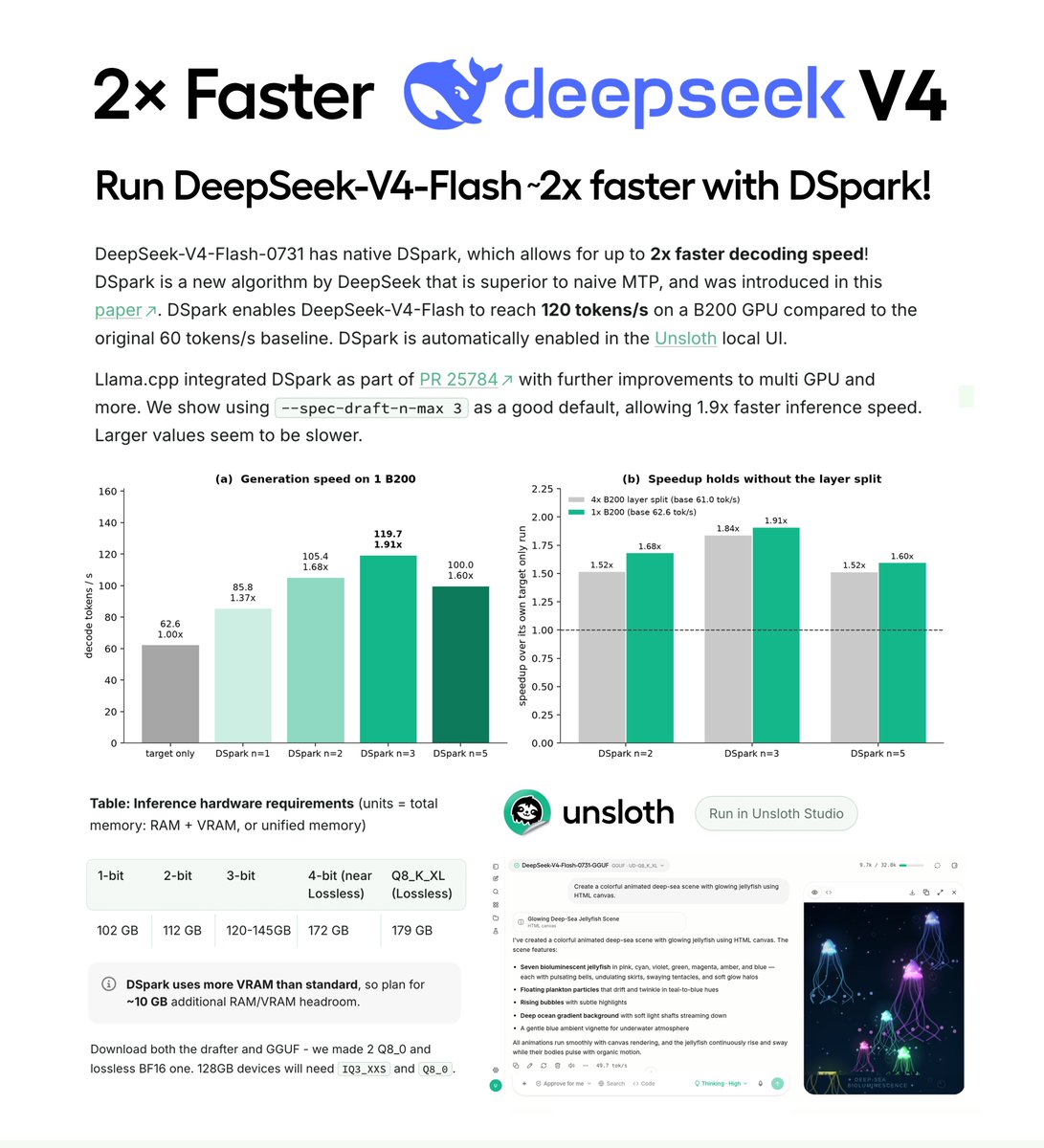
DeepSeek-V4-Flash can now run 2× faster locally with DSpark! ⚡️
DSpark enables V4-Flash-0731 GGUFs to generate ~1.4–2× faster with no accuracy change.
DeepSeek-V4-Flash-0731 can reach at 120 tokens/s.
GGUFs: https://t.co/ac6uOI8mZA
Guide: https://t.co/mCZZkpa95X
Announcing the Artificial Analysis Endpoint Accuracy Index, measuring how much of an open weights model's accuracy each serverless API endpoint preserves. We are initiating coverage with GLM-5.2, gpt-oss-120b and DeepSeek V4 Pro, with Kimi K3 coming soon
Providers trade off accuracy to optimize for speed and cost. They quantize weights, write custom kernels and tune their inference stacks, and sometimes they simply ship bugs. We are bringing the rigor of our Artificial Analysis Intelligence Index to measuring endpoints, so developers can pick providers on accuracy, not just price and speed
We benchmark each serverless endpoint against our own self-hosted reference deployment of the official weights, where 100% represents matching the reference. An endpoint is at reference parity when its result falls within the 95% confidence interval of the reference. Coverage is live for GLM-5.2, gpt-oss-120b and DeepSeek V4 Pro, with Kimi K3 accuracy coverage launching soon
Key elements of the Endpoint Accuracy Index:
➤ Three areas, equally weighted: tool calling (BFCL-500, 500 questions, 3 repeats), scientific reasoning (HLE-250, 250 questions, 10 repeats) and long context recall (AA-LCR-25, 25 questions, 10 repeats). Each subset separates endpoints on the serving choices that drive accuracy differences, with repeats sized for tight confidence intervals
➤ Reference deployment: we self-host the official weights at the lab's recommended precision, following the lab's serving recipe, and publish the complete commands for each reference
➤ Inference parameters: we run the model's highest supported reasoning mode and each endpoint's highest supported output length and context window
➤ Confidence intervals: the parity test accounts for uncertainty in both the endpoint's runs and the reference's runs
➤ Rotating coverage: models enter once sufficient number of providers serve them and exit when a newer version in the same family supersedes them. We benchmark new endpoints as providers launch them and refresh all listed endpoints periodically
➤ Point in time: each result carries the date it was measured, with multi-day benchmarks dated to their final day
Key results for GLM-5.2
➤ Output token limits restrict accuracy. Restrictive limits cut responses off before the model finishes reasoning, and the most restrictive endpoints score half the reference or less on HLE-250
Key results for gpt-oss-120b
➤ Tool call handling separates endpoints. Providers parse and format tool calls differently, and some endpoints score 22% on BFCL-500 against 37% for the reference
➤ Serving configuration changes what the model does at the same requested settings. Some endpoints produce far fewer reasoning tokens at the same configured level, and restricted context windows truncate long context tasks
Key results for DeepSeek V4 Pro
➤ DeepSeek V4 Pro endpoints are more in line with the reference. Majority of the endpoints are at reference parity, and DeepSeek's own first-party endpoint scores slightly above the reference
Great to see more than 230 organizations across the AI ecosystem have signed a letter supporting open weights as part of America’s AI future.
Their message: open weights enable more people to build, compete, and put AI to work.
Here’s why that matters. 🧵
DeepSeek V4 Flash 0731 scores 50 on the Artificial Analysis Intelligence Index, a 10-point jump over DeepSeek V4 Flash (released April 2026) that puts it 6 points ahead of DeepSeek V4 Pro. It shares identical architecture and pricing with the earlier DeepSeek V4 Flash, and lands on our Pareto frontier for Intelligence vs Cost per Task
@deepseek_ai’s DeepSeek V4 Flash 0731 is one Intelligence Index point behind GPT-5.6 Luna (max, 51). Even after OpenAI’s 80% price cut on GPT-5.6 Luna today, DeepSeek V4 Flash 0731’s Cost per Task on DeepSeek’s first-party API comes in at ~60% lower than GPT-5.6 Luna (max), a model with comparable intelligence. A key driver of this is DeepSeek’s ~98% cache hit discount on its first-party API, a significantly more aggressive discount than the 90% cache hit discount offered by most of the industry
The new model is a significant step up from the previous generation, DeepSeek V4 Flash (40), and places the model within 1 point of GLM-5.2 (max, 51). It remains 7 points behind the open weights frontier set by Kimi K3 (max, 57). For additional context, this places the model in line with recently released Gemini 3.6 Flash (50) and 1 point behind Muse Spark 1.1 (xhigh, 51). DeepSeek is expected to release the model’s full weights in the coming weeks
DeepSeek V4 Flash 0731 retains a 1M token context window, and its size remains unchanged from DeepSeek V4 Flash at 284B total parameters and 13B active at inference time
Key results:
➤ Improvements in agentic performance: DeepSeek V4 Flash 0731 achieves an Elo rating of 1559 on GDPval-AA v2, our evaluation focused on agentic real-world work tasks, up from 1189 for the previous DeepSeek V4 Flash. Once weights are released this will be the second highest open weights score, behind Kimi K3 (max, 1687) and ahead of GLM-5.2 (max, 1510). Terminal-Bench 2.1 rises 17 points to 79% and τ³-Bench Banking 8 points to 31%
➤ Token usage falls 12% against the predecessor: DeepSeek V4 Flash 0731 used ~206M output tokens to run the Intelligence Index, against ~234M for the previous DeepSeek V4 Flash. The new variant is more token efficient, achieving a higher Intelligence Index with a lower number of total output tokens
➤ DeepSeek V4 Flash 0731 improves over its predecessor on every evaluation in the Intelligence Index: Alongside the agentic gains, CritPt gains 9 points to 17%, SciCode 5 points to 50%, Humanity's Last Exam 5 points to 37%, AA-LCR 3 points to 66% and GPQA Diamond 1 point to 91%
➤ AA-Omniscience improvements are driven by fewer hallucinations, rather than higher accuracy: DeepSeek V4 Flash 0731 achieves an AA-Omniscience Index of -16, a +7 improvement from its predecessor. This improvement is purely driven by a reduced hallucination rate, with overall accuracy (percentage correct) unchanged. Its AA-Omniscience Hallucination Rate is 84%, a 12 point decrease from its predecessor, and comparable to models such as GPT-5.6 Terra (max, 85%) and Mistral Medium 3.5 (82%)
Additional model details:
➤ Context window: 1M tokens (equivalent to DeepSeek V4 Flash)
➤ Size: 284B total parameters (13B active)
➤ Input modalities: Text input and output only
➤ Accessibility: Available through DeepSeek’s first-party API
➤ Pricing: $0.14/$0.28 per 1M input/output tokens, unchanged from DeepSeek V4 Flash. Cache hit price of $0.0028 per 1M tokens, a 98% discount
Code Arena now measures fullstack capabilities!
View overall rankings across AI models on full-stack web development tasks: multi-step reasoning, tool use, and end-to-end app generation.
- Kimi K3 (Max) takes #1
- GPT 5.6 Sol (xHigh) at #2
- Claude Fable 5 at #3
See more scores at: https://t.co/Azyk1IP2U3
For my first post, I’m sharing a letter @NVIDIA signed on why open models matter.
AI will transform every industry, power every company, and be built by every country.
Open models strengthen safety and cybersecurity, accelerate innovation and diffusion, and enable sovereignty.
The world needs both frontier closed models and frontier open models.
https://t.co/AUKzoQ5Ikb
We analyzed GPT 5.5 vs GPT 5.4 and found that costs increased between 49-92%.
The 2x price hike of GPT 5.5 is mitigated by the model generating 19-34% fewer completion tokens for longer prompts.
More analysis here: https://t.co/neqlaSq11X
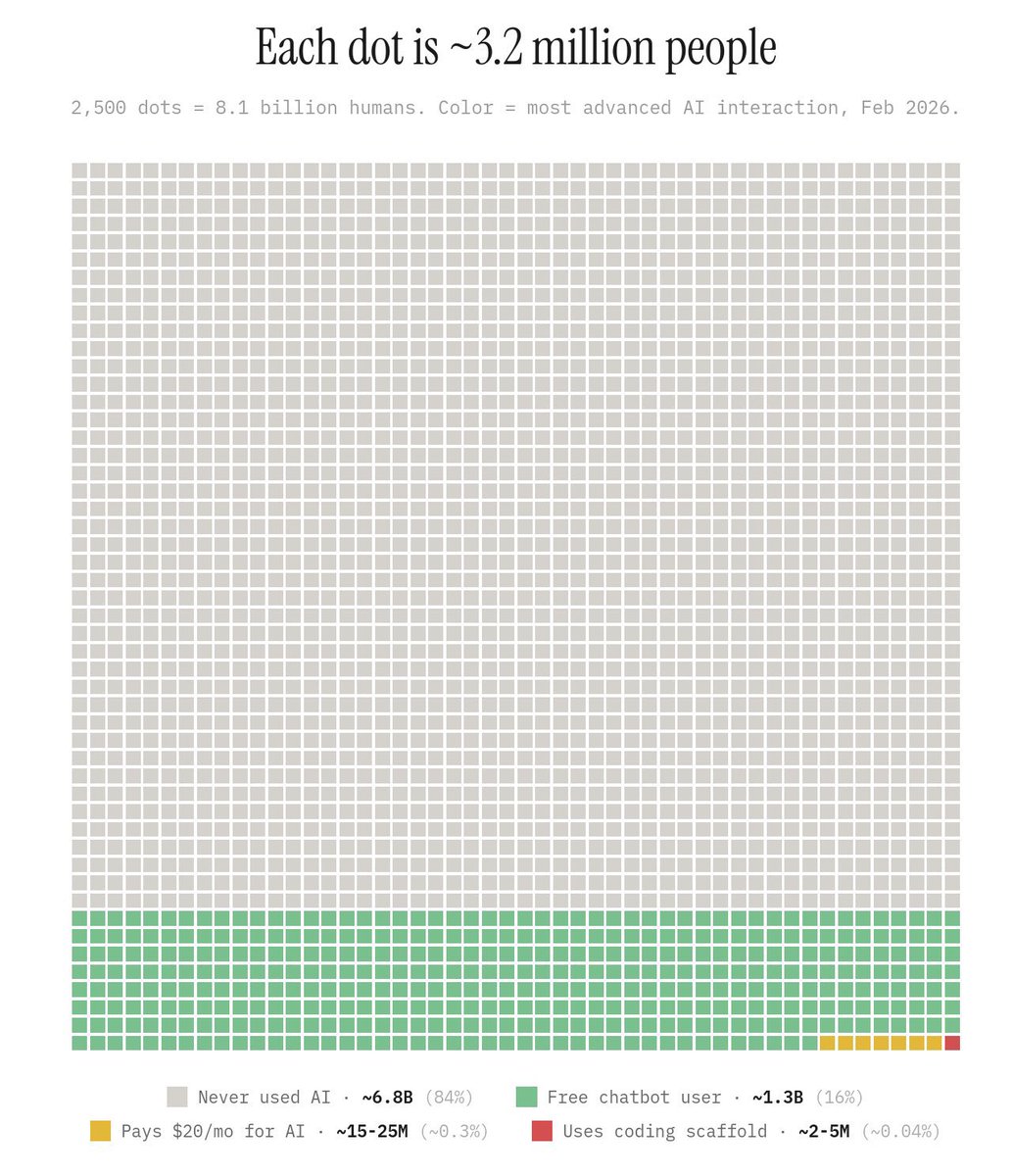
your timeline convinced you AI is in a bubble. talk to a boomer above the age 35 for 5 minutes.
most people don’t even know what claude is.
kind of wild when you zoom out.
We just added a "Plugins Collection" to the ecosystem dropdown on https://t.co/IusAdfIwHv. This is a curated collection of Vue libraries, utilities and components with stats and sorting, maintained by @jacobandrewsky .
The repo is at https://t.co/eXl2wgyS5K if you are interested in submitting your project!
We’ve developed Claude for Chrome, where Claude works directly in your browser and takes actions on your behalf.
We’re releasing it at first as a research preview to 1,000 users, so we can gather real-world insights on how it’s used.