An evidence-based program to deliver health and education interventions in children, adults & patients using the power of Football/Soccer for engagement
Cognitive reward shapes in sports and career
Sports are amazing environments to learn. When you play a sport for thousands of hours, you start to see the world through that sport. It is a simple fact—your biological neural network is being conditioned to respond to the behavior incentivized by the rules of the sport.
The funny thing is that most people choose their sports for accidental reasons such as parents, geography, or school programs. People rarely think about how the particular sport you play influences how your brain thinks more generally. Going a step further, playing the right sport may even benefit your career.
My two favorite sports are tennis and soccer. Tennis is one of the best sports for teaching consistency. In tennis, there are hundreds of points in a match, and each point is worth exactly one unit, regardless of whether your opponent made an unforced error or if you constructed the most beautiful point ending with a winner. Tennis is low-variance optimization—you win by reducing unforced errors, playing percentages, and grinding out small advantages. Tennis is also an individual sport, which teaches you to rely on yourself consistently.
Tennis has a similar cognitive reward shape to professions like being a surgeon or a pilot. Surgery and aviation require consistency, self-accountability, and deep focus. And similar to how you can only win one point at a time in tennis no matter how spectacular it was, there is no extra credit for the best appendectomy or the smoothest SFO-JFK flight. Your craft is to provide consistency with very low tolerance for error.
On the other hand, the tennis mindset transfers relatively little to entrepreneurship. Entrepreneurship is a high-variance, team game where failure is tolerated and occasional creativity gets rewarded exponentially. Minimizing unforced errors in tennis is a totally different mindset from deciding whether to make a moonshot business move that will likely fail but could potentially net a billion dollars. Obviously I am not saying that tennis players cannot be great entrepreneurs, but I do think it is a totally different cognitive reward shape.
Being a forward in soccer has a much closer reward shape for entrepreneurship. What a forward in soccer learns is to create many small chances. It is a fact that most of the game, you are not scoring—even if you look at all the times that Mbappe got on the ball in one of his best games, most of those led to nothing! But all that matters is creating enough chances to score once (or a few times) and win the game. If you break down a 90-minute game for a forward, almost all the time is failure or noise, a few minutes will be leverage, and a few seconds will determine the fate of the game. I have not played soccer for thousands of hours, but I can imagine that being a lifetime forward in soccer would teach you to be comfortable with failure and asymmetric returns.
In summary, I am claiming that there can be substantial value when the cognitive reward shape of your sport mirrors that of your career. I’ll admit that I’ve done some cherry-picking for illustration purposes—entrepreneurship also requires consistency and error avoidance; and goalies in soccer have reward shapes that are very different from strikers. But I think the point stands. If sports shape how we perceive risk, effort, and reward, then we should choose them wisely.
Exercise may be shaping the Parkinson’s brain. What does it mean when we say structural brain changes? Structural brain changes refer to measurable differences in brain thickness or volume that relate to thinking memory and brain health over time. Diaz-Galvan and colleagues describe in a new paper in Neurology how regular physical exercise is associated w/ brain structure and cognitive decline in folks w/ early Parkinson disease.
Key points:
- Higher levels of regular physical activity were associated w/ slower thinning of temporoparietal brain regions linked to memory and attention.
- Exercise was associated w/ slower volume loss in the hippocampus and amygdala which are both critical for memory and emotional processing.
- Slower cognitive decline in memory and attention was partly explained by preservation of these brain structures over time.
My take: This study moves exercise beyond lifestyle advice and into the biology of Parkinson's disease. Physical activity was frequently associated w/ measurable brain preservation that mattered for cognition. This does not prove cause and effect, however the signal was consistent, compelling and clinically meaningful. Movement appears tied to brain resilience, not just motor function. Here are 5 points that resonated w/ me:
1- Exercise may help slow brain changes that drive cognitive decline in Parkinson disease.
2- Brain regions affected were those frequently linked to memory and attention problems.
3- Benefits appeared longitudinally, reinforcing that consistency matters more than intensity bursts.
4- Physical activity should be viewed as a core component of Parkinson's care alongside medications delivered by healthcare providers.
5- Starting and sustaining movement early may possibly help folks build cognitive reserve over time.
https://t.co/nqVSdY53Dh #parkinson @ParkinsonDotOrg@GreenJournal@movedisorder
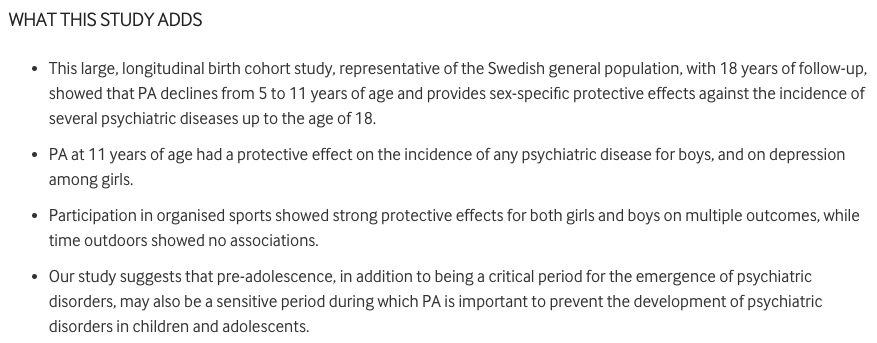
⚠️ What is the impact of physical activity on the incidence of psychiatric conditions during childhood? 🏃♀️
A longitudinal Swedish birth cohort study 📄
See the #KeyFindings 🔑 ⬇️
READ 👉 https://t.co/GQGqsMkmwa
Getting ready for the 6th Football is Medicine conference, in Florence, 23-24 Jan 2024. Read more: Krustrup P and Krustrup BR (2018). Football is medicine: it is time for patients to play! Br J Sports Med. 52(22):1412-14. https://t.co/DDX1MSaXO5
@SyddanskUni@DanishIAS@BJSM_BMJ
Former soccer players and newcomers alike are discovering that walking soccer is a safe, inclusive sport with benefits for both physical and mental health. https://t.co/Y8hiiCxDrw
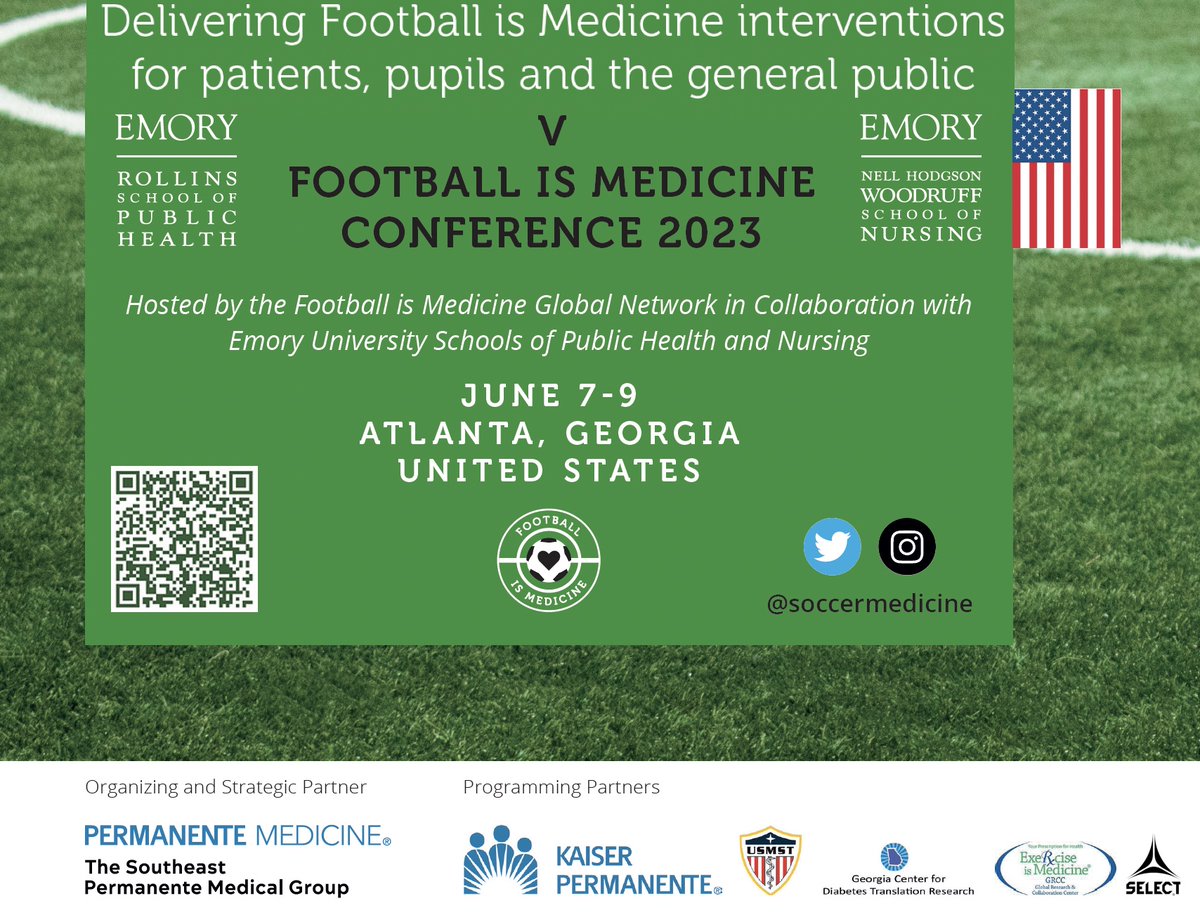
The V ⚽️ Football is Medicine Global Conference at @rollinsHDGH@EmoryRollins last week was such a success! Thanks so much to our strategic and programming partners @KPGeorgia & @TSPMG for their support! check out this nice summary piece by @Michelle_BNews from @univision34ATL
Yesterday’s big news in the ⚽️ 🌎 was the arrival of #FIM2023 to #Atlanta ! when #Messi𓃵 heard he got jealous 😉 & now he will also come to @MLS Excitement for ⚽️ in the 🇺🇸 is ↗️ and we are planning the @FIFAWorldCup health legacy! Joins us Online https://t.co/dQIi97BE04
• Pelé brought soccer to the mainstream with the Cosmos
• ‘94 World Cup helped give birth to MLS and a new beginning for the sport
• Beckham revolutionized the leagues approach and changing it’s DNA
• Messi is putting MLS on the World Stage. The GOAT is here 🇺🇸
#FIM2023 has arrived to Atlanta! Starts tomorrow 1 pm with pre-conference Workshop for coaches: How to adapt and deliver ⚽️ interventions for "patients, pupils and the general public"; 🔟scholarships supported by @KPGeorgia (PM). Registration onsite & ➡️ https://t.co/Vjo8SWsmlP
Only 5 days to #FIM2023 presented by @TSPMG
Limited spots so register now!
In-person https://t.co/y5pUBfyQHP
Webinar Online https://t.co/YnI7ybfPgb
Pre-conference Workshop for coaches to adapt soccer 4 health in patients, pupils & the general public
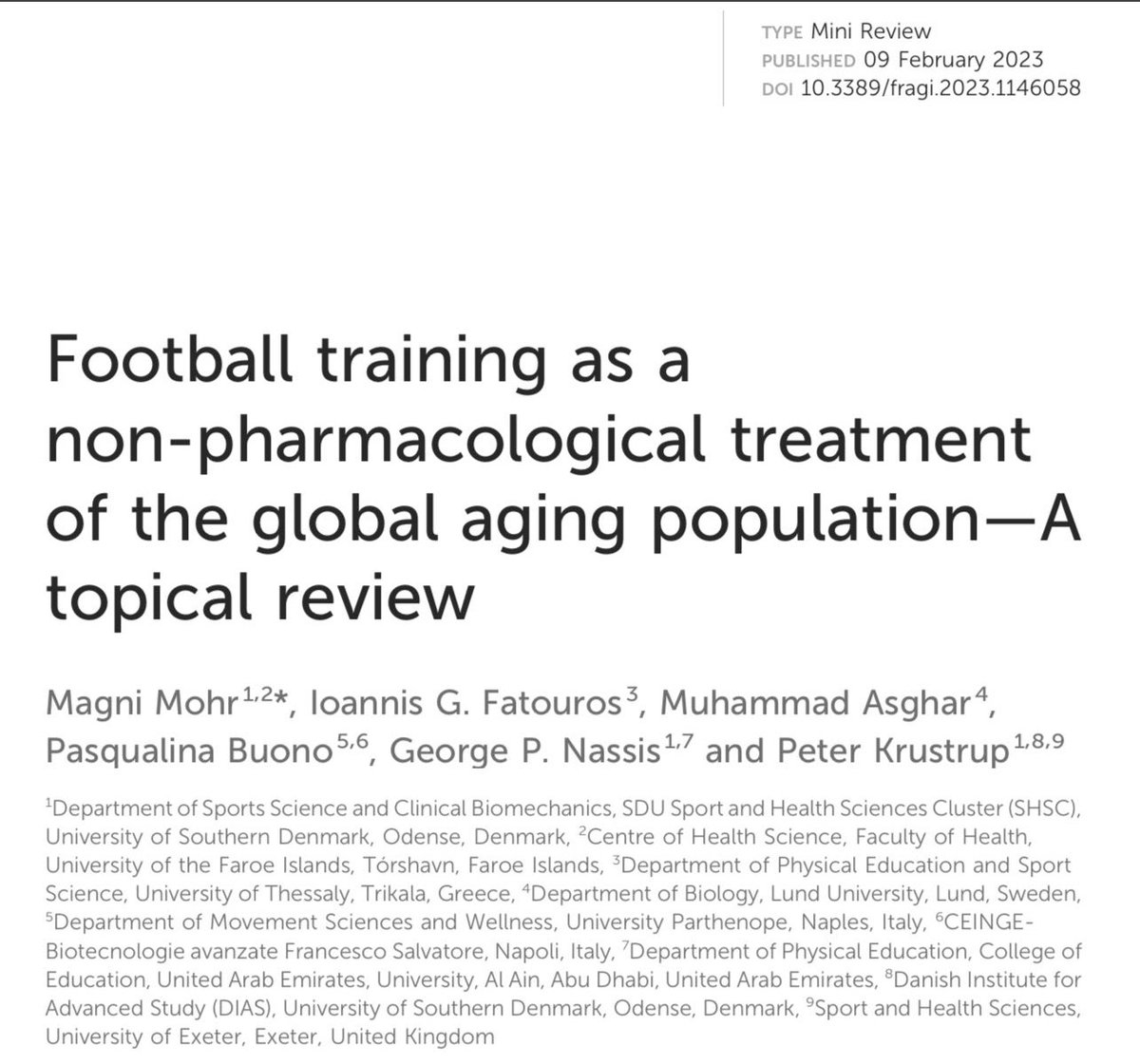
Football training for older adults. Read our mini review. Mohr M, Fatouros IG, Asghar M, Buono P, Nassis GP, Krustrup P (2023). Football training as a non-pharmacological treatment of the global aging population – A topical review. Front. Aging https://t.co/Po73IYIj4b @wcsf2023