Although Birmingham University have ‘paused’ their plans, the possibility of removal from Stratford still hangs over the Shakespeare Institute and its students.
Big discussions incoming. Please keep signing and sharing the below (and then I’ll shut up, I promise)
‘Over the past few days we have heard how much the Shakespeare institute means to the University of Birmingham’ is an incredible statement coming from the… University of Birmingham.
Friends, I need your help. After 75 years, @BirminghamU wants to close the Shakespeare Institute and move it from Stratford-upon-Avon to Edgbaston. It won't survive.
Please sign this and RT to the skies. And watch this space for further action https://t.co/Tnbuqdxu8x
@emswifthook@MinooFramroze So it comes down to a question of whether the king has a right to collect extra-Parliamentary taxes on grounds of necessity.
@emswifthook@MinooFramroze I see that as part of a similar set of issues. Parliament failed to grant tonnage and poundage, so the king, claiming 'reason of state', collected it anyway. He said he needed it, which he may well have done. Opponents said he couldn't collect it without a grant.
@emswifthook@MinooFramroze But the reason many future royalists opposed ship money was that they believed the idea of emergency was open to abuse by an overbearing Crown. The king declares and emergency, has his (royal appointee) judges agree, and then he can tax without Parliament or without limit.
@emswifthook@MinooFramroze The Militia Ordinance of 1642, which I see the fundamental issue in that year, was based on the idea that it was the representatives of the people who had the right to act in times of emergency, and were thus effectively sovereign. Same issue as Ship Money, different conclusion.
@MinooFramroze@emswifthook Yep. And there was a huge shift in the constitutional basis of taxation after the revolution. Pre-1640 I think about half of English central taxation is grounded in the prerogative. After 1660, 90% is grounded in Parliamentary grant.
@emswifthook@MinooFramroze Certainly that’s what the government said, and no doubt some believed them. The counter argument was that it was a) not really an urgent problem (Falkland’s view), and b) dangerous to let the king decide when a problem was urgent enough to create a new tax without Parliament.
@MinooFramroze@emswifthook Falkland's speech is quite interesting in a way, because it's an attack on the judges, who he thinks must have been corrupt to agree with SM. Whereas a more constitutionalist position would be that SM is wrong because it places too much power in the hands of the king.
Just gone live for buying tickets to the fourth @Caterham_School history festival on 14 November. An eclectic mixture of historians giving some excellent talk. Get ticktets at the link: https://t.co/p15CDArgcW @BloomsburyBooks#Battle@SocialHistoryOx
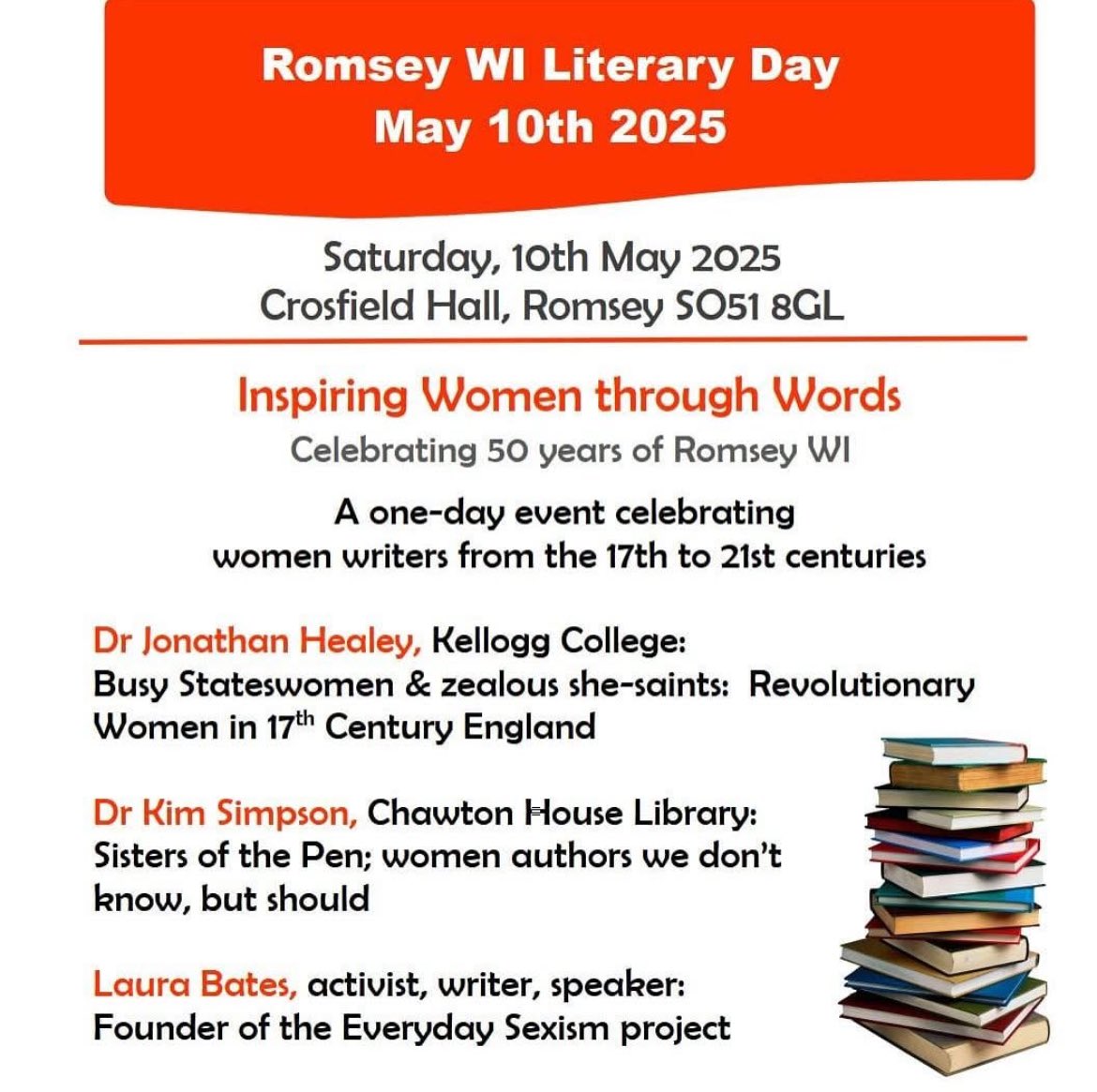
Coming up in just over two weeks - I’ll be talking about Katherine Jones, Margaret Cavendish, Mary Bankes and more….
Tickets here: https://t.co/I2ktYrwLtW