Creating the relational conditions for effective change: part two
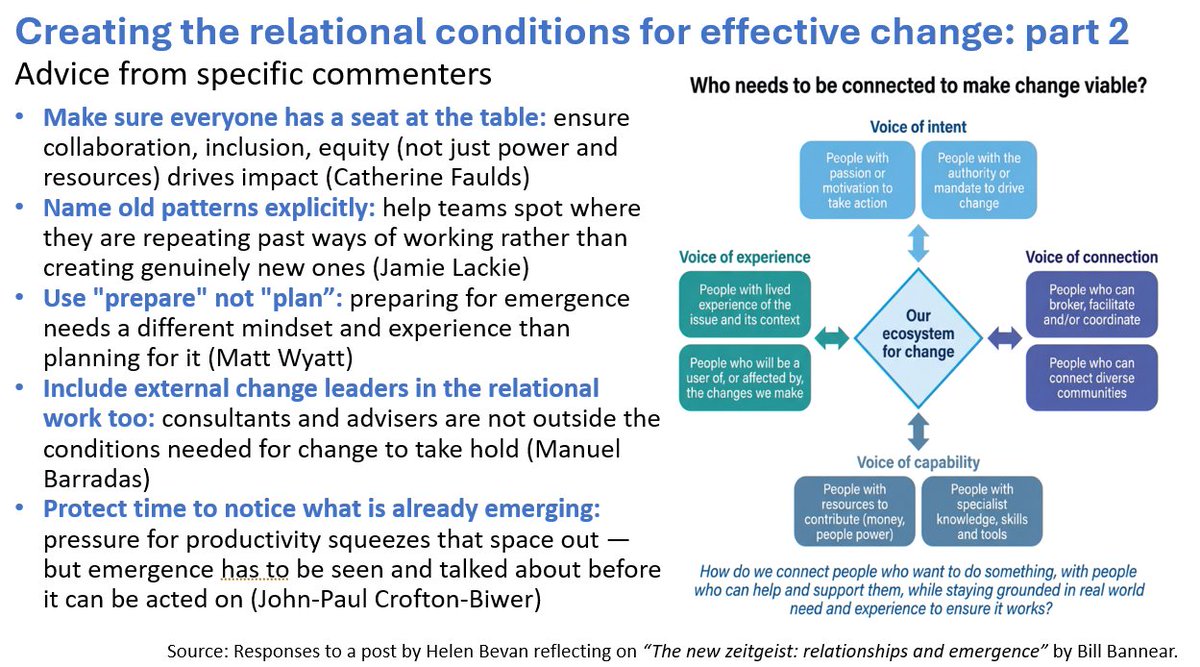
Summary of comments in response to my last post on relationships that enable change to emerge from across multiple social platforms. Six themes surfaced:
1) Relationships ARE the mechanism: many are living this
The strongest theme was direct confirmation from practice. Ish Ahmed described frontline teams that fail to progress "not because of a lack of ideas, but because the environment & relationships are not set up to support change." Diane Gudmundson stressed: "change does not move at the speed of strategy alone. It moves at the speed of trust, safety & relationships." Alana Ruakere described work at Tui Ora, where the opportunity now is to name & invest in relational infrastructure more deliberately.
2. The challenge of measurement & making the case
Several commenters identified the same problem: how do we demonstrate relational quality when “delivery” metrics are easier to measure? Antonia Field-Smith asked how to give it "a credible footing when positioned against easily measurable operational & financial metrics." Kenny Ajayi named the paradox: there is an upfront cost to building relationships, yet systems are not set up to value that investment. Ted Toussaint flagged that the "environment" is hard to sell to leadership focused on hard business impact.
3) Productive challenges to the framework
Anthony Lawton pushed back on "design for connection before content," arguing that "the strongest relational bonds form through the work itself, not before it." Matt Wyatt stressed "the phrase is prepare for emergence" — a small difference in wording but a significant difference in insight and experience required.
4) Remote & distributed environments
Rebeccah Marsh stressed "we can't leave relationships to chance when we're not co-located." Rebecca Blackwood argued that in hybrid environments "structures have to work harder to create the conditions for connection & trust to develop" & that designing for relational quality & measuring it may be two sides of the same coin.
5) Real-world applications & tools
Lesley Parkinson shared how the RCN-accredited Relationships for Change course is building capacity in relational & restorative practice across 50+ NHS Trusts. Helena Jackson connected the framework to Bill Sharpe's Three Horizons model. Amanda Jeppesen recommended Future Search as a method for bringing stakeholders together to create emergence conditions.
6) Relational competence as core leadership capability
David Pendleton framed relational competence as central: leadership operates across strategic, operational & interpersonal domains, with the interpersonal holding & enabling the other two. Jamie Lackie argued that relational infrastructure helps teams "update inherited patterns" - so interactions stop reproducing the past & start generating genuinely new ways of working.
The comments confirm both the resonance of this approach & the genuine tensions leaders face in applying it. Thanks to all commenters.
Organisational "fungibility": part 2. (Fungibility = the mistaken belief that you can restructure, redistribute roles & replace people without meaningful loss.)
Summary of comments in response to my last post across multiple social channels. Four themes surfaced.
1. Relational infrastructure is the real asset
Alison Leary observed that workforce commentary lacking grounding in social science misses what matters. Relational infrastructure is a systems concept, not an HR one. Allen C. Stines asserted that what organisations call capacity is actually relational capacity — sitting in connections, not only in individuals. Sheni Ravji-Smith noted that social capital (value created through connectedness) is often undervalued — but naming it as a fundamental component of effective services, rather than a replicable by-product, is a starting point for change.
2. The true cost is hidden — but can be made visible
Tim Curry argued the field is developing clearer ways to quantify lost social capital — making that case before decisions are taken, not only after. Dami Osibona noted that in the NHS, formal structures often get rebuilt first & informal trust takes years. That gap is where transformation fails. Ish Ahmed connected this to NHS mergers: performance dips even when capacity looks unchanged on paper, but knowing this in advance means leaders can monitor the right signals & intervene earlier.
3. Misreading the signals — & what to do instead
Anthony Lawton argued the fungibility assumption is a measurement failure: most restructures occur because informal networks are compensating for broken systems, which leaders misdiagnose as structural dysfunction. Asking why those networks became essential before any restructure begins changes the quality of the decision. Bill Powell & Mohammed Naseer Khan observed that post-restructure signals (slowed decisions, people defaulting to old contacts, hesitation where there was once flow) are misread as resistance. Yet the barrier to change is frequently fear of losing relationships & accumulated experience, not unwillingness to act differently. They are the loss of relational pathways. Alison Jaap added that leaders who understand how decisions flow through informal networks can design restructures that protect connective tissue rather than sever it.
4. Building forward
Paula Beattie stressed that rebuilding connectivity & agency are achievable starting points of recovery — & that planning for the human aftermath produces better outcomes. Cornelia Junghans Minton used the example of a GP with 30 years of patient relationships to show that accumulated relational knowledge can be seen, valued & protected. Jeppe Vilstrup Hansgaard argued the most practical leadership action is also the most basic: clarity about who connects with whom, about what & when. Done well, this builds the relational infrastructure that restructuring so often destroys.
There was little dissent amongst commenters - rather a collective recognition that the web of relationships is where value lives in organisations. Leaders who understand this can act on it.
Thanks to all who commented.
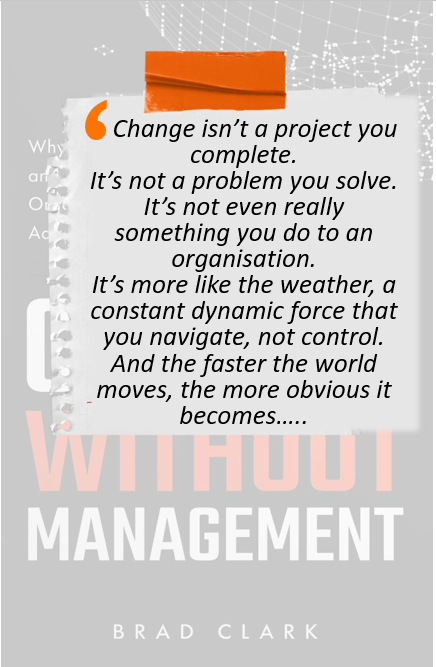
"Change without Management": part two
My last post, a review of Brad Clark's new book "Change Without Management" generated rich discussion across multiple social platforms.
Here’s what commenters said:
The strongest theme was shifting from change done TO people, to change done WITH & BY people. Bernhard Muhler concluded this in his assertion that command & control doesn't work. Qun Catherine Li reinforced this: creating conditions for others to act is what leadership is truly about, even when invisible. Muneera Rasheed added another dimension of leadership: designing a system that outlives you - an individual's time is finite, a system's is not.
Several commenters extended my critique of the book's binary framing. Arokia Antonysamy noted that AI operates probabilistically, not in binaries, arguing the real progression is from choosing to integrating to continuously navigating - not from one model to another. Tamara Zaple Rolfs discussed how binary positioning is reinforced by generative AI & by how human brains process complexity. Both identified the same problem: either/or logic is baked into our tools & our thinking alike. John-Paul Crofton-Biwer agreed: structure & adaptation need to work together, not replace each other. Dr Catriona Bradley contrasted "Our Iceberg Is Melting" (built for a single bounded problem) with today's simultaneous, compounding disruptions.
A connected theme was the gap between intention & operating reality. John Quinata observed that eliminating failure modes creates fragility: durable systems absorb strain rather than avoid it. Ethan Lim Yii Hong described how compounding complexity from silos & external pressures makes change harder to propagate as organisations grow. Daphnée Daniel added that conditions for adaptation are assumed present far more often than they are. Decisions get made on "intended" capability rather than actual capacity; & by the time the gap shows, the cost is locked in.
On healthcare specifically, Reza Hosseini Ghomi said designing for adaptation closely matches what healthcare leaders are living: change is a continuous condition, not a discrete event, requiring better local decision-making, faster learning & humility.
Several commenters welcomed the book (and the review). Kyla Avis read almost the whole thing in one day & called it "by far the best system change book I have ever read." Samantha Fowlds was drawn to the consultative framing, noting she distrusts cookie-cutter approaches. Rabih Dabliz valued the review as a guide to where the book sits in a learning journey. It was great that the author Brad Clark joined in the discussion, noting the strong response "speaks to the need."
My sense from these comments is that many people leading change are not just ready to move beyond sequential change frameworks; they are already operating without them & looking for language that matches their reality. This book & this conversation, help with that language.
Thanks to all commenters.
Here is the link to the book: https://t.co/PLfZqfURfd
Peer influence as a driver of change adoption: part 2.
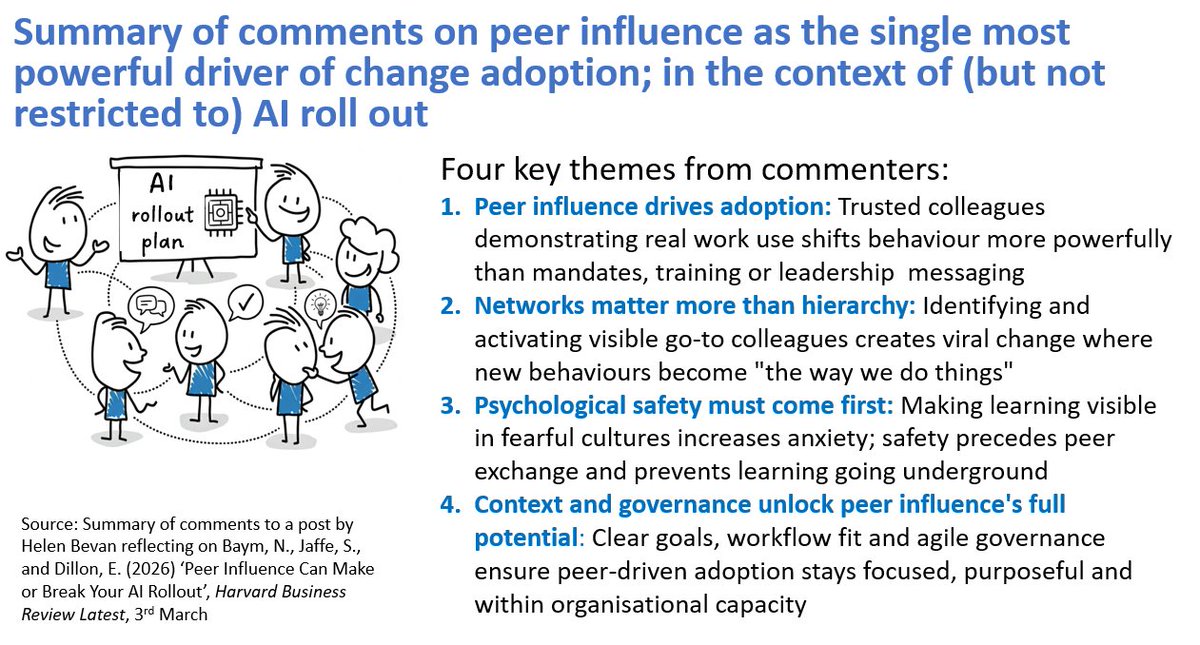
A summary of responses/comments to my previous post, reflecting on new @microsoft research on AI adoption (but applicable to other forms of change adoption). Four themes emerged from commenters across multiple social platforms:
1) Peer influence as the engine of adoption
Mark Green says: tools, training & executive enthusiasm are insufficient if "Dave from Finance" isn't quietly saying "this saved me two hours." Ian Kendall prefers pointing to someone "who walks in your shoes" over his own advocacy. John‑Paul Crofton‑Biwer adds that change sticks when people choose for themselves after being inspired by others. Treasa Coleman Nolan links this to intrinsic motivation. Lisa Evans, Sharon Mickan, Reza Hosseini Ghomi & Thomas Kempin describe the same pattern: informal relational networks & lived practice shift behaviour far more than formal policy.
2) Networks & who we activate
Marcella Bremer draws on Leandro Herrero's concept of "viral change", finding visible go‑to colleagues & engaging them so new behaviours become "the way we do things around here." Patrick Whalen actively seeks first movers & early champions as deliberate allies. Jeppe Vilstrup Hansgaard points to Innovisor's work on mapping who needs to be activated for success, reinforcing that informal influence matters more than formal hierarchy.
3) Psychological safety, capacity & sequencing
Andrew Jacobs says that psychological safety must precede visible peer exchange, not emerge from it — because making learning visible in a fearful culture can increase anxiety rather than normalise practice. Anthony Lawton argues that many public sector programmes run "mandate‑first, social conditions somewhere after that" — a sequence that pushes learning underground.
4) Strategy, governance & context
Catriona Bradley warns that peer influence can either support or distract from strategy depending on how it is framed. Robert Marotta gives a frontline view: tools purchased & mandated without clinical workflow fit or peer learning networks become "expensive shelfware." Miguel Guevara reframes peer influence as structural, not just social: trusted colleagues demonstrating AI in real work remove the path of least resistance back to the old way. Evelien Verschroeven describes how semi-structured conversations that create mutual vulnerability & complementary ownership make private experiments visible & collective learning possible. Lynsae Tulloch connects this to communities of practice, arguing that social learning backed by leadership advocacy can optimise tech adoption. Lillian Chiwera raises the balance between patient safety benefits & risks of cognitive decline, asking how resource redistribution can support culture change alongside technical adoption.
The overall message (with a few dissenters): If we want AI (or other forms of change) adoption that is meaningful & sustainable, we have to invest at least as much in relationships, networks & social conditions as we do in technology, mandates & messaging.
Suosittelen kaikille Linuxin käytön harjoittelua, esim. asentamista kakkostietokoneeseen.
Zorin, Mint ja Ubuntu -versiot ovat helppokäyttöisiä ja eivät vaadi juurikaan opettelua. Käytettävyys on nykyään ihan yhtä hyvä kuin Windowsissa.
https://t.co/LU4QopszCz
This is the Gaza we want to return to — and rebuild with our own hands.
We do not want a polished Gaza built by those who destroyed it.
We do not want a Gaza treated as land without people,
or as an “investment project” for those whose hands are stained with the blood of our families.
We do not want deception, false promises, or charity wrapped in power.
We want Gaza in its simplicity —
the Gaza we come from,
and the Gaza that comes from us.
Trump is in trouble: A New York Times/Siena poll found 69 percent of registered voters age 18-29 disapproved of Trump’s handling of the presidency, while just 26 percent approved. A notable 54 percent said they “strongly” disapprove of his handling. https://t.co/gOO39MKNUX
Israeli forces are massacring Palestinian journalists - committing war crimes on a scale that would normally make headline news - and yet Western media are still calling this a "ceasefire". Pure propaganda.
⚡️🇪🇸🇺🇸JUST IN: Spain’s PM Pedro Sanchez:
After much reflection, Spain has decided not to participate in the so-called Board of Peace.
We thank them for the invitation, but we decline.
This board is outside the United Nations framework. It does not include the Palestinian Authority.
The future of Gaza and the West Bank must be decided by Palestinians.
Spain has tripled its defense spending since I became prime minister. We are investing €34 billion a year in defense.
At the same time, we will not renounce public healthcare, public education, social cohesion, or development aid.
Security is not only weapons.
Security is scholarships for our children. Security is public hospitals for our elderly.
Torture of Palestinians has been widely documented. Justice must follow. A world governed by impunity is not a world we should accept.
➡️CUT TRADE WITH ISRAEL
➡️IMPOSE AN ARMS EMBARGO 🇮🇱
➡️SUSPEND ISRAEL FROM INT'L FORA.
Riikka Purra @ir_rkp aloitti @persut poliittisena suunnittelijana 2016. Sen jälkeen persut on maalittanut, ilman armoa, satoja naistoimittajia, naistutkijoita ja naispoliitikoita. Monen suu on tukittu pysyvästi. Nyt Riikka uhriutuu kun tuli paha mieli.
https://t.co/f1QJB1q7PK
TODAY: Hundreds of thousands in Minnesota braved -10°F weather to march through downtown Minneapolis as part of the statewide general strike demanding ICE out of the Twin Cities.
Näin ihmisenä joka työskentelee päivittäin useita tunteja tekoälyn kanssa ja myös erilaisia koneoppimismalleja itse tehneenä sanoisin, että tämä on - ainakin toistaiseksi - kuolleena syntynyt ajatus. En luottaisi mitään terveyspäätöksiä tekoälyn hoiviin. https://t.co/NBnIzKhBkn
Imagine the son-in-law of the US President presenting a ‘vision and plan’ for a shiny city with resorts on the ruins of Auschwitz or Theresienstatd where dozens of my mother’s family and tens of thousands of others were slaughtered. And from which he will personally benefit. Repulsive, inhuman & rapacious doesn’t even begin to describe what they are proposing
This is excellent political messaging. @ZackPolanski hits straight to the core of the problem. This system is intolerable and it must be overcome: production should be organized around human well-being and ecology, not around maximizing profits for the rich.
There’s so much change happening at present. It’s easy to feel powerless and overwhelmed, particularly when many of the factors affecting our situation sit outside our direct control.
I enjoy working with new ideas and practices for change (most of the time), but with many of the teams I’m working with now, I keep returning to a classic model: Stephen R. Covey’s ‘circles’ model from "The 7 Habits of Highly Effective People". The practical value is that it draws a clear distinction between (a) big concerns we care about, (b) what we can affect, and (c) what we can directly change through our own actions. Used well, it can help us prioritise better, reduce time spent unproductively “spinning our wheels”, and translate pressure into concrete next steps.
In pressured systems, our attention naturally gravitates to the biggest risks and threats. The problem is that many of those risks sit in the circle of concern, where effort does not translate into impact. The "circles" model is useful because it deliberately redirects our limited time and headspace towards areas where action can produce measurable change.
It also helps prevent a common failure mode in change: treating system constraints as if they are team-level problems. When teams repeatedly try to “solve” issues that require decisions at a higher system level (funding, policy, workforce supply etc), it creates frustration and helplessness. Separating concern from control creates a more realistic basis for action: escalate what needs to be escalated, adapt where adaptation is required, and take action where we have a level of control.
One way I use this model is to ask the team to identify a shared list of current issues, then sort them into concern / influence / control. The circle of influence is particularly important for enabling change in a system, because system change depends on coordination across boundaries—through relationships, alliances, and shared action.
This is not about ignoring the circle of concern. It is about managing it appropriately: acknowledge it, communicate it, escalate it when needed, and then avoid spending disproportionate energy where there is little prospect of change.
The central message of Covey’s model is that when pressure is high, the most effective response is to focus on what we can control and what we can influence—because that is where our effort and energy is most likely to convert into outcomes. All of us can make a difference in the world within our “circle of control” and “circle of influence”. Let’s put our energy where it will count: take the next practical step we can take today, strengthen the relationships that enable progress, and act on the things that we can change.
Bombing Venezuela while coordinating a genocide in Palestine while threatening to attack Iran (again) while destabillizing Somalia while carrying out a heist in the DRC...
US imperialism is the greatest threat to peace and security in our world today and it's not even close.
“Experts” & “expertise” can be very dangerous to change interventions.
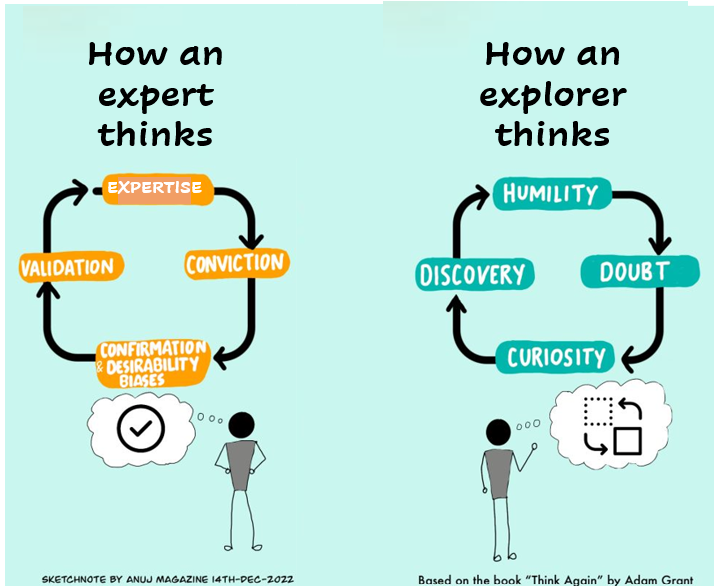
In leading change, it’s better to think like an explorer than an expert. See the graphic below.
An “expert” way of thinking can become a loop where knowing a lot turns into strong certainty. That leads us to mainly look for information that backs up what we already know, which then makes us feel confirmed. Experts can become oriented toward being right & getting affirmed, which can make their thinking narrower & more self-sealing over time.
An “explorer” way of thinking is a loop focused on learning. It starts with being humble enough to admit we might not have the full picture, then asking questions, staying curious & trying to find out more - so new information keeps shaping our views & change practice over time.
One of the greatest dangers in change experts (especially prevalent in external change experts coming into an organisation) is bias. Common biases are:
- Confirmation bias: we search for information/evidence that supports what we already think & overlook anything that contradicts this.
- “Solutioneering”: We jump quickly to a preferred intervention (new structure, operating model, digital tool etc) before fully understanding the local context & constraints.
- Authority bias: we can give extra weight to the opinion of the most senior person (or the loudest “expert”) & discount what others (especially people closer to the work) are seeing or can contribute.
- Overconfidence effect: we can be too sure we’ve got this under control, so we plan as if the future is predictable & leave too little room for learning & adaptation.
- One-size-fits-all / template bias: we over-apply what worked elsewhere (reusing change models, templates & assumptions) even when culture, incentives, capability or demand patterns differ.
- Case-study trap: We lean too heavily on successful past engagements & familiar sectors (“this looks just like Y”) & under-sample what is unique about this organisation.
In a relatively stable world, expert-led change can deliver results. But as AI accelerates the pace of disruption, the edge shifts from having the answers to staying open to better ones. The most effective change leaders will be those who keep their curiosity switched on, run experiments, learn quickly & humbly adapt when the evidence changes. In other words, the future belongs to explorers - because in an AI-shaped world, agility is likely to beat expert ability when it comes to change.
For experts/explorers see Joey Davis: https://t.co/Ya2L36fAPO
For more on biases, see the review by @grahamkmann of the work of Rolf Dobelli: https://t.co/54H7jtZBPs
Graphic adapted from one by @anujmagazine.