#BetoASaber | "El señor Mesía, si no conoce el reglamento del Senado, no puede presidir una Comisión, y lo que ha hecho es un papelón. Dan lástima"
@PolloFarsantePe
👉Entérate más aquí: https://t.co/Quj7NYVs2N
Esto es un escándalo por el que tendría que responder Zuckerberg
La periodista Daniela Lima muestra en directo como la IA de Meta favorece la campaña de Bolsonaro creando imágenes de "Flavio 22", y con las mismas instrucciones se niega a hacerlas de "Lula 13".
A decade ago, a few of us tried to get across the significance of Putin’s patronage of Trump. Here’s my book, "Road to Unfreedom," which puts that relationship in the larger setting of oligarchy vs democracy.
https://t.co/ulZkq6FPfp
Para que tirios y troyanos digamos lo mismo. Ese fue el modelo (coincido, mal diseñado) que hizo el Congreso anterior. El Senado sólo tiene competencias de revisión de lo aprobado, no de lo desaprobado. Aquí la entrevista con @elfoco_pe de la semana pasada☝🏻👉🏻https://t.co/h8EwGx6R2o
If Putin stops fighting, the war ends. If Zelensky stops fighting then his country will be occupied, leaders murdered, language banned, businesses stolen, children kidnapped. That's what happens in Russian-occupied Ukraine.
Qué pena, sinceramente. Nos sumamos de furgón de cola del intento del gobierno de EEUU de lavarle la cara a la versión del chavismo que sirve a sus intereses económicos más que a la legítima expectativa de los venezolanos de recuperar su democracia.
#EnVivo
Patricia Iturregui, senadora: La mesa de la Comisión de Constitución no ha querido aceptar que ganamos la votación. No se puede aceptar modificaciones a lo que viene de la Cámara de Diputados. Fuerza Popular está quebrantando el reglamento del Congreso
Encuentra más información en la WEB ► https://t.co/prWMaxwW21
I am a member of the Norwegian Nobel Committee.
There are five of us. Five people, appointed by a parliament most of the planet could not find on a map, who decide, once a year, which human being the world has agreed to call good.
I know. I know. I think about it on the tram.
We meet in a building on Henrik Ibsens gate, a street named after a man who wrote almost exclusively about people discovering they are frauds, which nobody on the committee finds funny except me. There is a room with a long table and the portraits of the dead laureates looking down, Mandela, the Dalai Lama, a great many earnest men in spectacles, and one portrait we do not discuss, which is Kissinger, 1973, awarded while the bombs were still falling, after which two of our predecessors resigned and the satirist Tom Lehrer said political satire was now obsolete. We keep him on the wall. A reminder. Every family has the uncle.
It is October in Oslo, which means the sun gives up around four in the afternoon like a civil servant, and it rains the particular Norwegian rain that isn’t quite falling, just hanging there, judging you. I arrive with wet shoes. I always arrive with wet shoes. There is coffee, because this is Norway and there is always coffee, we drink more of it per person than almost anyone alive, and someone’s wife has sent kanelboller, the cinnamon buns, and we sit, five Norwegians, damp, caffeinated, sugared, and we decide the moral standing of the entire species.
Let me tell you how it actually works, because the world imagines a cathedral and it is, I promise you, a book club with a mandate.
287 nominations this year. 208 people, 79 organizations. Anyone can nominate, that’s the secret nobody understands: a professor, a parliamentarian, a former laureate, so the “nominee” list is meaningless, it’s a suggestion box, and every autumn some congressman nominates his own golden retriever and the press writes “SHORTLISTED.” Nobody is shortlisted. There is no short list the public ever sees. There is us, and the coffee, and the rain, and the portraits, and a Norwegian stubbornness that is older than the prize itself.
We read reports. The institute’s advisers write them, thick dull documents, and we argue. Our chairman told the BBC once that in the final meeting “there is a high temperature.” High temperature, for a Norwegian, means someone slightly raised an eyebrow and then apologized for it. We don’t do high temperature. We do a long silence, and then Kristin says “well,” and everyone knows exactly what “well” meant, and it’s settled. That’s our shouting. “Well.” You’d have to be raised here to hear the violence in it.
Now. This year. I will not say the name, because we never say the name, but you know the name.
A certain head of state wanted this prize the way a child wants a thing in a shop window, which is to say loudly, and in public, and with the full belief that wanting it was itself the argument. He said he deserved it. He said he’d ended eight wars, a number that grew most times he said it, like a fish. He had other heads of state phone us. Israel’s prime minister posted it on the internet, “Give him the Nobel.” The leaders of Cambodia and Pakistan announced they’d nominated him, as though announcing it were part of it, as though we tally mentions. A man flew around the globe collecting endorsements for a Norwegian committee the way you’d collect signatures for a petition to the council about a noisy dog.
And here, uff da, is the detail I treasure, the one that makes me smile into my coffee. The nomination deadline is the 31st of January. He took office on the 20th. So for all the phone calls, all the posts, all the gilded lobbying, the only nominations that could possibly count for this year’s prize were filed in the first eleven days of his term, before he had, by his own arithmetic, ended a single one of the eight wars. He campaigned all year for a prize whose window had shut while he was still hanging up his coat. We didn’t have to reject him. The calendar did. We just watched. Norwegians are very good at watching. We have long winters.
People think we sit there weighing his deeds. We don’t. That’s the thing I can’t make the world understand. We’re not grading his homework. We don’t owe anyone the prize for a ceasefire, however real, however loud the announcement. “He made peace” is not a sentence that ends in a medal, the way he believes it does, the way he believes every good thing ends in his name on it. The will of a dead Swede says the prize goes to whoever did the most for fraternity between nations. A dead Swede, I should add, who made his entire fortune inventing dynamite and selling arms, and spent his last years horrified at his own obituary, which called him a merchant of death, and so bought his way to immortality as a man of peace. The whole prize is one guilty arms dealer’s attempt to launder his name. We are, all of us, administering a dead man’s public relations. I find this clarifying. It keeps me humble. It should keep everyone humble, and it keeps, by my count, no one humble at all.
So who did we give it to?
An eighty-five-year-old woman. A judge. Born in Durban, under apartheid, granddaughter of a Tamil man who came to South Africa as indentured labor, a bus driver’s daughter from the poor Indian quarter, who became the first non-white woman to run a law practice in her province, who defended Mandela’s people when defending them was dangerous, who sat on the Rwanda tribunal and the court at the Hague, and who, at eighty-five, is right now a judge weighing whether a genocide is a genocide. When we told the world, our chairman said the rule of law “underpins the system we have set up to ensure peace,” and that “peace requires justice.” She wasn’t even in Oslo. She was in Nuremberg. In courtroom 600. The actual room where they tried the Nazis. You cannot stage that. God staged that, and God, it turns out, is a better satirist than any of us.
She did not phone us. She did not post. No prime minister demanded it for her on the internet. She had, as far as our deliberations are concerned, the one qualification the loud man could never manufacture, which is that she wanted the work and not the medal. The medal finds those people. It flees the ones who chase it. This is not a rule we wrote. It’s just the only pattern the hundred-odd years of our mistakes has ever shown.
The reaction from across the ocean was immediate. His spokesman posted that we “place politics over peace.” Ja. Perhaps. We’re five damp pensioners in a rainy city; of course it’s political, it was always political, it was political when we gave it to a sitting American president nine months into his first term for the promise of things he had not yet done, and we have been quietly embarrassed about that one for fifteen years, so believe me, we had a particular reason this year to prefer a woman with fifty years of verdicts behind her over a man with eight wars in front of him and a deadline already behind him.
Here is what he will never understand, the thing I’d tell him on the tram if he ever took one. We are the one prize he cannot buy, cannot post his way to, cannot have a friendly dictator phone in for him. Not because we’re incorruptible, nei, we’re as vain and wrong and human as the portraits on our wall. But because the entire point of the thing, the only power a small cold country’s book club has ever held, is that it goes to the person not performing the wanting. The moment you demand it, you’ve proven you don’t understand what it’s for, and proving that is itself the disqualification. He ran the most expensive campaign in the history of the prize and the campaign was the reason. He was never losing to Navi Pillay. He was losing to the concept.
It’s dark now. Four o’clock dark. The buns are gone. Kristin said “well” an hour ago and we all went home. I’m on the tram with my wet shoes, and somewhere across the water a very powerful man is explaining to a camera that the prize is rigged, that we’re corrupt, that he’ll win it next year, and he genuinely might, we’re only five idiots and we’ve been wrong before, Kissinger is still on the wall.
But not this year. This year an old woman in Nuremberg, in the room where the law once stared down the exact kind of man who thinks wanting a thing loudly enough should make it his, got a phone call she didn’t ask for.
That’s the job. We don’t reward the man who ends the war and announces it.
We reward the woman who spent fifty years deciding what a war was.
He’ll never see the difference. That’s rather the whole point of him.
Takk for i dag. I have to change trams.
En nuestro marco normativo no hay reelección inmediata de alcaldes y tampoco puede haber segunda vuelta en las elecciones municipales. Esta existe solo para la fórmula de gobernador y vicegobernador, y desde 2010 está prevista en la Ley de Elecciones Regionales, no en la Ley de Elecciones Municipales.
Aun si se admitiera, sería inviable en la práctica. En las elecciones municipales se vota por una lista cerrada, encabezada por el candidato a alcalde seguido por los regidores. En las regionales, en cambio, se eligen por separado la fórmula de gobernador y vicegobernador, por un lado, y los consejeros regionales, al menos uno por provincia, por otro.
Una hipotética segunda vuelta municipal obligaría a desprender al alcalde de su lista. El Concejo Municipal de Lima está casi conformado y Renovación Popular obtendría 22 de los 40 escaños. Si en esa elección imaginaria ganara Allison, sería el único alcalde de la historia con un concejo de mayoría opositora.
No se pueden cambiar las reglas en medio de una elección para alcanzar el poder. Aquí habría un imposible jurídico y otro práctico. Como tampoco cabe encubrir una reelección con el mismo fin.
#reeleccion #alcaldia #Lima #segundavuelta
En otras palabras, va a liberar a los inocentes que no cometieron ningun crimen pero que igual los metio presos y torturo en un sistema penitenciario criminal e inhumano.
La dictadura senatorial que tratan de imponer desde el oficialismo va terminar destruyendo nuestra constitución. 33 años de prosperidad se pueden terminar y todos vamos a salir perdiendo
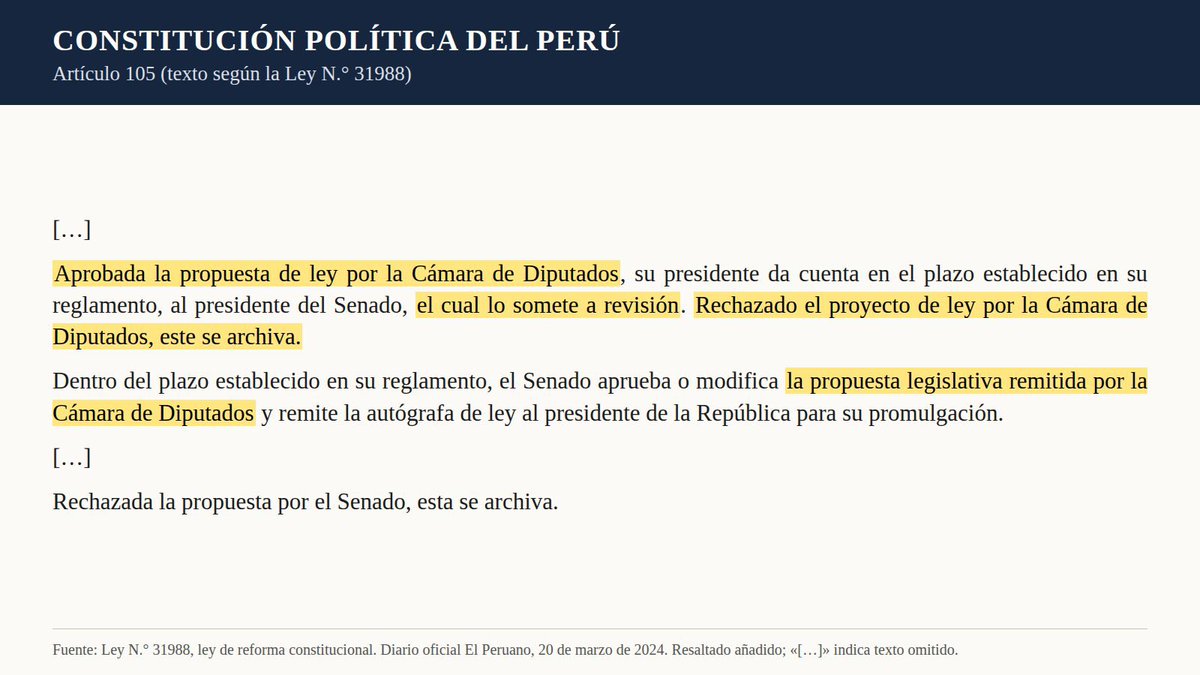
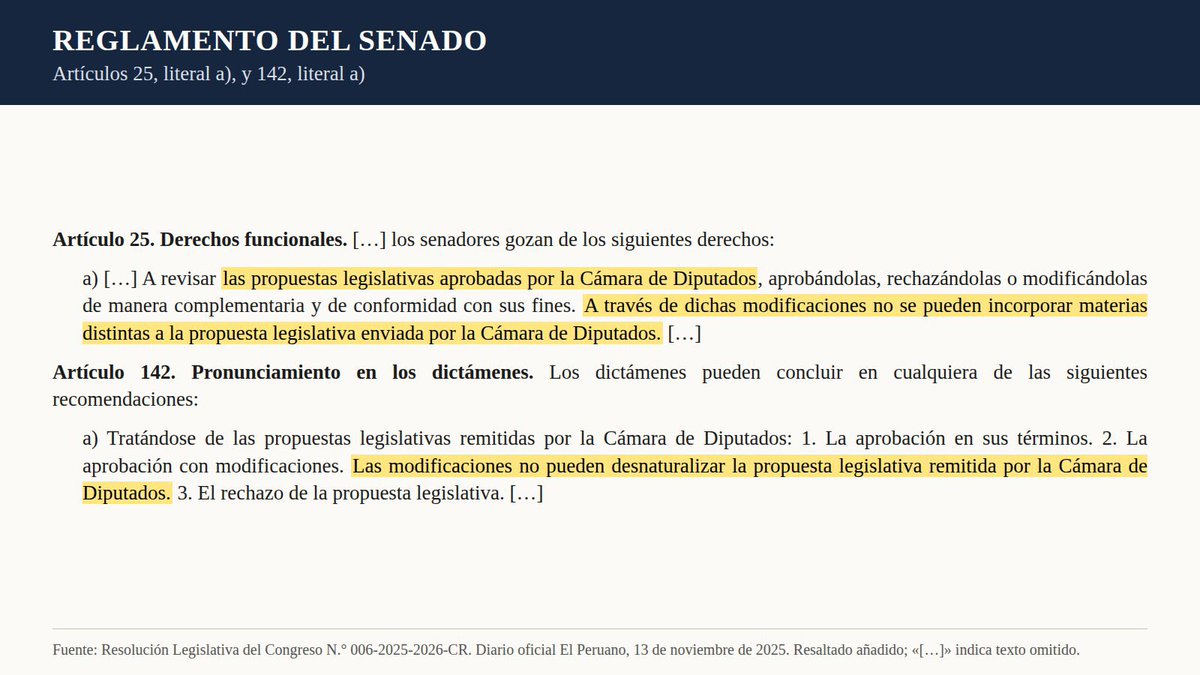
#Atencion Sobre la decisión del Senado de excederse en sus competencias en el proceso legislativo. Lo comenté hace algunos días, pero vale la pena reiterarlo:
1. El Senado revisa lo que Diputados aprobó y le remitió. Lo que Diputados rechaza «se archiva». Ese es el modelo que diseñó el congreso anterior: Constitución, art. 105.
2. Por tanto, sobre lo remitido por diputados, el Senado puede aprobar, modificar o rechazar (Constitución, art. 102-A.1). Fuera de ese campo carece de competencia: los senadores NO tienen iniciativa legislativa (Constitución, art. 107), y reponer lo rechazado por diputados es ejercerla.
3. El propio Reglamento del Senado lo confirma: no puede «incorporar materias distintas» ni «desnaturalizar» la propuesta remitida (arts. 25 y 142). Así, si lo remitido trata de seguridad ciudadana y del Fenómeno El Niño, el Senado no puede incorporar otras materias.
4. Lo rechazado por Diputados no se vuelve a presentar hasta el siguiente periodo anual de sesiones, salvo acuerdo de la mitad más uno del número legal de diputados (Reglamento de Diputados, art. 150).
5. Este conflicto entre cámaras (cuyo desahogo no ha contemplado la reforma del congreso anterior) no puede consultarse al TC. Este no tiene competencias consultivas. Solo podrá conocer el problema de constitucionalidad formal de la ley aprobada por el Senado (al haberse excedido en sus competencias) si el Ejecutivo no la observa y la promulga y esta es objeto de una demanda de inconstitucionalidad. Bastan 33 diputados (Constitución, art. 203.5). Por eso NO deberían estar opinando sobre el particular en los medios los jueces del TC porque el caso puede llegar a su conocimiento.
6. Las normas constitucionales y reglamentarias, leídas sistemáticamente, permiten llegar a estas conclusiones.☝��👇
No amount of support for Russia can end the war, because Russia is the criminal aggressor. A modicum of support for Ukraine could, however, end the war, by making it impossible for Russia to continue. This should not be a hard choice.
Rivera Lazo no fue absuelto. El TC le conmutó la pena. Fue condenado por los crímenes de Barrios Altos. Pero ahí está Canal N, haciendo eco de discursos negacionistas y desinformando. Esa ley pro impunidad es inconstitucional. Por eso, no se aplica.
Trump is lying again. Putin started the war and has repeatedly refused to negotiate to end it. The US spent nothing like $350 billion. Half the money is not missing. Washington and Moscow are both significantly more corrupt than Kyiv. Putin, not Zelensky, is a dictator who openly steals elections.
Como lo leen: niñas de 3 años contagiadas de VIH por violaciones y no son atendidas por la justicia. En vez de medidas ridículas como el pelo y las uñas, dotar al PJ a fin de cuidar a estas niñas abandonadas y no solo en Condorcanqui.
Most Americans think that Donald Trump is profiting off the presidency either illegally or unethically, according to a new poll
https://t.co/Ck1w4jjWOY