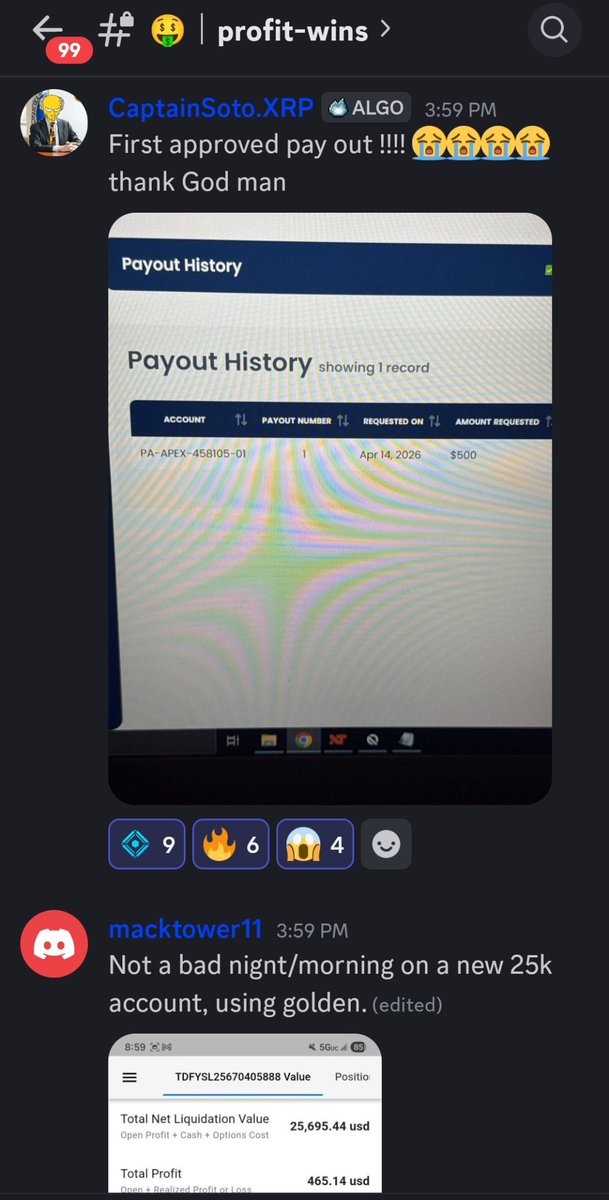
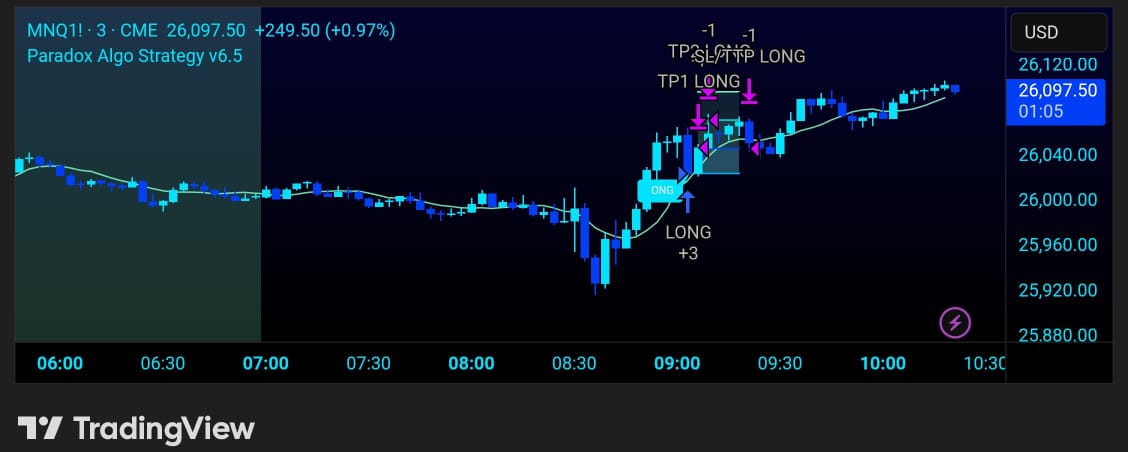
🚀 Paradox Algo | Version 6.3 Update
We are thrilled to announce that v6.3 is officially live. This update marks a fundamental shift in how Paradox processes market flow, solving one of the most persistent challenges in algorithmic trading.
⚡ The Hybrid Execution Engine
For a long time, traders have had to choose between the speed of "Realtime" data and the accuracy of "Historical" data. No more.
In v6.3, we have officially deprecated Data Mode. Our team has engineered a proprietary Hybrid Execution Engine that bridges the gap between data streams. This update delivers a seamless experience that eliminates the trade-offs of the past:
⚡Zero-Lag Synchronization
We’ve developed a custom logic layer that processes incoming ticks without the inherent latency typically found in historical backtesting engines.
⚡ Elimination of "Ghost Trades"
By refining our internal validation sequence, we have neutralized the repainting issues that often plague realtime calculations. What you see on the chart is now locked to the price action with absolute precision.
⚡ Unified Signal Integrity
Signals are now computed using a multi-phase verification process, ensuring that the entry you see in real-time matches the historical record perfectly.
🛠️ How to Update
To ensure you are running on the new engine:
-Refresh your charting platform.
-Remove any existing Paradox Algo indicators from your chart.
-Re-add Paradox Algo v6.3 from your "Invite-only scripts" folder.
Note: Because this update fundamentally changes the underlying data processing, you may notice cleaner signal execution and more stable visual outputs across all timeframes.
Chart layout with optimized input configurations for v6.3 (make a copy of the chart layout):
https://t.co/j68HcJsJ3g
We are committed to keeping Paradox at the cutting edge of quantitative analysis.
Thank you for your continued trust and feedback!
A few years ago, I was standing behind a small food vendor who had just lost a full afternoon of sales. Nothing was wrong with the food. The line was there.
The problem was simple: the payment terminal stopped working. Network issue. The bank said “wait.” Customers got angry and walked away. Cash only wasn’t an option anymore.
That stall lost a lot of sales that day, not because demand disappeared, but because permission did.
That moment stuck with me, and it’s why decentralized retail payments like @Ctap_io actually matter.
At its core, tap to pay today isn’t really “digital cash.” It’s a request system. Every transaction asks multiple intermediaries for approval, the bank, the processor, the network, sometimes a regulator, sometimes a policy engine deciding whether you’re allowed to transact *right now*. Most days it works. Until it doesn’t.
@Ctap_io flips that model. They don’t ask for permission first; they verify after the fact. Value moves the same way information moves on the internet, directly, peer to peer, without a single choke point that can fail, freeze, or quietly say no.
This isn’t just theoretical. For small merchants, decentralized tap to pay means fewer hidden fees, fewer arbitrary blocks, and fewer days where revenue depends on someone else’s uptime. For consumers, it means payments that don’t care who you bank with, what country you’re in, or whether a backend system is under maintenance.
That said, decentralization isn’t a silver bullet.
User experience still lags. Custody is hard. Regulation isn’t optional in the real world, and pretending it is doesn’t help adoption. Most people don’t want to think about keys, networks, or confirmations when they’re buying coffee. They want it to work, instantly and invisibly.
So here’s my honest position; decentralized retail payments don’t replace traditional systems overnight. They PRESSURE them.
Decentralized retail payments matter because they create an alternative, one that reminds the existing system it’s not the only game in town. They matter because when payments are programmable, borderless, and not owned by any single company or country, leverage shifts slightly back to the user.
The goal isn’t to kill Visa, banks, or tap to pay terminals. It’s to make sure that the ability to exchange value doesn’t depend entirely on centralized permission layers that can fail, exclude, or change the rules mid game.
Decentralized tap to pay isn’t about ideology.
It’s about resilience.
And in a world where “the system is down” can shut a business for the day, resilience is not optional, it’s the product.
After my experience years back, I personally believe decentralized retail payment is the future!
The markets are closed, your growth isn’t.
Take the weekend to:
• Review your trades
• Study your playbook
• Backtest a setup
• Strengthen your mindset
Consistency starts when no one is watching.
Happy weekend Paradox Family.