The complexity of using crypto bridges can be a major barrier for many users. The need to navigate different interfaces, manage multiple fees, and deal with wrapped tokens can make cross-chain activities frustrating and error-prone. At Solera, we’ve streamlined the entire process, making it as simple as possible for users to move their assets across chains. Our goal is to eliminate the confusion and provide a seamless experience that anyone can use, regardless of their technical expertise.
At Solera, we're leveraging a similar approach to Circle's CCTP for cross-chain transfers, but with a unique twist. Instead of backing our stablecoins with real-world assets, we use collateralized positions. Lock your collateral where you have it, mint stablecoins where you need them—no wrapping risks, seamless transfers across supported blockchains.
Stablecoins are the lifeblood ❤ of crypto, but they're stuck in their own little bubbles 🧱. It’s time to break those walls down so value can vibe 💎 across all chains, making crypto simple 🌟 and smooth for everyone. Let’s make it less sus, more seamless!
Stablecoins are the lifeblood ❤ of crypto, but they're stuck in their own little bubbles 🧱. It’s time to break those walls down so value can vibe 💎 across all chains, making crypto simple 🌟 and smooth for everyone. Let’s make it less sus, more seamless!
🌉 Bridges are unreliable and cumbersome. Different bridges mean different wrapped assets, creating confusion and risk. Solera simplifies this with CCTP, using burn 🔥 and mint 💰 operations for native stablecoin emissions across chains
After hours of research, I've discovered a better solution to the problems some protocols face.
Take MakerDAO, Lybra Finance, and Prisma Finance, for example. They're all solid platforms but share a common problem.
Are you curious about what it is? Stick with me as I reveal the issue and the solution ⤵️
Traditional stablecoin protocols often struggle with:
𝐂𝐨𝐥𝐥𝐚𝐭𝐞𝐫𝐚𝐥𝐢𝐳𝐞𝐝 𝐃𝐞𝐛𝐭 𝐏𝐨𝐬𝐢𝐭𝐢𝐨𝐧𝐬: Most stablecoins are created by locking up volatile crypto assets (like ETH) as collateral.
𝐒𝐢𝐧𝐠𝐥𝐞 𝐁𝐥𝐨𝐜𝐤𝐜𝐡𝐚𝐢𝐧 𝐋𝐢𝐦𝐢𝐭𝐚𝐭𝐢𝐨𝐧: These stablecoins and their collateral usually exist on the same blockchain, like Ethereum.
The solution is @SoleraFinance. 💎
Solera introduces the first native cross-chain stablecoin. So, how does it work?
This cross-chain orchestration is powered by Solera AVS, an autonomous validated service running on the EigenLayer infrastructure. It leverages staked ETH from the Ethereum consensus layer for enhanced security and reliability.
Here are some of its key operations ↙️
➳ Monitoring collateral
➳ Facilitating user actions across networks
➳ Minting and burning stablecoins
➳ Updating prices and handling liquidations
➳ Data storage
➳ Balancing stability pools for cross-chain liquidations
This enables flexibility and compatibility with both EVM (Ethereum Virtual Machine) and other smart contract-capable chains.
But that’s not all! With @SoleraFinance, you get ⤵️
➠ Efficient collateral management
➠ Simplified movement across networks
➠ Increased liquidity and lower costs
➠ Cross-chain collateral
Are you tired of traditional stablecoin limitations? Check out @SoleraFinance for cross-chain stablecoin flexibility.
𝐎𝐟𝐟𝐢𝐜𝐢𝐚𝐥 𝐋𝐢𝐧𝐤𝐬
Website: https://t.co/T8cLXdOss7
Discord: https://t.co/8p3Ls0bvLM
X: https://t.co/2XERchxDNT
Telegram: https://t.co/9Op2wMnTrm
Github: https://t.co/PUTn2ZWiko
Around 2014, Vitalik Buterin worked with a group of scientists on the colored coins protocol for Bitcoin. They made good progress and were on track to achieve their goals, but Vitalik realized that defining the problem was more important than solving it entirely. He returned to Canada, and instead of delivering the best protocol he could design, he created a new blockchain—one that could be Turing complete and support all the wildest dreams of running code on blockchains. Vitalik became not just one of the greatest entrepreneurs of this century but also the ultimate problem-definer, someone who knows how to focus his laser on the issue and bring in the minds to solve it. Even today, when addressing the issue of interoperability between blockchains, he pinpoints the challenge accurately. It's hard to move between L2s, rollups, or blockchains. DeFi is fragmented. But he's also right that there's a lot of energy being invested in solving the problem. Here at Solera, we believe we have the solution. @VitalikButerin, here we come.
I think people will be surprised by how quickly "cross-L2 interoperability problems" stop being problems and we get a smooth user experience across the entire ethereum-verse (incl L1, rollups, validiums, even sidechains). I'm seeing lots of energy and will to make this happen.
When the market crashes, Solera's liquidity pool activates, using stablecoins to cover bad debt and stabilize assets. By stepping in during volatility, it ensures your investments remain secure even in the most turbulent times.
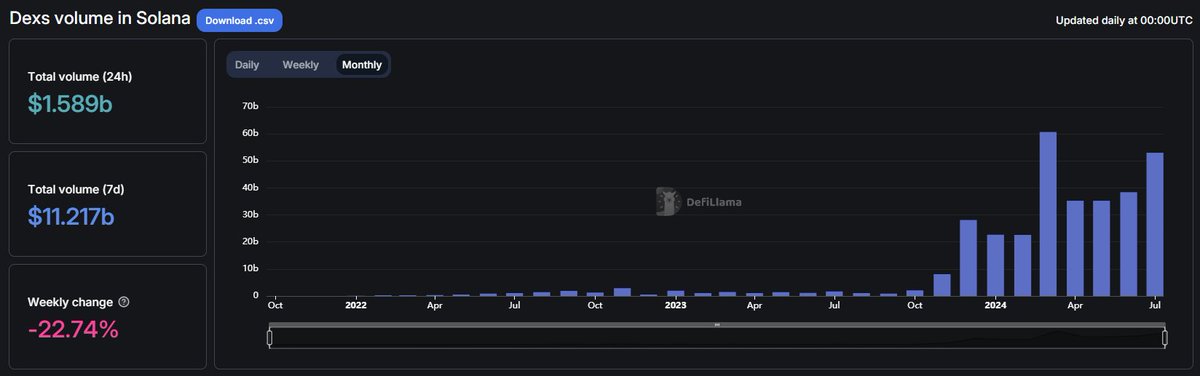
Look at this crazy data revealed today by DL News. Solana has been surpassing $1.5 billion in trading volume on decentralized exchanges (DEXs) for several consecutive days.
What does this mean? It means that the memecoin craze is at its peak, and a lot of people are flocking to Solana to buy meme coins.
No one, mind you, is buying Solana to shop at the grocery store. It's a place filled with noise, fun, and chaos. But getting there is such a convoluted process. No one wants to sell their crypto, so they take out loans, receive another token, cross a bridge (which might not even work tomorrow), get a wrapped token of questionable value, and finally reach the DEX—all this just to reverse the process when heading back.
This is what we are solving with Solera. Two clicks, and you're with a stablecoin on the network you requested, without the hassle or risks. And the world, it turns out, needs this.