Mr. @SecMullinDHS, as you step into your new position I ask you to provide particular consideration to the status of Iranian students and professionals in the United States who may be at risk of immigration complications due to Presidential Proclamations 10949 and 10998. Many of these individuals fled the Islamic Republic’s because they believe in freedom, democracy, and the values this country stands for. They are also contributing to the United States every day.
They arrived in this country legally, followed the rules, respect this country and its system of law and order and are among the most dedicated and accomplished contributors to American society. I ask that you and your department consider these factors, plus the personal and political risk many of these young people would face if sent back to the criminal regime in Iran.
America’s concerns for its national security and the threat posed by the Islamic regime to the homeland are entirely justified. To that end, my office stands ready to provide you and your colleagues with regime operatives, propaganda agents, and influence networks for investigation and removal from the United States.
Thank you for your consideration.
It's been 3 months since USCIS froze visa and work authorization processing for students and scholars from 39+ countries. No end in sight... people already here doing their science can't get their visas processed. This policy is again punishing people based on nothing but their country of birth. Morality aside, this is how you dismantle American scientific leadership in one fell swoop.
This is doubly hard for Iranian students who are now between a rock and a hard place! #USCISPause
Secretary @marcorubio
Iranian immigrants have long contributed to the U.S. economy, especially in STEM, medicine and AI. Most strongly oppose the Islamic regime and support the goal of a strong and secure USA under President Trump and your leadership.
Over the past few months, many have faced serious hardship due to the USCIS hold. They are here legally and often hold advanced degrees. Returning them to Iran would place them in danger and risk sending highly trained experts in strategic fields back to the Iranian regime.
We would greatly appreciate it if you could revisit this decision.
Thank you for your consideration.
Our article on hydrolysis kinetics at the air-water interface was just published in @J_A_C_S in collaboration with @DMEremin and @FokinLabUSC .
The results are not what we expected initially!!
https://t.co/L6p4Jb1fAO
🚨 Just published in @J_A_C_S! 🚨
What happens to the pH of #water when it’s squeezed into a space thinner than a nanometer?🤔
👉 https://t.co/rMtVYfiQin
In our latest study, we show that sub-nanometer confinement suppresses #water autoionization, raising its pKw by more than 2 units!💧
This effect is driven by:
✅ Destabilization of OH⁻ at the interface
✅ Disruption of the hydrogen-bond network
✅ Suppression of the Grotthuss proton-hopping mechanism
Our results highlight how nanoconfinement reshapes aqueous-phase chemistry, offering molecular insight critical for nanofluidics, catalysis, and membrane science. Stay tuned... 🏄♀️
Read more about our #machinelearning model of dissociable #water derived from density-corrected #DFT data:
🎯 https://t.co/asl8RU82EG
🎯 https://t.co/VnoUuPpWCn
👏 Congratulations to Saswata (@quantum_winger) and Suman (@SSuman_24)!
🙏 Big thanks to @NSF for funding and to @ACCESSforCI and @NERSC for providing computational resources!
@UCSanDiego@UCSDPhySci@UCSDChemBiochem@HDSIUCSD@SDSC_UCSD
Sub-nanometer Confinement Suppresses Autoionization of Water | Journal of the American Chemical Society @UCSD@scrippsresearch@PaesaniLab https://t.co/DCIo0TuEIu
Check it out!
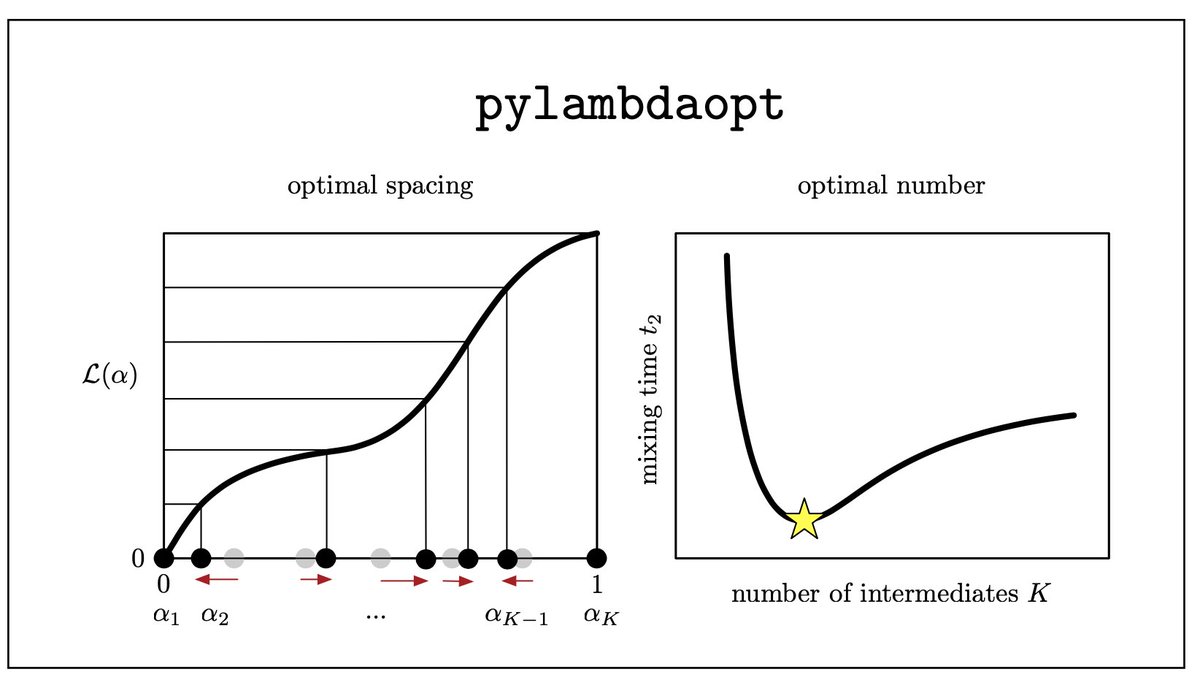
Simple Method to Optimize the Spacing and Number of Alchemical Intermediates in Expanded Ensemble Free Energy Calculations
https://t.co/M0715X0fWN
“Direct observation of carbon dioxide adsorption and binding at the air/aqueous interface” is published in March issue of @PNASNexus. Great work by @MokhtarMrashwan . Wonderful collaboration with @NymanMay.
@HESS_Argonne
https://t.co/TyaRLcu0RU
One needs to be cautious when using EG/PEGs as crowding agents to mimic cell-like environment.. Our FCS and MD simulation show they are not actually "inert"! They affect ligand binding kinetics to GqDNA in a complicated manner! https://t.co/wQaMBZsnoe
Revealing the molecular structures of <italic>α</italic>-Al<sub>2</sub>O<sub>3</sub>(0001)–water interface by machine learning based computational vibrational spectroscopy https://t.co/I7JD5HlDum
A great work from Voelz lab:
@RMRaddi @kpmans_theorem
A simple method to optimize the spacing and number of alchemical intermediates in expanded ensemble free energy calculations
https://t.co/YidIyiPACk
Cancer therapeutics methods based on microwaves/radio wave https://t.co/oHfA5NmB6L
Neda Iranpour Anaraki , Somaiyeh Dadashi
Electromagnetic Waves-Based Cancer Diagnosis and Therapy
Principles and Applications of Nanomaterials
2023, Pages 65-88
🎉 Kicking off 2025 with a bang! 🎉
Our first paper of the year is now published in @J_A_C_S! ✨
👉 https://t.co/KuNo5T0zq1
Combining our MB-pol #datadriven#manybody potential with the Te-PIGS #machinelearning model of nuclear quantum effects, we shed light on how the quasi-liquid layer on the #ice surface forms and evolves with temperature. 🧊
Huge congrats to @RichaRashm for her first first-author paper! 🎉
We are very grateful to @AFOSR for funding this research through our "MURI: Unraveling the Mechanisms of Ice Nucleation and Anti-Icing through an Integrated Multiscale Approach", and to @DoD_HPCMP and @SimonsFdn for providing #GPU and #CPU time!
@UCSanDiego@UCSDPhySci@UCSDChemBiochem@HDSIUCSD@SDSC_UCSD