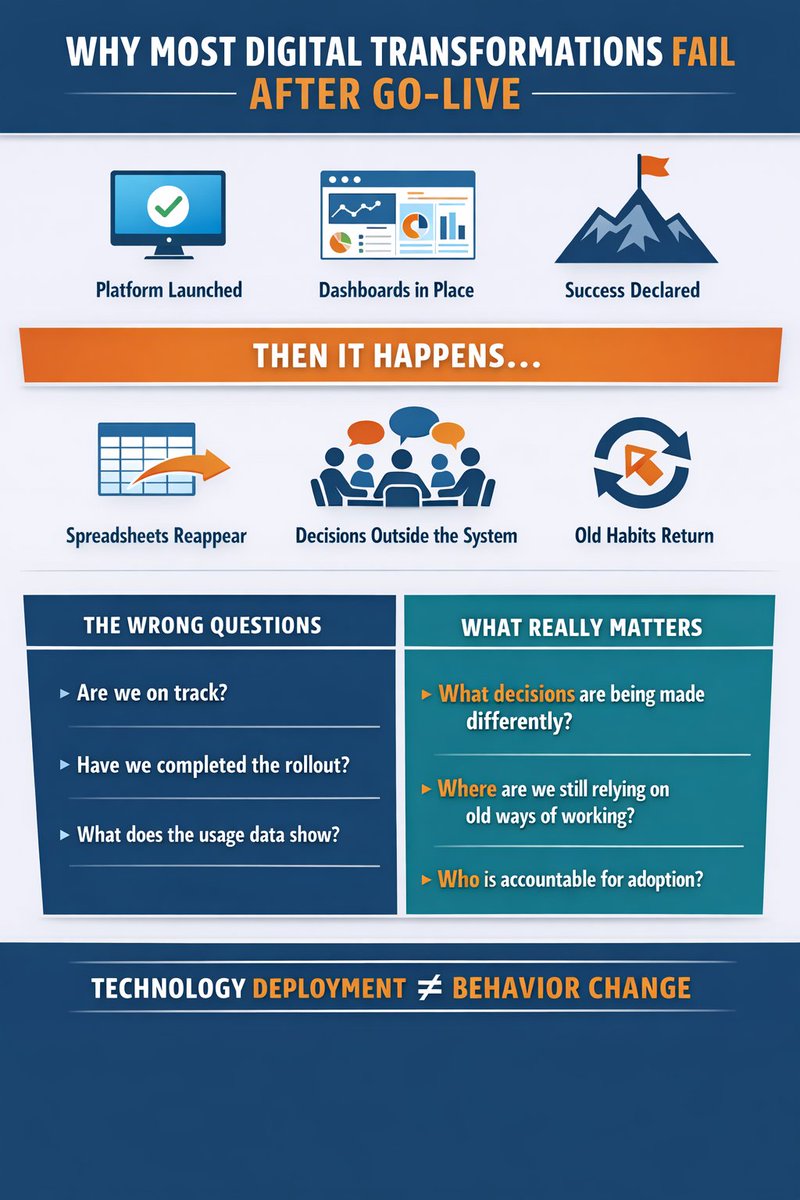
Most digital transformations don’t fail at strategy. They fail after go-live. When:
→ Spreadsheets return
→ Decisions happen outside the system
→ Old habits quietly win
Technology scales. Behavior doesn’t.
@_soniashenoy Looking at the comments here. Glad to see such optimistic responses. I have noticed smart youth invest in property, stocks, and secondary income sources that will likely sustain their non-productive years or at least create a sizeable corpus. The worry isn't money
@_soniashenoy@RajeevThakkar@PPFAS This is the state of affairs - as of now. But AI will evolve, so will the skills of the people who use AI. They will have to be more judicious, discerning, and efficient. The question is not how soon, but how are we making that happen?
Ethical leadership is often reduced to intent.
In practice, it is a system:
Defined behaviours
Reinforcing structures
Consistent follow-through
Where systems fail, silence becomes normal.
Full piece:https://t.co/7vdfpuifai
@RayDalio Open-mindedness isn’t just a mindset; it’s a governance capability. It drives curiosity, and curiosity strengthens the feedback loops boards rely on to learn, adapt, and course-correct.
Without it, transparency becomes performative—not transformative.
@ForbesIndia@ShadowzAndDust Mass layoffs of this scale expose a critical blind spot:
Human capital is still not governed as a strategic risk.
Beyond severance, boards should be asking—what’s the impact on capability continuity, morale, and long-term value creation?
@jay_kotakone@kotak811 Bold bet—and a strong reminder that transformation isn’t about digitizing products, but reimagining customer experience end-to-end.
What stands out is the sustained focus on adoption and trust—that’s what turns ambition into scale.
@Samantha090814 Good one. The real gap isn’t AI capability—it’s behavioral adoption. The question is: who owns that change? Organizations that win would treat AI adoption as a leadership and governance priority, not an implementation task.