Ok, here’s my corporate greed call-out of the day.
I was dispatched today for a no-cool call. The indoor unit was running, but the outdoor unit wasn’t.
The system was a 10-year-old Bryant Evolution high-end variable-capacity inverter system. After running the factory diagnostics, I found Code 77, indicating the inverter board was detecting excessive compressor startup current.
Following the manufacturer’s diagnostic procedure, I disconnected the compressor leads to determine whether the fault was in the compressor or the inverter board. The results confirmed the inverter board had failed. The system is only 8 months out of warranty.
At that point, I started preparing myself to tell the customer the repair would probably be around $1,500–$1,900. I figured the board would cost somewhere in the $800–$1,000 range. After all, it’s just a printed circuit board.
Before giving the estimate, I called Carrier Enterprise for pricing.
$8,900.
Not for the entire outdoor unit.
Not for a complete system.
Just the inverter board.
That’s not a typo. $8,900.
In my opinion, this is the definition of engineered obsolescence. There is no reasonable justification for a replacement circuit board on a 10-year-old residential HVAC system to cost nearly nine thousand dollars. At that price, you’re essentially forcing the homeowner to replace the entire system instead of repairing it.
This is exactly why I’ll never sell Carrier equipment. They make decent equipment, but pricing replacement parts like this turns a repairable system into a disposable one. Homeowners deserve better than that.
Carrier Carrier Enterprise or anyone that’s sells this shit, care to elaborate why this board is so expensive?
🎩 Patrick Henning
You guys are not gonna fucking believe this shit. OVER HALF OF ALL MILLENIALS AND ONE THIRD OF GEN X DEPEND ON THEIR PARENTS. That’s the majority of people 30-65 for those of you rusty on your demographics.
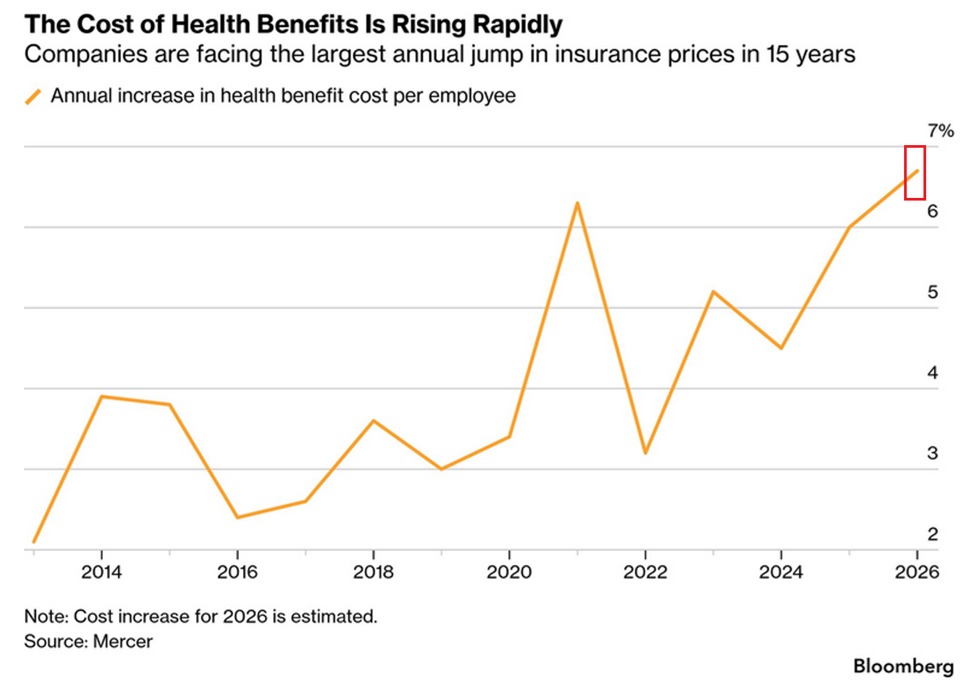
The surge in US health insurance costs shows no signs of slowing:
Health benefit costs per employee are expected to rise +6.7% YoY in 2026, to at least $18,500, the biggest annual increase in 15 years.
This is more than double the increase seen in 2019 or 2022.
Furthermore, health insurers are expected to raise the cost of employer group plans by over +6.0% for the 4th consecutive year.
In response, ~66% of large US firms plan to increase monthly employee premium contributions in 2027.
Workers who frequently visit doctors and fill prescriptions could see healthcare costs rise as much as +8.0% YoY.
US healthcare costs have never been higher.
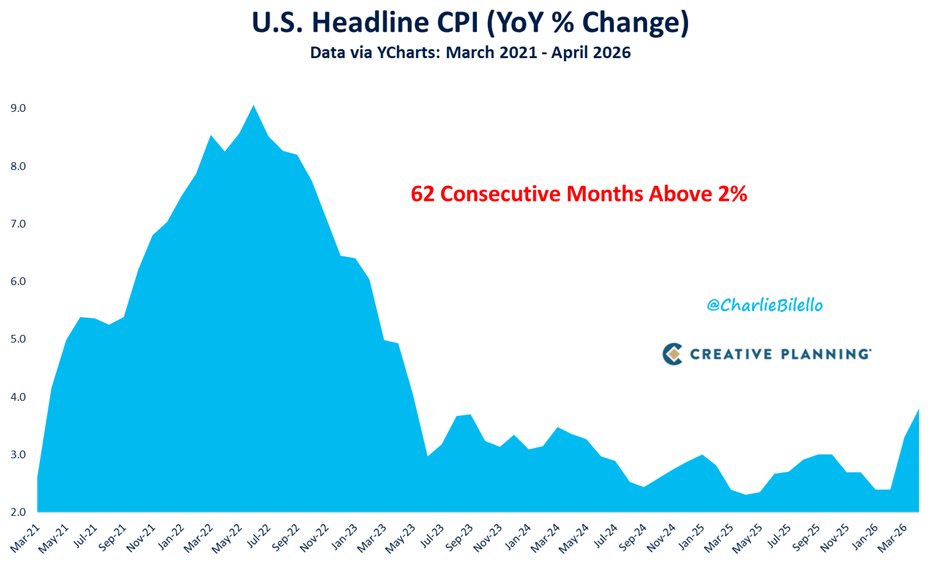
The 2020s are now one of the most inflationary decades in history:
US CPI has averaged 4.0% so far in the 2020s, the highest decade average since the 1980s.
This is more than DOUBLE the average of the 2010s, at 1.8%, and well above the 1990s and 2000s.
Since 1950, the only only periods with higher inflation were the 1970s and 1980s, at 7.4% and 5.1% on average, respectively.
This comes as inflation has been above 2.0% for 64 of the 76 months so far this decade, peaking at 9.1% in June 2022.
By comparison, during the 2010s, inflation was above 2.0% for 49 of the 120 months, with a peak of 3.9% in September 2011.
Inflation remains way too high.
In April, the American male labor force participation rate hit its lowest level since records began in the 1940s
We are losing one of the bedrock pillars of our society
What can be done to reverse this existential trend?
US inflation is persistently running above the Fed’s target:
US PCE inflation has surged +28.5% since February 2018, to an all-time high.
Had inflation run at a steady 2% target, it would have risen +17.4% over the same period.
In other words, the current path overshot the target by +11.1 percentage points.
The gap began to widen in 2021 following massive economic stimulus in response to the pandemic and near-zero interest rates in 2020 and 2021.
As a result, PCE inflation has been above the Fed's 2% target since April 2021, spanning 60 consecutive months.
The most recent reading for March stood at 3.5%, the highest since June 2023.
Inflation in the US remains way too high.
🚨BREAKING: Brown University student Alex Shieh previously EVISCERATED the school's administrators for having a $46 million deficit, despite surging costs for students.
They pay $90K+ PER YEAR.
Alex Shieh: "What about the kids who weren't born on third base?! [...] Brown is on track to run a $46 million DEFICIT this year. WHERE is all the money going?"
"I'll tell you where it's going. It's going into an empire of administrative bloat and bureaucracy! Brown employs 3,805 full time non-instructional staff for just 7,229 undergrads. That's one administrator for every two students."
"This isn't education. This is bloat paid for on the backs of students and families who are mortgaging their futures for a shot at a better life!"
Do you firmly support Alex Shieh on this?
A. Huge Yes
B. No
IF Yes, Give me a THUMBS-UP👍!!
MAKE THIS GO VIRAL ON 𝕏. LET’S GO 👏
New Mexico already has the highest percentage of its population on food stamps in the nation. We also have one of the highest SNAP payment error rates in the country.
Now the federal government says it identified 186,000 dead people nationwide still receiving SNAP benefits, along with hundreds of thousands of duplicate payments.
Taxpayers deserve accountability.
If New Mexico leads the nation in SNAP dependency and payment errors, lawmakers should be asking hard questions about waste, fraud, and abuse in our own system.
This is exactly why the Legislature needs a permanent Fraud, Waste, and Abuse Committee to investigate state programs and protect taxpayer dollars.
#Politics #NewMexico #SNAP #foodstamps #waste #fraud #abuse #nmpol
Joe Rogan and Abigail Shrier nailed a truth that feels increasingly rare to say out loud.
In our safer, more comfortable era, the threshold for what counts as 'trauma' has dropped hard. Rogan put it simply: the 'worst thing that’s ever happened to you' is totally relative — a dented car can feel like the end of the world if that’s your biggest reference point.
Shrier took it further: throughout human history, people lost parents, siblings, homes, and jobs… yet most rebuilt, formed families, showed up for work, and kept living. Resilience was the norm.
Today we’re often telling kids that normal life struggles equal trauma they may never fully overcome.
This conversation made me pause. It seems like many of us have turned ordinary setbacks into major emotional events. Our comfort might be quietly training people to be more fragile than generations that faced far worse.
If we keep labeling everyday hardship as trauma, we risk raising people who lack the toughness that helped humanity survive real adversity for centuries.
Have we over-diagnosed trauma and under-taught resilience — or is modern life actually harder on the mind?
Wealth taxes designed to go after billionaires never work. The billionaires have the flexibility to leave or find loopholes.
A wealth tax usually results in that jurisdiction bringing in LESS tax revenue, not more.
Ashton Kutcher just accidentally described the most terrifying future anyone has outlined this year.
He was trying to be optimistic.
Kutcher: “We get dopamine from consuming this content… But we also get cannabinoids every time we have a hug.”
One sentence. He just split the human brain into two competing markets. The synthetic market. And the authentic market.
The synthetic side is infinite. Your AI companions never tire. Never leave. Never disappoint. Engineered to farm your dopamine on a schedule you’ll never notice.
A closed loop. Perfectly optimized.
Free.
Then Kutcher tries to sound hopeful.
Kutcher: “As people can’t tell what’s authentic and inauthentic, they’ll crave authentic interaction. And so I wouldn’t short Live Nation.”
He didn’t say human nature would save us. He said buy the stock.
He just put a ticker on the human condition.
When you flood any market with cheap, infinite, synthetic supply, the authentic version doesn’t disappear.
It reprices.
A hug becomes a purchase. Eye contact becomes a service. Silence in the same room becomes a product.
Human connection is about to stop being the default setting of civilization. It is about to become a ticket price.
Most people get sedated by free synthetic companions tuned to their exact dopamine signature. The wealthy buy entry to a physical room just to feel something a screen cannot replicate.
We spent ten thousand years building technology to escape the brutal constraints of the physical world. We are about to spend the next hundred paying a premium to prove we still exist.
Kutcher thinks the craving for authenticity will save us. He forgot what a craving means.
If you are craving it, you are already starving.
You will not lose your humanity to a machine that overpowers you. You will lose it to one that was free.
While the real thing quietly moved behind a paywall you couldn’t afford.
State with the worst gap between population growth and spending in the last decade?
Illinois.
Population shrunk by 1%.
State spending grew 72%, inflation adjusted.
I'll continue asking - where did all the money go?
🔥🚨DEVELOPING: This footage of the moon is being considered the most detailed video of the celestial to date.
Surajit: “1000 frames stacked using a Nikon Z8 and Takahashi TSA-120 telescope, producing a stunning 40MP masterpiece”
Chamath Palihapitiya just described what happens to the entire tech sector the moment OpenAI and Anthropic go public.
Not a correction.
A verdict.
Chamath: “Nobody in the history of the world has ever seen two businesses like this at this scale.”
Not the dot-com era. Not mobile. Not cloud. Not crypto.
Nothing in the history of venture capital has assembled this much value, this fast.
Chamath: “These are trillion-dollar companies. They both are. And they both deserve to be.”
He is not speculating. He is closing the debate.
Two companies. Both trillion-dollar entities. Both built in under a decade. Both converging on the same IPO window.
When they arrive, they will not simply absorb capital. They will decide where every dollar in the sector is allowed to flow.
Chamath: “The tech sector P/E is going to shrink faster, in my opinion, than non-tech P/E.”
That inverts every consensus assumption in the room.
The prevailing thesis is that AI benefits tech first. AI rises. Tech sector wins.
Chamath is saying the opposite. AI does not lift the sector. AI eats it from inside.
Chamath: “It will eliminate, cannibalize, and erode most of the moats that support this differential trading.”
Three verbs. Eliminate. Cannibalize. Erode. He chose all three because one was not violent enough.
For twenty years, software companies commanded premium multiples because they had moats. Proprietary code. Switching costs. Network effects. Data advantages.
AI dissolves all of it.
When an intelligence that compounds every ninety days can replicate your entire product stack at a fraction of the cost, your moat is not a moat.
It is a trench your competitor crosses in a single quarter.
The market is still pricing software companies as if that defensibility holds for fifteen years. Chamath just cut the window to five or six.
Chamath: “I’ll buy the first five or six years of this story, but I’m not buying year 15 of this anymore.”
That is a Wall Street death sentence written in plain English.
Every SaaS company trading at 20x revenue on the assumption of a long runway just had that runway cut by two-thirds.
Not because their product failed.
Because three companies are about to make the entire software category irrelevant.
OpenAI. Anthropic. SpaceX.
When those three hit the public market, capital does what capital always does.
It consolidates around certainty.
When the highest-conviction bet available is general intelligence itself, every other software company becomes a rounding error.
Capital does not slowly migrate. It floods.
Institutions do not politely trim their mid-tier SaaS exposure. They dump it. They redeploy everything into the three companies that now control the direction of the entire industry.
The companies left behind do not gradually decline.
Their multiples compress. Their valuations crater. Their ability to raise capital, retain talent, or execute a meaningful acquisition evaporates inside a single earnings cycle.
Chamath: “These software businesses are going to approach the rest of the non-tech P/E… it’s going to be nasty.”
Tech companies valued like tech companies for two decades are about to be valued like everyone else.
Not a market correction.
The moment Wall Street strips the software sector of its premium and never gives it back.
Three companies absorbed the premium.
The rest of the sector gets the invoice.