Past few months foreign publications are in a race to decide who will lower their editorial standards more to spread negative news about India. Today Bloomberg won that race by easily defeating Reuters piece about Indians eating raw food due to gas shortage.
This is information war. And we all are the target.
I shed no tears for the TMC’s self-destruction. My only hope is that the political culture of the vandals doesn’t start contaminating the W.Bengal BJP. We in the BJP have to be always wary of false friends who are today cosying up to us because they need to wash away their past sins. The detox of Bengal cannot be left incomplete.
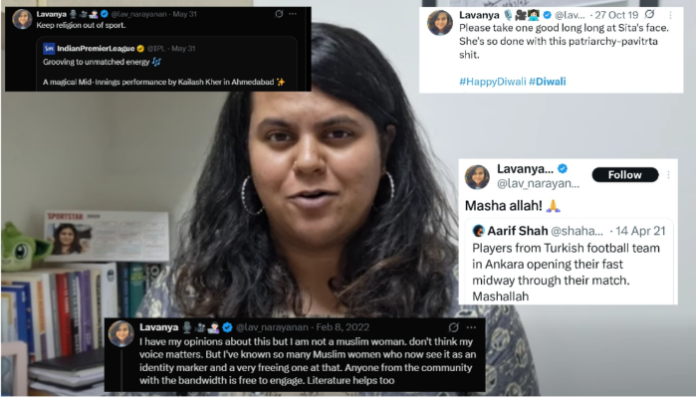
The Hindu journalist Lavanya Narayanan objected to Kailash Kher’s Shiva themed IPL finale performance.
Old posts showed her praising Roza during sports events and Eid broadcasts.
Her remarks on burqa, hijab, Sita and patriarchy triggered backlash over alleged anti Hindu bias.
writes @willofvalhalla
https://t.co/WUsyDvyQtb
Look at what the currently bumbling Education Ministry has to deliver:
- NEP, private university regulation, IoE issues
- AICTE/UGC issues
- CBSE/NEET and other exams.
- On top of this: textbook wars of ideological importance
Can Dharmendra Pradhan deliver ALL this? Any ONE minister?
The alternative question you have to ask is: is the minister the only person of political orientation you can appoint to run the place?
Why not develop a class of political operators? Those with political loyalty to party, with managerial/operational competence, someone who can navigate courts, govt and bureaucracy. Basically, get things done and ENSURE NO GOOF UPS HAPPEN (like UGC rules) and corruption are held at bay.
A team of 15-20 to assist the minister but not "PA to Minister" types - rather, imagine a solid team of professionals.
Given the diversity of issues that need to be handled well, given the sheer amount of work and coordination and ideological clarity needed, why not add massive executive bandwidth to the system? This is true across ministries - there are simply not enough party-loyal professionals who can assist the ministers/govt. Why not open the door?
We did a short review of how this political operator class works across the world and the crucial role they play in getting things done. Do read.
https://t.co/x1iiuS8DvH
Everyone is completely right to hate Gautam Adani. He is a terrible entrepreneur.
Instead of doing real business like importing ₹50 plastic electronics from China, slapping a minimalist logo on them and burning $50M in VC money to build a revolutionary D2C brand he is just wasting time.
Look at his utterly boring businesses:
• Building massive deep water ports that actually handle global trade.
• Constructing the world's largest renewable energy parks in the middle of a barren desert.
• Taking on brutal, high risk, decades long infrastructure projects that actually require guts and physical execution.
Nobody else in the private sector has the guts to build such heavy infrastructure businesses. If there is anyone in India who can make India a superpower, it is none other than Mr. Gautam Adani.
But how dare he build the physical backbone of an economy?
He has absolutely no vision. If he really wanted to help the economy, he would launch a podcast and sell a cohort based course on productivity.
Difference is clear. Beef eater first surrendered to Muslim invaders, got converted. Then he surrendered to Daal Khor four times in 70 years.
Moral: Beef leads to surrender. Go back to Dal.
Arfa Khanum Sherwani often positions herself as a guardian of journalistic ethics and a champion of women’s rights. Which is why her conversation with Nivedita Menon on love jihad was revealing, but perhaps not in the way she intended.
What began as a discussion about individual choice quickly descended into crude communal stereotypes. The suggestion was that Hindu men are frustrated because Muslim men supposedly have some special appeal to Hindu women that Hindu men do not enjoy with Muslim women. Cue the laughter, the jokes about appearance, and the casual mockery of an entire community of men.
Think about the contradiction. If interfaith relationships are fundamentally about personal autonomy, why reduce them to a competition between religious communities? Why frame it as one side ‘winning’ and the other side ‘losing’?
The contradiction runs even deeper. The exchange was initially framed around the idea that interfaith relationships are simply the result of women exercising their agency. Yet within minutes, the conversation shifted from individual choice to collective outcomes, from personal decisions to communal patterns, from agency to a discussion about which group of men is supposedly more successful in attracting women from another community. If the issue is truly about individual choice, why analyse it through the language of communal success and communal frustration at all?
The irony is hard to miss. In the process of mocking concerns about ‘love jihad’, Sherwani ended up framing interfaith relationships as a competition between religious communities herself. More importantly, she inadvertently echoed a much older prejudice that has existed in sections of Islamist discourse across the subcontinent for generations: the idea that the Hindu is weak, timid, inferior and less capable, while the Muslim is strong, virile and dominant. Variations of this stereotype have been repeated for decades in political, religious and military narratives.
Reality, of course, is less accommodating to such prejudices. India’s armed forces have repeatedly defeated Pakistan despite the latter’s alliances, foreign backing, and strategic advantages at different points in history. Strength, competence, and character are not determined by religion.
The same applies to appearance, attractiveness, and every other stereotype casually invoked in such conversations. Indians and Pakistanis are not separate races. They are people of the same broad civilisational and genetic stock, shaped by geography, family history, region, and climate rather than by religion. There is no Muslim gene for attractiveness, confidence, or masculinity, just as there is no Hindu gene for weakness or timidity. People of every complexion, appearance, and temperament exist in every community.
This is why Sherwani remarks matter. Not because they were offensive, but because they inadvertently exposed a bias that many pretend does not exist. Beneath the language of progressivism and feminism emerged a familiar communal stereotype, one that would have been condemned instantly had the communities been reversed.
For someone who spends so much time identifying prejudice in others, it was a surprisingly unguarded display of her own.
Source: The following clip is excerpted from a podcast published on Arfa Khanum Sherwani’s YouTube channel on 23 February 2026, and shared solely for the purposes of commentary, criticism, analysis, and public discussion.
Kashmir is not a "leftover from history."
History was settled when Maharaja Hari Singh signed the Instrument of Accession in 1947 & Jammu & Kashmir legally acceded to India.
The real unfinished issue is Pakistan's continued illegal occupation of parts of Jammu & Kashmir and China's occupation of Indian territory in Aksai Chin.
Nations violating India's sovereignty don't get to lecture India on Kashmir.
WARNING SIGNAL
Last year, Nayara Energy — one of India’s largest oil-refining companies — received a notice that should have alarmed every policymaker in Delhi. Microsoft informed the company that it might have to discontinue its cloud services, citing US sanctions compliance obligations arising from Nayara’s Russian shareholder, Rosneft. Nayara was operating within Indian law. Its refinery is on Indian soil. But the digital infrastructure on which it ran its operations was leased from a company headquartered in Redmond, Washington — and was, therefore, subject to American law. The threat was not ultimately executed, but India had just glimpsed what digital dependence looks like when geopolitics turns hostile. https://t.co/SnhzKlRNTu
Exams are the primary segue of social mobility in India, at least for the middle/lower middle classes. Wholesale gaffes in conduct of 2 critical exams, and no heads roll? Whither accountability?
Murder accused in the Surya Chouhan case, Mohammad Asad, was killed in a police encounter in Uttar Pradesh.
But before that happened, everyone should know what happened just two days earlier.
Surya Chouhan was friends with Asad, Javed, Sameer and Aqif. They were all teenagers between 15 and 17 years of age.
They played together. Watched movies together. Shared years of friendship.
On Eid, Surya was invited to their home. He was asked to participate in the slaughter of a goat. Surya refused.
What followed was horrifying.
The Class 11 student was attacked with butcher knives by the very people he trusted. Despite severe injuries, Surya ran nearly 200 metres in a desperate attempt to save his life.
He could not make it.
A 15 year old boy was killed in broad daylight by those he considered his friends.