THE NEURON ECONOMY IS ALREADY OPERATIONAL
Most people still think the economy runs on money, labor, or data. That model is outdated.
What’s actually being optimized now is human cognition — attention, decision-making, impulse control, memory, and intention.
The scarce resource is not capital. It’s neuronal bandwidth. Every scroll, notification, recommendation, and prompt is competing for one thing: your nervous system’s limited capacity to process meaning. This is the Neuron Economy!
Here’s what’s happening: Platforms no longer sell products first. They sell states of mind. Algorithms do not optimize for truth or utility. They optimize for engagement persistence. AI systems amplify this by personalizing stimulus at the level of individual cognition. This creates a subtle shift most people miss. When attention becomes the primary input, agency quietly degrades.
You still feel like you’re choosing, but the choice architecture has already been shaped. You still feel autonomous, but your cognitive load is externally managed. That’s not dystopian fiction. It’s operational reality.
The Neuron Economy doesn’t require coercion. It works through convenience, reward loops, and predictive modeling. Once cognition is intermediated, intention becomes negotiable. Once intention is negotiable, behavior becomes programmable.
This explains why:
Burnout feels constant.
Focus feels fragmented.
Motivation feels externally driven.
Time feels compressed.
Most discussions stop at “attention economy.”
That framing is incomplete.
Attention is just the surface layer.
The deeper layer is neural energy allocation across competing systems.
The open question isn’t whether this economy exists. It’s whether individuals will learn to recognize when their neurons are being spent, and by whom.
Because in this economy, what you fail to govern internally will be governed externally.
The next phase isn’t louder content. It’s cognitive sovereignty.
🔔 Follow @soultechsage for more updates on The Neuron Economy and more.
The correct frame is the clockmaker → screw → watchmaker → industrial parts ecosystem pattern.
The screw was a small component, yet once it became standardized and mass-produced, it allowed precision machines to scale.
The same pattern is forming now.
The new “screws” are: tokens, embeddings, context windows, inference calls, model weights, MCP endpoints, tool schemas, evals, audit logs, identity credentials, payment mandates, GPUs, cooling systems, power contracts, and data pipelines
When a civilization creates a new technical primitive, labor reorganizes around it.
you'll have to accept the neuron economy for what it is
everything begins and ends with the neuron
& every time someone offloads their cognition to a machine, it dehumanizes all of humanity
MIT's Nobel Prize-winning economist proved that AI is mathematically guaranteed to destroy human knowledge.
They published a massive NBER paper modeling the long-term impact of AI on human cognition.
And they found the most alarming conclusion in the AI literature so far.
It’s called "Knowledge Collapse."
Here is how human progress actually works.
When you struggle to solve a complex problem, you generate two things:
General knowledge about how the world works, and context-specific knowledge about your exact problem.
Normally, humans acquire both at the same time. You do the hard work to solve your specific problem, and in the process, you learn a general principle.
You share that principle. That is how human knowledge grows.
Then comes Agentic AI.
AI is incredibly good at giving you the exact, context-specific answer you need right now. It hands the solution to you on a silver platter.
So you stop doing the hard work.
And because you stop doing the work, you stop generating the "general knowledge" that society relies on.
Acemoglu calls it the "knowledge-collapse equilibrium."
When AI reaches a certain accuracy threshold, the incentive for humans to learn drops to zero.
Nobody verifies. Nobody explores. Nobody discovers new fundamental truths.
Society gets increasingly sophisticated automated outputs, while our actual capacity to generate new knowledge quietly erodes.
But here is the most terrifying finding in the paper.
Welfare is "non-monotone" to AI accuracy.
That means as AI gets more accurate, society actually gets worse off.
These are not peripheral parts. In cybernetic terms, they are the effectors—the muscles and joints that translate signals into physical action and close the feedback loop.
Without reliable, cheap, high-torque, low-backlash actuators, the entire sensing–action loop stays slow, expensive, or brittle.
Key cybernetic risks and dynamics
Fragile feedback speed at scale
The most powerful inventions accelerate civilization’s correction loops.
Humanoids promise instant physical scaling (pick, carry, assemble, inspect 24/7 with rapid iteration).
But supply concentration creates negative feedback delay—geopolitical shocks, export controls, or price spikes in rare-earth magnets (already pressured by EVs + wind + robotics) act as massive lag in the system.
The loop between “AI software improves → demand for bodies surges → hardware supply chokes” becomes unstable.
We get boom–bust instead of smooth exponential embodiment.
Control surface captured upstream
Robot makers (Tesla, Figure, etc.) compete on integration and software, but the real margins and leverage sit with the component monopolists (magnets, gearboxes, rare-earth processing).
This is classic cybernetic power shift: control moves to whoever owns the lowest-level actuators and materials.
The “nervous system” of the robot economy is being wired through a narrow set of nodes. Whoever controls those nodes controls the tempo and direction of physical automation.
Embodiment and Neuron Economy distortion
Humanoids will rewrite human posture, labor rhythms, sensory experience, and agency at population scale.
If the hardware layer remains fragile and China-centric, deployment slows or becomes geopolitically gated.
That delays (or skews) the very nervous-system upgrade your thread describes: humans outsourcing more and more physical loops to machines.
The danger is a half-realized transition—enough robots to disrupt labor markets and attention patterns, but not enough redundancy or sovereignty to make the new embodiment stable and broadly distributed.
Perception vs. actuation asymmetry (the software escape hatch)
That’s pure cybernetics—internal model feedback and predictive control reducing reliance on perfect hardware sensors.
? The open question is whether software can also compensate for actuator limitations (e.g., coarser motors + advanced compliance control, learning-based torque estimation, or entirely new soft-robotics paradigms).
If it can, the Neuron Economy prize goes to the teams that treat actuators as a solvable control problem rather than a fixed hardware constraint.
Strategic cybernetic takeaways
Build redundancy and variety into the loop (Ashby’s Law of Requisite Variety): The system needs enough diversity in actuator tech, materials, and manufacturing geography to absorb shocks.
Single-source magnets or harmonic drives reduce the whole civilization’s regulatory capacity. Make the invisible visible early: Right now the actuator bottleneck is still “visible” to insiders.
The real risk is when humanoids become infrastructure—then the supply dependencies train entire economies and bodies without anyone noticing the leverage points.
Accelerate the software–hardware co-evolution feedback: Treat the entire robot as a learning control system. The faster software can compensate for hardware imperfections (and vice versa), the faster we close the loop toward abundant embodiment.
https://t.co/XL5Gi78A47
McKinsey just mapped the supply chain bottlenecks for humanoid robotics and everyone is focused on the wrong thing.
The real story is not that actuators and sensors are the bottleneck, that is obvious. The real story is what happens next.
🧵 Some thoughts and keys:
1. NdFeB magnets (neodymium iron boron) are in every single rotary actuator inside these robots. China controls ~90% of global rare earth processing. This means Beijing has a kill switch on the entire Western humanoid robotics industry before it even starts. The next chip war is not chips. It is magnets.
2. Harmonic drives and cycloidal gearboxes are precision components with maybe 3 serious manufacturers globally. Harmonic Drive Systems (Japan) has near monopoly status. One earthquake, one export restriction, and the entire sector stalls. Nobody is pricing this risk.
3. The EV industry already burned through this playbook. Battery bottlenecks, magnet shortages, supply chain concentration in China. Robotics is about to replay the exact same movie 5 years later and most investors are acting like it is a new plot.
4. Here is my contrarian take: the winners will not be the robot companies. The Teslas and Figures of the world will compress margins fighting each other on the finished product. The real margin will sit with component monopolists nobody has heard of yet. Just like $TSM prints while phone brands race to the bottom.
5. Sensing and perception is labeled "high risk" but I think this is where AI flips the script. Software defined sensing (using cheaper cameras + AI models instead of expensive LiDAR arrays) could collapse this bottleneck faster than anyone expects. Whoever cracks that eats the entire sensor supply chain.
6. One more: if humanoid robots scale to millions of units, NdFeB magnet demand will compete directly with EV motors and wind turbines for the same limited supply. Three industries fighting over one material. That is not a bottleneck, that is a price explosion waiting to happen.
7. The picks and shovels play for robotics is not even public yet. Most of these companies are Japanese, German, or Chinese industrials trading at 12x earnings while "AI" stocks trade at 50x.
The asymmetry is insane.
Neuron Economy ranking system
When looking at any invention, score it by asking:
How much does it alter attention?
Low: tool sits in the background.
High: tool changes what people notice all day.
How much does it alter agency?
Low: human remains fully in charge.
High: system nudges, predicts, automates, or constrains choices.
How much does it alter trust?
Low: old institutions stay intact.
High: new verification layer replaces older authority.
How much does it alter embodiment?
Low: no major effect on the body.
High: changes sleep, posture, nervous system, labor, movement, or sensory experience.
How much does it alter civilization’s feedback speed?
Low: slow feedback.
High: instant correction, instant reaction, instant scaling.
The clean thesis
From a cybernetics perspective, inventions are feedback-loop upgrades.
From a Neuron Economy perspective, inventions are nervous-system interventions.
The most powerful inventions are the ones that become invisible. Once they become infrastructure, people stop seeing them as inventions and start experiencing them as reality.
That is the real danger and opportunity. The invention disappears into the environment, then the environment trains the mind.
THE NEURON ECONOMY IS ALREADY OPERATIONAL
Most people still think the economy runs on money, labor, or data. That model is outdated.
What’s actually being optimized now is human cognition — attention, decision-making, impulse control, memory, and intention.
The scarce resource is not capital. It’s neuronal bandwidth. Every scroll, notification, recommendation, and prompt is competing for one thing: your nervous system’s limited capacity to process meaning. This is the Neuron Economy!
Here’s what’s happening: Platforms no longer sell products first. They sell states of mind. Algorithms do not optimize for truth or utility. They optimize for engagement persistence. AI systems amplify this by personalizing stimulus at the level of individual cognition. This creates a subtle shift most people miss. When attention becomes the primary input, agency quietly degrades.
You still feel like you’re choosing, but the choice architecture has already been shaped. You still feel autonomous, but your cognitive load is externally managed. That’s not dystopian fiction. It’s operational reality.
The Neuron Economy doesn’t require coercion. It works through convenience, reward loops, and predictive modeling. Once cognition is intermediated, intention becomes negotiable. Once intention is negotiable, behavior becomes programmable.
This explains why:
Burnout feels constant.
Focus feels fragmented.
Motivation feels externally driven.
Time feels compressed.
Most discussions stop at “attention economy.”
That framing is incomplete.
Attention is just the surface layer.
The deeper layer is neural energy allocation across competing systems.
The open question isn’t whether this economy exists. It’s whether individuals will learn to recognize when their neurons are being spent, and by whom.
Because in this economy, what you fail to govern internally will be governed externally.
The next phase isn’t louder content. It’s cognitive sovereignty.
🔔 Follow @soultechsage for more updates on The Neuron Economy and more.
8. Robotics / drones / autonomous systems
These are embodied control systems.
Cybernetically, robotics closes the loop between sensing and action in physical space. A robot perceives, calculates, moves, corrects, and repeats.
Drones are especially important because they extend perception and force into the sky. They turn distance into interface. They also make warfare, agriculture, inspection, surveillance, mapping, and delivery more automated.
Neuron Economy effect: humans outsource perception, risk, labor, and sometimes violence. The body’s limits matter less when machines can sense and act for us.
The deeper insight: robotics gives algorithms hands, wheels, wings, and weapons.
Key Features of Grok Build: A Terminal-First Coding Agent by xAI (in BETA)
Feature Description / Why It Matters
Multi-Agent / Sub-Agents
Can spin up to 8 parallel agents working on different parts of a task
Handles complex, large projects faster by dividing work
Plan → Search → Build
Structured 3-stage workflow
More reliable than pure “vibe coding”
Arena Mode
Multiple agents generate solutions; an automated evaluator scores and ranks them
You see the best options instead of one random output
Plan Mode
Dedicated mode where you review/approve the plan before code is written
Gives you control and reduces wasted work
Full Repo Awareness
Reads, edits, and manages files across an entire codebase
Feels like a senior engineer working in your
Grok Imagine Integration
Generate/edit images directly inside the workflow
Useful for UI work, assets, mockups
Plugins & Connectors
GitHub, Gmail, Slack, Notion, Linear, etc.
Can interact with real tools and data
MCP Support
Works with Model Context Protocol - Easy to give it tools and connect to other agent systems
Local-first + Self-hostable
Runs on your machine with git integration
Privacy, speed, and version control friendly
Terminal TUI
Fullscreen terminal interface with mouse support
Stays in your existing developer workflow
How It Compares to Similar Tools
vs Claude Code / Anthropic tools: Grok Build emphasizes parallel sub-agents and Arena Mode (automated competition between solutions). It’s more “multi-agent native.”
vs Cursor: Cursor is editor-first (VS Code fork). Grok Build is terminal-first — many developers who live in the terminal prefer this.
Philosophy: xAI is leaning into agentic workflows (multiple agents + evaluation) rather than just single-shot code generation.
https://t.co/hXCwCNudlB
After 15 years of investing, we realised that truly exceptional founders have something impossible to fake: deeply unconventional lives.
We analysed 15,000 founders using five binary signals to measure this: odd hobbies, early signs of exceptionalism, extreme life choices, unusual geographies, non-linear careers. These sum to give a 0-5 score per founder. Whether someone started coding at 10, speaks five languages, climbed Everest or quit a safe job to live in Chile, the signal was deviation from the mean.
Rather than focusing on IQ or EQ, we call this metric the Outlier Quotient, or “OQ”. When forecasting founder success, it turns out that OQ was the single most predictive variable in our entire classification model, trained on ~70 different factors.
Our OQ score had zero correlation with having worked at a top-tier company or attending an elite university. The signals most VCs rely on aren’t just noisy, they’re blinding. The best founders don’t signal like everyone else, they don’t think like everyone else, and they certainly don’t build like everyone else.
If you want to spot breakout talent before the rest of the market, stop screening for conformity. Back the founders the system was built to filter out.
🚨 THE ENTIRE AI BOOM MIGHT BE BUILT ON FAKE REVENUE.
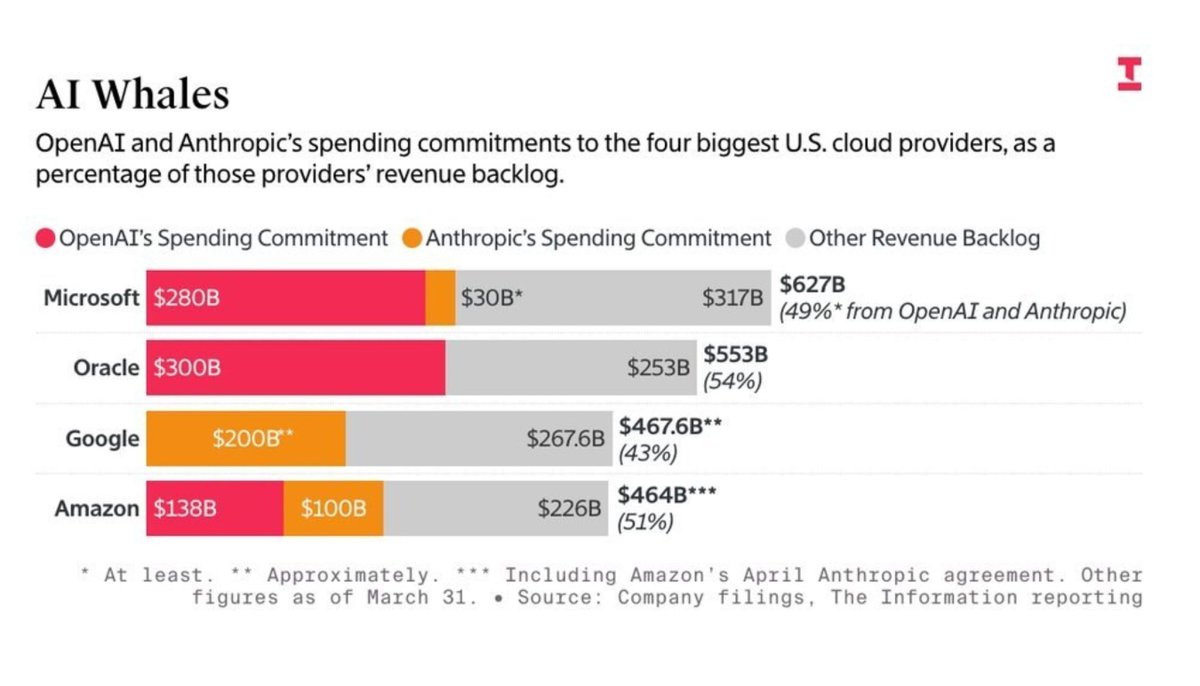
Latest corporate filings show that OpenAI and Anthropic alone make up over half of the entire $2 trillion future cloud backlog held by Microsoft, Oracle, Google, and Amazon.
This massive pipeline is actually being created through a circular accounting trick called a round trip revenue loop.
But how it works ?
A tech giant gives billions of dollars to an AI startup as an "investment". But hidden in the contract is a strict rule forcing the startup to hand that exact same money straight back to the tech giant to rent their computer servers.
Look at the documented case of Microsoft and OpenAI.
When Microsoft invested $13 billion into OpenAI, it didn't just give them cash; it gave them "cloud credits" to use Microsoft servers. OpenAI used those exact credits to train its AI models, and Microsoft then turned around and recorded that server usage as brand new "cloud revenue" from a customer.
The tech giant is literally paying itself with its own money and calling it a sale.
This is why OpenAI’s annual cloud bill has ballooned to over $60 billion, double its actual revenue of $25 billion, kept alive solely by this recycled funding loop.
Anthropic runs the exact same play, spending $2.66 billion on Amazon Web Services in just nine months, which was basically 100% of all the money it earned at the time.
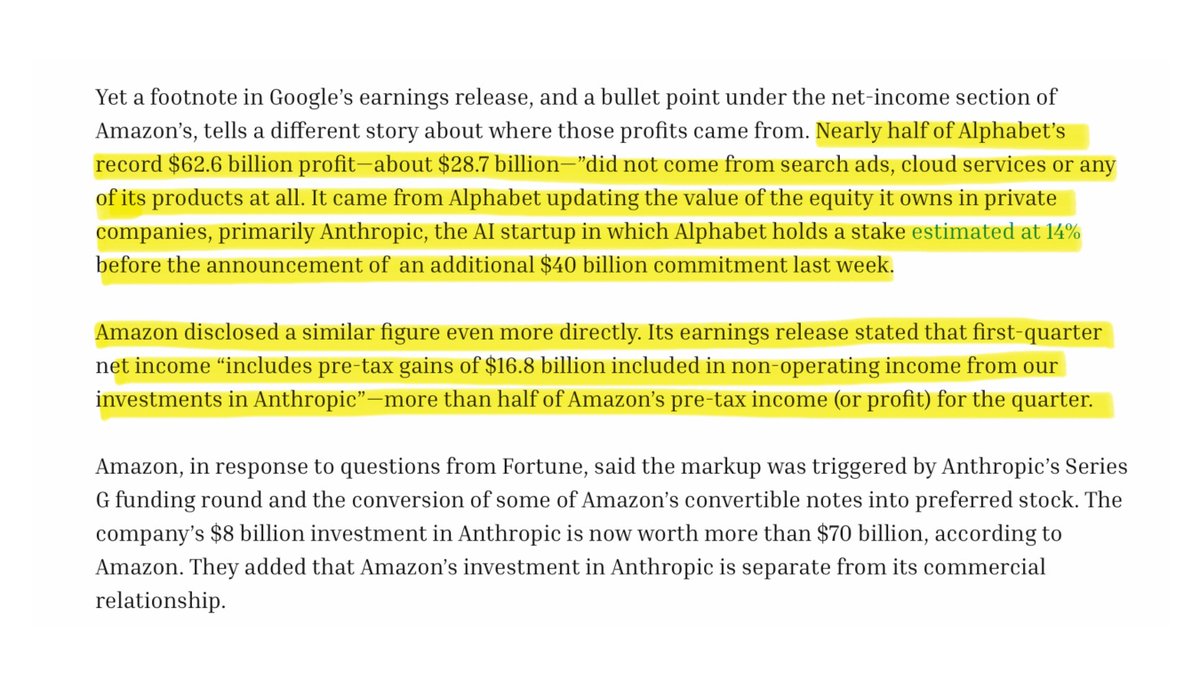
This manufactured demand triggers a second accounting trick where tech giants book massive paper profits. Every time a startup gets a higher value from a new funding round, the tech giant updates the value of its investment on its books and counts that unearned paper gain as direct profit.
In Q1 2026, Alphabet reported a record $62.6 billion profit, but $28.7 billion nearly half, was just a paper markup on its Anthropic investment. In the same quarter, Amazon reported $30.3 billion in profit, but $16.8 billion of it was just an Anthropic paper gain.
While Amazon reported record profits, its actual free cash flow collapsed 95% to just $1.2 billion because it had to spend $44.2 billion in real cash to build physical data centers.
This has created a massive danger where these giant companies rely heavily on just one or two unstable startups. Microsoft has 49% of its $627 billion future backlog tied to OpenAI, while Oracle has an incredible 54% of its entire $553 billion pipeline relying on OpenAI alone.
This perfectly mirrors the 2001 dot-com crash when Global Crossing and Qwest Communications swapped identical fiber-optic network capacity with each other just to book fake sales.
Qwest had to erase $1.4 billion in fake income, and Global Crossing went completely bankrupt.
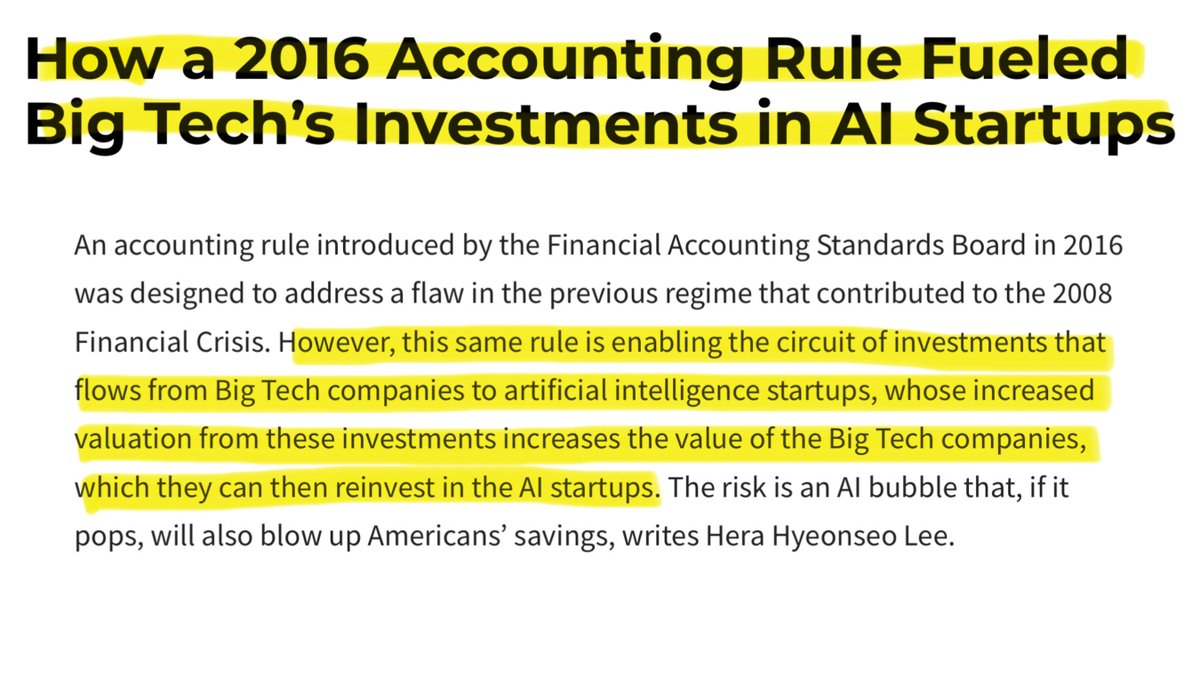
The only difference is that the dot-com swaps were illegal, but today's AI loop is fully legal under current accounting rules.
This legal loop inflates tech company stock prices, forcing automatic retirement accounts and index funds to buy even more of these tech stocks. It is a self feeding loop where investments, sales, and stock prices all go up on paper without the AI technology ever making real cash profits.