Netaji Subhas Chandra Bose knew- Sanskrit, Bengali, Hindi, German, English, Urdu, & Hindustani. He was a linguist- but he took his 'INDIAN CIVIL SERVICE' examination in English as that was the language used for this examination. I wonder who has given such wrong information to Prime Minister- @narendramodi. Such distortions in history should be avoided. Jai Hind! @VinodSharmaView@htTweets@EduMinOfIndia@SuparnoSatpathy@NaveenBamel3
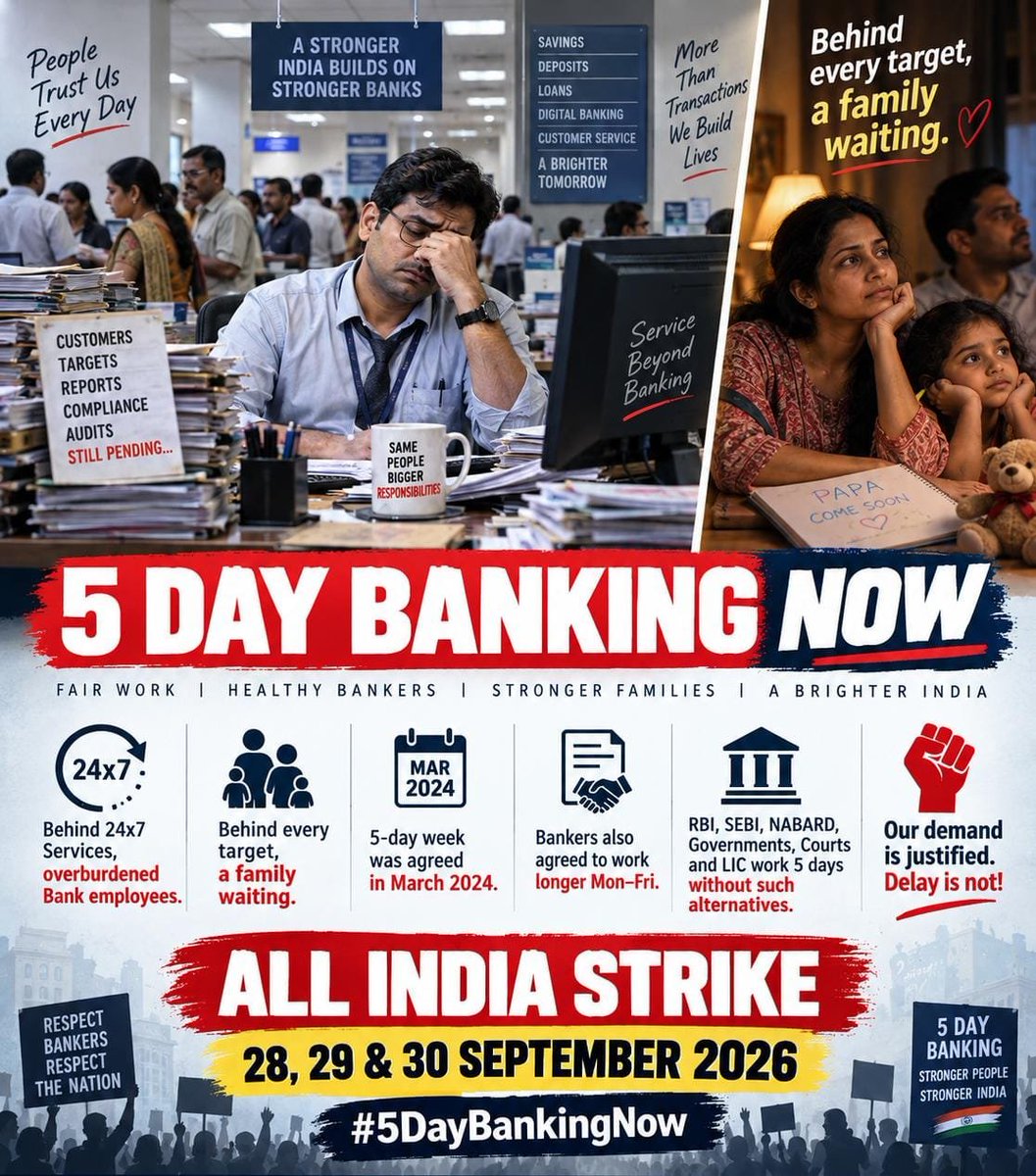
The forthcoming strike on 28-30 September is to reaffirm the demand for the 5-day week agreed upon in 2024. #5DayBankingNow#AIBOC@PMOIndia https://t.co/k6cuhbeKjh
8.86 lakh employees in 2012-13.
7.58 lakh by March 2025.
Business past Rs 283 lakh crore.
Record profits, over a lakh fewer hands and still six day per week.
5 day banking is not a concession. It is arithmetic that caught up long ago
#5DayBankingNow@DFS_India@ANI
Bankers keep India connected 24×7.
But behind every transaction, target and deadline is a human being, with a family, responsibilities and a life beyond the branch.
A 5-day week was agreed in March 2024, with bankers accepting longer working hours from Monday to Friday.
The demand is reasonable. The commitment is proven. The delay is difficult to justify.
Implement 5-Day Banking now.
@PMOIndia@narendramodi@FinMinIndia@nsitharaman@DFS_India
#5DayBankingNow
An agreement must be honoured. A reward system must be fair.
#5DayWeekandFairPLI
The 5 Day Work Week for bank employees was agreed in the Bipartite Settlement of March 2024. Its implementation cannot remain pending indefinitely.
At the same time, a unilateral and discriminatory PLI framework that divides the workforce must give way to a fair, transparent and inclusive system for all employees.
Every achievement of our banks is the outcome of collective effort.
Recognition too must reflect that collective contribution.
We seek no privilege, only implementation of an agreed commitment, equality in reward and dignity at work.
@PMOIndia
And finally, the PM CARES numbers have arrived.
The Fund had ₹8,452 crore at the end of 2024-25.
What did it spend? ₹88 lakh.
The rest, it seems, had a very comfortable year in fixed deposits.
@Jahnavi_R reports.
https://t.co/8li7Qr579d
मैं सरकारी प्रेस कॉन्फ्रेंस में आईं सभी ऑटो कंपनियों को चिट्ठी लिखूँगा, कि वे लिखित में अपने ग्राहकों को यह आश्वासन दें कि गाड़ी में E20 इस्तेमाल करने पर यदि—
1) माइलेज 10% से ज़्यादा गिरता है, तो कंपनी उसकी भरपाई करेगी।
2) गाड़ी का कोई भी पार्ट डैमेज होता है, तो कंपनी उसे मुफ़्त में रिप्लेस करेगी।
अगले हफ़्ते मैं प्रधानमंत्री जी को भी चिट्ठी लिखूँगा और पूछूँगा कि अगर किसी की गाड़ी में कोई भी दिक्कत आती है, तो उसका हरजाना आप देंगे या कंपनी देगी?
When TMC was down to 1 MP and 30 MLAs in 2000s, Madan Mitra would gather few partymen most evenings, take out a procession in Bhabanipur against CPM. He was sidelined when TMC was in power. Today, when most leaders have vanished, he's still on road. That's what loyalty looks like
@gullykagunda@abhishekaitc How was tampering and intimidation happening in just one constituency throughout when there was adequate forces to ensure free and fair elections in the state? (which apparently happened)
From homes to hawker stalls, the poor are paying the price of political arrogance. Bengal does not believe in bulldozer politics. The land of Tagore and Netaji cannot be ruled through fear, force, and demolition drives against ordinary citizens.
What we are witnessing today is an attack on the dignity of the people of Bengal- daily wage workers, street vendors, small shopkeepers, and struggling families who have built their lives brick by brick. The massive eviction drive around Howrah Station, the unrest and anger erupting on the streets of Tiljala and Park Circus, and the growing desperation among those suddenly stripped of shelter and livelihood expose a government more obsessed with optics than humanity.
A government that demolishes first and listens later has forgotten the very spirit of Bengal. Real progress is measured by how a state treats its weakest citizens, not by how quickly it can erase them.
Bulldozers cannot become the language of governance in a state built on culture, compassion, and resistance to oppression.
Dear President @realDonaldTrump
Greetings.
As a Member of Parliament from India, I write in response to reports of your congratulations to PM Narendra Modi on the West Bengal Assembly election results.
These are state-level elections—an internal matter of India’s federal democracy. Any external endorsement appears premature and misplaced.
More importantly, serious concerns have emerged. Numerous complaints allege an atmosphere of fear, intimidation, and systemic pressure. There are widespread perceptions that the Election Commission did not act impartially and that its functioning appeared to favor the BJP, raising questions about institutional neutrality.
Equally troubling are allegations regarding the extensive deployment of central forces, which many believe created coercion rather than confidence.
Senior leaders, including Mamata Banerjee, have publicly raised concerns about the fairness of the process. These reflect a broader unease that cannot be ignored.
Democracy is not just about elections—it is about ensuring they are free, fair, and credible. When serious allegations arise, they warrant scrutiny, not celebration.
Were these concerns considered before your statement?
Given your emphasis on democratic values, I urge a more informed and balanced view.
Thank your very much
My exit poll! As I leave #Bengal, it would be a disservice not to say this: I have come to deeply admire the way women inhabit space here. There is a quiet, almost subconscious elevation of women as independent beings . something that stands in stark contrast to the entrenched misogyny that still finds resonance across much of northern India. Perhaps it stems from a cultural understanding of shakti. A form of empowerment that manifests here in ways both subtle and profound, unlike anywhere else in the country, even in the south.
Any woman journalist who has covered political rallies across India will recognize the difference immediately. Other states, a crowd is not just a logistical challenge, it carries risk. the inevitability of wandering hands, the violation masked by chaos. Here, the crowds are no less dense, the air no less heavy with sweat and alcohol—but the hands, for the most part, do not grope. Men step aside to make way. When contact happens, as it inevitably does in chaos, there is visible embarrassment rather than entitlement. What you encounter is not chivalry, but something far rarer: equality. And equality feels far more meaningful. Was never a fan of chivalry in any case :)
There is more. Women politicians across party lines campaign with a striking freedom, aggressive, sharp, unapologetically irreverent, often using what would elsewhere be labelled as ‘masculine’ rhetoric. In most states, such behaviour would invite judgment, even censure. Here, it is met with acceptance, applause. What feels liberating to an outsider is, in Bengal, simply normal. What we frame as empowerment here is a cultural undercurrent.
I have covered four elections in this state, and each time I have returned with the same sense of awe. Bengal, meanwhile, ambles on with a certain bemusement, as if unaware of what sets it apart. But it is a big deal. And perhaps the most remarkable part is that Bengal does not think so.
Governments will come and go. One can only hope that this constant endures, not just how Bengal sees its women, but how, in many ways, it doesn’t. ♥️♥️♥️