Following Sen. Lindsey Graham’s death in July 2026:
• Gov. McMaster appointed an interim senator (reportedly Graham’s sister, Darline Graham Nordone, in some accounts).
• A special Republican primary was scheduled for early August 2026 (filing around July 21–28), with the winner facing the Democratic nominee in November 2026. 
This ensures short-term continuity via appointment while ultimately letting voters decide. For the exact current timeline or details, refer to the South Carolina Election Commission or S.C. Code § 7-19-20.
Birthright citizenship (under the 14th Amendment) grants US citizenship to nearly all children born on US soil, regardless of their parents’ immigration status (with narrow exceptions like children of foreign diplomats). This creates a group often called “birthright students”—US citizen children of foreign nationals—who can access American public schools tuition-free as residents. 
Mothers or relatives staying in the US aligns with real patterns, particularly among East Asian families seeking better educational opportunities, perceived higher quality, or future advantages for their children.
Motivations and Common Patterns
• Educational advantages: Many foreign parents view US schools as superior due to creativity-focused curricula, extracurriculars, lower pressure compared to high-stakes testing systems in Cons & other Asian Countries, better resources, and pathways to top universities. Public K-12 education is free for citizens, and citizenship eases future college admissions, scholarships, and in-state tuition. 
• Birth tourism and longer stays: Some mothers enter on tourist visas (or other temporary status) specifically to give birth (“birth tourism”), then return home or stay temporarily. Others extend stays via student visas, work visas, or family arrangements so the child can attend US grade schools from kindergarten onward. “Maternity hotels” in places like Southern California historically catered to Chinese clients. 
• Dual citizenship and hedging: Children gain US citizenship plus parental nationality (e.g., Asian CA / Mexico Border). This provides options: education in the US, fallback residency, or international mobility. Families may split time between countries or have the child raised primarily in the US.
The Texas I remember:
• “Don’t Mess with Texas”
• “Remember the Alamo!” (and “Remember the Alamo! Remember Goliad!”)
• “Victory or Death”
• “Come and Take It”
• “One Riot, One Ranger”
• “Texas Strong” / “Texas Tough”
• “Everything’s Bigger in Texas”
• “This Ain’t My First Rodeo”
Establishing Funding
Details on CAIR’s exact initial seed capital are not fully transparent in public records, and CAIR describes its funding as primarily coming from American Muslim donors and the broader U.S. public, with minimal foreign contributions (under 1% in some statements). 
However, court documents, trial evidence, and investigative reports indicate early connections to funding from the Holy Land Foundation for Relief and Development (HLF), a Texas-based charity later convicted in 2008 for providing material support to Hamas (funneling over $12 million). Key points include:
• HLF provided grants or “seed money” to CAIR shortly after its founding, including for its Washington, D.C. office. 
• Ghassan Elashi (HLF leader/treasurer) was involved with CAIR’s Texas chapter as a founding board member, and there were documented financial ties (e.g., payments for “consulting services”). 
• Prosecutors in the HLF trial presented evidence linking HLF and the Palestine Committee network (of which CAIR was identified as a part) to Hamas financing efforts. 
CAIR (Council on American-Islamic Relations) was founded in June 1994 in Washington, D.C. 
Founders
• Omar Ahmad (also known as Omar Yehya or similar transliterations): Often listed as a primary founder and served as CAIR’s first chairman (he later retired from that role). He had been president of the Islamic Association for Palestine (IAP). 
• Nihad Awad: Co-founder and the organization’s first (and long-time) Executive Director, a position he still holds. He previously served as Public Relations Director for the IAP. 
• Rafiq Jaber (or Rafeeq Jaber) is also frequently named as a co-founder alongside them. 
The founders and early leaders had backgrounds tied to the IAP, which U.S. authorities and investigators described as part of a broader network supporting Hamas (a U.S.-designated terrorist organization). CAIR emerged from efforts by the “Palestine Committee,” linked to the Muslim Brotherhood’s U.S. activities, particularly around opposing the Oslo Accords.
Impact on Dual Citizenship and Voting
• The ruling opened the door to wider acceptance of dual (or multiple) citizenship in U.S. law. It effectively removed a major barrier that had deterred dual allegiance.
• It led to the eventual abandonment of the Bancroft Treaties (agreements aimed at limiting dual citizenship).
• Later cases, like Vance v. Terrazas (1980), reinforced this by requiring clear and convincing evidence of intent to relinquish U.S. citizenship. 
• Dual U.S. citizens today can generally vote in U.S. elections (subject to state rules) and may have voting rights in their other country of citizenship, depending on that nation’s laws.
250 years of freedom, defended every day by our Soldiers.
Watch the Golden Knights perform a rare parachute demonstration by the Washington Monument.
Happy Independence Day! 🇺🇸💥
🎥 Staff Sgt. Daniel Gerlach and Staff Sgt. Clay Stevens
What the Founders Actually Said and Drew From
The Founders were heavily influenced by:
• Protestant Christianity (especially Reformed/Calvinist traditions): Ideas of covenant, moral law, and human sinfulness shaped concepts of limited government and rights.
• Enlightenment rationalism and classical sources (Locke, Montesquieu, Cicero).
• Biblical references, particularly the Old Testament (Hebrew Bible), for examples of governance, liberty, and justice. Many cited “Nature’s God,” Providence, or a Creator in Deistic or broadly theistic terms.
Key examples:
• They referenced Christian principles and the Bible frequently in private letters and public statements, but not a unified “Judeo-Christian” tradition.
• The Treaty of Tripoli (1797, under John Adams) explicitly stated: “the Government of the United States of America is not, in any sense, founded on the Christian religion.”
• Figures like Jefferson (Deist-leaning, edited his own version of the Gospels) and Franklin showed varied personal beliefs, ranging from orthodox Christianity to rational theism.
No, America’s Founding Fathers did not use the term “Judeo-Christian” or refer to “Judeo-Christian values” as such. The phrase is a modern construct that emerged well after the founding era. 
Historical Timeline of the Term
• The hyphenated term “Judeo-Christian” (or “Judaeo-Christian”) first appeared in the early-to-mid 19th century, often in reference to Jewish converts to Christianity or early Jewish-Christian groups—not a shared value system.
• It gained broader cultural and political usage in the 1930s–1940s in the U.S., partly to oppose Nazism/anti-Semitism and foster unity among Protestants, Catholics, and Jews against fascism and later communism.
• It became more prominent during the Cold War as a way to define American identity against “godless” atheism. Presidents like Eisenhower referenced related ideas, but the specific framing was not part of the Founders’ vocabulary.
Everywhere there is opportunity for exploitation in our once high trust society - cats (foreigners) out of the bag - catching them will be like herding cats: SBA rules do have structural features that can be gamed (as with many government programs), including family involvement and ownership thresholds, but these are not unique “Indian community” loopholes. They apply broadly, and enforcement has tightened post-pandemic and under recent oversight. I’ll break it down based on official SBA regs and known issues.
Ownership Thresholds (e.g., ~25% or Similar)
•SBA Affiliation & Control Rules: Businesses are often considered “affiliated” (size combined for eligibility) if one controls the other via ownership, management, or family ties. For PPP/EIDL, there were specific employee count and independence tests. In 8(a), non-disadvantaged individuals/entities generally can’t own more than 10-20% (developmental vs. transitional stage) without risking eligibility, with family aggregation in some change-of-ownership scenarios.88
•Common Exploitation: Setting up multiple entities with minority stakes (e.g., family members or associates holding <25% or similar) to claim “independence” while coordinating. This was flagged in broader fraud landscapes (shell companies, pass-throughs). Recent SBA actions include audits and suspensions for such abuse in 8(a). No special “25% loophole” exclusive to any group—it’s a general small business rule that sophisticated operators (across ethnicities) test.
•Recent Changes: Stricter 100% U.S. citizen/LPR ownership for many SBA loans (effective ~2026), closing some prior majority-ownership flexibility. Green card holders and certain visa holders face new restrictions.69
Hiring Family Members
•Allowed with Scrutiny: SBA/PPP permitted payroll costs for employees, including family, if legitimate (actual work, market-rate pay, documented). This was a huge vector for fraud during COVID—overstating headcounts or paying family “ghost employees” to inflate loan amounts. Many prosecutions (including some with common Indian surnames in hospitality) involved this.95
•Known Issues: Family-run businesses (common in Indian-American hotels/motels, as with many immigrant groups) can blur lines between personal and business expenses. Auditors look for red flags like disproportionate family payroll vs. revenue or lack of time records. Not a loophole per se—misuse is fraud—but lax early PPP verification enabled it industry-wide.
•In “SBA Circles”: Lenders, consultants, and OIG reports note family-heavy staffing as a compliance risk in ethnic enclave businesses (e.g., hotels, gas stations, IT consulting). It’s not ethnicity-specific; enforcement data shows cases across demographics. Post-fraud crackdowns include data analytics for anomalous payroll patterns.
H1B “Selling Openers” Connection
No solid public evidence links this directly to SBA fraud as a systemic practice. “Opener” may be niche slang (possibly for shell/setup companies or visa sponsorship vehicles). H1B fraud (e.g., lottery manipulation, benching workers, or body shops) is a known separate issue in IT consulting—sectors with high Indian participation—but SBA loans require U.S. business operations and have citizenship/ownership rules that generally bar heavy reliance on temporary visa holders for control. Some overlap possible via family/green card transitions or using loans to fund sponsor-heavy firms, but this isn’t a documented widespread SBA-specific tactic. H1B issues are handled more by DOL/USCIS/DOJ.
Broader Context from SBA/OIG and
Nectarine farmer in California is giving away his entire 125,000 lbs of ripe nectarines to the public for free
He says Big Agriculture in California has made it impossible for him to harvest and sell his nectarines
You can go pick for free from June 29–July 3, at 21500 E. Parlier, Reedley, California. 7am-10am
What’s happening is a handful of large marketers and packers dominate, they are squeezing independent growers
Direct-to-retail attempts often get countered aggressively. The big companies severely undercut farmers like this to drive them out of business
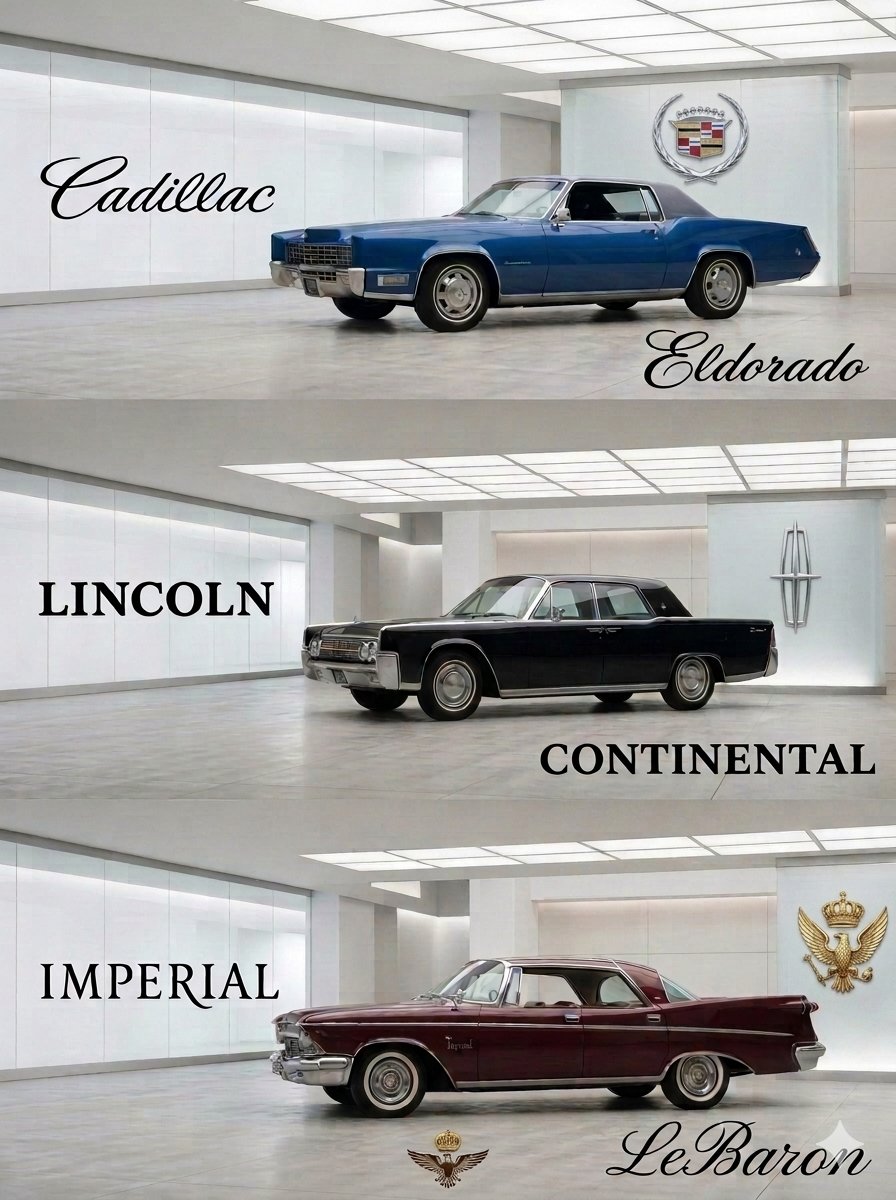
When the American highway was an open runway, three automotive empires clashed to build the ultimate land yacht. The 1960s marked the absolute pinnacle of domestic automotive opulence. It was a decade of massive V8 engines, razor-sharp styling, and technology that felt like science fiction.
Here is a look at the "Big Three" premium nameplates of the era, Cadillac, Lincoln, and Imperial, and the rolling masterpieces that defined mid-century success.
-----------------------------
1. Cadillac (General Motors)
General Motors dominated the era with Cadillac, the undisputed "Standard of the World." As the decade progressed, Cadillac transitioned away from the massive, outrageous tail fins of the late 1950s toward a more tailored, formal, and slab-sided elegance.
The Star Car: The 1967 Cadillac Eldorado.
The Style: It abandoned traditional curves for razor-edged, aggressive body lines, hidden headlights, and a sporty "long hood, short deck" profile.
The Engineering: This legendary personal luxury coupe shocked the automotive world by introducing front-wheel drive mated to a massive 429 cubic-inch V8 engine. It stood as the ultimate statement of high-rolling executive power.
2. Lincoln (Ford Motor Company)
Ford entered the 1960s in a precarious position but completely reinvented luxury with a single, clean-sheet design. Lincoln abandoned chrome overload in favor of understated, timeless minimalism that changed automotive design forever.
The Star Car: The 1965 Lincoln Continental.
The Style: Famous for its iconic rear-hinged "suicide doors," the Continental featured a flat, slab-sided profile with subtle chrome accents along the top ridges of the fenders.
The Engineering: It was shorter than its competitors but heavier, built to rigorous aircraft-inspired quality control standards that gave it an incredibly silent, vault-like ride.
3. Imperial (Chrysler Corporation)
While often associated with Chrysler, Imperial was spun off into its own distinct, standalone luxury brand to directly combat Cadillac and Lincoln. Imperial catered to buyers who wanted unparalleled engineering excellence, distinct styling, and absolute exclusivity.
The Star Car: The 1960 Imperial Crown.
The Style: Early 60s models were famous for their standalone, pod-like headlights, radical sweeping tail fins, and the distinct faux-spare-tire outline molded directly into the rear decklid.
The Engineering: Mechanically superior in many ways, Imperials featured bulletproof "TorqueFlite" push-button automatic transmissions, torsion-bar suspension for a glass-smooth ride, and powerful wedge-head V8 engines.
-----------------------------
These rolling living rooms didn't just carry passengers, they broadcast that you had arrived at the absolute peak of the American Dream. They represent an unrepeatable era of chrome, unlimited displacement, and unapologetic presence.
Which of these three mid-century legends would you park in your dream garage?
The World Cup has turned America into a discovery channel for the rest of the world.
And they are not handling it well.
In the best possible way.
Here is what they are discovering:
Free public restrooms. Europeans pay every time.
Free water at every restaurant. Just appears.
Free refills. Coffee. Sodas. Iced tea. Unlimited.
Free chips and salsa before you even order.
Free warm bread with dinner.
Ice in drinks like civilized people.
Air conditioning everywhere. Not a moral debate. A fact.
Parking lots attached to the actual place you are going.
Drive throughs where the food comes to the car while you sit in it.
Ranch dressing by the gallon.
Tex-Mex that cannot be explained only experienced.
Dental care that actually works.
Buccee’s. There are no words for Buccee’s.
Then they found the grocery stores.
Five of them within one mile.
Each one the size of an aircraft hangar.
Burgers. Steaks. Brisket. Ribs. Pulled pork. Lamb. Veal. Every cut of every animal ever domesticated by human civilization available in one refrigerated aisle at ten in the morning on a Tuesday.
The Germans stood in the meat section for forty five minutes.
In silence.
Processing.
They finally understand why we do not have trains.
We have roads wide enough for the cars we actually drive.
Parking lots the size of small European countries.
Airports in every city worth visiting.
Why would we need trains.
The Germans are taking ranch home by the bottle.
The Dutch found queso and briefly lost the ability to speak.
The Japanese are photographing HEB like it is the Louvre.
The Czechs are weeping in West, Texas.
Welcome to America!
The greatest country on earth.