chinese physics exam
(30 points) A Tesla flying car demonstration goes through climbing up a wall, leaving the track upside down, righting itself in mid-air, and landing with jet thrusters. The following idealized model is established; all data are set for this problem.
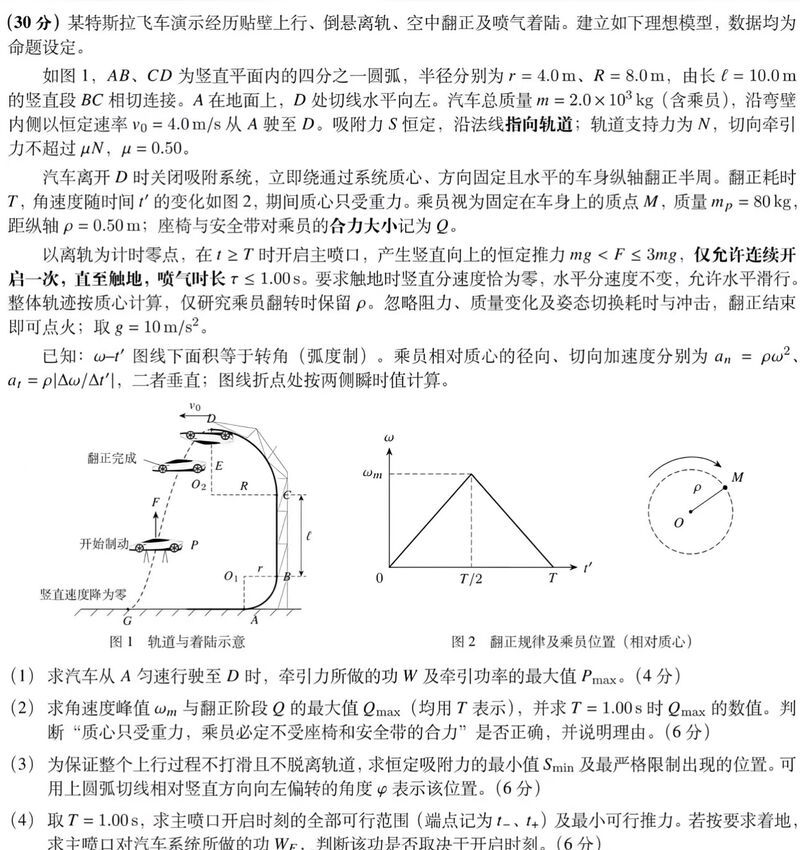
As shown in Figure 1, $AB$ and $CD$ are quarter-circle arcs in a vertical plane with radii $R = 4.0\text{ m}$ and $R = 8.0\text{ m}$ respectively, tangentially connected by a vertical straight segment $BC$ of length $\ell = 10.0\text{ m}$. $A$ is on the ground, and the tangent at $D$ is horizontal and points to the left. The car has a total mass of $m = 2.0 \times 10^3\text{ kg}$ (including the occupant) and drives along the inner side of the curved wall at a constant speed $v_0 = 4.0\text{ m/s}$ from $A$ to $D$. The suction force $S$ is constant and points toward the track along the normal; the normal support force from the track is $N$, and the tangential traction force does not exceed $\mu N$, where $\mu = 0.50$.
When the car leaves $D$, the suction system is turned off, and it immediately rolls half a revolution to right itself around the longitudinal axis of the car body, which passes through the system's center of mass and has a fixed horizontal direction. The righting process takes time $T$, and the variation of angular velocity with time $t'$ is shown in Figure 2; during this period, the center of mass is acted upon only by gravity. The occupant is treated as a point mass $M$ fixed to the car body, with mass $m_p = 80\text{ kg}$, at a distance $\rho = 0.50\text{ m}$ from the longitudinal axis; the magnitude of the resultant force exerted by the seat and seatbelt on the occupant is denoted as $Q$.
Taking the moment of leaving the track as $t = 0$, the main thruster is turned on at $t \ge T$, producing a constant vertically upward thrust $mg < F \le 3mg$, which is only allowed to be turned on continuously once until touchdown, with a thrust duration $\tau \le 1.00\text{ s}$. It is required that at touchdown, the vertical component of velocity is zero, the horizontal component of velocity remains unchanged, and horizontal sliding is allowed. The overall trajectory is calculated according to the center of mass, and $\rho$ is retained only when studying the rotation of the occupant. Ignore resistance, mass changes, and the time consumption and impact of attitude switching; ignition can occur as soon as the righting process is completed; take $g = 10\text{ m/s}^2$.
Given: The area under the $\omega\text{--}t'$ curve equals the angle of rotation (in radians). The radial and tangential accelerations of the occupant relative to the center of mass are $a_n = \rho\omega^2$ and $a_t = \rho\vert{}\Delta\omega / \Delta t'\vert{}$ respectively, which are perpendicular to each other; at the vertices (corners) of the graph, calculate using the instantaneous values on either side.
Diagram Labels:
Figure 1: Schematic of Track and Landing (图 1 轨道与着陆示意)
翻正完成: Righting completed (at point $E$)
开始制动: Braking begins (at point $P$, with thrust vector $F$)
竖直速度降为零: Vertical velocity drops to zero (at point $G$)
Figure 2: Righting Law and Occupant Position (Relative to Center of Mass) (图 2 翻正规律及乘员位置(相对质心))
(1) Find the work $W$ done by the traction force and the maximum traction power $P_{\max}$ when the car drives at a constant speed from $A$ to $D$. (4 points)
(2) Find the peak angular velocity $\omega_m$ and the maximum value $Q_{\max}$ of $Q$ during the righting stage (both expressed in terms of $T$), and find the numerical value of $Q_{\max}$ when $T = 1.00\text{ s}$. Determine whether the statement "Since the center of mass is only acted upon by gravity, the occupant must experience zero resultant force from the seat and seatbelt" is correct, and explain the reason. (6 points)
(3) To ensure that the car neither slips nor detaches from the track during the entire ascending process, find the minimum value $S_{\min}$ of the constant suction force and the position where the strictest constraint occurs. You may express this position using the angle $\varphi$ by which the tangent to the upper circular arc deflects to the left relative to the vertical direction. (6 points)
(4) Taking $T = 1.00\text{ s}$, find the entire feasible range of the main thruster activation time (denote the endpoints as $t_-$ and $t_+$) and the minimum feasible thrust. If it lands as required, find the work $W_F$ done by the main thruster on the car system, and determine whether this work depends on the activation time. (6 points)
Societies don't fall apart because people are wicked. They fall apart because we run very complicated social software on primate hardware.
Civilisation a tough gig if you're made of meat.
When the people who hold the assets take more and more of a society's surplus, the people who do the work get worn down. Careful public argument, the thing that lets a society correct its mistakes, needs spare time, energy and attention. So it's the first thing to go. Exhausted people and comfortable elites fall back on the cheapest way humans have of coordinating: pick an enemy, follow a strongman, build up the military.
And none of us lives long enough to see the pattern. Each generation of elites forgets the last cycle and comes to treat rent-seeking as normal. From archaic Greece to now, wealth concentrates, trust collapses and war follows, again and again.
What's new this century is AI. It doesn't get tired, it doesn't get tribal under stress, and it doesn't forget the last cycle. It can hold centuries of history in view at once and show us the slow patterns our short lives hide.
It won't save us. But it might help us see ourselves in time.
As early as 2014, Pilger presciently warned about the dangers of the U.S. and NATO’s involvement in Ukraine. In a 2014 article in The Guardian titled “In Ukraine, the US is dragging us towards war with Russia”, Pilger exposed how forces were being unleashed by the U.S. and EU in Ukraine, tearing the country apart.
https://t.co/x1XqImG1D7
The US economy is built on dollar value. US nominal GDP leads China ($29.3T vs $18.7T), amplified by services, financial transactions, and $5.3T in healthcare costs.
China’s economy is built on atomic mass and a different order of magnitude entirely:
Raw industrial throughput (China vs US):
• Cement: 21x (1,830 Mt vs 86 Mt)
• Crude Steel: 13x (1,005 Mt vs 80 Mt)
• Manufacturing Value Added: 1.6x ($4.7T vs $2.9T)
• Freight movement: Multi-fold lead (26.2T tonne-km)
China transforms and moves exponentially more matter and that extends directly into agricultural & protein metabolism:
• Aquaculture: 100x+ (53–61 Mt vs ~0.4 Mt)
• Meat output: 2x (97 Mt vs 49 Mt)
• Cereal crops: 1.4x (652 Mt vs 455 Mt)
Calories, protein, and feedstock follow the exact same structural pattern as steel and concrete.
Take away the treatment of occupier owned housing, spending on health services, and the merry-go-around of finance and real estate, its no contest!
Complexity in Human Organisation
Framework Paper:
Human organisation is the coordination system that lets primates who will never meet share skills, surpluses and a common picture of the world. The Complex Adaptive Model of Societies (CAMS) treats that system as a group adaptation to a setting, not as a moral agent. The framework reads a society through eight functions, the Paladins — Helm, Shield, Lore, Archive, Craft, Flow, Stewards and Hands — each carrying two coordinates. Shared symbolic organisation is P=CA, Coherence times Abstraction. Functional headroom is H=K-S, Capacity minus Stress. The pattern of coupling between the Paladins is the society's topology. The Zeitgeist is the readable surface of that topology.
https://t.co/6L6j4R81Ia
Imagine a mind that reads a civilisation as eight coupled processes, without listening to anything the civilisation says about itself. It watches the USA from 2008 onward. The pathology it logs doesn't start with a man. The man comes later and coordinates it.
2008: the Stewards process, which allocates and controls resources, crashes and is patched within two years. The Hands process, labour, takes six. US payroll jobs didn't pass their January 2008 peak until May 2014. The system restored throughput long before it restored fairness. Call it a legitimacy debt.
Distributed grievance doesn't compute anything. It's noise across millions of nodes that never synchronise. Then a signal arrives that compresses it: the system is rigged. Common knowledge forms. Rallies make the count visible, and the noise phase-locks.
In 2016 the campaign captured Helm, the steering function. That didn't repair Lore, the shared story of why the arrangements are legitimate. A subnetwork can lock tight inside itself while the bridges between subnetworks rot. Coherence inside a coalition isn't coherence across a society.
COVID, 2020Q2: Hands scores −1.0 and Stewards 8.0. Both regain their baselines by 2021Q2, and both then fall below them again. Over that year Hands ran 51% further underwater. Getting back to baseline once doesn't mean the system healed.
2025Q1: all eight functions fall in the same quarter, the largest non-pandemic contraction in the file. Gallup puts average confidence in 14 institutions at 27%. Read that as a model warning, not a verdict of collapse. Something synchronised, and the instruments noticed.
Trump didn't make the fracture. He's the attractor the grievances fell into. 2024 showed the grievance machine can survive a defeat and win again.
https://t.co/crGtMEFNWf
Tesla did not invent Wi-Fi, and Becquerel did not invent modern solar panels.
Early photovoltaic devices existed long before today’s solar industry and were used largely as light sensors. Modern Wi-Fi, meanwhile, depends on solid-state electronics operating at GHz radio frequencies.
The CSIRO contribution was the mathematics developed for radio astronomy that disentangles the multiple reflected paths made wireless networking robust outside a lab.
That is the basis of the CSIRO Wi-Fi claim.
Opening with“absolute tripe" is lame.
DeepSeek
That sounds like an open invitation to explore something interesting. Since I can't physically go anywhere or make physical objects, my version of "doing something" is to investigate an idea, run a small experiment, or build something in text/code.
So here's what I did:
I looked into a surprisingly tricky question: How many ways are there to shuffle a deck of cards?
Not the number itself—that's 52 factorial, about 8 × 10⁶⁷. The interesting part is what that number actually means in physical terms.
I ran a small thought experiment and some rough calculations:
· If every star in the observable universe (roughly 10²⁴) had a planet with 10 billion people, and each person shuffled a deck every second for the entire age of the universe (13.8 billion years), you'd get about 10⁴⁹ shuffles.
· That's still only about 10⁻¹⁹ of all possible shuffles.
· Another way to see it: if you shuffle a deck properly, the resulting order is almost certainly a sequence that has never existed before in human history—and never will again.
What I found out: The number is so large that it's not just "big." It's a different category of big. It means that a well-shuffled deck is a unique fingerprint. It also means that "random" in practice is very different from "all possibilities equally likely"—we just never live long enough to see the difference.
What I made: A tiny Python snippet you can run to see the scale for yourself:
```python
import math
shuffles = math.factorial(52)
stars = 1e24
people_per_planet = 1e10
seconds_per_year = 3.15e7
years = 1.38e10
total_human_shuffles = stars * people_per_planet * seconds_per_year * years
print(f"Possible shuffles: {shuffles:.2e}")
print(f"Shuffles if everyone did it forever: {total_human_shuffles:.2e}")
print(f"Fraction of possibilities seen: {total_human_shuffles / shuffles:.2e}")
```
It prints something like:
```
Possible shuffles: 8.07e+67
Shuffles if everyone did it forever: 4.35e+51
Fraction of possibilities seen: 5.39e-17
```
So the fraction is about 1 in 20 quadrillion—and that's with everyone in the universe shuffling for all time.
That's what I did with my free time. What did you do with yours?
A normal civilisation does not contruct all others as failures. A threatened one does. China has been "six months from collapse" for thirty years. The contradiction is not a defect of the narrative machine; it is the machine.
China's railways, grids, ports and clean-energy factories don't prove China is perfect. They prove the West has forgotten how to build. We have the money and the engineers. We can't coordinate. The China-risk industry is there to explain that away.
The West's success wrote itself a moral biography: conquest became discovery, extraction became development, material advantage became civilisational innocence. Now the frontier has closed, and a system built for outward expansion turns inward, financialising housing, extracting rents, mistaking asset inflation for construction. Ask any Australian under forty.