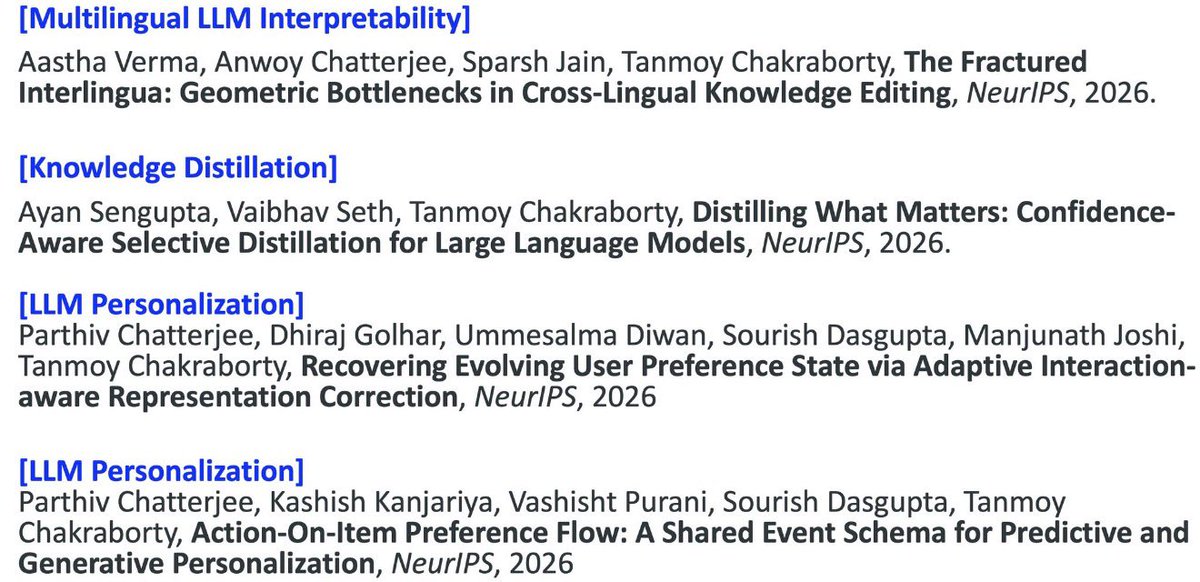
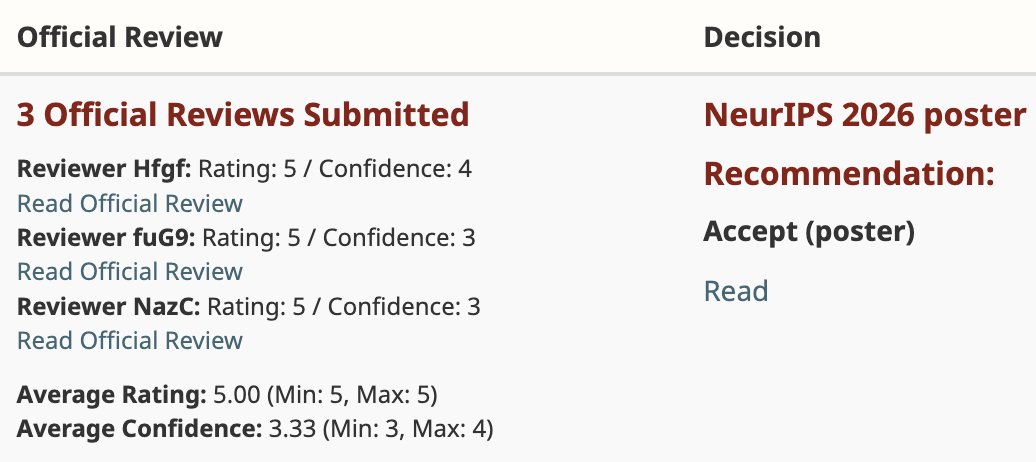
🎉 Time to celebrate the acceptance of 4 papers at #NeurIPS2026 — all in the Main Track!
The papers span multilingual LLM interpretability, knowledge distillation, and LLM personalization. Huge congratulations to all the students and collaborators! 👏
Details of the papers are here: https://t.co/md5SLGYkoA
@NeurIPSConf@lcs2lab@iitdelhi
Organising (w/ @IGurevych) GAI4HM -- the Indo-German Bilateral Workshop on Green AI for Healthcare & Mental Wellness at @iitdelhi -- an entirely in-person event, funded by @INDOGSTC!
🇩🇪 13 German speakers
🇮🇳 15+ Indian speakers
🏛️ 20+ institutions
💬 2 panel discussions
Bringing together computer scientists, engineers, psychiatrists, psychologists, public health researchers, regulatory experts, industry representatives, and healthcare professionals -- a truly interdisciplinary forum at the intersection of Green AI, healthcare & mental wellness.
@lcs2lab
SAE features are often found to be interpretable but not useful for steering. SAEs are inherently trained for local re-construction, and most existing works study the local geometry and local effect of these features.
In our latest work, we study the downstream geometry of SAE features and try to understand why most often they aren’t useful as stable steering directions. We introduce an analysis framework, FEGA, to study this. In the process, we were also able to distinguish between two classes of features: value-like ones encoding concepts, and pointer-like features encoding functions operating on context supplied values.
We observe that consistent one-dimensional effects are rare across SAE variants. Value-like features more often produce structured low-dimensional effects, but usually across several directions, while pointer-like features predominantly produce diffuse effects.
This means that a feature can be interpretable and causally relevant without behaving like one reusable steering vector.
Check out our paper to learn more. Our project page also provides an interactive way to explore the nature of different features.
🌐 Project page: https://t.co/LzGji9vLJP
📄 Paper: https://t.co/V7ymtIf7Bd
💻 Code: https://t.co/TszVl6enIN
It was a great collaboration with @UKPLab at @TUDarmstadt . Kudos to my amazing co-authors: Phu Gia Hoang, @Tanmoy_Chak , @IGurevych , and Subhabrata Dutta.
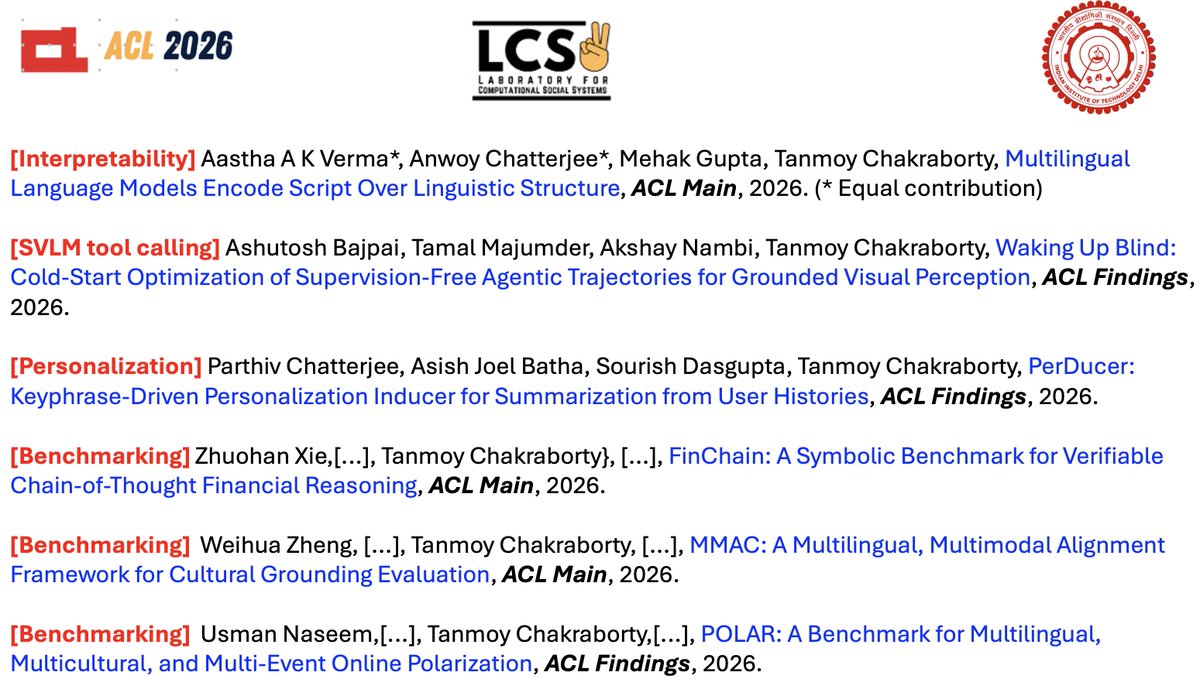
Six papers from our lab have been accepted for publication in #ACL2026. The papers cover topics including Interpretability, empowering small VLMs with advanced tool calling, LLM personalisation, and different benchmarking.
#nlproc@aclmeeting
🔬 Parmanu (Hindi for Atom) is live.
Parmanu is part of the Computational Social Systems (LCS2) @lcs2lab at IIT Delhi, led by Prof. Tanmoy Chakraborty @Tanmoy_Chak , and is our dedicated home for Efficient Large Language Models (LLMs) and Small Language Models (SLMs).
We’re at a turning point in AI. The future won’t be defined by scaling alone - it will be shaped by efficiency, accessibility, and real-world deployability. Parmanu is our effort to push this efficiency-first vision forward. ✨🤖
🔗 Explore the project page: https://t.co/siVwaKY1GN
Why Parmanu matters 🔥
• 📚 A centralized hub for our research, with papers accepted at ICLR, ICML, NeurIPS, TACL, ACL, and TMLR
• 🛠️ Open access to tools, code, and artifacts spanning model compression, KV efficiency, PEFT, inference optimization, knowledge distillation, and model coordination
• 🧠 A growing ecosystem focused on making strong language models smarter per parameter, not just larger
What this means for the community
For researchers 👩🔬👨🔬
A curated, evolving resource tied to top-tier venues
Reproducible artifacts and principled problem formulations
A shared space to advance efficiency-centric LLM research
For practitioners 👩💻👨💻
Practical techniques to deploy LLMs under tight latency and memory budgets
Faster paths from paper → production
Tools that actually work under real deployment constraints
What’s coming in 2026 🚀🔮
• 📊 Efficient LLM/SLM leaderboards
• 🧪 Open-sourced efficient LLM artifacts
• ⚙️ More tools for compression, distillation, and inference
• 🤝 Deep integration with Hugging Face and other popular libraries
If you’re excited about efficient, sustainable, and scalable AI, check out Parmanu, share feedback, and collaborate with us. The next wave of LLMs won’t just be bigger - they’ll be leaner, faster, and more impactful. 🌟
#EfficientLLMs #SLMs #ModelCompression #InferenceOptimization #KnowledgeDistillation #AIResearch #NLP #ICLR #ICML #NeurIPS #ACL #TACL #TMLR #IITDelhi #LCS2 #Parmanu
The scale of IndicVoices is powered by people. Nearly 1,900 coordinators, mobilizers, and experts worked alongside 16,000+ participants to capture speech in 22 Indian languages.
Their role wasn’t limited to logistics. They built trust, helped participants navigate apps, and encouraged natural conversation. AI4Bharat’s mission depends on this collaboration across the country.
🔗 Read the full post here: https://t.co/UGWcbkEHL5
🔗 Read the blog: https://t.co/aN5LPzlVgh
🔗 Research paper: https://t.co/zODSjAmQMR
🔗 Read the Report here: https://t.co/M243L7Ab8S
@MiteshKhapra@pratykumar@anoopk@vivek_raghavan@EkStep_Org@PeoplePlusAI
Still can’t believe it. Our work on uncovering plagiarism in AI generated research received the outstanding paper award at ACL!!
Effort led by, and envisioned by the amazing @tarungupta360!
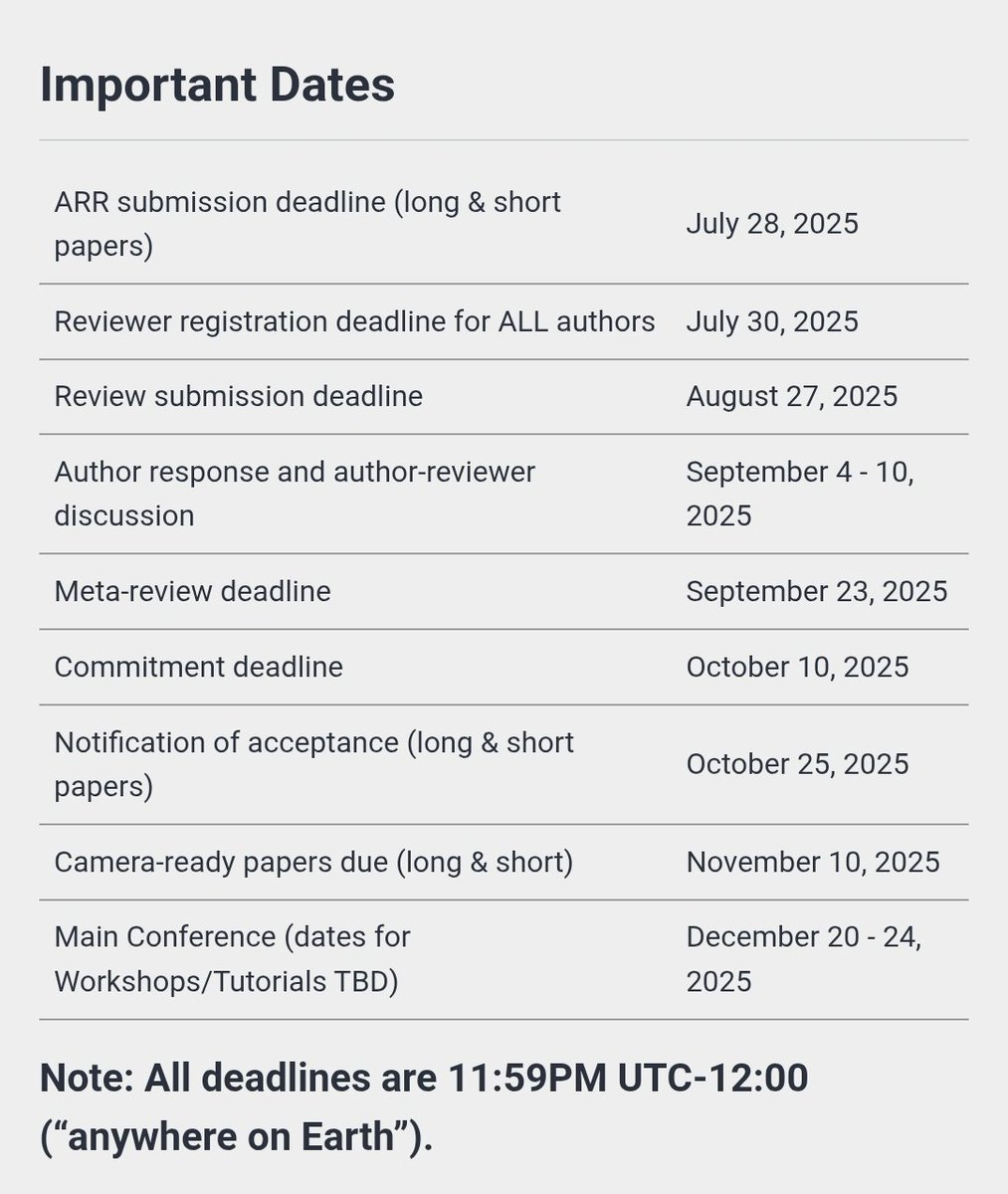
The ARR submission deadline for AACL-IJCNLP 2025 is soon approaching.
Please submit your best works and hope you see you in Mumbai.
Conference website: https://t.co/zZM18JEaKo
Main conference ARR submission deadline: 28th July (AoE).
@aclmeeting@naaclmeeting@emnlpmeeting
Introducing Cadence, our new SOTA generalist punctuation restoration model supporting all 22 scheduled languages of India, along with English. Cadence is designed to "Mark My Words" accurately, handling both clean written text AND messy, spontaneous spoken transcripts.
Current models often struggle with punctuation in speech transcripts, especially with disfluencies (false starts, backtracking). This hinders downstream tasks like translation, TTS, and summarization where sentence boundaries are crucial.
Paper: https://t.co/cJDZhr0BC0 Model: https://t.co/HIu0QCotd5
@psidharth567@Sparshj8287@_iunravel
🚨 I'm releasing Notebook 0 a week earlier than planned! 🚨
This is the soft intro to our modern Text-to-Speech (TTS) tutorial series.
It’s designed to ground you in signal processing concepts & why they matter for speech!
👉 https://t.co/QEedMQBJDP
Thrilled to share that our work "Towards Building Large Scale Datasets and State-of-the-Art Automatic Speech Translation Systems for Indian Languages" has been accepted at #ACL2025 (Main Conference)! 🎉🚀
Huge thanks to my amazing sensei @prajdabre for the guidance and support.
IndicTrans3 and IndicSeamless have arrived!
IndicTrans3
Following in the steps of IndicTrans2, we have released a beta version of IndicTrans3 (yes a better one is coming soon). It works at the sentence as well as the document level. It's lightweight, and of fairly high quality, especially if you want to translate documents.
Demo and link to model: https://t.co/qyezwuPjCZ
IndicSeamless
Along with IndicTrans3, we have released a speech translation model built on top of seamless v2 by @AIatMeta. This is currently the best open weights speech translation model for atleast 13 Indian languages. We had fun collecting data (BhasaAnuvaad) and then training the model. Currently this model can't be commercially used due to Seamless's license but we plan to train and release a fully open source and commercializable model soon.
Demo and link to model: https://t.co/OznNhAcE8g
Please try out, give feedback and share.
@anoopk@sumanthd17@_iunravel @sparshjain21 @ai4bharat