Bitcoin has changed how money works.
It even allows companies like Strategy, one of the largest corporate Bitcoin holders in the world, to offer an 11.50% dividend yield through its preferred stock, STRC.
The model is simple: raise capital through equity, convertible notes, and preferred stock, then use the proceeds to buy BTC. The 3.3x BTC coverage ratio means Strategy holds enough Bitcoin to cover STRC notional 3.3x over, giving preferred holders a cushion in any drawdown.
But this only works as long as BTC appreciates and capital markets stay open. If BTC drops hard and markets freeze, that dividend becomes very difficult to sustain.
STRC is essentially a leveraged BTC credit instrument dressed as a yield product. The 11.50% yield is the market pricing in exactly that risk.
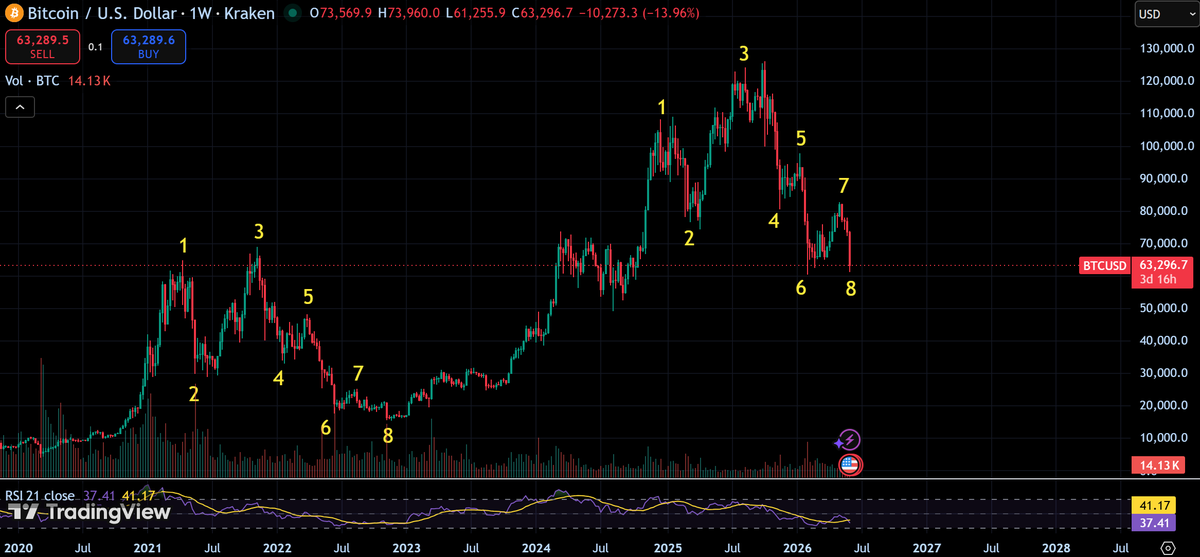
Bitcoin has done this before. Almost exactly.
Two full Bitcoin cycles mapped side by side. Eight structural pivot points. Nearly identical sequence.
What stands out is the compression. Cycle 1 ran 2,200% and dropped 77%. Cycle 2 delivered 620% and is currently down 50% from its peak. The upside shrunk. So did the downside. That is what happens when an asset matures and deeper capital enters the market.
If the structural analogy holds, point 8 corresponds to the same exhaustion zone that marked the 2022 bottom. Mapping the proportional drawdown from this cycle's peak suggests a likely bottom somewhere in the $54,000 to $55,000 range before the next leg up begins. Weekly RSI in the high 30s to low 40s is consistent with where capitulation phases have historically resolved.
The pattern has played out once already. Now it is playing out again.
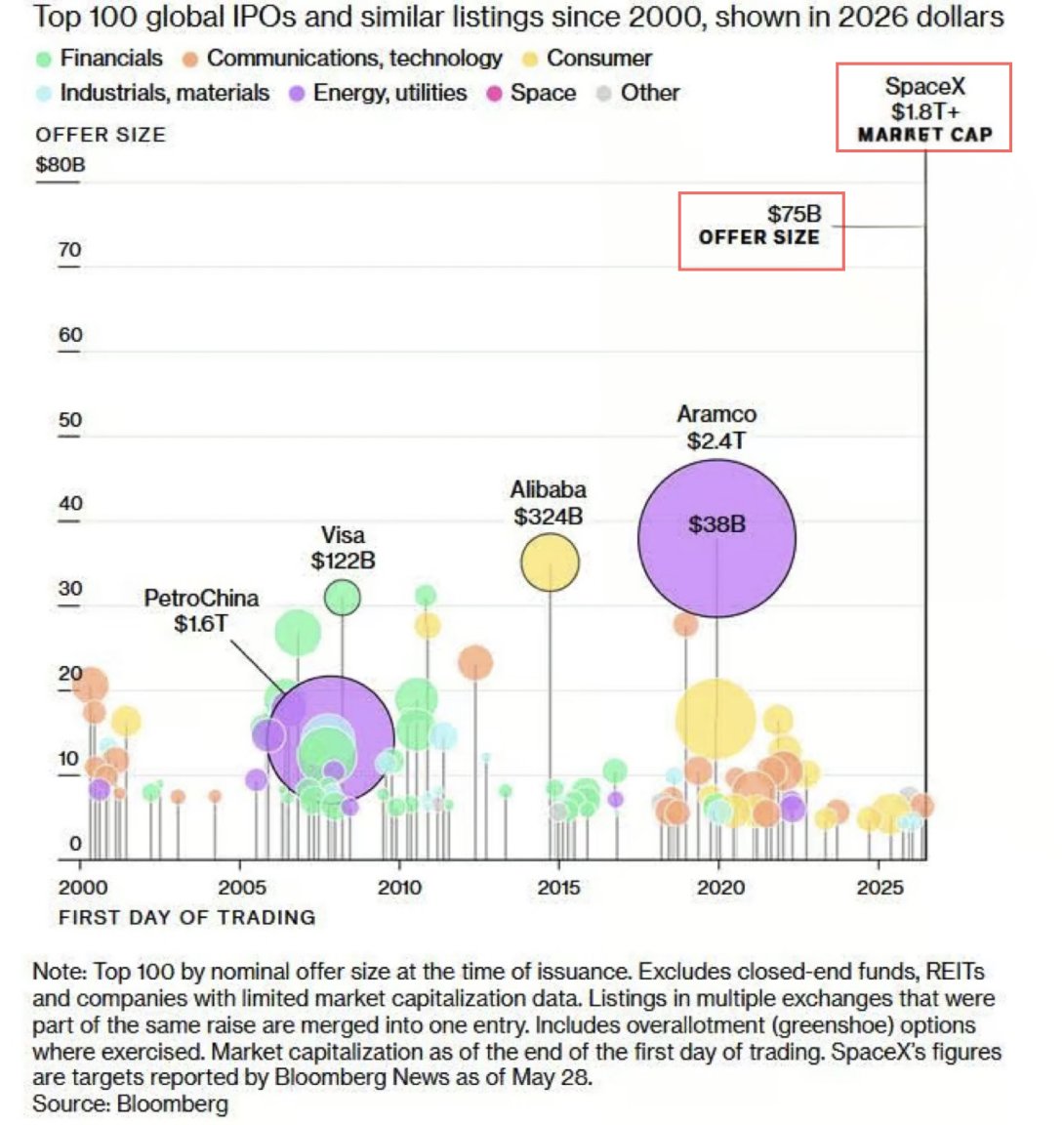
As we all know, SpaceX, Elons Musk's company is going public soon.
It's about to become the largest IPO in history, but I don't think anyone is pricing the risk that comes with it.
the targeted offering is $75 billion at a valuation north of $1.8 trillion. That blows past the old record.
Aramco raised $38 billion back in 2019, and remember, Aramco is the single most profitable company on the planet, roughly $350 billion in net profit last year.
SpaceX is set to raise nearly double that, and it doesn't print a fraction of those earnings.
Why does it matter?
A company like this gets absorbed into the major indices, and the moment it does, every passive fund tracking the S&P 500, the Nasdaq 100, the Russell 1000 is forced to buy it.
That is something as a concentration risk. A single name, instantly one of the heaviest weights in the index.
Here is the part most people miss.
When one stock carries that much index weight, the whole market becomes hostage to it.
If SpaceX stumbles, the passive machine that was forced to buy on the way up becomes a forced seller on the way down. A wobble in the most crowded mega-cap in the index doesn't stay contained in equities.
It pulls capital out of the entire risky asset complex, including Bitcoin.
$BTC sits at the far end of that risk curve. When the index heavyweights crack and global risk appetite drains, Bitcoin will get affected as well.
The analysis also aligns with the Bitcoin MVRV score.
Historically, since the first cycle, $BTC bear markets have always bottomed out at around 0 to -0.4.
For context, we're currently at 0.42.
Hence, a lower low in price action might be needed for BTC to reach that bear market bottom level.
Might sound scary, but to me, it's an opportunity to buy Bitcoin at the cheapest price in the past 2-3 years.
The new PRDT Pro mobile is here.
Fully revamped from the ground up for a cleaner, faster and smoother mobile experience.
Trade Up or Down in seconds.
No leverage. No liquidations. Just simple market predictions.
Now live on https://t.co/bb6sDsAlQX 🚀
ethereum:0xb2617246d0c6c0087f18703d576831899ca94f01 is saving my portfolio right now.
While everything is crashing, it's up 103% in the last month, 11% on the week, and another 5% today.
What a beast.
Behind every tokenized asset is a technology stack designed to make real estate more accessible, efficient, and connected.
Stoneform is being built on Binance Chain, enabling a secure and scalable environment where investors can access real estate opportunities with greater transparency, while developers gain access to new sources of global capital.
Our goal is simple: remove friction, increase accessibility, and help real estate move at the speed of modern finance.
We're building the infrastructure that connects real estate with the next generation of digital finance.