The quantum internet is being built — and it's almost empty. Spooqy is here to fill it: A new kind of software whose security comes from the laws of physics, not from assumptions you have to trust. Keys that can't be Broken, Value that can't be Cloned. https://t.co/0rq2SACjos
Incredibly fascinated by the work of the @spooqyai team around quantum memory and monetary sovereignty.
In his blog post, The Final Form of Money, @StefanoGogioso describes “money the universe itself would refuse to copy.” What interests me is where that places the burden of enforcing scarcity. A ledger prevents double spending by coordinating updates to an ownership record or protocol. A secure quantum money scheme would make the note itself unforgeable, allowing ownership to pass through transfer of the underlying quantum state.
In another one of the company's blogs (Quantum Memory Is All You Need), they develop the complementary architecture: separate the distribution of quantum resources from their consumption. Entanglement could be generated, distributed and stored in advance. At payment time, teleportation would consume those resources to transfer quantum states using classical communication. The quantum infrastructure would have already done its work before the counterparties decided to transact.
Read together, the posts suggest that monetary sovereignty is partly a question of when coordination is required. Infrastructure can be necessary to provision a system without retaining authority over every subsequent exchange. Manufacturing a monetary instrument and maintaining a veto over its circulation are distinct functions, even though digital money routinely binds them together.
Like woah... that's the research direction I am in love with. Imagine moving coordination out of the transaction itself. It would make settlement depend on the resources counterparties possess and the verification they can perform locally, without requiring a network to establish a canonical transaction history.
The proposal’s credibility, and my friend's at Spooqy, ultimately rests on secure verification protocols and memory with sufficient coherence time, capacity and portability. Those requirements connect an abstract claim about ownership to specific physical capabilities we can investigate and build.
https://t.co/w0fzcg5TqJ
https://t.co/wWwWgnO70y
Yesterday, OpenAI demonstrated the incredible promise of agentic systems for advanced research, constructing a solution of the Navier-Stokes equations which likely settles a long-standing, highly prized mathematical problem.
This kind of AI-assisted exploration of mathematical landscapes is exactly what we are betting on at @SpooqyAI: that agents, with well-crafted tools at their disposal, will be able to make advances along directions which human ingenuity alone has found hard to pursue.
We are focusing our efforts on quantum information, computation and cryptography, some of the fields where human intuition struggles the most. Our objective? To find the applications currently hiding in the uncharted space of near-term quantum technology.
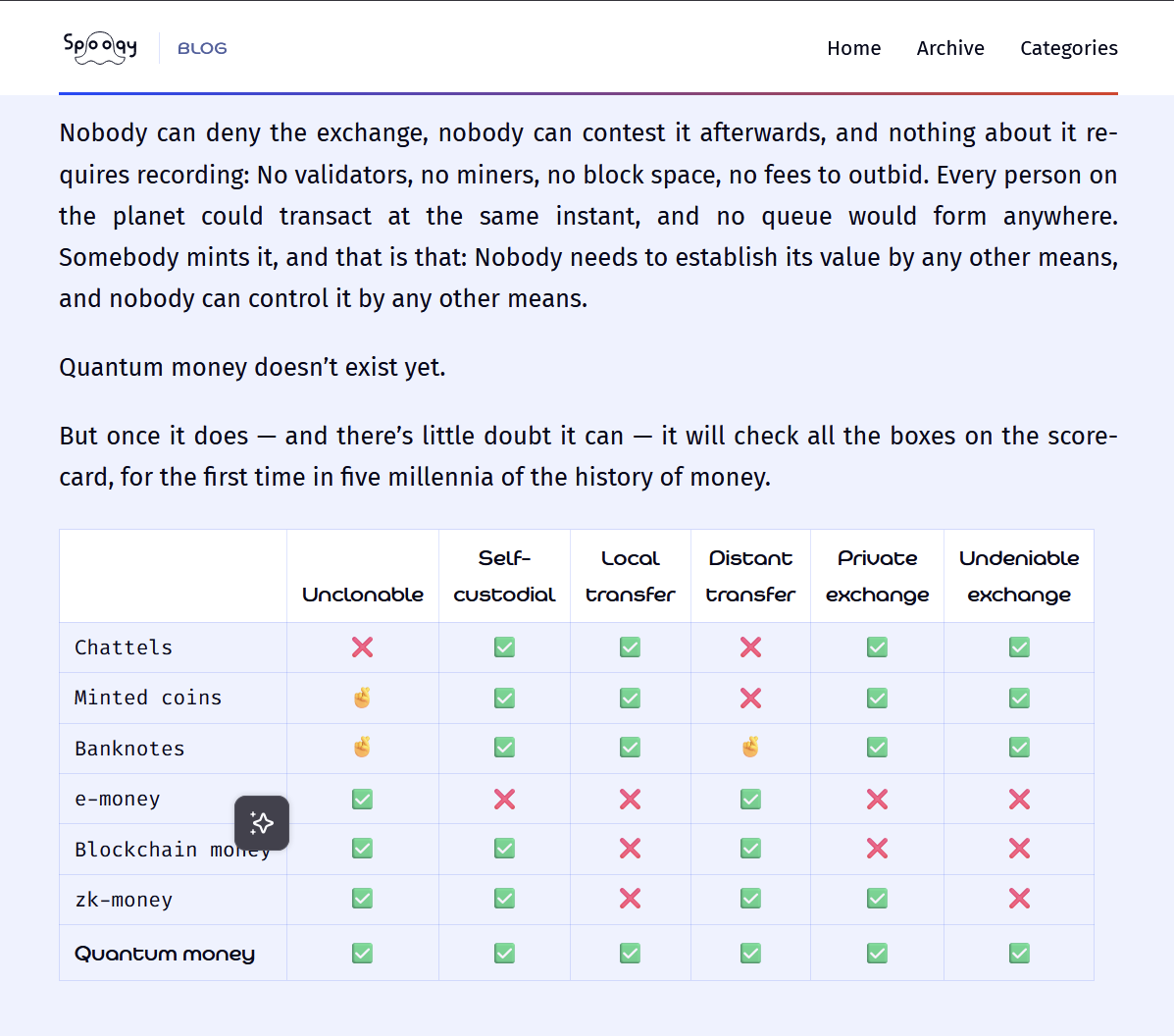
When cash changes hands, the exchange is recorded nowhere: No infrastructure, no fees, no permission, no bottleneck. Massively local, massively parallel, running at the full speed of human commerce. Nothing powers it but the trust that notes cannot be cloned.
An endless arms race between minting and forgery, the history of money is one of shifting compromise between the desire for sovereignty and the needs of commerce.
Quantum money is the final stop on that journey.
It doesn't exist yet. But once it does — and there's little doubt it can — it will check every box, for the first time in five thousand years.
Unclonable by the laws of physics. Digital money, truly sovereign, truly peer-to-peer. Money you can hold in the palm of your hand and transact across the stars. Money worthy of the age of quantum information.
Quantum money is a natural end state in the evolution of digital value exchange, and quantum memory is the technology that gets us there. Thanks @JakubDziadkowie and @beincrypto for covering our update!
What's truly fascinating is that we've known about this for over half a century. Stephen Wiesner came up with the idea in the early 1970s, a decade before the earliest cryptographic applications of quantum would even be conceived. At @SpooqyAI , we're taking up the torch to finish what he started: unforgeable money, secured by physics.
Quantum memory is the most consequential piece of cryptographic infrastructure that does not yet exist.
Bring this one artefact into the world and our mission snaps cleanly into place: unclonable digital money you can carry in a wallet, exchangeable undeniably across the web.
In his latest blog post, @NicolaPinzani reflects on his experience attending Quantum Physics and Logic 2026 last week in Amsterdam.
A year of exceptional quality, but also of profound change. How we do research in the age of LLMs, what we have gained, and what we might lose.
We are building a secure software ecosystem requiring no trust in hardware or networks.
Our breakthrough? Fully automate the process.
A compiler for synthesis + certification, as a tool in the hands of AI agents.
Introducing: A Spooqy Technology Roadmap.
In an age of AI-supercharged adversaries, the assumptions of cryptography are crumbling one by one. Under an onslaught of novel attacks, we are quickly reaching the end of "No one has broken this yet" as a practical security paradigm.
We can formally verify our software and certify our hardware, but at the bottom of this process there is always a boundary of trust, an interface which hides the inevitable complexity of concrete implementation and deployment.
The issue is not the process, but the shape of the security guarantees we try to achieve. The complexity of our physical artefacts has long ago outgrown our ability to scrutinise them. The solution, then, must be a radical rejection of the current paradigm:
Do not defend the stack. Do not describe the devices at all.
Instead, push security to the ultimate boundary, to the interface that actually defines what a protocol does — the agents involved, the inputs they choose, the outputs the observe, and the causal structure which constrains their interactions.
Box the complexity away, then, and a new paradigm is born. One where security does not derive from mathematics that an agent can break, nor from hardware that a supplier can backdoor, nor from networks that an eavesdropper can tap.
This is the promise of Device-Independent Security: Keys that Can't be Broken, because the Universe won't let you.
The technology behind our products is the end result of years of innovation in the foundations of quantum information. We are proud to give back to our community by sponsoring a new iteration of Quantum Physics and Logic.
If you're in Amsterdam attending, come meet @NicolaPinzani to talk about contextual cryptography, its near-term applications, and our long-term vision for the future of security and finance.
The quantum internet is being built — and it's almost empty. Spooqy is here to fill it: A new kind of software whose security comes from the laws of physics, not from assumptions you have to trust. Keys that can't be Broken, Value that can't be Cloned. https://t.co/0rq2SACjos
Contextual cryptography is the most promising route to commercial applications of near-term quantum technology.
An extension of contextual programming techniques to full-scale quantum computing would be a huge leap for the field. We're looking forward to the challenge 💪👻
In our work at @SpooqyAI, we use contextuality as the fundamental resource to power new quantum applications suitable for near-term hardware.
But there is a growing body of evidence that contextuality might be the resource behind all quantum advantage.
@NicolaPinzani and I have been thinking about this connection for a long time, and we're both convinced that the techniques we're developing — at present, to enable new cryptographic and financial solutions — will ultimately form the basis for a much broader software stack aimed at universal quantum computing.
We know what post-Mythos cryptography should be, and it is quantum.
This is exactly the promise of device-independent security: assumptions that stop at the interface between actors and machines, independent of inadequate mathematics, software bugs, and hardware flaws.
There is a non zero chance highly capable AI models will break cryptographic assumptions we rely on.
This is way more imminent than quantum computing and could be existential to the digital interconnected society we built in the past 30 years.
We need “post-mythos cryptography”
A couple of weeks ago, we talked with @beincrypto about the opportunities quantum technology brings to decentralised finance.
The crown jewel is quantum money: value that can't be cloned, not because of problems we believe are hard to crack, but because physics fundamentally won't let you.
Web3 taught us a key lesson: novel cryptography and novel financial applications drive each other in a virtuous cycle. Spooqy drops quantum cryptography into that flywheel, toward money that is truly sovereign.
In 2024, quantum computing was 30 years away. Today, that timeline has collapsed to just 1-2 years.
Google cut the power needed to break encryption by 75%. A single hacked Satoshi wallet could shatter Bitcoin's market trust forever.
We sat down with Oxford cryptographer @StefanoGogioso and @dynexcoin CEO Daniela Herrmann to unpack the reality of Q-Day and the quantum denialism inside the BTC community.
Full episode: https://t.co/fdn17y3A0l
In an age of AI-supercharged adversaries, the traditional assumptions of cryptography are crumbling one by one.
We're reaching the end of "no one has broken this yet".
Don't rely on the apparent hardness of mathematical problems. Trust the guarantees of physics instead.
🧮 A week after an AI model found a weakness in HAWK, a new quantum algorithm claims to break the maths behind most post-quantum cryptography schemes.
📝 A preliminary paper just dropped describing a new polynomial-time quantum algorithm against the family of problems that includes lattice cryptography, one of the most famous post-quantum approaches.
⚠️ Big disclaimer: the paper is not peer reviewed, and the author labeled it preliminary himself. In 2024 a comparable lattice claim was refuted within days.
🧠 That said, this comes from Daniel Simon, whose 1994 algorithm directly inspired Shor's, the one that breaks RSA and elliptic curves, most of the encryption today.
🔍 If it holds (we are already starting to see cracks in the proofs), the stakes are bigger than last week's. HAWK’s flaw hit one candidate scheme nobody had deployed yet. This claim targets the mathematical assumptions under the whole lattice family, ones NIST has selected to replace RSA and ECC.
📈 Cryptanalysis is active like never before. It is moving on several fronts at once: mathematics, quantum computing, and AI, and we expect more results like this in the coming months.
⚛️ Meanwhile, the quantum computers that would run these algorithms are being built, fast. Replacements have to be trusted before those machines arrive, and post-quantum cryptography cannot afford to be left without options.
✅ Bottom line: these schemes earn trust by surviving attempts to break them. To the cryptography and quantum communities: keep pushing post-quantum cryptography research. What matters is having options we can trust before the hardware catches up.
🔗 The paper in question: https://t.co/840xiGnfIy
#Cryptography #QuantumComputing #PostQuantumCryptography #Cryptanalysis #NIST
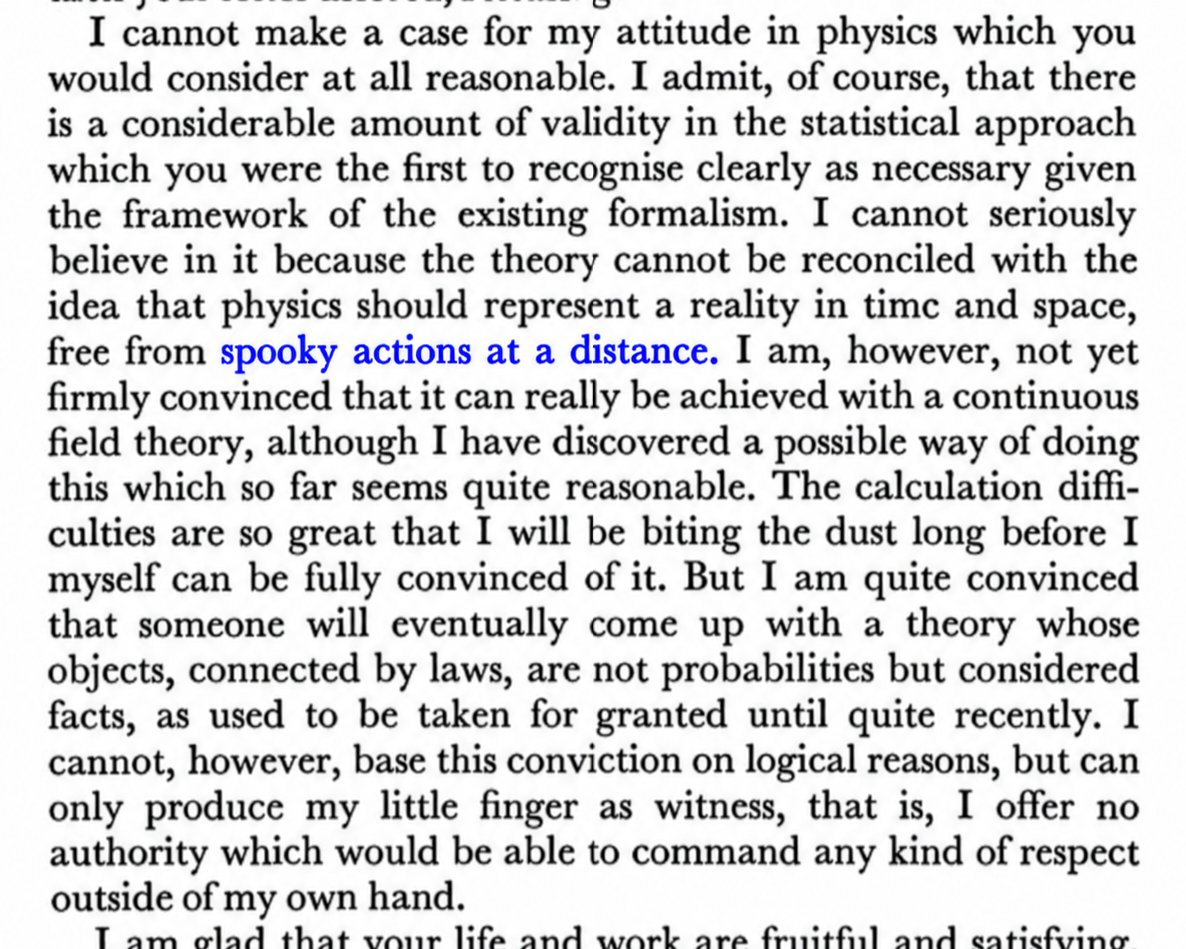
A century ago, the pioneers of quantum theory stumbled onto a prediction so strange that Albert Einstein refused to accept it: That two particles could remain invisibly bound across any distance, each instantly reflecting the fate of the other.
He derided it as “Spooky action at a distance” and insisted it meant the theory was broken. He was wrong. The spookiness is real, it is fundamental, and it is the most powerful resource for security ever discovered.
We named our company after it.
Introducing Spooqy — Action at a Distance.