Delighted to see our paper published in @NatureComms! We identified EDA2R as the top gene linked to aging across all human tissues, acting as both a biomarker of inflammaging and a driver of aging. @LJMUSportSci
https://t.co/6iIGjzGabZ
📢Biology of Sport 2025 CiteScore has increased to 10.7, ranking 5th /257 (98th percentile).
Q1 in:
➡️Physical Therapy, Sports Therapy & Rehabilitation
➡️Orthopaedics & Sports Medicine
➡️Physiology (medical)
🙏Thank you to our community for supporting sports science research
@GongDennis EDA2R and GDF15 are the two most frequently mentioned proteins in published studies using UK Biobank proteome data. They also commonly appear in transcriptomic studies. My personal favorite is EDA2R.
https://t.co/IROvsgK7fv
When extreme traits, such as elite athletic performance, are not adequately explained by common polygenic scores, research efforts should focus on identifying rare genetic variants with large effects.
https://t.co/PGNGe9kthW
Our latest paper in Physiological Reports:
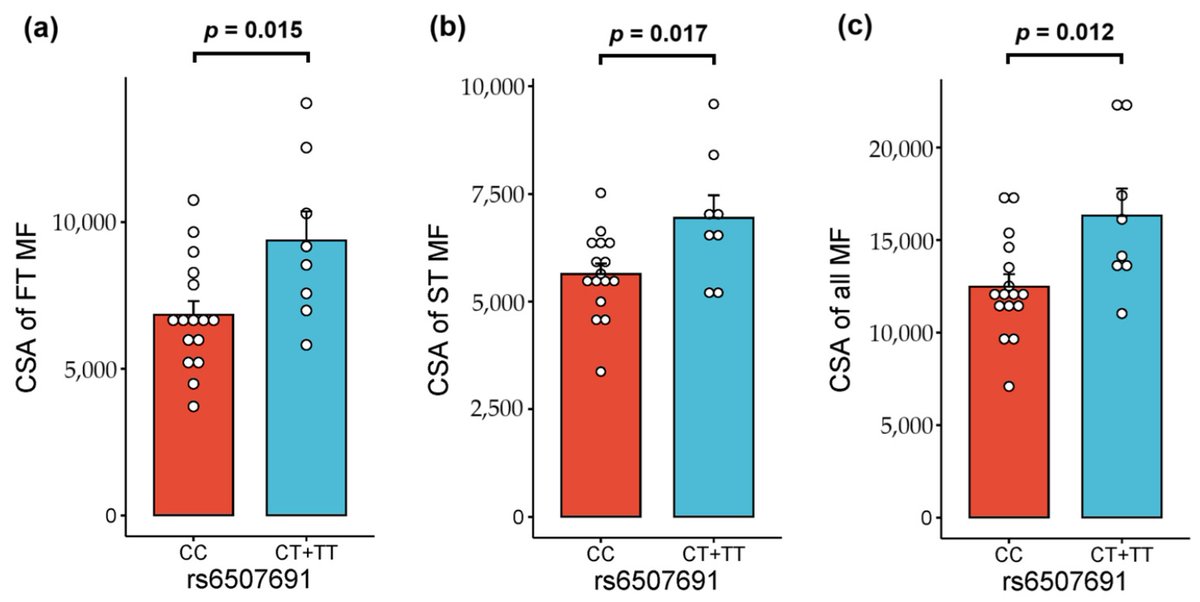
EPAS1 is associated with human muscle fiber composition and endurance phenotypes.
https://t.co/lVPQgv1rBW
@LJMUSportSci
Every two additional concussions are associated with a 5-year increase in DNAmFitAge acceleration among contact sport athletes.
https://t.co/kgQqGuWZNL
GWAS identified 107 genetic variants associated with creatine kinase (CK), a biomarker of muscle damage.
CK levels exhibit positive genetic correlations with muscle mass and strength, and negative correlations with C-reactive protein.
https://t.co/Z9EfeO7Rly
Polygenic score for handgrip strength explains 4.6% of variance in measured strength. Physical activity benefits for strength development are greater in individuals with lower genetic predisposition to strength.
https://t.co/zpIzQv374O
🌟 Editor's Choice Paper
📖 The ARK2N (C18ORF25) Genetic Variant Is Associated with Muscle Fiber Size and Strength Athlete Status
🧑🏻🔬By Dr. Rukiye Çığırtaş, et al.
🔗https://t.co/ddfRx14pKu
Rare MSTN variant (rs143242500; p.Ile225Thr; ~0.2% in EUR), representing a partial loss-of-function phenotype, is associated with higher fat-free mass and handgrip strength, as well as lower body fat percentage and reduced LV myocardial wall thickness.
https://t.co/6TxBlsEGD7
Muscle fibre composition can be estimated from expression of MYH1, MYH2, MYH7 genes (PMID: 31076557). Expression of each gene is divided by sum of all three. In our dataset, predicted fibre-type proportions showed strong correlation with immunohistochemistry estimates (r = 0.92).
Our latest comment in @GeroScienceAGE:
Shorter lifespan in some female athletes may result from selection for traits like tall stature and hyperandrogenism, which boost performance but increase health risks, along with chronic low energy availability.
https://t.co/sSlXqrh9Ni
Leisure-time moderate to vigorous physical activity is linked to longer lifespan. Doubling the odds of being physically active in leisure time may translate into ~1.41 extra years of life in men and ~1.68 years in women.
Our new study is now published in Advanced Science
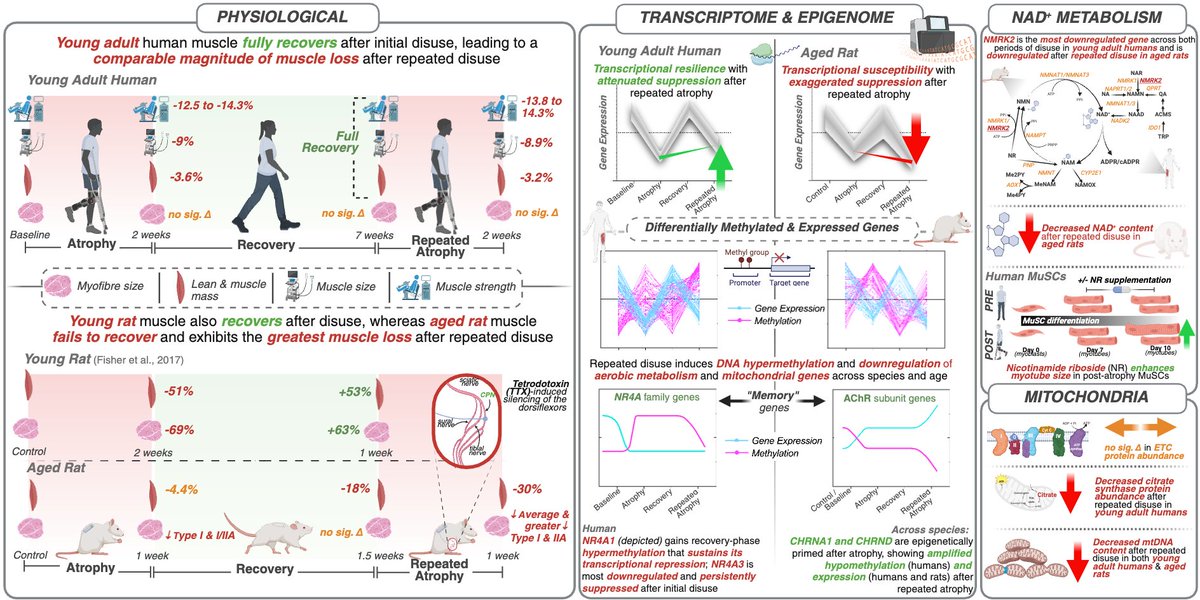
We show that skeletal muscle retains a molecular memory of disuse
Young muscle shows transcriptional resilience
Aged muscle shows exaggerated vulnerability
https://t.co/55QUOqyIbF
@nih_sognsvann@nih_physicperf