Big Lesson:
Elite players don’t bluff just because they have no showdown. They bluff when they’ve spotted an opponent’s line that has removed their strongest hands.
Range reading > hero cards.
Study spots like this = edges. What do you think of this bluff? Drop your thoughts 👇
#Poker #WSOP #GTO #MTT
Foxen’s Masterful River Bluff vs Xu’s 88 (WSOP Main)
One of the sickest triple-barrel bluffs you’ll see. Alex Foxen turns KJo into a hero jam on the river… and it’s barely about his hand.
It’s all about what Xu’s passive line screams about his range. Let’s break it down 👇
Foxen doesn’t need a “magical” bluffing hand — he just correctly reads that Xu’s passive line removed the nuts. Solver loves this exact KJo jam because Xu is left defending mostly 9x and a sliver of his strongest 8x.
The 4♦ even improves some of Foxen’s backdoor flush value.
River: 4♦ (final board T♥9♦2♥T♦4♦)
Foxen jams ~92% pot with King high. Xu tanks and folds 88.
By this point, the overwhelming majority of Xu’s Tx combos have either already jammed earlier or been heavily discounted. His range is now dominated by bluff-catchers (9x, weak 8x, etc.).
Turn: T♦ (board now T♥9♦2♥T♦)
Foxen fires 72% pot. Xu calls again.
Many strong Tx hands want to check-raise the flop on this dynamic board to play for stacks. The weaker suited Tx that called flop now often want to check-jam turn (protect vs river check-through + SPR).
Xu’s second call heavily caps him.
Setup: 30BB effective, Late Stage WSOP Main.
Foxen (LJ): K♠J♦ opens
Xu (BB): 8♠8♦ flats
Flop: T♥ 9♦ 2♥
Foxen c-bets 40%. Xu calls.
At 30BB, the BB’s big blind doesn’t come with many premium Tx combos (ATo, KTs etc. are often 3-bet or jammed pre). So Xu’s calling range is already capped toward weaker suited Tx.
@SubhaniHanif Ever wish you had one spot for all your Poker knowledge, statistics, learning etc etc, instead of having all your information spread everywhere? This is it ☺️.
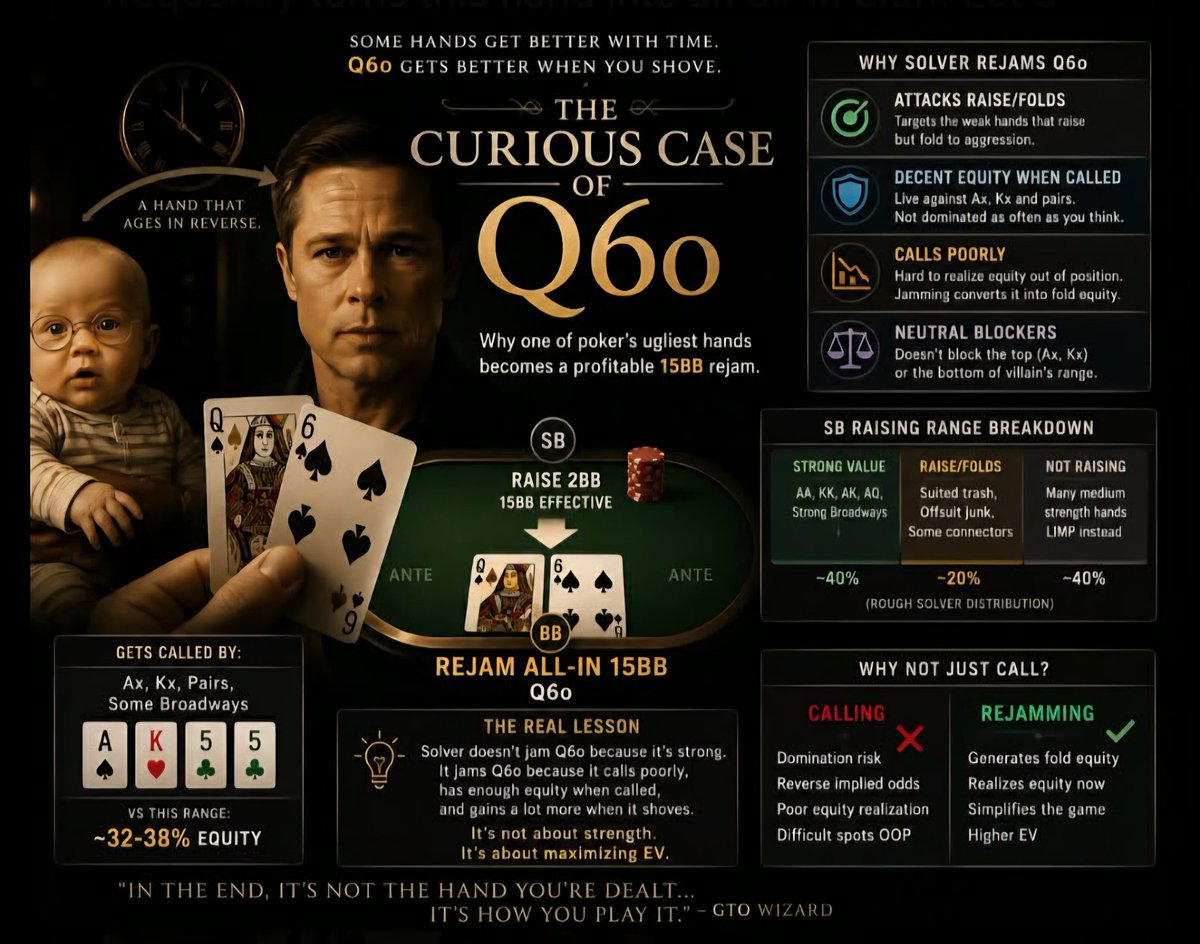
The Curious Case of Q6o 👀
15bb effective, heads-up MTT. SB min-raises, you’re in the BB with Q6o.
Looks like an easy fold, right?
Solver says: All-in rejam.
One of poker’s ugliest hands suddenly becomes a profitable bluff. Here’s why. 🧵
Want more spots like this in your pocket?
The SpotVault app is in closed beta. Webpage available.
Coaches & serious students already inside.
DM me or check https://t.co/r0aF9LYiwF if you want in.
Which board would you bet bigger on? Drop your answer 👇
#Poker #MTT #GTO #PokerStrategy
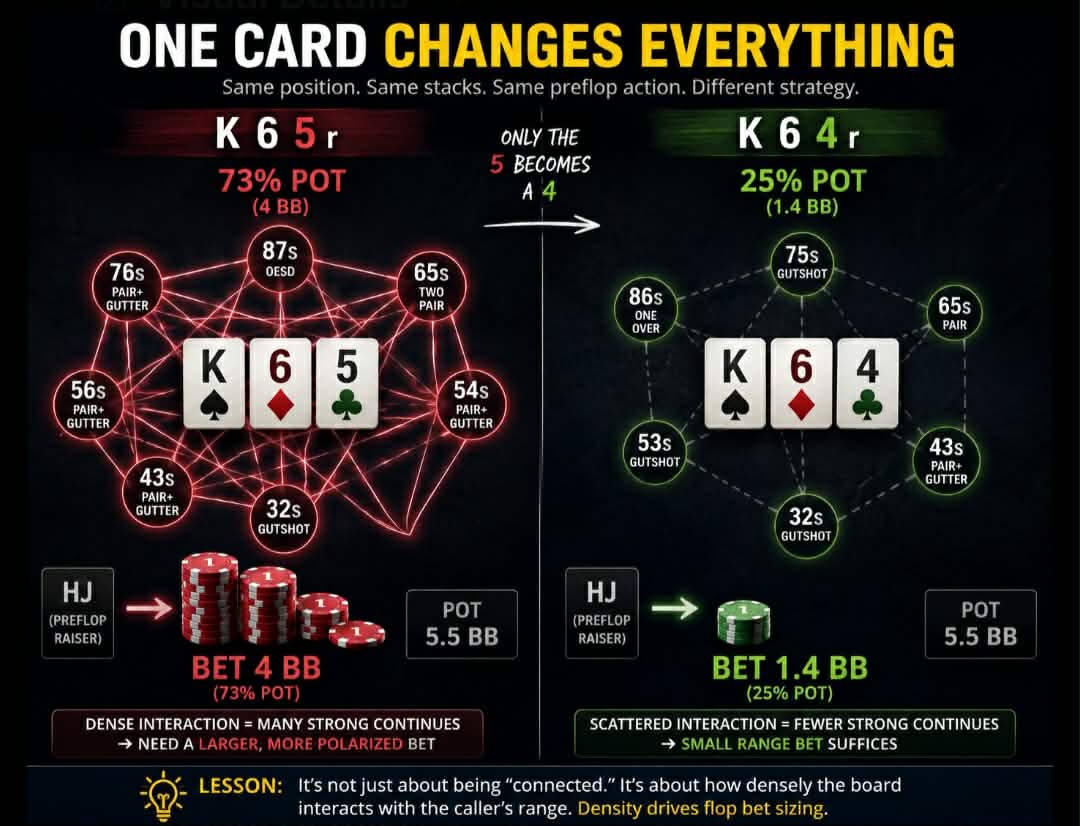
From K65 to K64: Why the Solver Completely Changes Its Mind
Most players look at K65 rainbow and instinctively reach for a small c-bet.
The solver does the opposite.
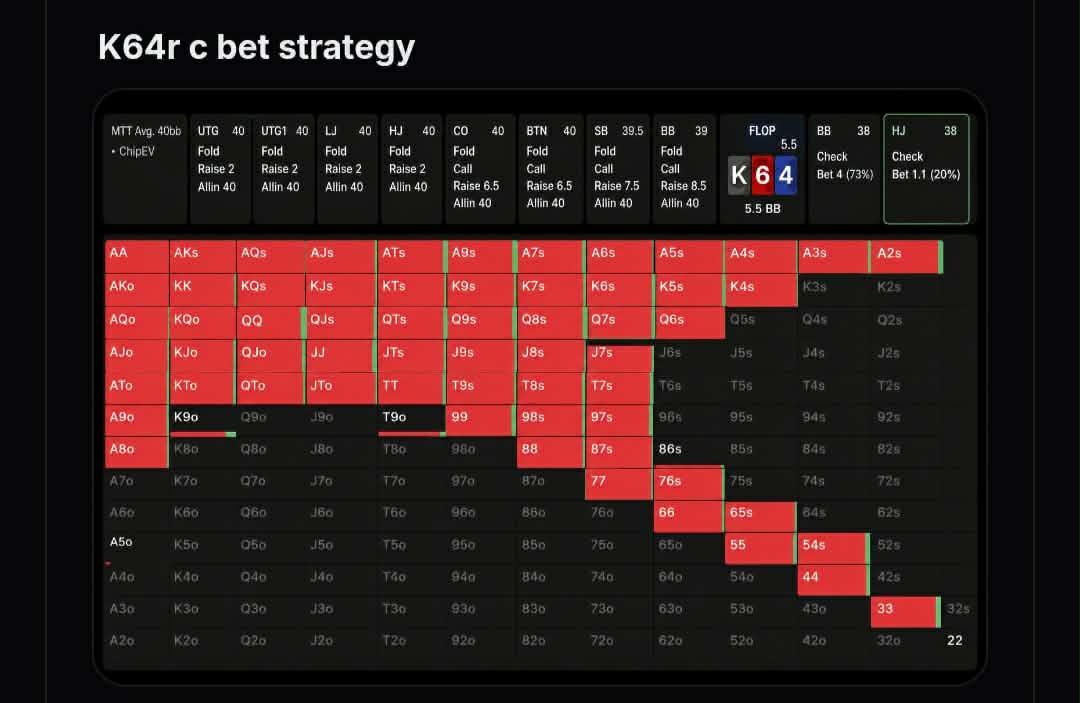
It fires 73% pot (4bb) on K65r… but switches to a tiny 25% pot range bet (1.4bb) on K64r.
One card. Massive strategy shift.
Why?
This is exactly the kind of deep, practical insight SpotVault is built for.
No fluff. Just solver-backed spots with clear explanations, visuals, and “why” breakdowns so you actually understand the strategy — not just memorize it.
Lesson:
Flop sizing isn’t just about whether the board is “connected.”
It’s about how densely the caller’s range interacts with the texture.
When the caller has tons of strong continuing hands, the solver often abandons the small bet in favor of a larger, more polarized size.
One card really can change everything.
[Attach the “ONE CARD CHANGES EVERYTHING” graphic + hand details]
Now swap the 5 for a 4 (K64r).
That single card breaks apart many of those connected combos.
The BB’s continuing hands become more scattered. Fewer strong draws and pair+draw combos.
Result? The solver is happy to use a small range bet because BB can’t punish it as effectively.
The Key Difference: Board Density vs BB’s Range
K65r creates a dense collection of natural continues for the Big Blind:
Pair + draws
Open-enders
Gutshots
Two-pair
Sets
Hands like 87s, 76s, 65s, 56s, 54s, 43s, 32s all smash this texture.
BB has plenty of aggressive check-raise candidates → solver goes big & polarized.
Same position. Same stacks. Same preflop action.
HJ opens, BB calls → 5.5bb pot on the flop.
On K♠6♦5♣ the solver loves the big bet.
On K♠6♦4♣ it goes small.
The boards look almost identical… but the solver sees something very different.
Biggest takeaway:
Hands that look ugly often make the best bluffs — precisely because they suck at realizing equity postflop.
Solver doesn’t shove Q6o because it’s strong. It shoves because the combo of blockers + fold equity + poor playability is +EV gold.
Full breakdown + solver tree in SpotVault 👇
https://t.co/7YU0YWx1cx (or grab the app)