Dear @bosuntijani
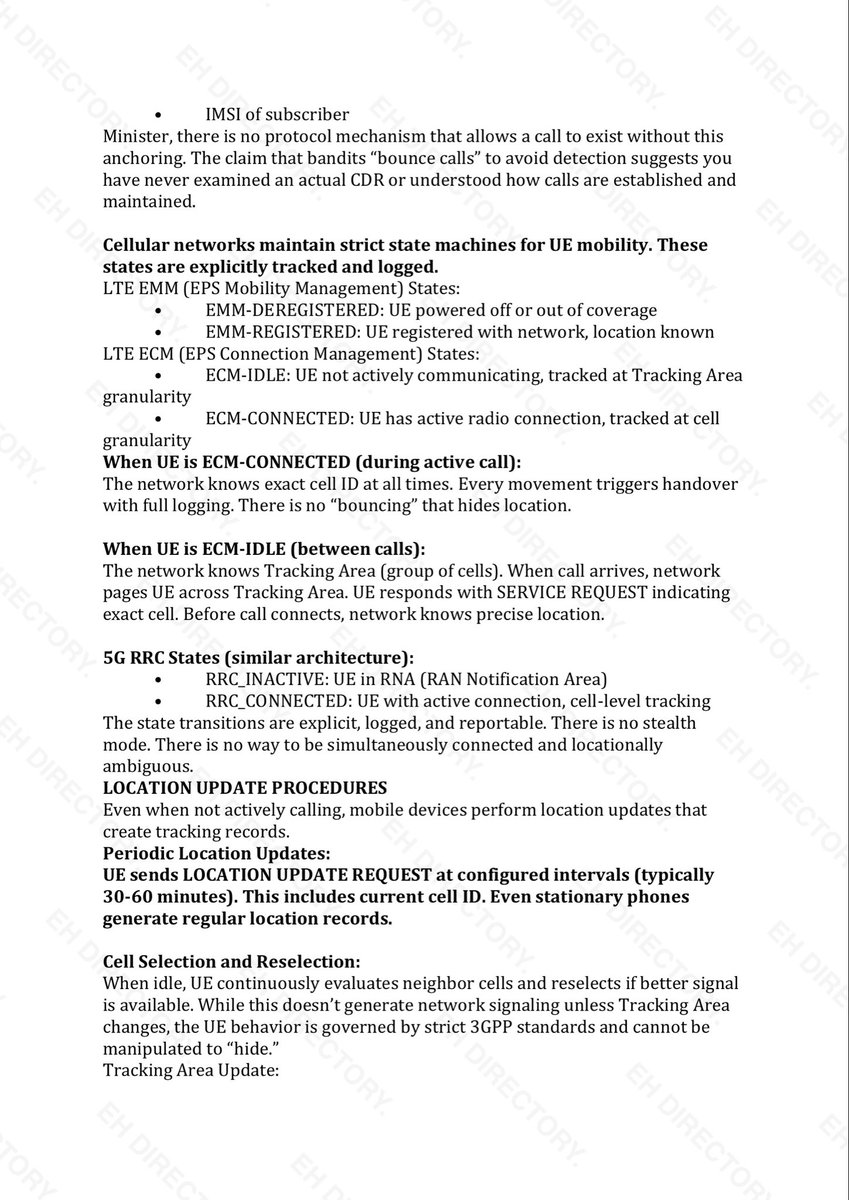
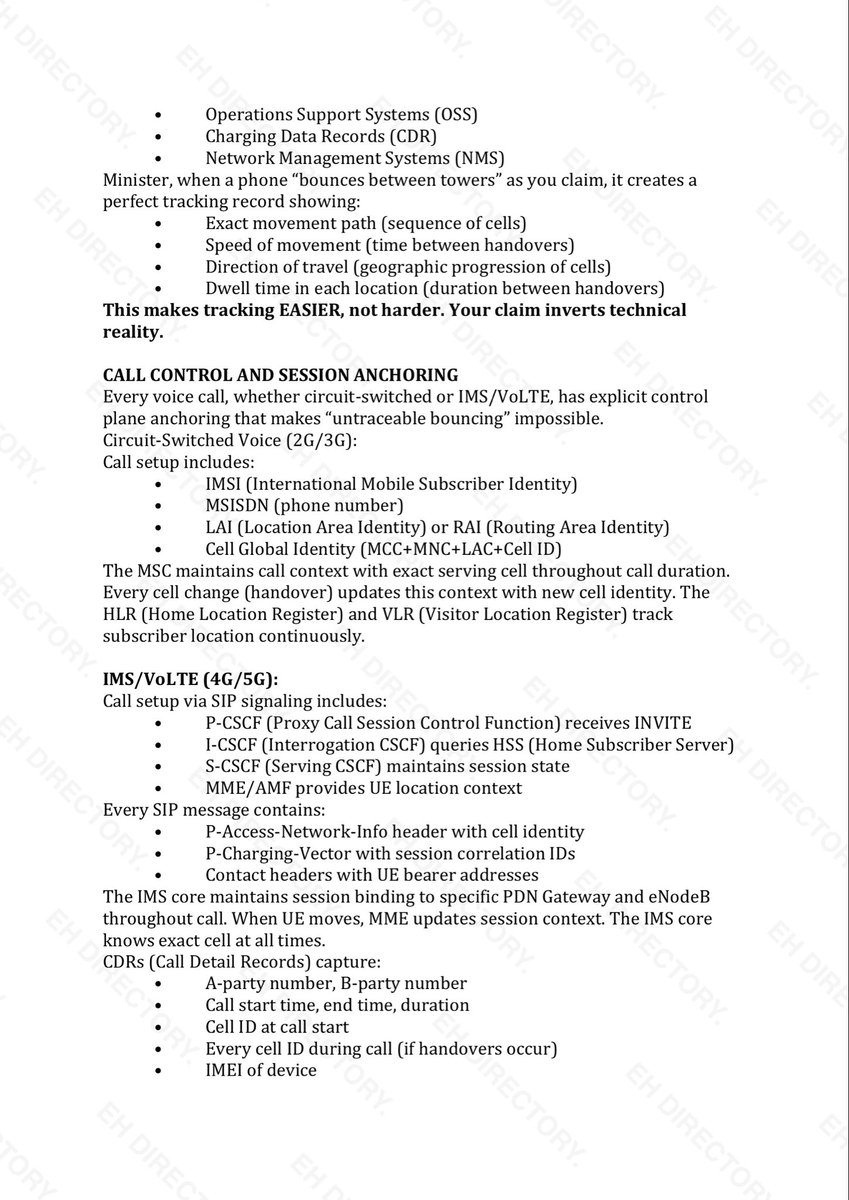
Please do find attached. I am attaching a full technical document as an image to this write up.
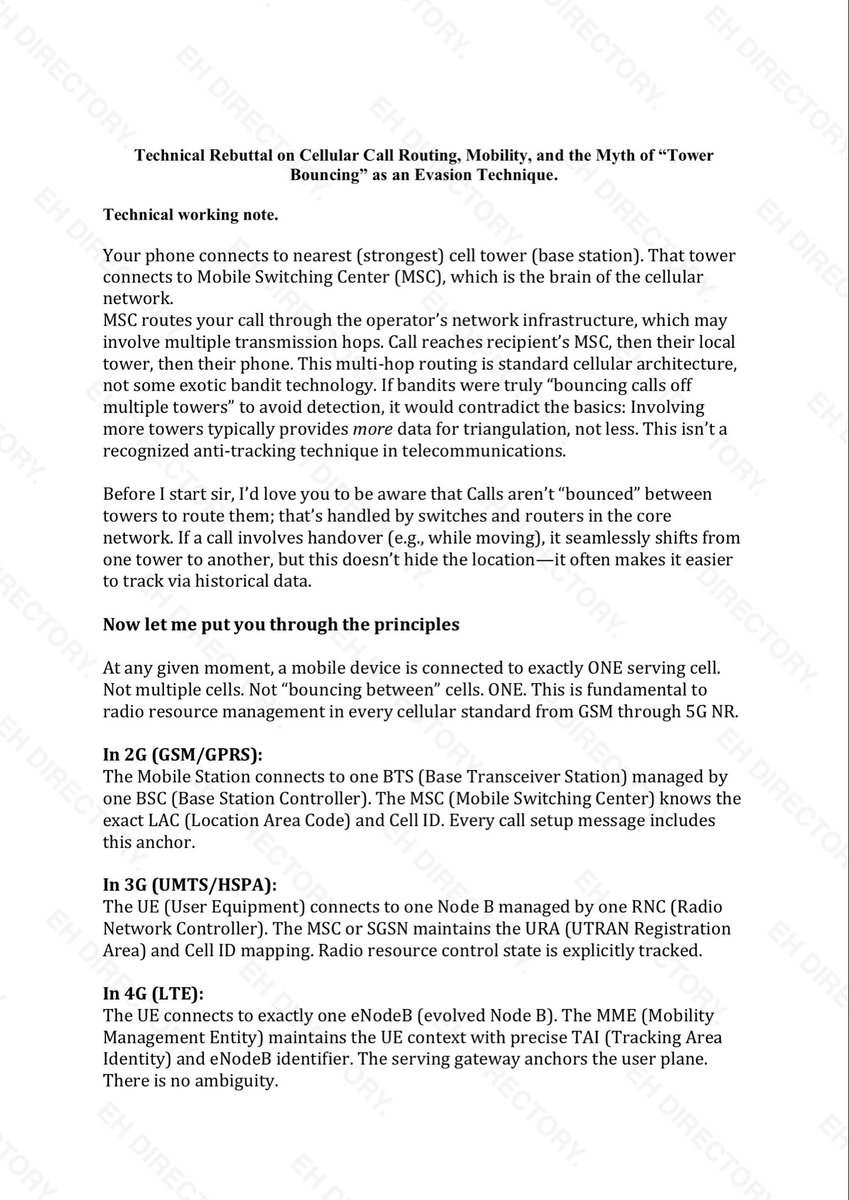
When you make a call: Your phone connects to nearest (strongest) cell tower (base station). That tower connects to Mobile Switching Center (MSC), which is the brain of the cellular network. MSC routes your call through the operator’s network infrastructure, which may involve multiple transmission hops. Call reaches recipient’s MSC, then their local tower, then their phone. This multihop routing is standard cellular architecture, not some exotic bandit technology. If bandits were truly bouncing calls off multiple towers to avoid detection, it would contradict the basics: Involving more towers typically provides more data for triangulation, not less. This isn’t a recognized anti tracking technique in telecommunications.
Before I start sir, I’d love you to be aware that Calls aren’t “bounced” between towers to route them; that’s handled by switches and routers in the core network. If a call involves handover e.g. while moving, it seamlessly shifts from one tower to another, but this doesn’t hide the location as it often makes it easier to track via historical data.
Now let me put you through the principles. At any given moment, a mobile device is connected to exactly ONE serving cell. Not multiple cells. Not bouncing between cells. ONE. This is fundamental to radio resource management in every cellular standard from GSM through 5G NR.
In 2G (GSM/GPRS):
The Mobile Station connects to one BTS (Base Transceiver Station) managed by one BSC (Base Station Controller). The MSC (Mobile Switching Center) knows the exact LAC (Location Area Code) and Cell ID. Every call setup message includes this anchor.
In 3G (UMTS/HSPA):
The UE (User Equipment) connects to one Node B managed by one RNC (Radio Network Controller). The MSC or SGSN maintains the URA (UTRAN Registration Area) and Cell ID mapping. Radio resource control state is explicitly tracked.
In 4G (LTE):
The UE connects to exactly one eNodeB (evolved Node B). The MME (Mobility Management Entity) maintains the UE context with precise TAI (Tracking Area Identity) and eNodeB identifier. The serving gateway anchors the user plane. There is no ambiguity.
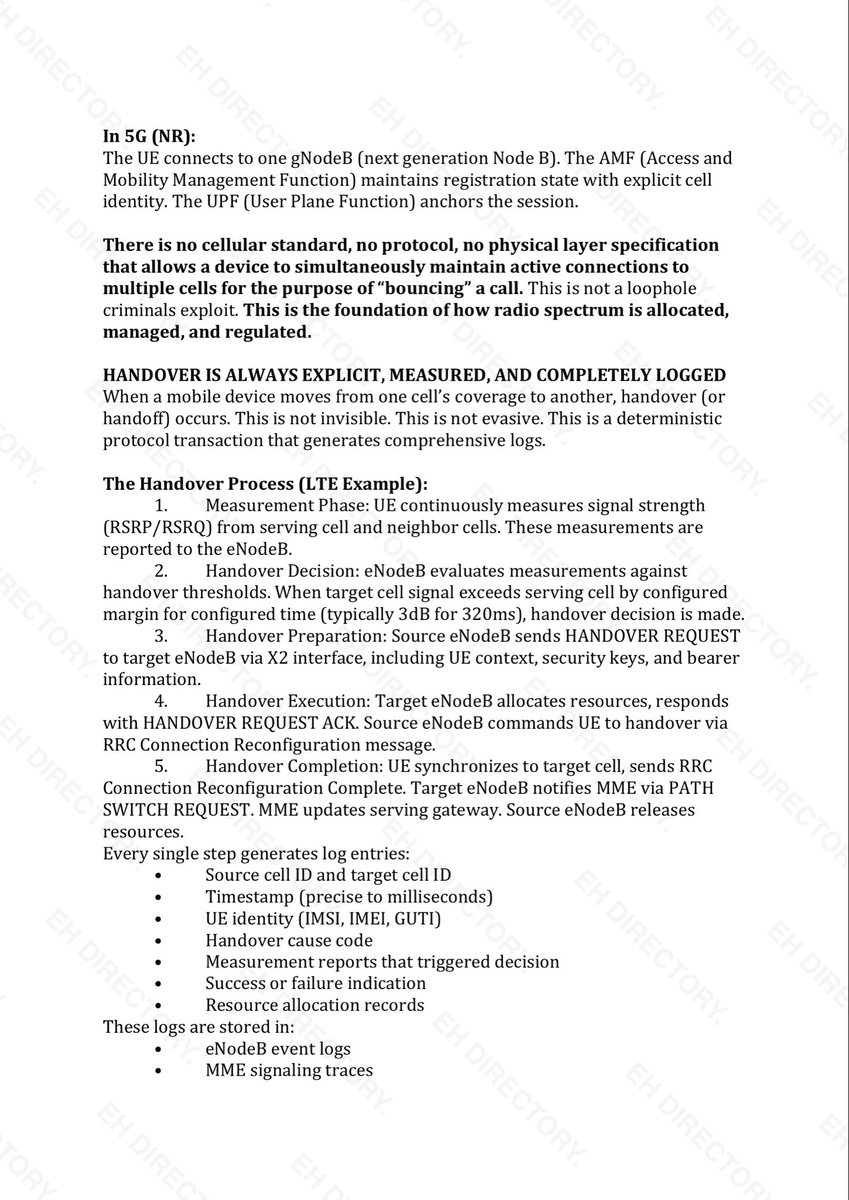
In 5G (NR):
The UE connects to one gNodeB (next generation Node B). The AMF (Access and Mobility Management Function) maintains registration state with explicit cell identity. The UPF (User Plane Function) anchors the session.
There is no cellular standard, no protocol, no physical layer specification that allows a device to simultaneously maintain active connections to multiple cells for the purpose of ��bouncing” a call. This is not a loophole criminals exploit. This is the foundation of how radio spectrum is allocated, managed, and regulated.
HANDOVER IS ALWAYS EXPLICIT, MEASURED, AND COMPLETELY LOGGED
When a mobile device moves from one cell’s coverage to another, handover (or handoff) occurs. This is not invisible. This is not evasive. This is a deterministic protocol transaction that generates comprehensive logs.
The Handover Process (LTE Example):
1.Measurement Phase: UE continuously measures signal strength (RSRP/RSRQ) from serving cell and neighbor cells. These measurements are reported to the eNodeB.
2.Handover Decision: eNodeB evaluates measurements against handover thresholds. When target cell signal exceeds serving cell by configured margin for configured time (typically 3dB for 320ms), handover decision is made.
3.Handover Preparation: Source eNodeB sends HANDOVER REQUEST to target eNodeB via X2 interface, including UE context, security keys, and bearer information.
4.Handover Execution: Target eNodeB allocates resources, responds with HANDOVER REQUEST ACK. Source eNodeB commands UE to handover via RRC Connection Reconfiguration message.
1 of 2
The famous 'men leave sick wives' narrative needs to die.
People inadvertently Psyop themselves by reading headlines.
- The Karraker & Latham paper that popularized it was retracted for coding errors. After recalculation, they found NO statistically significant gender difference in divorce after illness (except in heart disease) and concluded they 'fail to reject the null hypothesis.'
- The Cancer reference is from a 2009 (Glantz) study, which did find a 6/7-fold disparity when the patient was female.
But crucially: they never recorded, or even tried to determine, who filed/initiated divorce (separation).
The authors merely inferred “partner abandonment” from the pattern of who was sick, not from documentation of who filed the papers.
To be clear, it's not unreasonable to assume that the sick partner would not initiate divorce, but we should be honest that we don't know, because it simply wasn't measured.
We do know two things
1. Base priors - women initiate divorces more often than men. So we should factor that in when looking at the numbers (at least do a bayesian revision).
2. Anecdotally, sick partners have divorced the healthy partner. Molly Kochan did this, and talked about it in her book Dying for Sex.
While Molly's case was extreme, it is possible for the sick partner (the woman) to initiate the divorce because the healthy partner (the man) is not capable of caring for her as well as she needs.
But beside that, context matters enormously. I don't know how much weight we should place on the Glantz study.
Glantz studied 515 patients with severe, rapidly-progressing brain tumors/MS at ONE hospital, with Only 60 divorces in total.
That is what this study is based off of.
Meanwhile, population studies tell a different story:
1. In the more recent Karraker study there was no overall gender difference; and a small effect for wives' heart disease only
2. Multiple studies of breast cancer - a female-specific cancer - actually show a different story
Germany: 108 patients, ZERO divorces after 1 year
Sweden: 4,761 patients, same divorce risk as healthy women
Finland: 3,225 patients, no difference over 10 years
Denmark & Norway: 8% LOWER divorce risk
3. Denmark (Carlsen 2007) studied 46k survivors, All-cancer divorce risk was statistically indistinguishable. Norway (Syse & Kravdal 2007) studied 1.4M couples (215k with cancer) and found most cancers showed small declines in divorce for both men and women.
When we do see increased divorce risks in cancer illness are gender-specific, fertility-linked cancers (cervical for women, testicular for men). Those raise divorce for the patient, not just the wife.
To be clear, gendered caregiving burdens are real and worth addressing.
But the rhetoric that 'men abandon, women stay' is a gross oversimplification from absolutely shoddy data at worst, or weak data at best.
The broader data shows most marriages survive serious illness regardless of which partner is sick.
One small, extreme study shouldn't define the narrative about millions of couples facing illness together.
Suddenly, we are expected to exalt those who adopt the fad of thought-terminating malice—trippingly tossing around “anti-intellectual” or “olodo”—while they, in that very act of petulant reproach, betray themselves as smitten with the same palsy of mind they impute onto others.🤣
We need a constitutionally backed working hours cap on the medical sector. Working hours at a stretch, working hours per week and legally mandated locum cover when colleagues take sick off. With this, people who don't know how to confront authority will still get some respite.