Mr. Mukul Agarwal has a portfolio of Rs. 7,500 Crores today. 🔥
But he started as a trader and became a long term investor after 2008:
“During 2003-08, stocks went up 50x -100x and I realised what an idiot I am, trading for 10-25% gains.”
Mukul ji invested his trading profits into real estate before 2008 i.e. coming into long term investing.
“Earlier I used to just keep buying real estate out of profits from stock markets and used to hold that.”
“So from 2008-09 onwards, I started taking investing seriously.”
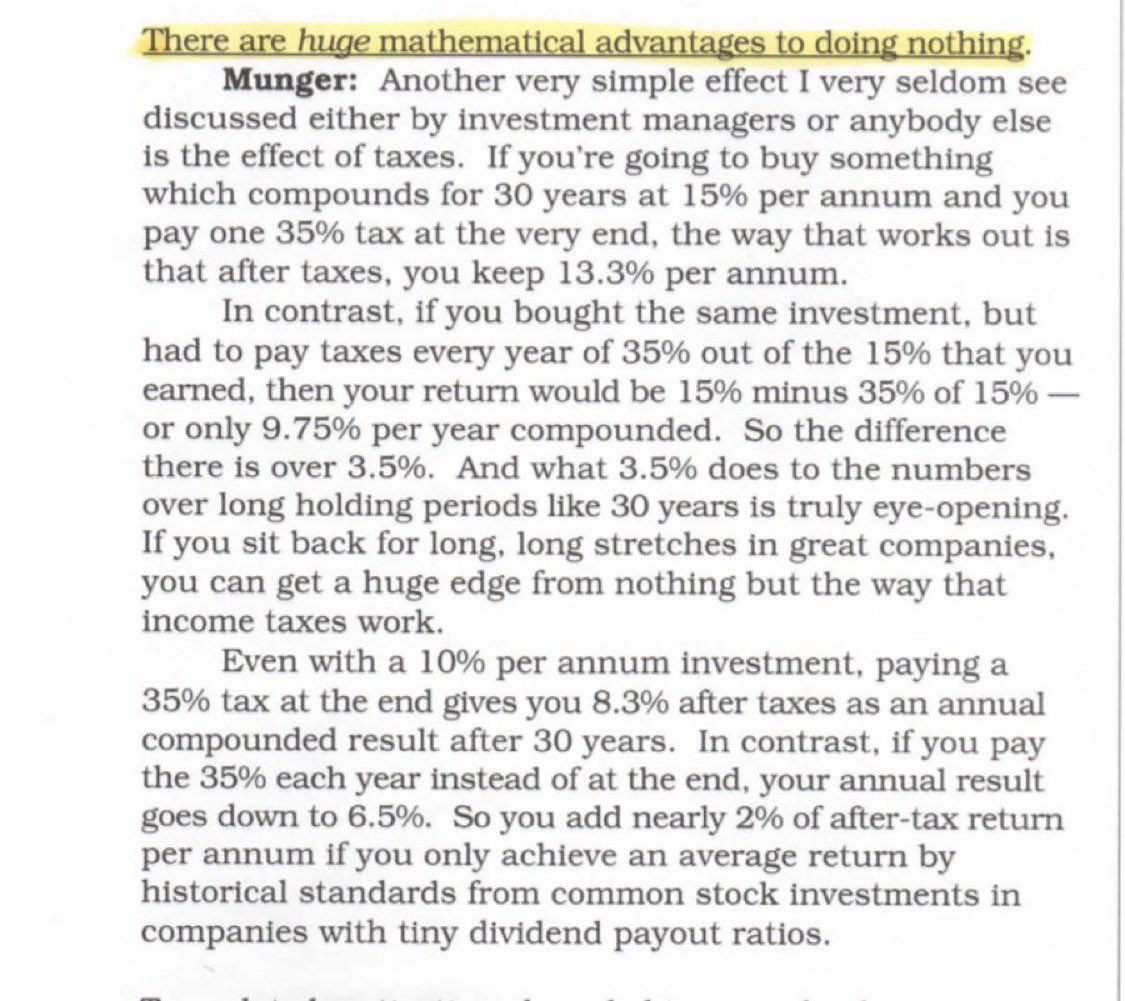
Initial capital can be generated by trading…however real wealth is generated only through long term investing.
"It never was my thinking that made the big money for me. It always was my sitting. Got that? My sitting tight! It is no trick at all to be right on the market. You always find lots of early bulls in bull markets and early bears in bear markets. I've known many men who were right at exactly the right time, and began buying or selling stocks when prices were at the very level which should show the greatest profit. And their experience invariably matched mine--that is, they made no real money out of it. Men who can both be right and sit tight are uncommon." ~ Edwin Lefevre
Market Wizard Linda Reschke's 12 Technical Trading Rules:
1. Buy the first pullback after a new high. Sell the first rally after a new low.
2. Afternoon strength or weakness should have follow through the next day.
3. The best trading reversals occur in the morning, not the afternoon.
4. The larger the market gaps, the greater the odds of continuation and a trend.
5. The way the market trades around the previous day’s high or low is a good indicator of the market’s technical strength or weakness.
6. The previous day’s high and low are two very important “pivot” points, for this was the definitive point where buyers or sellers came in the day before. Look for the market to either test and reverse off these points, or push through and show signs of continuation.
7. The last hour often tells the truth about how strong a trend truly is. “Smart” money shows their hand in the last hour, continuing to mark positions in their favor. As long as a market is having consecutive strong closes, look for up-trend to continue. The up trend is most likely to end when there is a morning rally first, followed by a weak close.
8. High volume on the close implies continuity the next morning in the direction of the last half-hour. In a strongly trending market, look for resumption of the trend in the last hour.
9. The first hour’s range establishes the framework for the rest of the trading day.
10. A greater percentage of the day’s range occurs in the first hour then was the case in the past, and thus it has become increasingly important to trade aggressively if there are early signs of a strong trend for the day.
11. There are four basic principles of price behavior which have held up over time. Confidence that a type of price action is a true principle is what allows a trader to develop a systematic approach.
The following four principles can be modeled and quantified and hold true for all time frames, all markets. The majority of patterns or systems that have a demonstrable edge are based on one of these four enduring principles of price behavior.
Charles Dow was one of the first to touch on them in his writings. Principle One:
A Trend Has a Higher Probability of Continuation than Reversal Principle Two:
Momentum Precedes Price Principle Three:
Trends End in a Climax Principle Four:
The Market Alternates between Range Expansion and Range Contraction!
12. In the world of money, which is a world shaped by human behavior, nobody has the foggiest notion of what will happen in the future. Mark that word –
Nobody! Thus the successful trader does not base moves on what supposedly will happen but reacts instead to what does happen.
First Share I Bought In My Life Was Asian Paints
Originally they had public issue at 27 & I Bought it for 54 rupees, after it doubled
For 5 years it was the only single share portfolio
And then in 1991 in those days 3 years was long-term capital gains & if you sold it & bought a house, there was no capital gains
Dumbest thing in my life is i sold my Asian Paints in '91 to buy a house in Nalla Sopara
And after great difficulty, 8 years later i sold that house in Nalla at the same price that i bought
- Sanjoy Bhattacharya's
Charlie Munger says a math genius wrote him a letter confessing his hedge fund job was a total waste of his talent
"He has 300 million long and 300 million short he's allowed to deviate but between size of the total long and short position by no more than 2%"
"He's using computer algorithms sort of devised by codebreaking skills and for six years he has made money without knowing a damn thing about the companies or relevant to what happens in capitalism"
"But he's a brilliant man and he knows he's in a sick lousy system"
"He says I'm in the sick lousy system and this what I want you to know I only bought one stock and it's BYD and I'm glad you bought it too"
"Of course it's a huge misuse of talent and if I were running the world I would pass laws that would get all those people either selling apples on the street or doing something more productive"
P.S. I made a playbook breaking down 100+ most powerful decision making mental models used by history's greatest thinkers.
5,000+ downloads.
113 five-star reviews.
Grab a free copy here:
https://t.co/u2q1uUm9vD
If you're new here, follow @GeniusGTX for content on the greatest minds in economics, psychology, and history.
— Charlie Munger, Vice Chairman of Berkshire Hathaway, on Ross School of Business's channel
Warren Buffett on Rose Blumkin (Mrs. B) the owner of Nebraska Furniture Mart :
“If I could start a business and I had the first draft pick like the NFL of the top 25 graduates in USA or the top 25 CEOs of Fortune 500 companies or I could take Mrs. B”
“I’d take Mrs. B to run the business. There aren’t any other Mrs. Bs.”
“If 10 lakh people trade, 9,99,999 people say they’ve made money. But I’ll tell you that 9,99,909 are lying.”
“Only 90 would’ve made money.”
“You’ll say, you did gambling but are telling us to avoid. I’d say that my daddy used to drink whiskey but told us not to drink.” 😂
- Late Rakesh Jhunjhunwala
Every casino, insurance company, and Wall Street bank runs on math invented in 1654 to settle 1 drunk gambler's bet.
Here was the bet. 2 men are playing for a pot, first to a set number of wins takes it all. The game gets cut short before anyone wins. The score is uneven. Who gets the money?
It sounds easy. It stumped everyone for over 150 years.
A French gambler called the Chevalier de Méré dragged it to Blaise Pascal. Pascal could not crack it alone, so he wrote to Pierre de Fermat, one of the sharpest minds alive.
Over a summer of letters in 1654, the 2 of them broke it open. And the answer flipped everything. You do not split the pot by the current score. You split it by each player's chance of winning if the game had kept going.
That 1 idea, pricing the future by probability, is exactly what Jerison is teaching. It is called expected value, and it is the engine under the entire subject.
From a bar-room dispute came the math that prices every insurance policy, runs every casino, and lets a poll claim it is "accurate within 4%."
2 geniuses, 1 summer, a gambler's tantrum. They accidentally built the mathematics of luck itself.
A magician spent 10 years rigging card decks. then he became a Stanford professor and proved the market works the same way. he published the math for free. Wall Street still pretends nobody saw it.
his name is Persi Diaconis. his quote: "I've spent my life on two tricks. making a rigged deck look random, and making a random one look rigged. the market is the first trick, and almost nobody catches it."
the tilt is invisible to human intuition. a 50.75% edge buried inside what looks like pure chance. your gut reads a losing week as a broken system and a hot streak as skill. wrong both times. that's exactly why funds hand the decision to the math.
it takes thousands of trades for a 51% edge to separate from luck. almost everyone quits before then. the ones who didn't quit manage the money now.
Diaconis has taught this for decades. the probability goes back to 1713. the lecture is free.
the patience to trust it past your own eyes is the edge.
A Stanford physicist walked into a lecture hall in gym shorts, with no notes, and spent 70 minutes explaining what happens inside a black hole. He is the man who spent 20 years arguing with Stephen Hawking about this exact question, and who eventually won.
The man is Leonard Susskind, one of the founders of string theory.
And the way he does it is what makes the video worth it.
The argument that started it was simple enough to state at a dinner table. Hawking said that when something falls into a black hole, the information about it is destroyed forever. Susskind said the universe cannot forget. If it can, physics itself stops working.
That disagreement ran for two decades. Hawking eventually conceded.
The part that stays with you is what Susskind says happens to you at the edge. From your own point of view, you cross it and notice nothing unusual. From someone watching outside, you never cross at all. You slow, stretch, and burn at the boundary. Both descriptions are correct. Neither one is a trick.
He explains why with no equations and almost no props, from memory, in front of a room where somebody in the front row is eating a sandwich.
The comments spend more time on the shorts than the physics, which is its own kind of proof of confidence.
Nothing that falls in is gone. The universe keeps a copy of everything, including you.
70 minutes. It is in the video.
A man who turned 7 million dollars into 500 million in 10 years sat on a desk in a classroom and taught the method to 30 students.
The man is Joel Greenblatt. He ran Gotham Capital from 1985 to 1994 at roughly 50% a year, then returned all outside capital in 1995 and kept running his own money. Almost nobody sustains that number over a decade.
A Columbia classroom in 2005. Chalkboard, blue plastic chairs, a camera at the back of the room recording for the students who missed it. He sits on the edge of the desk with a stack of paper.
He does not teach a screen or a formula. He teaches situations most funds cannot touch, the corners of the market where the usual buyers are structurally forced to sell regardless of price.
The first lecture is where he sets up why those corners exist at all, and why they keep existing after everybody knows about them.
The uncomfortable turn is what he says about diversification and about how few positions he actually held. It runs directly against everything the same school teaches two floors down.
It matters more now. Every screener is free, every filing is searchable, and the constraint was never information.
Free on YouTube, filmed from the back row, audio uneven, students blocking the frame.
He gave away 50% a year to a room of 30 people. The tape has been public for years.
One classroom. 1 camera. It is in the video.
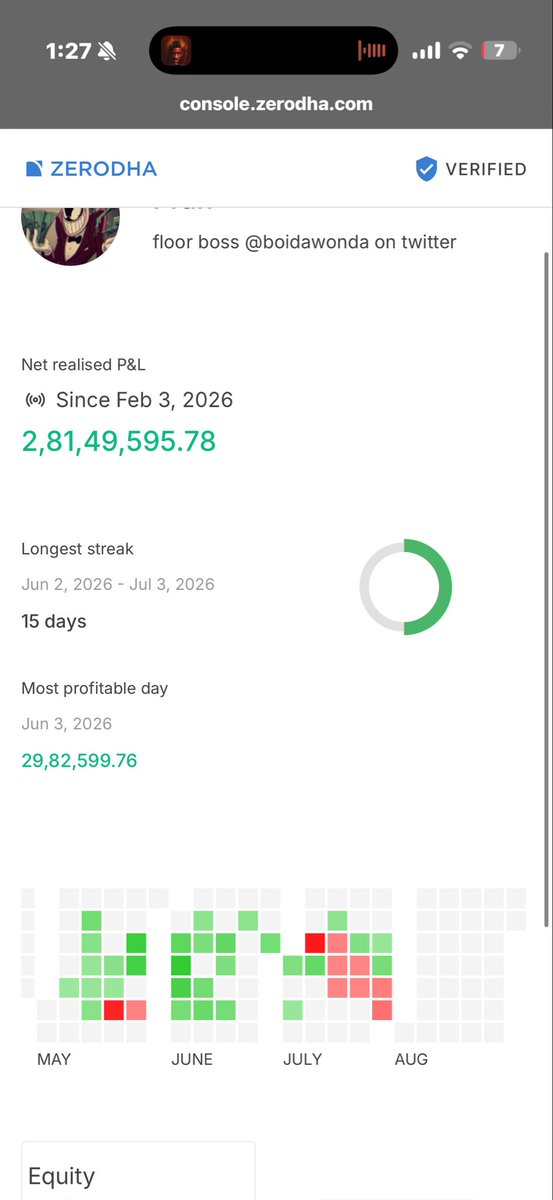
no more pnl sharing from me (or tweets probably lol) until we start clocking 1-2 cr per trade
i'm also tired of being a twitter philosopher just a couple days in
u can always track it here but expecting not much action for the next few months from my side here
https://t.co/avby2qEIWK
it's time to think bigger and go to war
happy with the 2.8 crores profit for the year
but i'm not a trader
open the casino
see u october
-- big bull
“The hard part of process for most people is the first $100,000.”
“If you have a standing start at zero, getting together $100,000 is a long struggle for most people.”
“People who get there quickly are helped if they’re passionate about being rational and underspend their income grossly.”
- Charlie Munger. 1999