I am starting to DCA here, this very Sunday, with the profits from the bull market, and I will buy every Sunday same hour for the next 2 years, let's see how it goes #Bitcoin
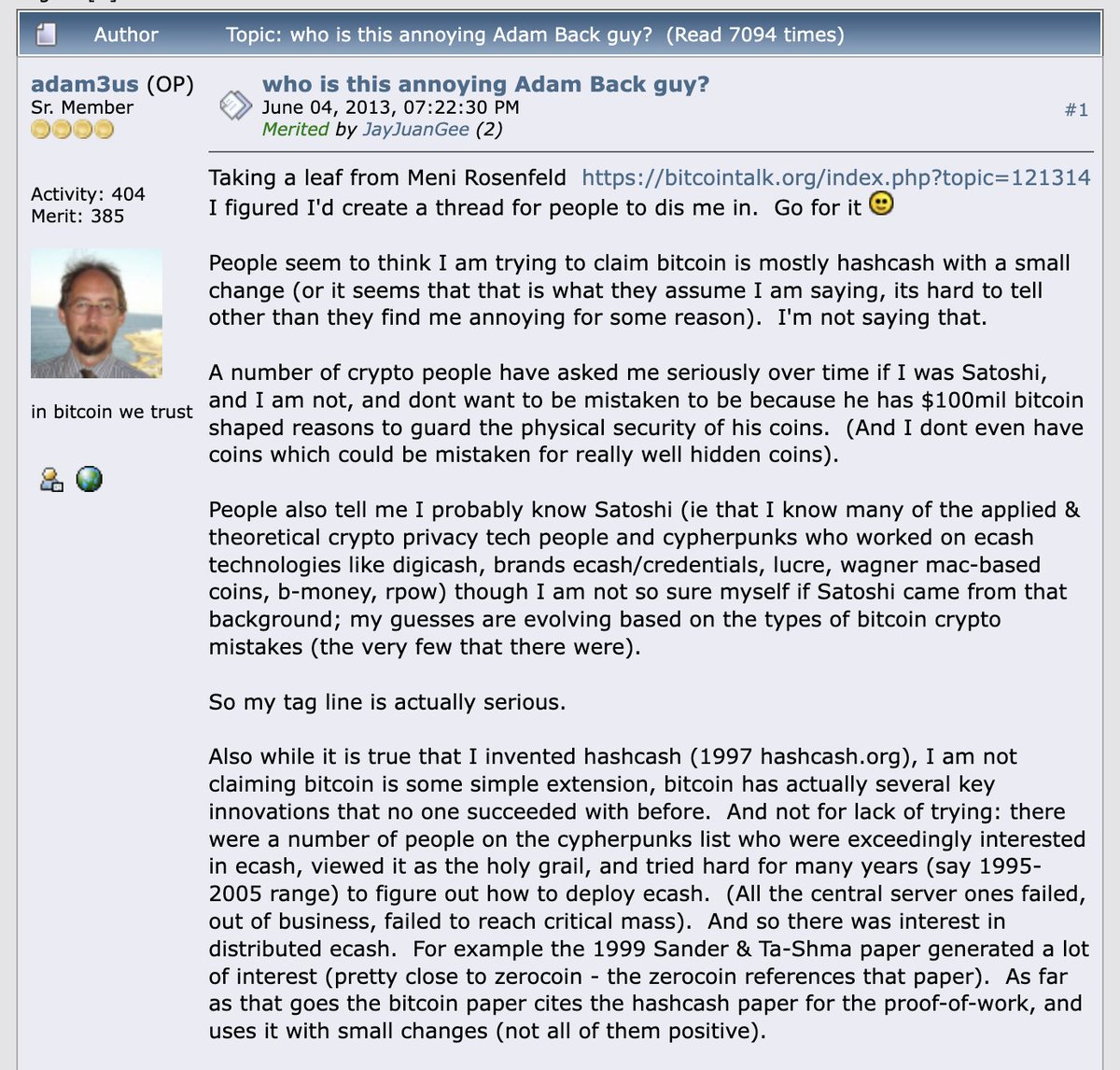
Adam Back is a larper who humblepretends to not be Satoshi to give off the impression that he might be, when he actually isn't.
Back tries to big note himself extremely hard with "hashcash" which was literally a weekend project - an extremely bad one - and he didn't even know what it was for. Just a toy that someone made over a weekend. Satoshi didn't really have any idea about it and just gave Back a citation to be nice.
Then after Bitcoin got traction, Adam Back tried to essentially rewrite history and spruce up hashcash to make it seem like the precursor to BTC. Which it wasn't. He's constantly humblebragging and trying to fake being humble. He did a revival paper five years later, lol, to rewrite history about hashcash.
In OG Bitcoin socials he is well known as "braggy and obnoxious," only the completely uninitiated would find him compelling or insightful.
Even in his recent clips you can see that he loves implying that he has the skills to make Bitcoin (when in reality he doesn't), he's the same loser as he was before. He's also what I would consider a pseudoscammer, because he only came back after Bitcoin got traction, rewrote his involvement, and then raised money from VCs on that premise. Adam Back is the only guy that I (and others from the OG community) am 100% sure is not Satoshi.
(To be fair to him, it's pretty impressive to have messed around with a "proof of wasted effort" for email spam concept in 1997, based on a concept already created in 1992, see someone found an actual use for an adjacent technology, start publishing larpy papers and websites about it, imply you invented Bitcoin, and raise a bunch of money out of it. Good quality scam.)
Also, hashcash wasn't even the first implementation of proof of work. It just had a name that sounded like a currency, lmao. He never invented the concept, he never popularised it, all he did was spend one weekend making "hashcash" and then having zero use for it. Saying "I invented hashcash" and calling things "an implementation of hashcash" is inherently inaccurate and misleading because hashcash isn't the core concept (which he didn't invent anyway), hashcash is just an implementation of precursor concepts (b-money by Wei Dai for instance is a closer precursor to Bitcoin, although probably created independently).
He's probably enjoying the new wave of attention, but Adam Back is not Satoshi. As for who Satoshi actually is, there's a good candidate (who has already been discussed plenty, most people know the name) but he lives a normal life, has a family, and doesn't have a ton of mainstream publicity, so it's respectful to leave him out of things and not broadcast his identity. He's probably happy that Back loves doing his Satoshi-not-Satoshi victory tours.
@StuFinancesTech@lurkaroundfind What are you talking about? $eth premined allocation to the foundation was around 15%, the rest was distributed via public sale... :/
As a concentrated ETH investor, I spend most of my time thinking about why we're *not* going to hit multi trillion.
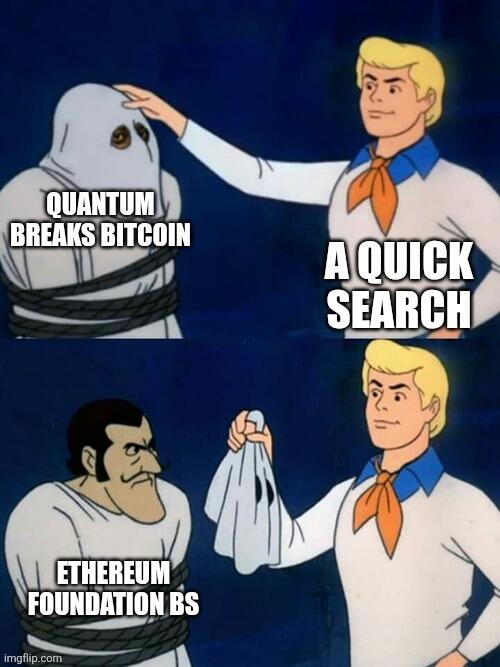
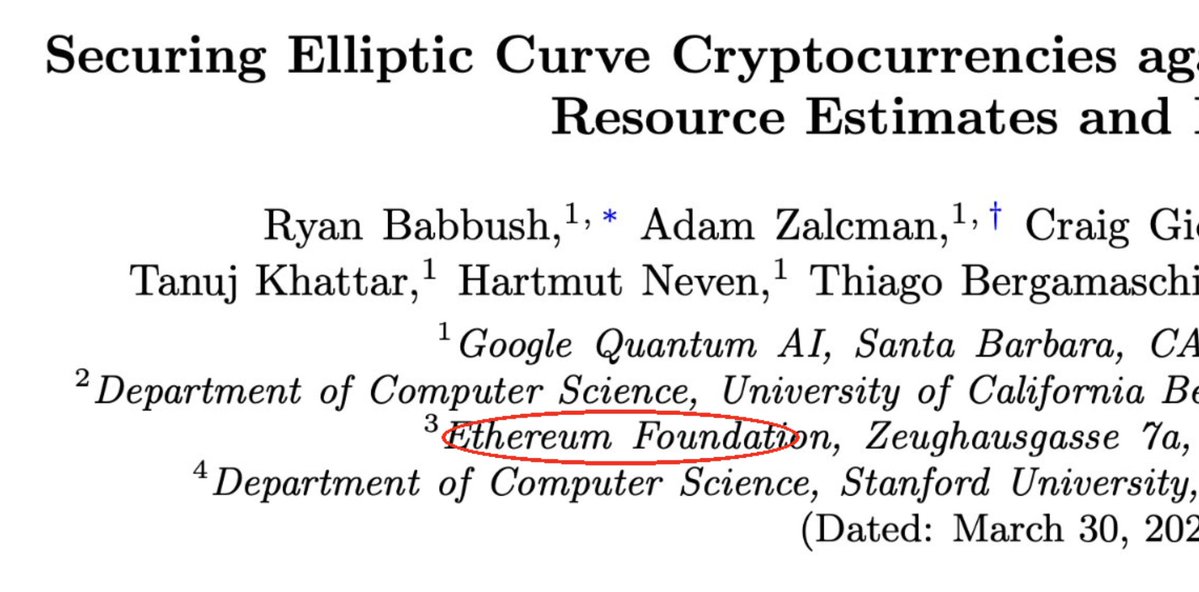
BTC collapsing due to a quantum disaster (real attack or market pricing it earlier) has become perhaps the top bear factor for ETH, because ETHBTC is unlikely to rise enough to offset the fall in BTCUSD.
In the real world, what ETH investors want is
- strong BTCUSD
- rising ETHBTC due to eth growing to global ubiquity
- Bitcoin investors confidently diversifying into ETH
- other investors buying ETH directly
That's how we actually get to multi trillion ETH (~$17k+ ETH)
Brian's new personal involvement in leading Bitcoin through its quantum crisis is crucial and bullish. Hope to see Tether's Paolo join this effort.
Elliptic curve cryptography is on the brink of obsolescence. Whether it’s 3 or 10 years; it’s over and we need to accept that
The only thing that matters is how quickly blockchain developers recognize that they need to bake in cryptographic mutability into their networks
This of course requires an entire reimagining of how these systems work. Today the crypto is hardcoded in. That will have to change
ETH people have already figured this out. Everyone else seems to be petrified in fear. Unless something changes quickly ETHBTC will start to reflect the divergence in prioritisation
This is the new EF Mandate.
For many of you, the contents should be no surprise, and a clarification along the lines that we have been going and thinking for the past few months. But the clarification is nevertheless worth making.
Ethereum is a unique object and has a unique role in the world. Its role is to be a sanctuary technology, to preserve technological self-sovereignty, to enable cooperation without coercion, domination or rugpulling, and to provide an escape hatch, to ensure that no single person, organization or ideology's victory in cyberspace can be total.
The Ethereum Foundation is a steward of Ethereum - the original steward, and today, the steward specifically dedicated to preserving and expanding the above aspects of Ethereum. This means a heavy emphasis on CROPS (censorship and capture resistance, open source, privacy, security), both at the protocol layer, and at the access layer, user-facing applications and tools that we create or contribute to.
There are things that we do in Ethereum because we believe that they are valuable for the underlying goals that we have for Ethereum. There are things that we do not do because from the perspective of our values we find them uninteresting (or worse, harmful). But there are also things that we do not do because while they are useful, they are not our role.
At the Ethereum protocol layer, we focus on decentralization, verifiability, inclusion guarantees, protocol liveness, security and privacy first and foremost. We also value capabilities (eg. L1 scale, account abstraction, perhaps some forms of in-protocol aggregation), particularly because improvements in these capabilities better enable users to properly benefit from Ethereum's CROPS properties and displace the need for higher-layer intermediaries that might weaken the extent to which Ethereum's properties carry over into the full stack.
We also believe that the Ethereum protocol must strive to pass the walkaway test. "We do X to specialize to serve the use cases of today, if more use cases appear later, we will continue to keep adding more EIPs for them later" is logic fit for many other blockchains whose names you hear often on this forum, but we do not believe it is logic fit for a decentralization-first blockchain like Ethereum.
At the application layer, we focus on making "the zero option" - user experience that goes hard on ensuring security and privacy, avoiding dependence on intermediaries, and respecting the user's agency - as high quality as possible. We see this as complementary to work in the Ethereum ecosystem that "goes broad", starting from the world that it exists, and brings it onchain and improves its properties over time. Such work has its natural home outside the EF. We intend to be supportive of such efforts. We believe that the two are complementary: tools that are developed within the EF can be adopted by anyone, including partially, and even partial adoption that improves people's security, privacy and agency is a good thing.
But the form of user experience that is more heavily insistent on CROPS properties is where we want the EF to develop its center of expertise. This does not mean shrinking from the hard questions. We believe in a vision of self-sovereignty that protects users, and does not leave users in the cold to face environments where they lose their life savings if they make a mistake, and click "yes" on a confirmation screen by accident two seconds after. But such protection must be designed based on a philosophical baseline of empowering the user, not empowering centralized organizations that claim to act in the user's name. This quadrant of design space - caring about users' (including non-experts') well-being and safety, and yet insistent on doing this in a way compatible with their agency and freedom, is underserved (not just in crypto, but in the world). We wish to use Ethereum as a platform to build out and showcase this quadrant, and ideally work with others to expand its reach over time.
This is also a new chapter in how we see our position in the world. We must see ourselves not just as the Ethereum community, but also as maintainers of the Ethereum tool within what you might call the CROPS community or the sanctuary tech community, or a dozen of other words that have for a long time been used by people with similar values to us but far outside Ethereum. This means open-mindedness to new conceptions of what things in the world are our natural allies.
Ethereum is not the world. Ethereum is a specific object in the world that is here to have specific properties. The Ethereum Foundation is a specific organization within Ethereum - one steward, not the sole one.
I encourage all to read the mandate in detail; it includes concrete examples of how we intend to deal with the challenges and nuances of these ideas. We are doubling down on Ethereum and are excited about its next chapter.
@MonkeyCharts The worst part is I had like 30% left after figuring out he got fooled overnight. Told him to turn off the bot then I get notifs that he’s still firing
These things are retarded for being so smart
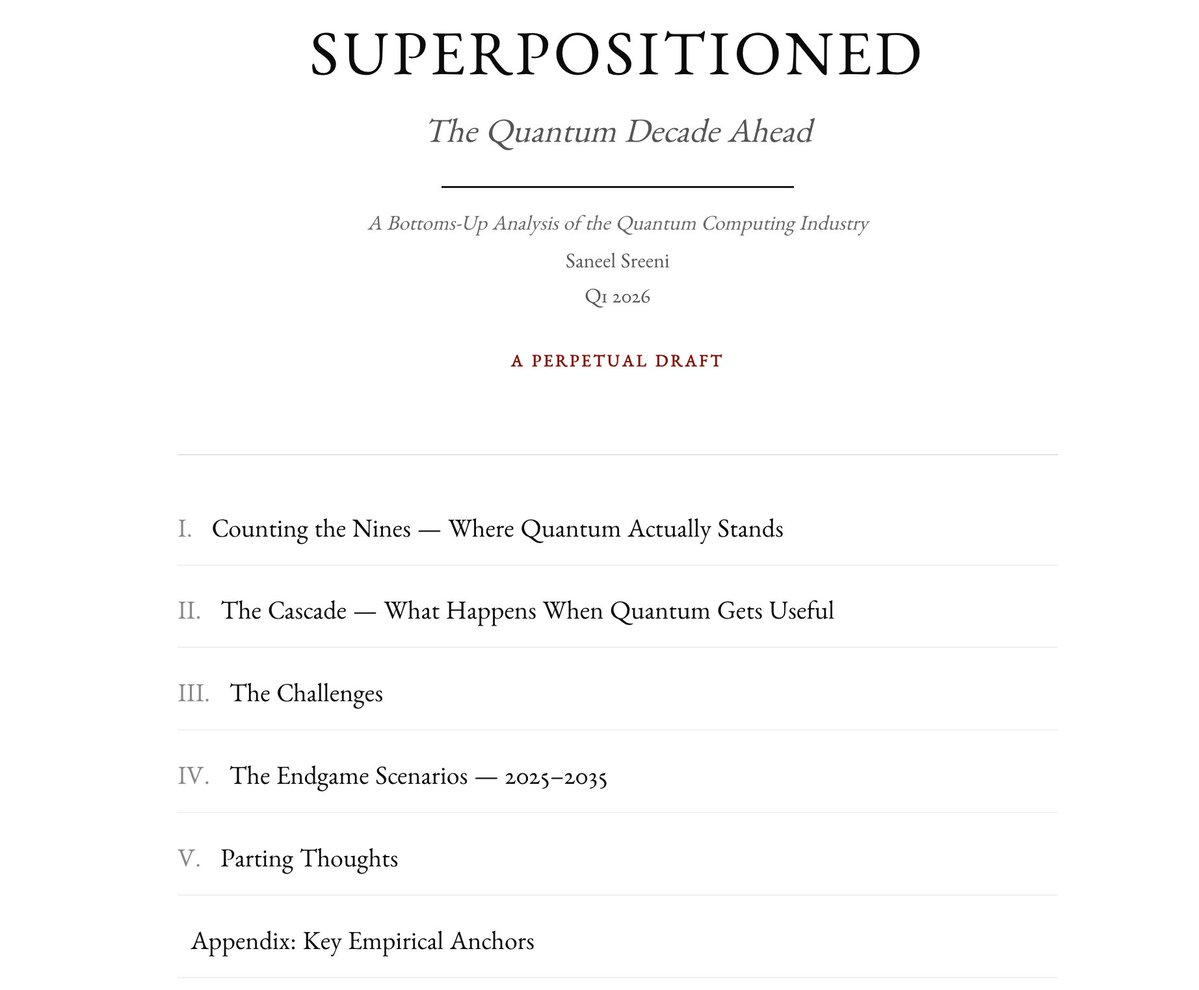
SUPERPOSITIONED: QUANTUM SITUATIONAL AWARENESS
While everyone watches AI, quantum crossed a threshold in 2025 thought impossible 30 years ago.
Yet, no analysis exists covering the breakthroughs, the money, the key players, and what's next.
Until now.
(Link in next tweet).
CT is just a collection of poors hating on anyone with money
vitalik created the second biggest blockchain of all time. he raised $10m and turned it into a network worth $250 BILLION
outside of bitcoin, every crypto innovation that people like was enabled by his work
stablecoins, memecoins, liquidity pools, lending, zk stuff, all of it was bootstrapped on ethereum. even solana only exists because ethereum inspired competition
bro is allowed to sell $40m every once in a while. shut the fuck up
1. built defillama directory
2. built defillama extension that detects scam urls and twitter scams
3. built llamasearch extension
4. built llamasearch into defillama extension
5. built internal product to prevent any scam ads when users search for llamaswap
6. built https://t.co/Avo8N8Sfqg
7. working on it rn
I'm actually trying to do something even more ambitious:
Create "cypherpunk principled non-ugly ethereum" as a bolt-on to the present-day system, in a way that's as tightly integrated and interoperable as possible, and then grow it over time, in the mean time making sure ethereum itself gains the cypherpunk and simplicity properties that just necessarily have to be system-wide (eg. censorship resistance, zk prover friendliness, consensus properties). Then, in 5 years (or maybe way sooner with AI coding and verification, who knows), we have an open pathway to turn the existing system into smart contracts written in the language of the new system if/when we want.
Ethereum has already made jet engine changes in-flight once (the merge), we can do it ~4 times more!
(state tree, Lean consensus, ZK-EVM verification, VM change)
There have recently been some discussions on the ongoing role of L2s in the Ethereum ecosystem, especially in the face of two facts:
* L2s' progress to stage 2 (and, secondarily, on interop) has been far slower and more difficult than originally expected
* L1 itself is scaling, fees are very low, and gaslimits are projected to increase greatly in 2026
Both of these facts, for their own separate reasons, mean that the original vision of L2s and their role in Ethereum no longer makes sense, and we need a new path.
First, let us recap the original vision. Ethereum needs to scale. The definition of "Ethereum scaling" is the existence of large quantities of block space that is backed by the full faith and credit of Ethereum - that is, block space where, if you do things (including with ETH) inside that block space, your activities are guaranteed to be valid, uncensored, unreverted, untouched, as long as Ethereum itself functions. If you create a 10000 TPS EVM where its connection to L1 is mediated by a multisig bridge, then you are not scaling Ethereum.
This vision no longer makes sense. L1 does not need L2s to be "branded shards", because L1 is itself scaling. And L2s are not able or willing to satisfy the properties that a true "branded shard" would require. I've even seen at least one explicitly saying that they may never want to go beyond stage 1, not just for technical reasons around ZK-EVM safety, but also because their customers' regulatory needs require them to have ultimate control. This may be doing the right thing for your customers. But it should be obvious that if you are doing this, then you are not "scaling Ethereum" in the sense meant by the rollup-centric roadmap. But that's fine! it's fine because Ethereum itself is now scaling directly on L1, with large planned increases to its gas limit this year and the years ahead.
We should stop thinking about L2s as literally being "branded shards" of Ethereum, with the social status and responsibilities that this entails. Instead, we can think of L2s as being a full spectrum, which includes both chains backed by the full faith and credit of Ethereum with various unique properties (eg. not just EVM), as well as a whole array of options at different levels of connection to Ethereum, that each person (or bot) is free to care about or not care about depending on their needs.
What would I do today if I were an L2?
* Identify a value add other than "scaling". Examples: (i) non-EVM specialized features/VMs around privacy, (ii) efficiency specialized around a particular application, (iii) truly extreme levels of scaling that even a greatly expanded L1 will not do, (iv) a totally different design for non-financial applications, eg. social, identity, AI, (v) ultra-low-latency and other sequencing properties, (vi) maybe built-in oracles or decentralized dispute resolution or other "non-computationally-verifiable" features
* Be stage 1 at the minimum (otherwise you really are just a separate L1 with a bridge, and you should just call yourself that) if you're doing things with ETH or other ethereum-issued assets
* Support maximum interoperability with Ethereum, though this will differ for each one (eg. what if you're not EVM, or even not financial?)
From Ethereum's side, over the past few months I've become more convinced of the value of the native rollup precompile, particuarly once we have enshrined ZK-EVM proofs that we need anyway to scale L1. This is a precompile that verifies a ZK-EVM proof, and it's "part of Ethereum", so (i) it auto-upgrades along with Ethereum, and (ii) if the precompile has a bug, Ethereum will hard-fork to fix the bug.
The native rollup precompile would make full, security-council-free, EVM verification accessible. We should spend much more time working out how to design it in such a way that if your L2 is "EVM plus other stuff", then the native rollup precompile would verify the EVM, and you only have to bring your own prover for the "other stuff" (eg. Stylus). This might involve a canonical way of exposing a lookup table between contract call inputs and outputs, and letting you provide your own values to the lookup table (that you would prove separately).
This would make it easy to have safe, strong, trustless interoperability with Ethereum. It also enables synchronous composability (see: https://t.co/9jy6v1X6Fw and https://t.co/gZmu3YjebM ). And from there, it's each L2's choice exactly what they want to build. Don't just "extend L1", figure out something new to add.
This of course means that some will add things that are trust-dependent, or backdoored, or otherwise insecure; this is unavoidable in a permissionless ecosystem where developers have freedom. Our job should make to make it clear to users what guarantees they have, and to build up the strongest Ethereum that we can.
karma doesn't drive markets, but bitcoiners surely deserve it for
- embracing DATs
- idolizing a guy that sells $1 of Bitcoin for $1.50 to retail
- believing in fantasies like "the four year cycle" and "stock to flow" or an ever growing MSTR premium
- embracing apocalyptic self-serving ideologies like "hyperbitcoinization"
- denying obvious realities, like the fact that stablecoins stole the MoE crown from BTC
- persisting in delusions like "the lightning network will work any day now"
- spending dev resources on wasteful navel-gazing instead of fixing real problems