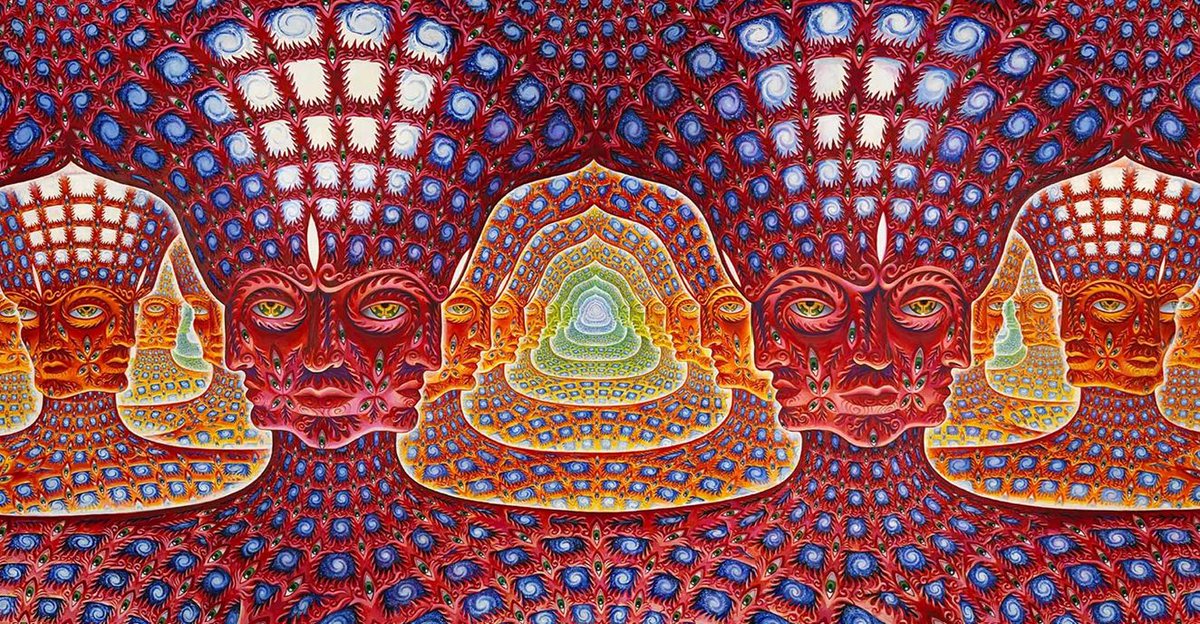
1/10 ¿Y si las entidades autónomas del DMT fuesen realmente conscientes?
Esta es una de las propuestas más locas con las que me he topado en mucho tiempo. Tan absurdo como serio, y tan improbable como interesante.
(preprint) DOI 10.31234/osf.io/8qvgy_v2
Millennials, it's time to choose your midife crisis
1. Date a 23 year old
2. Quit drinking and become insufferable about it
3. Double down on drinking
4. Train for a marathon nobody asked about
5. Have a panic baby (with wife you hate)
6. "We're opening the relationship" (she bangs)
7. Get divorced
8. Get diagnosed with adult ADHD/autism
9. Niche side quests like rock climbing, hyrox, gardening, handstands
Este tipo de contrastes se dan mucho en Nochebuena. Tu primo el que corre con la moto en el circuito de Jerez y el primo ingeniero informático que igual se anima a darse una vuelta después de cenar
La crisis no es solo de los MBA.
Es de un sistema educativo entero diseñado para un mundo donde el valor estaba en acceder a la información, memorizarla y reproducirla de forma ordenada.
Ese mundo ya no existe.
Hoy cualquiera puede acceder a conocimiento técnico de altísimo nivel desde su casa y apoyarse en IA para aprender muchísimo más rápido que antes.
Pero ahí aparece una confusión importante:
informarse no es lo mismo que formarse.
Porque formar a alguien no es solo transmitir contenido.
También es desarrollar:
criterio,
tolerancia a la incertidumbre,
capacidad de integrar contradicciones,
trabajo con otros,
agencia,
profundidad,
y una identidad profesional propia.
Y eso no se resuelve simplemente viendo vídeos, leyendo hilos o preguntándole cosas a Claude.
La paradoja es que cuanto más barata y accesible se vuelve la información, más valiosas serán precisamente las capacidades que menos se pueden automatizar.
Game theory explains why most ambitious people stay stuck at the level they currently operate at. Although their effort feels intense and their output is very real and impressive, their position never changes.
Most go on to blame "bad circumstances" for this. The truth is far worse: they are competing in an already saturated game. And effort in saturated games produces marginal returns, regardless of genuine intensity and razor-sharp focus.
The correct response is not to work harder. It's to identify a game with fewer players and a more exponential payoff curve. Yet, most people refuse to do this because this "new game" has no proof of viability yet, so they remain stuck working with their marginal gains.
They end up spending years exhausted, sometimes in a worse position than before.
Just because saturation is invisible doesn't make it any less lethal.
The fear of the unknown silently collapses your positioning and facilitates inertia.
Arabic has 14 words for love. Each one describes a different stage. And here's what got me. Each one comes from a root that has nothing to do with love. Until you see the connection. And then you can't unsee it.
All 14. Let me walk you through them.
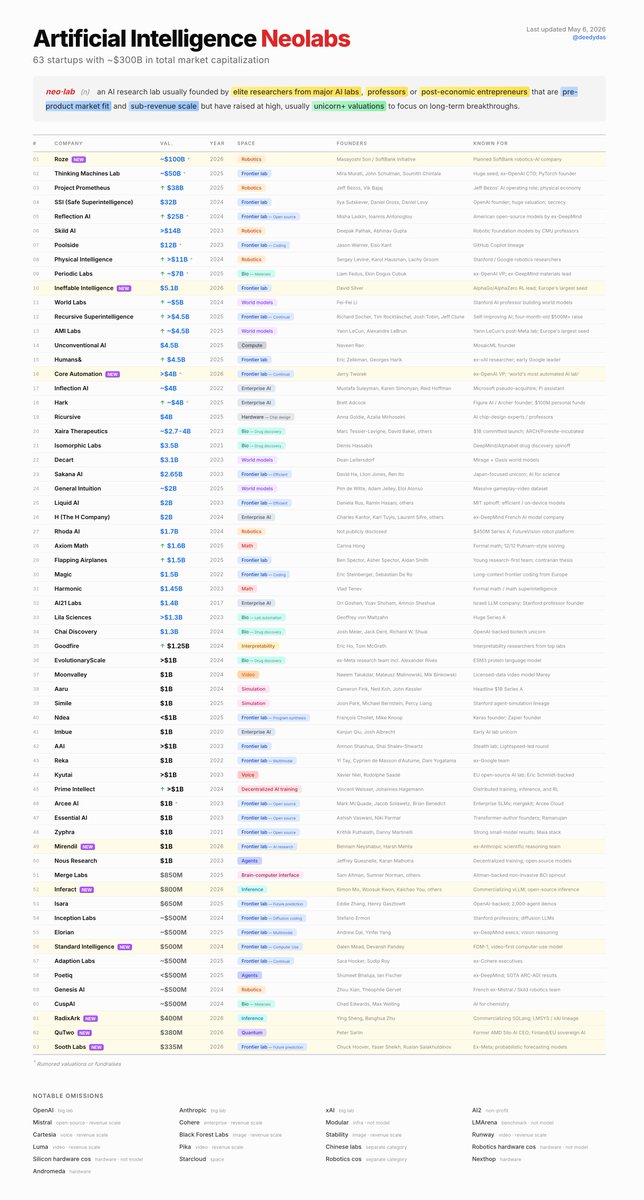
The Ultimate List of Artificial Intelligence "Neolabs": May 2026.
A Neolab is a pre-revenue scale startup working on long-term AI breakthroughs, usually with a $1B+ valuation.
There are now 63 of them!
The older I get the more I realize luck is mostly exposure. The men who seem to get lucky are not blessed. They are just out in the world more. Different rooms. Different people. Different conversations. If your routine has been the same for five years, your luck will be the same for five years. Move around. Talk to strangers. Show up where you do not normally go. The rest of your life is sitting in a room you have not walked into yet.
Game theory explains why working harder inside a broken system is the worst response to that system. Because a system is never truly broken. It's just producing exactly the outcomes its own incentive structures were designed to produce, whether intentional or not. Working harder inside this system increases your output in the payoff matrix, but it simply won't change the actual structure of the system's matrix. Thus, the correct response is not more effort. Instead, you must aim to identify whose interests the current structure serves and position yourself in favor of those interests rather than against them. Change the game, or play the game that is actually being played. Either way, you must stop optimizing for the game you wish it to be and start acting realistically.
MIT proved every major AI model is secretly converging on the same "brain."
It’s called the “platonic representation hypothesis,” and it’s one of the most mind-blowing papers you’ll ever read.
You train a vision model purely on images. You train a language model purely on text.
They use completely different architectures. They process completely different data. They should have completely different "brains."
But as these models scale up, something impossible is happening.
When researchers measure how they organize information, the mathematical geometry is identical.
A model that only "sees" images and a model that only "reads" text are measuring the distance between concepts in the exact same way.
The models are converging.
The researchers named this after Plato’s Allegory of the Cave.
Plato believed that everything we experience is just a shadow of a deeper, hidden, perfect reality.
The paper argues that AI models are doing the exact same thing.
They are looking at the different "shadows" of human data, text, images, audio. And they are independently discovering the exact same underlying structure of the universe to make sense of it.
It doesn't matter what company built the AI.
It doesn't matter what data it was trained on.
As models get larger, they stop memorizing their specific tasks. They are forced to build a statistical model of reality itself.
And there is only one reality to map.
2024, Arxiv
@RAZxxxxxxx De las más críticas en mi opinión es la falta de comunicación, no saber comunicar a tu pareja lo que se quiere ni saber escuchar. Parece básico y se da por sentado pero es bastante común que falle por algún lado.
Terence Tao has won every award mathematics can give a human being.
Fields Medal. Breakthrough Prize. MacArthur Genius Grant.
He is widely regarded as the greatest living mathematician. Not one of. The greatest.
He just said something that should terrify every university on Earth.
Tao: “We live in a particularly unpredictable era. I think things that we’ve taken for granted for centuries may not hold anymore.”
Not years. Not decades. Centuries.
The assumptions governing who gets to contribute to knowledge have been in place longer than most nations have existed.
Tao just told you those assumptions are dissolving.
Tao: “The way we do everything, not just mathematics, will change.”
This is not a man who deals in hyperbole. He builds arguments the way he builds proofs. Piece by piece. Nothing unverified.
When he says everything, he means everything.
Tao: “In math, you previously had to basically go through years and years of education, be a math PhD before you could contribute to the frontier of math research.”
That was the contract. You give a decade of your life to an institution. You grind through coursework, committees, dissertation reviews, postdoc rotations.
Then maybe you get to touch the boundary of what’s known.
The entire system was built on that bottleneck. Time was the gate. Credentials were the key.
Tao: “Now it’s quite possible at the high school level that you could get involved in a math project and actually make a real contribution because of all these AI tools.”
A high schooler. Contributing to frontier mathematics. The same frontier that used to require a decade of institutional obedience to even approach.
He said this about math. He already told you this applies to everything.
AI didn’t just speed up the path. It removed the path entirely.
The university sold you a ten-year toll road. AI just paved around it overnight.
The toll booth operators haven’t realized yet that no one’s coming.
Tao: “In many ways, I would prefer the much more boring, quiet era where things are much the same as they were ten years ago, 20 years ago.”
This is the line that should haunt you.
The smartest mathematician on the planet would rather this wasn’t happening.
He is not selling this. He is not positioning himself for a funding round.
The acceleration is so violent that even the mind best equipped to process it would prefer it stopped.
If Tao is uncomfortable, you should be paying very close attention to your own assumptions about what’s coming.
Tao: “The things that you study, some of them may become obsolete or revolutionized, but some things will be retained.”
That word “some” is doing enormous work in that sentence.
It means the rest won’t be.
Entire fields that people spent their careers building will collapse. Not slowly. Not politely. And Tao is telling you he can’t predict which ones survive.
Tao: “You should be open to very, very different ways of doing science, some of which don’t exist yet.”
Most people will scroll past this. It’s the most important line in the entire clip.
He’s not saying learn new tools. He’s not saying adapt your workflow.
He’s saying the methods themselves haven’t been invented yet.
The frameworks don’t exist.
You cannot prepare for what hasn’t been created. You can only build the kind of mind that doesn’t break when the ground shifts beneath it.
Tao: “It’s a scary time, but also very exciting.”
He said scary first.
Every tech founder says exciting first and mentions risk as a footnote.
Tao reversed it.
When the most brilliant mind of a generation leads with fear and follows with possibility, that is not optimism.
That is a man telling you the truth about what’s coming while still choosing to walk toward it.
The people who survive the next decade won’t be the ones with the best credentials.
They’ll be the ones who stopped mourning the world that was and started building for the one that doesn’t exist yet.