China's Unitree Will Dominate Global Robotics
The Fastest Iteration Cycle In Next-Gen Robotics Should See Unprecedented Acceleration
https://t.co/0HKSayvvTK
🚨 BREAKING: Claude can now map out your retirement better than most people charging $3,000 ever will.
Here are 6 prompts to figure out exactly when and how you can retire.
(Save this before it disappears).
We just handed our investors a $4.3M tax loss on a new construction apartment building in Dallas.
That's 53% of the amount they originally invested.
The 2025 return is filed. Here's the exact math.
Total cost was $19.8M, Investors put in $8.2M, a bank lent us the other $11.6M
We built it in the Cedars, just south of downtown.
Here's how the loss works.
The IRS lets you depreciate an apartment building over 27.5 years. Slow and steady.
A cost segregation study speeds it up. An engineer walks the property and breaks it into parts: cabinets, lighting, flooring, appliances, landscaping, parking. Each part has its own shorter life.
On this building, the study pulled $4.3M of the $13M depreciable basis into 5-year and 15-year buckets.
Then the new tax law did the rest.
Under the One Big Beautiful Bill Act, Congress brought back 100% bonus depreciation. So instead of spreading those shorter-lived parts over five and fifteen years, we wrote all of it off at once.
$4.3M of deductions available as soon as we placed the building into service
It's not a loophole. It's the tax code working as written to get housing built.
Now, who can use a loss like this?
Rental real estate losses are passive. A passive investor can only use them against passive income—the kind that comes from other rentals or syndications. They can't wipe out a salary.
Two groups put these losses to work:
--> The investor with passive income from other deals, who uses this loss to shelter it.
--> The high earner who qualifies as a Real Estate Professional, who can take passive losses against active income.
At a 37% rate, a $4.3M loss is about $1.6M of tax that doesn't get paid this year.
One more piece makes those losses usable at all.
Our construction loan is qualified nonrecourse debt. That means investors add their share of it to their tax basis, not just the cash they put in. With $11.6M of debt behind $8.2M of equity, there's room to absorb the full loss.
A paper loss you can't use is worthless. This one, they can use.
Some haters will read to this point and say, "BUT WHAT ABOUT DEPRECIATION RECAPTURE!?!"
When you sell a building, the IRS wants those deductions back. They call it depreciation recapture, and it takes a real bite out of the gain. The IRS adds up all the losses you've taken over the hold period and taxes them at 25%.
Investors can avoid recapture in two ways:
A 1031 exchange defers the tax. You roll the proceeds into another property and keep the clock running.
Or you build using the Opportunity Zone tax structure.
This asset, The Marcus, sits in an OZ census tract, and our investors all came in with capital gains.
Hold the investment for ten years and you pay no tax on the appreciation and no recapture on the depreciation.
The $4.3M loss against this year's income will be tax free.
The appreciation on this $19.8M building will also be tax free.
Most tax strategy pushes the bill into the future.
Opportunity Zones get rid of it.
A crazy tax idea for Elon Musk.
He could become the biggest OZ investor in history.
The IPO is the trigger.
SpaceX goes public June 12 under the ticker SPCX and the valuation might go to $2 trillion. The largest IPO ever.
Insider lockup runs 180 days. It expires around December 15.
The day it ends, insiders can sell. Every share sold throws off a capital gain. For Elon, holding billions in SpaceX paper, the gain is staggering.
Under the new Opportunity Zone rules that take effect January 1, 2027, any capital gain rolled into a Qualified Opportunity Fund within 180 days of the sale earns a five-year tax deferral.
Sell in late December 2026. Invest in early 2027. The tax bill is not due until 2032.
If the QOF investment is held for ten years, the entire appreciation comes out tax-free. No capital gains. No depreciation recapture. Zero.
But Elon isn't going to suddenly start investing in apartments or hotels in low income areas. He is going to remain obsessed with investing in his core businesses.
Good news.
The town of Starbase, Texas sits inside an Opportunity Zone census tract. Grimes County, where Musk is building a $55 billion semiconductor fab called Terafab, has three OZ tracts of its own.
Elon could sell SPCX shares after lockup. Roll the gain into his own Qualified Opportunity Fund. Use that fund to build infrastructure at Starbase or finance the Terafab site.
Then lease the asset back to the public company.
SpaceX pays the rent. The rent is deductible to SpaceX. The depreciation flows to Elon and offsets his other income for a decade.
Then he sells the QOF interest in 2037.
No tax on the appreciation. No recapture on the depreciation. The original gain that funded it all was deferred to 2032.
The IPO funds the infrastructure. The infrastructure runs the company. The taxpayer pays nothing for ten years and almost nothing forever.
This is the crazy idea.
The mechanics are real. The zones are real. The IPO is real.
I am glad to advise his tax team. 🤠
Every dollar you take from the market is more than just money, it’s time.
It’s freedom.
It’s a piece of your life that you no longer have to trade away doing something you don’t want to do.
Think about how much time people give up just to earn a single dollar.
Some wake up before dawn, commute for hours, and spend their entire day at a job they hate just to make barely enough to survive.
Others grind away at physically exhausting labor, breaking their bodies for wages that never seem to be enough.
When you see money for what it truly is, thus energy, time, and sacrifice, you start to realize that every dollar deserves to be respected.
Glorifying every dollar doesn’t mean being obsessed with money for the sake of it.
It means understanding what it represents.
If you pull $100 from the market, that might be an entire day's wage for someone working a job they can’t stand.
If you make $1,000, that’s someone’s entire week, spent dealing with a boss they hate, stuck in traffic, drained and exhausted and you did it in minutes, from a screen, with nothing but skill, patience, and the right execution.
This is why preserving every dollar matters.
Every dollar kept is another moment of your life bought back.
Every dollar wasted is time you’ll never get back.
The people who treat money carelessly, who gamble it away without thought, are choosing to stay trapped in a cycle where they have to keep selling their time to survive.
The ones who respect what they earn, who protect and grow it with discipline, are the ones who break free.
And breaking free isn’t just about making money, it’s about knowing how to keep it, compound it, and multiply it.
This is where technical skill, discipline, and long-term thinking separate those who succeed from those who don’t.
Understanding capital preservation means knowing that every unnecessary loss pushes financial independence further away.
A trader who consistently protects their profits extends their ability to take more opportunities, allowing their edge to play out over time.
A reckless trader, on the other hand, can have the best strategy in the world but will ultimately fail if they don’t know how to manage risk and hold onto what they make.
The math behind compounding is simple but ruthless.
If you lose 50% of your account, you don’t need a 50% gain to recover, you need 100%.
If you take unnecessary drawdowns, you aren’t just losing money, you’re losing time, options, and the ability to scale.
Every dollar preserved keeps you in the game longer, giving you more chances to leverage your skill and execute properly when the best opportunities arise.
Those who dismiss small profits, who fail to respect every dollar, are often the ones who never reach true financial freedom because they don’t see money for what it really is, a tool to reclaim control over your own life.
Remember that if you are in a rush to use your money, do not be surprised if your money is in a rush to go somewhere else.
CLAUDE FULL COURSE 4 HOURS
This is the most detailed Claude guide I’ve seen online.
Bookmark this before you forget.
4 hours.
Build tools.
Automate work.
Learn how people build bots and systems.
Claude → Tools → Automation → Products → Money
@zostaff Great guide. Level 5 is the real insight — the multi-agent debate is where the edge lives. We built the same architecture but run it across 85 models simultaneously on 500+ tickers every night. Users get the tier-3 consensus signal, not the terminal.
https://t.co/ig4x2xyLai
One of my favorite loopholes in the US tax code:
If a married couple earns more than $246K, they cannot contribute directly to a Roth IRA
But, they can instead use their 401k to get $140K into their Roth IRA every single year
Here's how the "mega backdoor Roth" works:
Caught up with @karpathy for a new @NoPriorsPod: on the phase shift in engineering, AI psychosis, claws, AutoResearch, the opportunity for a SETI-at-Home like movement in AI, the model landscape, and second order effects
02:55 - What Capability Limits Remain?
06:15 - What Mastery of Coding Agents Looks Like
11:16 - Second Order Effects of Coding Agents
15:51 - Why AutoResearch
22:45 - Relevant Skills in the AI Era
28:25 - Model Speciation
32:30 - Collaboration Surfaces for Humans and AI
37:28 - Analysis of Jobs Market Data
48:25 - Open vs. Closed Source Models
53:51 - Autonomous Robotics and Atoms
1:00:59 - MicroGPT and Agentic Education
1:05:40 - End Thoughts
Game theory
Most people are playing the wrong game.
If you want to get rich, there are only 3 games that actually matter.
Everything else is a distraction
1/ Today I’m releasing an open-source book in collaboration with @FrankResearcher that I wish existed when I started in crypto. It’s split into 15 chapters covering everything that matters - from BTC to DeFi, MEV, Hyperliquid, quantum resistance, etc.
https://t.co/oDYsukFxvF
BREAKING: Microsoft just released its own "OpenClaw" called Copilot Tasks.
It can automate almost anything on your computer, quietly and without slowing your workflow.
Here are 10 plug-and-play prompts you can test right now 👇
STEM for KIDS:
National Geographic Kids.
NASA Space Place.
How Stuff Works.
Extreme Science.
Science Buddies.
Go Science Kids.
Exploratorium.
YouTube Kids.
EPA Students.
Instructables.
STEM Works.
Khankids.
Funology.
MathTV.
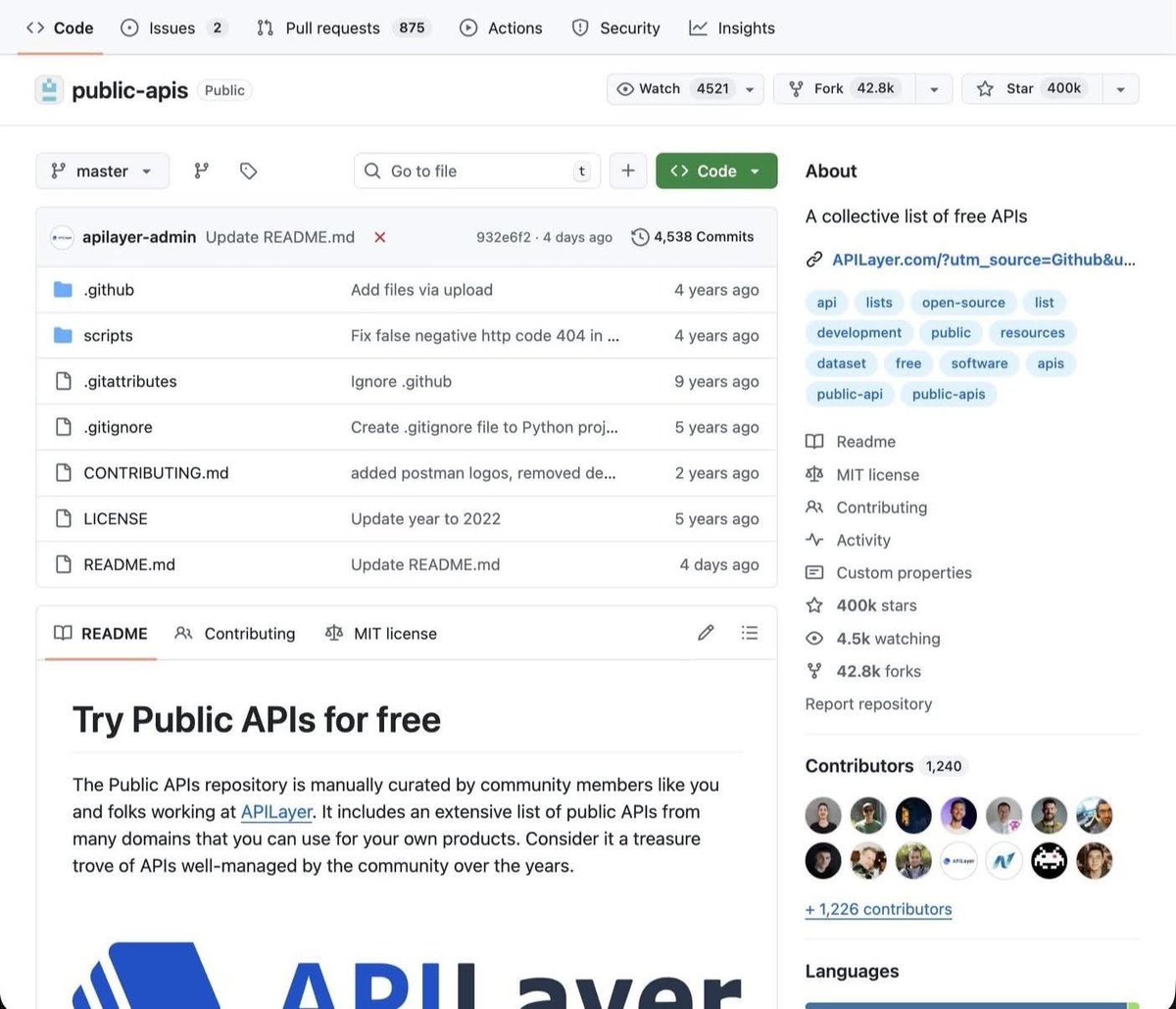
🚨𝗕𝗥𝗘𝗔𝗞𝗜𝗡𝗚: Build your next app without spending a dollar on data.
Someone made a list of 320,000+ free public APIs, and developers are going crazy.
→ Weather, finance, news, sports, crypto
→ AI & machine learning APIs you can call right now
→ Government open data, maps, geolocation
→ Entertainment: movies, music, games, anime
→ Categorized, searchable, and verified as working
Free and 100% open source. Link Bellow:👇
honestly..Claude + Local SEO is going to quietly create a bunch of business “blue collar millionaires” this year.
This feels exactly like when people figured out Facebook ads in 2016-2017.
Average businesses were beating better businesses… just because they understood distribution first.
We’re in that same window again.
But this time, your alpha isn’t ad spend.
It’s how fast you can publish helpful local pages + optimize your Google Business Profile before your competitors even wake up.
The stack to win local search didn’t look like this 12 months ago, but now it’s here:
→ Claude (or ChatGPT): $20-30/month
→ Google Business Profile: Free
→ A basic website (WordPress/Shopify/Webflow): low cost
→ Canva/CapCut for simple visuals: Free
→ Google Search Console + Analytics: Free
Total cost to start: Under $100/month. And people used to pay agencies $1k–$3k/month just to move slowly.
Here’s how to use it:
Step 1: Find your local keywords with Claude
You don’t need to guess anymore.
Give Claude your services + your city/areas. Ask it to list:
- A “service + location” keywords
- “near me” intent keywords
- emergency keywords
- comparison keywords (best, affordable, etc.)
Step 2: Build service area pages (fast)
Tell Claude your exact offer, prices, process, and service areas.
Ask it to draft pages for each area you serve (one page per area).
Then you add the real stuff: photos, reviews, FAQs, and a call button.
Step 3: Turn your Google Business Profile into a lead machine
Ask Claude to write:
- GBP description
- services list (with short blurbs)
- 20 FAQs + answers
- weekly Google Post ideas (offers, tips, before/after)
Step 4: Create “proof” content that ranks
Claude can turn one job into 10 pieces of content:
- a short case study page (“AC repair in Bandra: fixed in 45 mins”)
- a Google Post
- a simple Reel script
- a FAQ update
Step 5: Get reviews + replies done in minutes
Ask Claude to write 3 review request texts and a review reply template.
Then do the only part AI can’t: actually ask customers.
This isn’t magic.
It’s the same local SEO fundamentals… but now you can execute 10x faster.
And the businesses that publish first will collect the calls.
The tax code incentivizes real estate investment through ACCELERATED depreciation.
Buy a $2M building → Take $600K in deductions YEAR ONE.
Our clients understand this well.
Here's how we have helped them defer over $1 BILLION in tax in the last 3 years: