The longer I build software, the less I believe in perfect architecture.
Requirements change.
Teams change.
Products change.
The code that survives is usually the code that's easiest to change.
Heading to Delhi on 6th June to stand with @abhijeet_dipke and my Indians who genuinely care for our nation (Cockroaches …. I’m proud to be one)
Viksit Bharat isn’t a slogan for us…. it’s a calling.
We don’t want politicians engaging only in politics.
We want politicians with a VISION for our country.
We want a roadmap for Health, Education, Infrastructure, Jobs, real per capita growth.
In my request to our political class, the youth aren’t your adversaries, engage with them, listen to them, they ARE the future of the Viksit Bharat, you claim to build by 2047.
Please let it be Peaceful, Purposeful and Patriotic.
“With great power comes great responsibility”.
As a first step….. take responsibility.
Min. Dharmendra Pradhan should resign before 5th June.
Let genuine, hardworking students rise to the top.
Stop the paper leaks.
We don’t need the Air Force to secure an exam.
We need an Education Minister who actually cares about education.
Let the cause be Peaceful, Purposeful and Patriotic.
#SackDharmendraPradhan
Jai Hind 🙏🇮🇳
I read a Forbes piece this week about career pathways breaking down in the AI era. It said something that stopped me completely.
"Jobs remain. Yet pathways weaken."
Four words. The whole problem in four words.
We are not in a job displacement crisis yet.
We are in a career development crisis right now.
And the people paying the highest price are the ones who haven't been in the workforce long enough
to have built their foundation before the ground shifted.
Claude AI Usage by Country (2026) 🤖
🇮🇱 Israel — 4.90x (Most Usage)
🇸🇬 Singapore — 4.19x
🇺🇸 U.S. — 3.69x
🇦🇺 Australia — 3.27x
🇨🇭 Switzerland — 3.21x
🇨🇦 Canada — 3.15x
🇰🇷 South Korea — 3.12x
🇳🇿 New Zealand — 3.11x
So many jobs lost. Sad.
But spare me the performative grief.
Most of them will get severance.
Most are highly skilled and will find another role.
A few will suffer more than others — especially those hit by ageism — but this is still not the humanitarian collapse Twitter wants it to be.
Companies are not families.
They are for-profit machines.
They owe employees fair pay while employed, a humane exit, and decent severance if possible — not lifelong emotional loyalty.
All this public “tch tch” mourning is mostly noise from people who want to cosplay moral outrage for engagement.
He got rejected,
But still made it to the offer round.
Rejection emails are not always the end.
Sometimes, they are clues.
A candidate named Aditya applied for a role and got instantly rejected.
Reason?
The job required candidates who could join within 30 days.
His application mentioned 30 to 45 days notice period.
Most people would move on.
But he did something different.
He read the rejection email carefully, spotted the real reason, fixed the input, and applied again.
This time?
He got shortlisted.
Cleared the interviews.
And is now in the final offer round.
Lesson:
Before you move on from a rejection, check the actual reason.
Sometimes it is not your skills that got rejected.
It is just a filter.
@GithubProjects Vibe Coding in 2026:
After “Nobody Knows How It Works”
comes the final folder:
📂 Production
┣ 📂 It’s live
┣ 📂 Users love it
┗ 📂 Please don’t ask me to add a feature
🤖💀
#Trending#AI#Tech
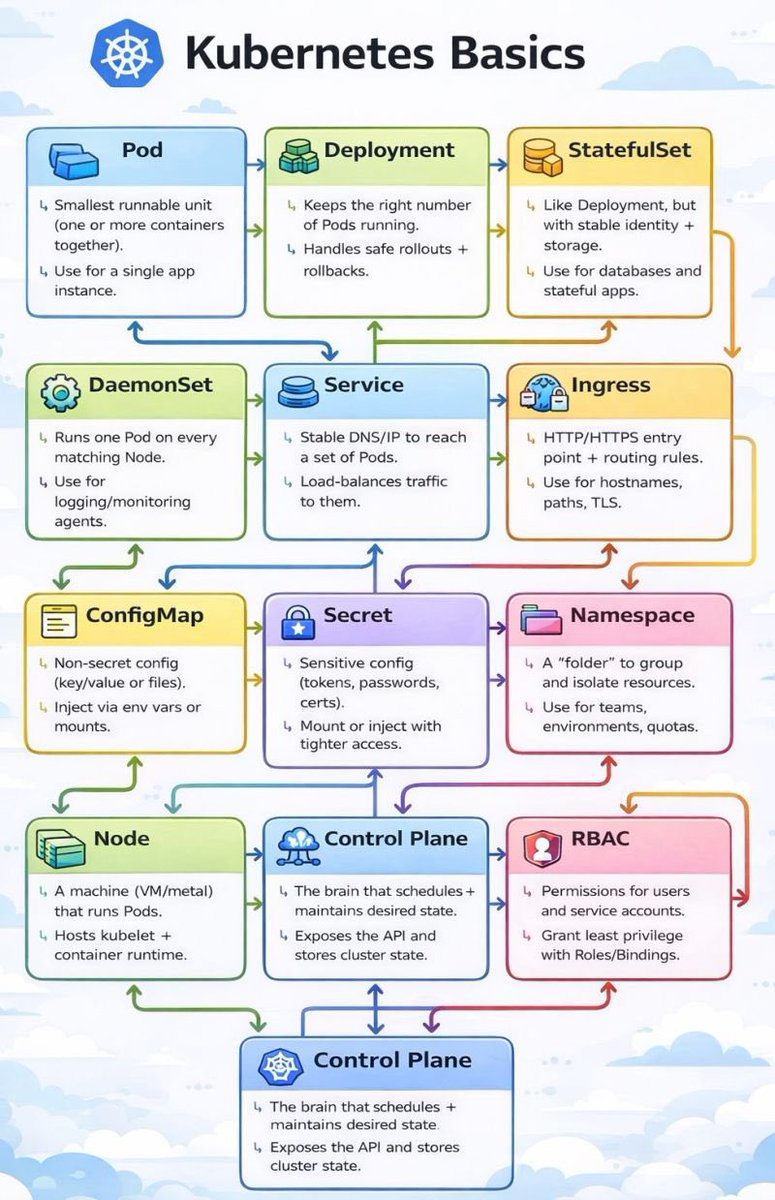
Kubernetes in Plain English (Made Simple)
Kubernetes can feel overwhelming at first: Pods, Deployments, Services, Ingress, RBAC, etc..
Here are the core concepts explained simply:
🔹 Pod → Smallest unit. Runs your app.
🔹 Deployment → Keeps the right number of Pods running.
🔹 StatefulSet → For stateful apps like databases (stable identity + storage).
🔹 Service → Stable IP/DNS to access Pods.
🔹 Ingress → Internet entry point (HTTP/HTTPS routing).
🔹 DaemonSet → Runs one Pod on every node (e.g. monitoring/logging).
🔹 ConfigMap → Non-sensitive configuration data.
🔹 Secret → Sensitive data (passwords, tokens).
🔹 Namespace → Logical separation (dev/test/prod).
🔹 Node → Worker machine (e.g. EC2 instance in EKS).
🔹 Control Plane → Brain of the cluster.
🔹 RBAC → Permission system.
💡 Think of Kubernetes like a building:
Pods = App rooms
Nodes = Buildings
Deployment = Manager
Service = Reception
Ingress = Main gate
RBAC = Security guard
Simple analogies make complex systems easier to understand.
As a DevOps Engineer, breaking down tough topics helps in interviews and real production troubleshooting.
Master These 12 Microservices Patterns to Build Scalable Systems!
Microservices architecture is all about scalability, resilience, and efficiency—but without the right design patterns, things can get messy fast!
Here are 12 essential microservices patterns every developer should know:
1. API Gateway Pattern – A single entry point that routes requests to the right microservice.
2. Saga Pattern – Breaks distributed transactions into smaller steps with compensating actions.
3. Event Sourcing Pattern – Stores all changes as a sequence of events instead of just the latest state.
4. CQRS – Separates read and write operations for better scalability and performance.
5. Strangler Fig Pattern – Gradually replaces monolithic applications with microservices.
6. Service Discovery Pattern – Automatically finds and connects microservices without hardcoded addresses.
7. Circuit Breaker Pattern – Stops a failing service from overloading the system by blocking further calls.
More in graphics below.
Consider reposting if you found this helpful!