to reverse & stop brain drain, a simple solution is to allow a private player to build & manage a city (entry controlled by that private player) with 2000 sq km area (singapore has only 750 sq km) in western coast or deccan plateau, which will offer world class civic amenities, and then build GCCs and other corporate HQs and research labs. This city will be a true global hub. GOI may also give this city Dubai type tax benefits to stop capital migration from India for tax reasons.
to reverse & stop brain drain, a simple solution is to allow a private player to build & manage a city (entry controlled by that private player) with 2000 sq km area (singapore has only 750 sq km) in western coast or deccan plateau, which will offer world class civic amenities, and then build GCCs and other corporate HQs and research labs. This city will be a true global hub. GOI may also give this city Dubai type tax benefits to stop capital migration from India for tax reasons.
ex-CEO of Goldman Sachs just revealed his entire portfolio - 98% equities, 90% single stocks - and he trades every single day from his iPad
"the difference between somebody who's really really good and somebody who can't make it is not that great"
"I thought SpaceX was overpriced at $100 billion - they're now proposing $1.75 trillion"
"I've known people in high office - after they finish speaking they say how did I do - they want affirmation - people are a lot more insecure than you think"
bookmark & watch the full podcast ↓
NVIDIA CEO, Jensen Huang:
"Nobody writes prompts anymore. The new job is to write and handle loops."
He calls it the shift that defines the rest of 2026.
Interview was out just yesterday.
Watch the 23 minute talk, then save the full framework below👇
Nuclear batteries like the ones @zeno_power is making store hundreds of times more energy per kg than chemical batteries
They just announced their taking over the first commercial nuclear license the AEC ever commissioned in 1957
Right next to Silicon Valley - heres why 🧵
I can't believe this is real
I have GLM 5.2 running 100% locally on my Mac Studio. 2 bit quant.
The results I'm getting are better than Opus 4.8
It's now powering my Hermes Agent and Codex. 100% free, local, private super intelligence on my desk
I also have it in a loop coding for me 24/7 now
I thought we were at least a year away from this type of event. It happened today.
The model takes up about 250gb of memory. So you can technically run it on a Mac Studio with 256gb, but you probably want the 512gb memory version (please tell me you listened to me 5 months ago when these were sitting on store shelves)
With Fable gone, I now have Opus 4.8 level intelligence on my desk for free. This is the future.
Local, private, secure, personal super intelligence.
If you're still writing off local AI as a fad or engagement bait, you are officially delusional
🤯 Midjourney -- yes, the AI image company -- just shipped a brand new type of imaging machine. 🤯
- 100x faster than an MRI.
- 10x cheaper.
Full body scanned in 60 seconds instead of an hour in a tube. Ultrasound based, MRI-level resolution.
And it's real -- not a concept, a working machine. You step into a shallow pool of warm water, a ring of half a million sensors sends sound through your body from every angle, and ~60 seconds later you have a 3D map of your insides down to a fraction of a millimeter. No radiation, no tube, no lying still.
They're not even building it as a hospital machine -- they're building a spa. The scan is a side-effect of a place you'd want to hang out anyway.
Lastly, it is built by 9 people. NINE PEOPLE.
You can just do things.
AMD ACABA DE MATAR LAS SUSCRIPCIONES DE IA
La CEO de AMD Lisa Su presento oficialmente una PC del tamaño de una lonchera y ejecuto en vivo un modelo de 235 mil millones de parametros
Sin centro de datos. Sin nube. Sin GPU alquiladas
El chip en su interior es el AMD Ryzen AI Max+ 395
Es el primer chip x86 en el que la CPU y la GPU comparten el mismo bloque de memoria
Hasta 128 GB de memoria unificada
Una RTX 5090 te ofrece 32 GB de memoria de video
Una 4090 te da 24 GB
Pero esta pequeña maquina te ofrece mas de tres veces la memoria de cualquiera de ellas
Y cabe en una mochila
En inferencia con DeepSeek R1 le gano a una RTX 5080 por 3x
Una desktop del tamaño de un libro grueso superando una tarjeta grafica de mas de mil dolares en una carga de trabajo real de IA
Ahora haz las cuentas de tus suscripciones
Claude Code Max: $200 al mes
ChatGPT Pro: $200
Cursor: $20
Gemini: $20
Son $5,280 al año antes de construir una sola cosa
La version de 128GB de esta maquina cuesta entre $1,800 y $2,500
A ese ritmo se paga sola en menos de un año
Y despues corre sin costes adicionales, GRATIS
> Instalas Ollama
> Bajas Qwen3 235B
> Apuntas Claude Code a localhost
> La misma interfaz que ya usas
> Nada sale de tu maquina
> Nada cuesta por request
> Sin limitaciones a las 3am cuando por fin tienes tiempo para construir
Los abogados dejan de preocuparse por lo que OpenAI hace con sus archivos
Los developers dejan de ver el contador de tokens
Los founders dejan de matar prototipos porque la factura de la nube los asusta
La IA local ya no es solo una opcion mas economica
Es la unica IA que nadie puede quitarte
Y la pregunta ya no es si la IA local es lo suficientemente buena
Esta claro que si lo es
La verdadera pregunta es por que seguir pagando suscripciones cada mes cuando puedes correrla tu mismo
We rotated EARLY into memory names like $MU and $SNDK before the crowd.
Then we caught the AI / semi move with $ARM $NVDA and $AMD.
Then photonics / optics exploded:
$AAOI $NVTS $ALAB
Then infrastructure and data centers started running:
$TTMI $IREN $CIFR $CORZ
Space followed:
$ASTS $RDW $LUNR
Software is now starting to emerge with $NOW and $CRM.
What’s next?
1. Continuing to trim extensions and rotate strength
2. Watching consumer laggards like $NKE
3. Watching travel names like $CCL $AAL $DAL
Holding cash for major dip buys on AI leaders.
We rotate BEFORE the crowd. You need buy the fear and pullbacks in Bull runs.
I will make sure those following become Millionaires.
Germany is a sleeping giant of physical AI
everyone's been writing Germany off in the AI race because there's no German OpenAI and no big data center story.
but theres actually two AI races happening:
the first is software. chatbots, LLMs, data centers. US/China are winning that, not even close.
the second one is physical. robots that pick up boxes, weld cars, carry groceries, stack pallets.
and on this one Germany is one of the top contenders in the world
this stat might convince you (it convinced me):
Germany is 3rd in the world for robots per factory workers (449 robots per 10,000 human workers).
only South Korea (1,220) and Singapore (818) are ahead.
Japan is behind at 446. the US is all the way back at 307.
so Germany already runs more of its economy on robots than almost anywhere else on earth.
and the German companies building this next wave of physical AI are some global heavyweights.
a few worth knowing...
> Neura Robotics in Metzingen is building humanoid robots and raising €1B from Tether at a €4B valuation (this was March 2026). Volvo already in from an earlier round.
> Sereact in Stuttgart raised $110M in April 2026 to build the software brain that lets robots see and grab things. already runs 1 billion+ real-world picks for BMW, Mercedes, and Daimler Truck.
> Agile Robots in Munich was the worlds first robotics unicorn. revenue doubling yearly, around €200M now, heading for €1B.
>RobCo in Munich raised $100M in early 2026 at a ~$500M valuation. their robots learn new tasks by watching a worker do it once instead of getting programmed line by line. already pushing into the US and aimed at the small and mid-size factories that make up most of german industry.
> Fraunhofer (Germany's network of 76 applied research labs) built the evoBOT in the video below. self-balancing, two arms, carries 100kg of cargo, being tested at Munich Airport right now.
but why is Germany specifically well positioned for physical AI though?
three things stack on top of each other.
first, the factories. Germany has thousands of family-owned precision manufacturing shops that have been logging sensor data for decades.
that data is basically the training fuel for physical AI and almost nobody else has it at this depth.
second, the customers are already there in-country.
VW, BMW, Mercedes, Porsche, Bosch, Siemens. a robotics startup in Stuttgart can ship its first commercial deployment to a brand everyone recognizes in year one.
that's why Sereact's customer list reads like a german car show lol.
third, the engineer pipeline. Fraunhofer spins out companies like Agile Robots straight from its labs. KUKA built the first 6-axis electromechanical robot arm back in 1973. they've been doing this for 50 years.
so the chatbot race is mostly settled and Germany lost spectacularly
but the robot race is still early innings. and i think Germany's well positioned
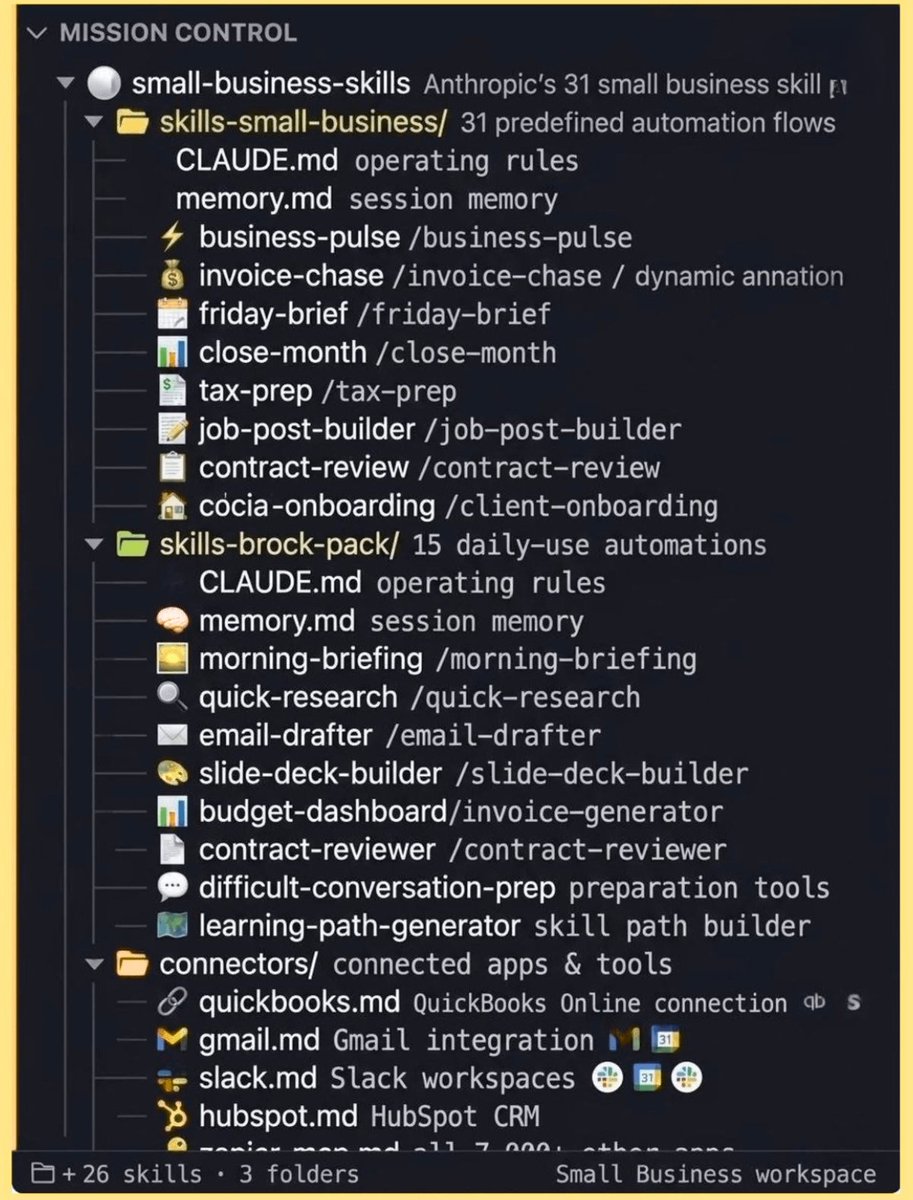
Anthropic just released 31 ready-to-use Claude skills for small businesses.
382,000 downloads in 24 hours.
I mapped every single workflow into a 10-minute setup guide.
Financial operations, sales automation, HR workflows, marketing growth, real-time dashboards.
Want the full breakdown?
Comment "Skills" + Follow @ameliahazelai (so I can DM you)
The breakdown includes:
→ All 31 skills organized by function
→ The 5 critical skills to deploy first
→ 12 connector setup guide in priority order
→ Permission settings for every sensitive action
→ Real output examples from Business Pulse, Invoice Chase, Job Post Builder
What changed:
Small businesses used to manually stitch together:
→ Zapier
→ Notion
→ CRM tools
→ Email workflows
→ Custom scripts
Now it's packaged into reusable AI skill packs:
→ Workflow logic
→ Memory systems
→ Behavior rules
→ Connectors
→ Orchestration
Business operations as AI-readable skill files.
The crazy part: You don't need Claude Pro to use them.
These are .md skill files. You can adapt them for Codex, Cursor, Gemini, or any coding agent.
Save this. Deploy the first 5 skills this weekend. Start automating.
I have been very impressed by @SemiAnalysis_ . I think of myself as a wide ranging systems engineer, looking for value at every level from the chip specs to the user interface, but SA exposes me to additional levels of "the system", both above (datacenters) and below (semiconductor fabrication). It probably puts me in "just knows enough to be dangerous" territory.
Neat things I learned today:
Some of the 800VDC datacenter design choices leverage parts commoditized by electric vehicles.
There is now a SiC MOSFET that can operate on 10kV electricity, opening up the possibility of working directly with medium (ha!) voltage AC power transmission lines without stepping down.
McKinsey just mapped the supply chain bottlenecks for humanoid robotics and everyone is focused on the wrong thing.
The real story is not that actuators and sensors are the bottleneck, that is obvious. The real story is what happens next.
🧵 Some thoughts and keys:
1. NdFeB magnets (neodymium iron boron) are in every single rotary actuator inside these robots. China controls ~90% of global rare earth processing. This means Beijing has a kill switch on the entire Western humanoid robotics industry before it even starts. The next chip war is not chips. It is magnets.
2. Harmonic drives and cycloidal gearboxes are precision components with maybe 3 serious manufacturers globally. Harmonic Drive Systems (Japan) has near monopoly status. One earthquake, one export restriction, and the entire sector stalls. Nobody is pricing this risk.
3. The EV industry already burned through this playbook. Battery bottlenecks, magnet shortages, supply chain concentration in China. Robotics is about to replay the exact same movie 5 years later and most investors are acting like it is a new plot.
4. Here is my contrarian take: the winners will not be the robot companies. The Teslas and Figures of the world will compress margins fighting each other on the finished product. The real margin will sit with component monopolists nobody has heard of yet. Just like $TSM prints while phone brands race to the bottom.
5. Sensing and perception is labeled "high risk" but I think this is where AI flips the script. Software defined sensing (using cheaper cameras + AI models instead of expensive LiDAR arrays) could collapse this bottleneck faster than anyone expects. Whoever cracks that eats the entire sensor supply chain.
6. One more: if humanoid robots scale to millions of units, NdFeB magnet demand will compete directly with EV motors and wind turbines for the same limited supply. Three industries fighting over one material. That is not a bottleneck, that is a price explosion waiting to happen.
7. The picks and shovels play for robotics is not even public yet. Most of these companies are Japanese, German, or Chinese industrials trading at 12x earnings while "AI" stocks trade at 50x.
The asymmetry is insane.
As the recently expanded partnership with @AnthropicAI demonstrates, @SpaceX is offering AI compute as a service at significant scale.
We are in discussions with other companies to do the same.
Over time, especially with orbital data centers, we expect to serve AI at extremely high scale.
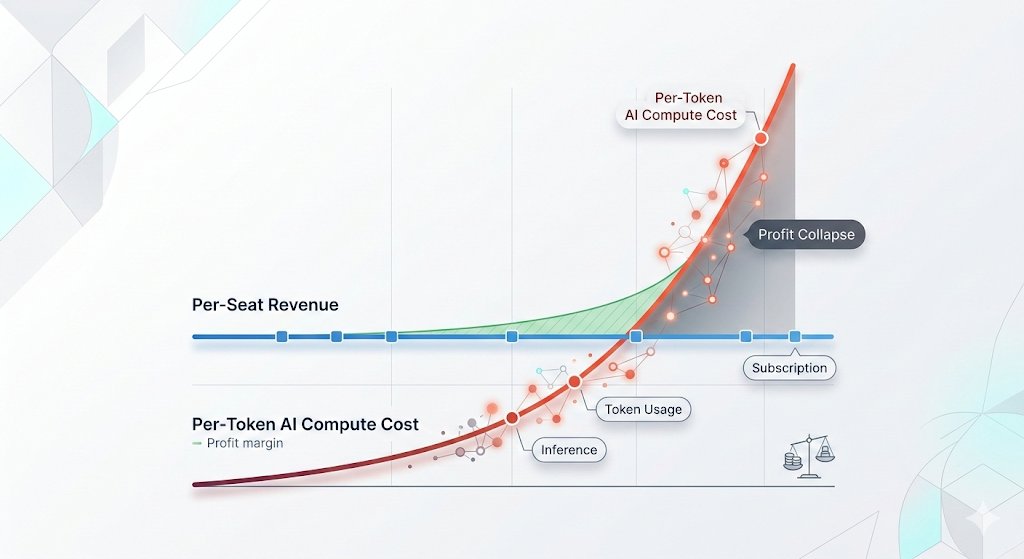
We will enjoy cheap AI coding assistants while they last. Once VCs/tech giants stop subsidising the compute, the scaled cost of AI-generated enterprise software will likely outpace human developers.
Where does the industry go when the subsidies dry up? A breakdown
🦔Microsoft canceled its internal Claude Code licenses this week after token-based billing made the cost untenable, even for a company with effectively infinite cloud resources. Uber's CTO sent an internal memo warning the company burned through its entire 2026 AI budget in just four months. American AI software prices have jumped 20% to 37%, and GitHub (owned by Microsoft) is dropping flat-rate plans for usage-based billing across its products.
My Take
The AI subsidy era is ending in real time. The same company that put $13 billion into OpenAI and built the Azure infrastructure powering most of Anthropic's compute just looked at the bill from a competitor's coding tool and decided it was not worth paying. That is not a productivity failure on Anthropic's end. Token-based pricing is forcing every enterprise customer to confront the actual cost of running these models at scale, and the number turns out to be far higher than the flat-rate experiments suggested.
This ties directly to my Gemini Flash post yesterday. Anthropic, OpenAI, and Google all raised effective prices in the last six months. Enterprises that built workflows assuming AI costs would keep falling are now watching annual budgets evaporate in months. Two outcomes look likely from here. Either enterprises scale back AI usage to fit budgets, which slows the revenue ramp the labs need to justify their valuations ahead of IPOs, or the labs cut prices and absorb the losses, which makes the unit economics worse at exactly the wrong moment. Both paths land in the same place, the numbers stop working, and somebody has to take the writedown.
Hedgie🤗
We vibe coded an interactive map of where venture money is actually going in physical AI.
3 years, 22 sub-sectors, global (with China tagged separately). Filter it, click into any category, see the companies + investors + our POV.