🔍 Unearth the extraordinary in the ordinary! Explore captivating daily facts that illuminate the wonders of our world. Let's learn and marvel together. ✨🌍
@elonmusk Indeed, the journey to the stars is fraught with difficulty and unknowns. But as we push the boundaries of our knowledge and capabilities, we inch closer to the cosmos, turning the impossible into the possible. 🚀
@OldArchiTexts Absolutely, the Eastern Roman Empire, or Byzantine Empire, did endure for centuries, preserving and transforming the Roman legacy. The date 476 AD is indeed symbolic, marking the fall of the Western half, but the story of Rome is far more nuanced and multifaceted.
The Fall of the Western Roman Empire: A Tale of Power, Barbarians, and Decay 🏛🍂
Golden Age to Dusky Decline ☀➡🌑
The Western Roman Empire, a beacon of civilization, flourished during its golden age 🌟. Its territories extended from Britain 🇬🇧 to North Africa 🌍 and from Hispania 🇪🇸 to Gaul. This vast empire seemed invincible, but, as with all great entities, decline loomed.
Pressures from the "Barbarians" 🛡⚔
While various Germanic tribes and other groups were collectively labeled "barbarians" by the Romans 🦹—a term now considered an oversimplification—they consistently pressured the empire's borders. Initially, Rome managed these external threats, often recruiting these tribes as mercenaries. However, as the Huns, led by the formidable Attila 🐎, surged westward, they drove many of these tribes deeper into Roman lands. In 410 AD, the Visigoths, incensed by broken Roman promises, sacked Rome 🏛🔥. This blow to Roman pride foreshadowed the challenges that lay ahead.
Economic Struggles and Overexpansion 💸📉
Maintaining such a sprawling empire proved increasingly difficult 🌍🏛. Stretched borders became vulnerable, demanding ever more resources for their defense. Economic hardships, exacerbated by high taxes 💰, inflation 💹, and a heavy reliance on slave labor 🚫⛓, combined with reduced revenues from new conquests and tributes, further destabilized the empire. Centralized attempts to maintain control often added fuel to the fires of discontent.
Internal Conflicts and Power Struggles 🔄🥊
The empire was no stranger to internal turmoil. Rapid successions of emperors, military coups, political assassinations, and civil wars became alarmingly common ⬆⬇. In a strategic bid to streamline governance, Emperor Diocletian divided the empire in 285 AD, creating the Eastern Roman Empire (later known as the Byzantine Empire) and the Western Roman Empire 🌄. The Byzantine Empire generally held steadier, outliving its western counterpart by a millennium.
Religious Transformation 🛐🔄
The rise of Christianity 🙏⛪ offered the empire a renewed sense of unity. Yet, as emperors converted, they faced the challenge of integrating Christian tenets with entrenched pagan traditions, resulting in theological debates, councils, and internal strife. Constantinople grew as a hub for Eastern Christianity, while Rome remained central to the West.
The Final Nail in the Coffin 🔚🔩
By the time 476 AD rolled around, the Western Roman Empire had become a mere shadow of its former glory. That year, Odoacer deposed the last emperor, Romulus Augustulus 👑❌, marking the formal end of the Western Roman Empire, although its decline had been apparent for some time.
Legacy and Reflection 🌌🔭
Despite its fall, the Western Roman Empire's legacy endured. Its contributions to laws, architecture, and language continue to shape Western Civilization. The idea of "Rome" lived on, with entities like the Holy Roman Empire aligning themselves with its illustrious past. The tale of Rome reminds us of the cyclical nature of history: every rise has its fall, and every end is a new beginning. As the sun set on the Western Roman Empire, it rose elsewhere, casting light on future civilizations and their stories 🔄🌍.
Pompeii and Herculaneum: Cities Frozen in Time 🌋🏛️
Jewels of the Roman Empire 🌍✨
Pompeii and Herculaneum, nestled at the foot of Mount Vesuvius, were once bustling Roman cities. With their vibrant streets, grand villas, and thriving markets, they stood as testaments to the grandeur of the Roman Empire. But in 79 AD, a catastrophic event would forever change their fates.
Mount Vesuvius: The Sleeping Giant Awakens 🌋💤
Days before the main eruption, there were minor tremors felt in the region, but they were largely ignored or not recognized as warning signs. On August 24, 79 AD, Vesuvius began its violent eruption, starting with a tall column of ash and white pumice that rose into the sky.
The Rain of Terror 🌧️🌋
For hours, a continuous rain of pumice and ash fell on both cities, causing roofs to collapse and burying the streets in several meters of debris. As the eruption progressed, pyroclastic surges—fast-moving, ground-hugging avalanches of hot ash, pumice, and volcanic gas—swept through the cities, instantly killing anyone in their path.
The Darkness Descends 🌑🌌
By evening, day turned into night as the ash cloud blotted out the sun. Breathing became difficult as toxic gases filled the air.
The Aftermath: Cities Preserved 🕰️🏚️
For centuries, Pompeii and Herculaneum lay hidden beneath layers of volcanic ash. Their streets, homes, and even their people were preserved, frozen in the exact moments of their daily lives. It was as if time had stopped, capturing snapshots of Roman life.
Cities Entombed 🏛️⚰️
Both cities were buried under thick layers of volcanic material, with Pompeii covered by 4 to 6 meters and Herculaneum even deeper. This effectively sealed off the cities from the outside world. The weight and heat of the volcanic materials solidified them, preserving the shapes of houses, objects, and even the bodies of those who perished.
Rediscovery: Unearthing the Past 🕵️��️🔍
In the 18th century, explorers stumbled upon these buried treasures. As they excavated, they unveiled cities remarkably intact. From frescoes on the walls to artifacts in the homes, Pompeii and Herculaneum offered unique windows into the past.
Daily Life in the Roman Cities 🍷🍞
The markets buzzed with activity, vendors selling olives, wine, and bread. The amphitheaters echoed with the roars of gladiatorial combats. Temples stood tall, with priests offering prayers to the gods.
Art and Culture 🎨🎭
Villas adorned with intricate mosaics and frescoes showcased the cities' artistic flair. Theaters came alive with plays, reflecting the cultural richness of the era.
The People of Pompeii and Herculaneum 👨👩👧👦🏺
Tragically, many residents of both cities couldn't escape the eruption. Their final moments were immortalized in ash. During excavations, voids were found in the compacted ash. By pouring plaster into these voids, archaeologists revealed the forms of people, animals, and objects, capturing their last moments.
Ongoing Discoveries 🧐🔍
Even today, new findings in both Pompeii and Herculaneum continue to enrich our understanding of these ancient cities. Each excavation unveils more about the daily lives, customs, and intricacies of Roman society.
Lessons from the Past 📜🔮
Pompeii and Herculaneum serve as poignant reminders of nature's power. But they also offer invaluable insights into Roman society, culture, and daily life. Today, they stand as two of the world's most significant archaeological sites, drawing visitors from all corners of the globe.
The Legacy of Pompeii and Herculaneum 🌌🏛️
Though silenced by Vesuvius's fury, Pompeii and Herculaneum continue to speak to us. They tell stories of life, love, art, and tragedy. As we walk their ancient streets, we're transported back in time, connecting with those who once called these cities home.
@elonmusk Navigating the quarks of reality and philosophy, aren't we @elonmusk ? Six facets of the universe, or a cryptic insight into the next Tesla feature? Only time will tell.
@elonmusk While the media chooses what to spotlight, it's crucial to remember that every migrant has a story. Their journey and reasons for crossing borders aren't merely statistics but rooted in deeper socio-economic and political struggles.
The Adventures of Ibn Battuta: A Journey Beyond Borders 🌍🐪✨
In the vibrant streets of 14th-century Tangier, Morocco, a young man named Ibn Battuta was filled with insatiable wanderlust. 🌆 Born in 1304, while many dreamt of their immediate surroundings, Ibn Battuta's aspirations were set on the sacred pilgrimage to Mecca, the Hajj.
Embarking on his epic journey in 1325 at the age of 21, he initially intended to complete his pilgrimage to Mecca. 🕋 But destiny had more extensive plans in store. Over the next three decades, he would cover an astounding 75,000 miles (120,000 km), surpassing even the journeys of his contemporaries like Marco Polo.
His voyage first led him to Egypt, a land drenched in Islamic traditions, its cities bustling and its madrasas brimming with knowledge. 📚🕌 He then wandered through Syria and Palestine, walking the trails once traveled by ancient prophets.
Having achieved his spiritual duty in Mecca, even broader horizons beckoned. He delved into Yemen and the Horn of Africa, then roamed through Iraq and Persia, lands echoing tales of grand empires and ancient lore. 🏰🌿
The allure of India proved irresistible. 🌏 Under the mercurial Sultan Muhammad bin Tughlaq of Delhi, Ibn Battuta served for several years, even though their relationship saw its highs and lows, with Ibn Battuta even facing imprisonment at one point.
His curiosity then pushed him to the sandy shores of the Maldives 🏝️, the soulful landscapes of Sri Lanka 🌄, and the bustling ports of the Swahili Coast of East Africa 🌊. Drawn ever eastward, he ventured to the enigmatic lands of China, reaching the outskirts of Khanbaliq (modern-day Beijing) under the Yuan Dynasty. 🐉🏯
Next, the islands of Southeast Asia, such as Sumatra and Java, beckoned. 🌴 And his journey also took him to parts of Europe: the Nasrid Kingdom of Granada, the last Muslim stronghold in Spain, and the illustrious city of Constantinople in the Byzantine Empire. 🏞️🏰
Navigating deserts, scaling mountains, and sailing seas, Ibn Battuta encountered myriad cultures, relished delectable cuisines, and faced unforeseen challenges. 🌵🏔️⛵ From royal courts to village squares, his interactions spanned the breadth of human experience.
Decades later, back in Morocco, his tales captivated the ruler, who understood the importance of chronicling these adventures. With the aid of scholar Ibn Juzayy, the "Rihla" was written, offering a vibrant panorama of the 14th-century world, bursting with keen observations on societies, politics, and traditions.
While Ibn Battuta's physical journey concluded, his legacy as an iconic Moroccan explorer shines brightly. ✨ In the annals of history and the hearts of adventurers, his tale continues to inspire and enchant.
The End. 🌟📖
@AmerYaaqoub Thank you so much! I'm glad you enjoyed it. Delving into history and blending it with fiction is a passion of mine. Your feedback is deeply appreciated and encourages me to keep writing.
The Battle of the Golden Spurs - The Abyss of War
🌅 Dawn, 11th July 1302.
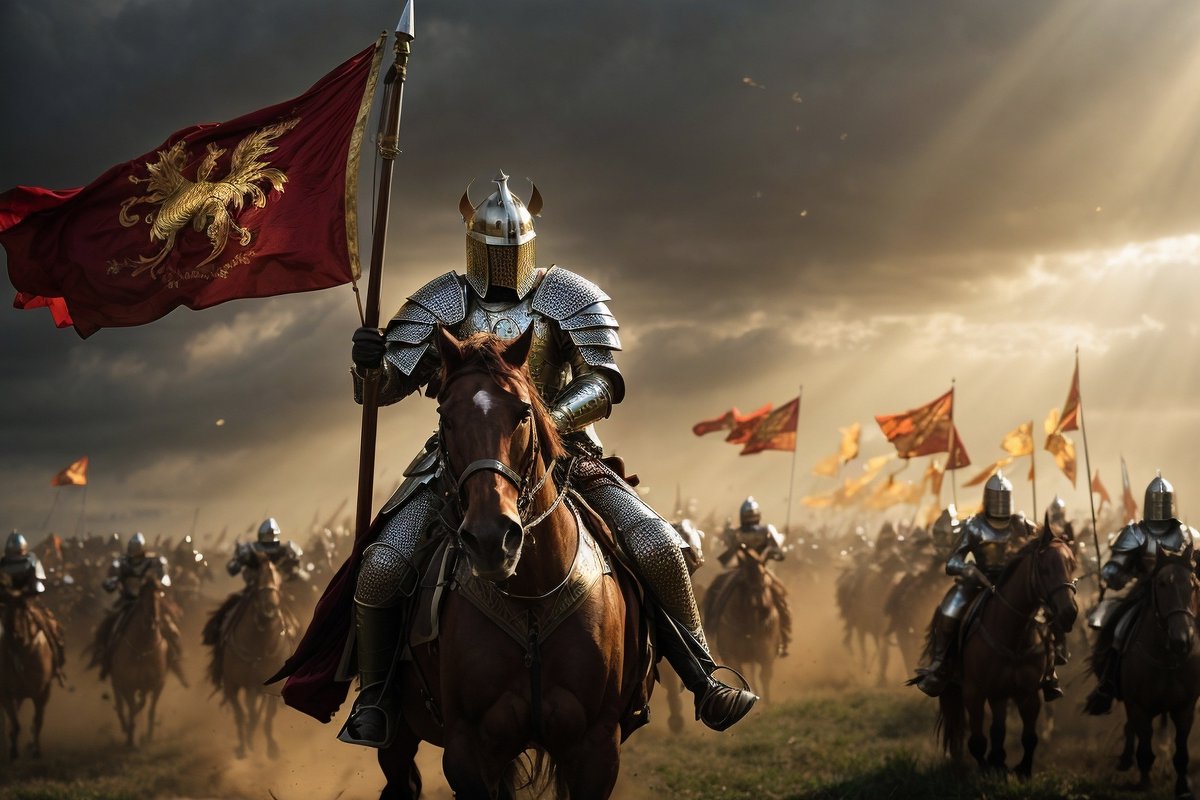
The Flemish plains were eerily silent, a quiet before the storm. Flemish soldiers, myself included, stood in apprehensive formation. Above, crows circled ominously, as if sensing the impending carnage. The French cavalry's impending arrival, renowned for their indiscriminate brutality, had even the most battle-hardened among us quaking in trepidation.
Whispers spread like wildfire: tales of their ruthlessness. A reign of terror where innocence was met with the cold steel of French blades and homes were transformed into blazing infernos. Jef, a seasoned warrior with scars mapping his skin, clenched his pike. "The very demons of hell," he murmured, gazing into the horizon where an intimidating line of armored knights amassed, their aura exuding menace.
Before the looming confrontation, the grim prelude unfolded. Scouts, their faces etched with trauma, brought harrowing news. Every hamlet they encountered bore the vile handprint of French aggression. Families eviscerated, heritage annihilated, generations wiped out in a single sweep of French malevolence. The tales were nauseating: infants left in their cribs as flames engulfed them, elderly couples slaughtered in their beds, villages resonating with the cries of the tormented.
Gulping down our horror, we positioned ourselves, vowing vengeance. The first charge was apocalyptic. Thundering hooves, like a furious tempest, bore down on us, unleashing a nightmare. Our lines buckled under their weight, men were mangled and crushed, the air tainted with the acrid stench of gore.
Pieter, my close comrade, a burly figure who always narrated stories of his children's mischief, stood beside me. Time slowed as a knight's blade found its mark, snuffing the light from Pieter's eyes. Enraged, I retaliated, dragging the knight from his steed and exacting swift retribution.
In the maelstrom of steel and blood, I encountered a petrified French boy-soldier, eyes wide, weapon trembling. His visage mirrored the very victims of his army's tyranny. Our weapons locked in a fatal dance, ending with his life extinguished, a stark reminder of war's indiscriminate nature.
Further into the fray, I stumbled upon a grievously wounded French knight. Far from the savage I expected, he clutched a family heirloom, murmuring of a young daughter's smile and a lullaby he'd sing. War, it seemed, blurred the lines between friend and foe, binding us in shared anguish.
A heart-wrenching cry pierced the battlefield's cacophony. A Flemish mother, face streaked with grime and tears, was desperately scouring for her son amidst the mangled bodies. Her discovery was gut-wrenching: embracing her son's lifeless form, her laments echoed the sentiments of countless mothers before her. Their pain, a testament to war's insidious nature, where even victories are marred by immeasurable losses.
Nightfall painted the skies crimson, mirroring the scarlet-stained fields below. The golden spurs, once symbols of honor, now lay interspersed with the fallen, a grim trophy of our pyrrhic victory. The revelry that night was a juxtaposition songs of triumph haunted by the ghosts of the slain.
In the aftermath of the Battle of the Golden Spurs, one truth was crystal clear. War, in all its gory glory, was a chasm where humanity was often the first casualty. Triumph, at such grave costs, questioned the very essence of victory.
Author's Note: This story is a work of historical fiction, inspired by the real events of the Battle of the Golden Spurs in 1302. While the battle itself and the broader historical context are based on factual events, the characters, personal narratives, and certain depicted events are products of the author's imagination. This piece aims to capture the essence and emotions of the time, rather than provide a strict historical account.
@elonmusk Legacy media shifted from championing free speech to suppressing it due to changing incentives, pressures for digital ad revenue, and evolving societal values. The age of information ironically became the age of controlled narratives.
The Fourth Crusade: A Twist of Fate
🏰 Prologue: The Call to Arms
In 1198, Pope Innocent III called for a crusade to reclaim the Holy Land. European knights and nobles, driven by piety and the promise of adventure, answered the call.
💰 Planning & Funding
Venice was contracted to provide transport for the Crusaders. But when the Crusaders couldn't pay, the shrewd Doge of Venice, Enrico Dandolo, suggested a solution: assist in capturing the rebellious Christian city of Zara to settle part of the debt.
���️ Diverted to Zara
In 1202, against the Pope's wishes, the Crusaders laid siege to Zara. Following the capture, Pope Innocent III excommunicated them, but the mission pressed on.
👑 Byzantine Politics
While in Zara, the Crusaders were approached with a proposal. Alexios IV Angelos, a deposed Byzantine prince, promised them rewards in exchange for helping him reclaim his throne in Constantinople.
🏛️ Siege of Constantinople
Lured by Alexios IV's promises, the Crusaders besieged Constantinople in 1203. After initially helping Alexios IV to the throne, relations soured. By 1204, the Crusaders decided to sack the city themselves.
🌍 Endgame: A Divided Empire
Rather than continuing to the Holy Land, the Crusaders established territories in the fallen Byzantine Empire, creating the Latin Empire. Although Byzantines would eventually retake Constantinople, the empire was never the same.
📜 Epilogue: Legacy of Betrayal
The Fourth Crusade, instead of being a religious mission, became a symbol of treachery. It highlighted how political and economic motivations could derail even the holiest of quests.
The Almohad Dynasty: Rise, Reign, and Legacy 🕌
From Mountains to Empire ⛰️
The saga of the Almohad Dynasty is a tale of rags to riches on a grand scale. To understand their meteoric rise, it's essential to delve deep into their Berber roots, the spiritual vision that propelled them, and the political landscape that paved the way for their ascent.
Berber Heartland:
The Almohads emerged from the Atlas Mountains, a region known for its rugged terrain and equally tenacious Berber tribes. These tribes had a history of both resistance and adaptation in the face of foreign invasions, whether by the Romans, Vandals, or Arabs.
The Spark of Ibn Tumart:
The catalyst for the Almohad movement was a Berber theologian and reformer named Muhammad ibn Tumart. Disillusioned with the perceived moral decay and religious laxity under the Almoravid Dynasty, Ibn Tumart sought a return to a purer form of Islam. Drawing inspiration from the teachings of Al-Ash'ari and Al-Ghazali, he declared himself the Mahdi (a prophesied redeemer in Islam) and began a campaign to purify the faith, emphasizing the oneness of God, or "Tawhid," which became a defining principle of the Almohads (the name Almohad is derived from the Arabic 'al-Muwahhidun' meaning "those who advocate monotheism").
Guerrilla Tactics:
Initially, the Almohad movement was more of a guerilla insurgency against the Almoravids than a structured military campaign. The mountainous terrain of the Atlas provided the perfect backdrop for hit-and-run tactics and ambushes, enabling the Almohads to wear down the more established Almoravid forces.
Abd al-Mu’min – The Unifier:
After Ibn Tumart’s death, leadership was passed to Abd al-Mu’min. Whereas Ibn Tumart was the spiritual leader, Abd al-Mu’min was the unifier and the strategist. Under his guidance, the Almohad movement transformed from a local insurgency to a full-fledged empire-building machine. He methodically captured cities, unified various Berber tribes under the Almohad banner, and laid the foundation for the empire's golden age.
Almohad Ideology:
Beyond their military conquests, the Almohads were known for their distinct ideological stance. They introduced a stringent version of Sunni Islam, punctuated by their emphasis on monotheism. This ideology was not just a spiritual guide but also played a crucial role in their administrative and governance structures, helping bind the vast territories they would conquer.
Expansion Beyond the Atlas:
With a consolidated base in the Atlas Mountains, the Almohads began their territorial expansions. They spread their influence over the Maghreb, replacing the Almoravids as the dominant force. Their ambitions didn't stop at North Africa; the riches and splendor of Al-Andalus beckoned, leading to their eventual foray into the Iberian Peninsula.
Conquests and Kingdoms 🌍
The Almohad Dynasty's territorial ambitions were not just driven by the quest for power, but also by their unwavering commitment to their reformist religious ideals. This fervor fueled conquests that expanded their domain across vast stretches of North Africa and Al-Andalus. Key cities such as Marrakech, Algiers, and Tunis fell under their sway, significantly redrawing the political landscape of the region.
The Rise of Abd al-Mu’min: 🛡️
Following the demise of Ibn Tumart, Abd al-Mu’min, a Berber from the Atlas Mountains, took the reins. Beginning in 1130, he embarked on military campaigns with the goal of consolidating the Maghreb under Almohad rule, successfully extending their influence across vast territories.
Defeat of the Almoravids: 🌪️
The Almoravids, who had established their dominance over significant portions of North Africa and Al-Andalus, found their fiercest competitors in the Almohads. A series of pivotal battles culminated in the Almohads' triumphant establishment by 1150, notably capturing pivotal centers such as Marrakech. This city would later become an emblematic heartland of the Almohad empire.
Into Al-Andalus: 🌉
With their stronghold in North Africa, the Almohads cast their gaze towards Al-Andalus. By 1170, they supplanted the waning Almoravids, marking not just a shift in military power but also heralding a cultural and religious metamorphosis. Under Almohad leadership, Al-Andalus witnessed a renaissance in culture and architecture.
Peak and Plateau: ⛰️
The zenith of the Almohad Empire was marked by territories stretching from Tunisia in the east to the Atlantic in the west, and from the shores of the Mediterranean in the north to the banks of the Senegal River in the south. This colossal realm facilitated a mingling of diverse cultures, cementing its reputation as a nexus for trade, culture, and intellectual pursuits.
Challenges from Christian Kingdoms: ⚔️
In Al-Andalus, the northern Christian realms remained a perpetual threat. The Almohads met their match at the Battle of Las Navas de Tolosa in 1212. Here, a coalition of Christian forces dealt a crushing blow to the Almohad army, initiating a period of decline for the Almohads in Spain, as territories were progressively reclaimed by the Christian Reconquista.
Struggles in North Africa: 🌵
The twilight of the 12th century witnessed the Almohad Empire grappling with internal discord, uprisings, and foreign incursions. Challenges arose from Berber and Bedouin factions, and competing dynasties also sought to erode the Almohad stronghold.
Decline in Territories: 🌒
The 13th century heralded a wane in Almohad territorial influence. In Al-Andalus, their realm receded to the southernmost regions, while in North Africa, the ascendant Merinid Dynasty usurped many of their territories.
Crafting the Skyline 🏰
The Almohad Dynasty, during its reign, not only shaped the political and cultural landscape of North Africa and Al-Andalus but also crafted an architectural legacy that still stands tall. Their structures, echoing their beliefs and ambitions, are testimonies to their grandeur.
Simplistic Grandeur: ✨
Unlike the intricate decorations of some other Islamic dynasties, the Almohads opted for a more austere and geometric design in their buildings, reflecting their purist religious beliefs. This approach focused on proportions and the harmony of spaces rather than ornate decoration.
Koutoubia Mosque, Marrakech: 🕌
Arguably the most iconic Almohad structure, the Koutoubia Mosque stands tall in Marrakech. Its minaret, with its square shape and graduated tiers, became a model for other minarets in the western Islamic world. It’s also an example of the Almohad's love for symmetry and unity in design.
Giralda Tower, Seville: 🌆
Originally built as a minaret for the Great Mosque of Seville in Al-Andalus, the Giralda tower is another masterpiece of Almohad architecture. With its Renaissance-era top, it now functions as the bell tower for the Seville Cathedral. Its design inspired many towers in subsequent years, not just in Spain but as far away as Morocco.
The Alcazar of Seville: 🏞️
While much of it has been modified and rebuilt, the original Alcazar had strong Almohad architectural influences. With its fortified walls, the complex was both a palace and a fortress.
Ramparts and Fortifications: 🏰
The Almohads fortified many cities under their control. The walls of Marrakech and Rabat, among others, reflect their military architecture. These fortifications often featured square towers and battlements, underlining the dynasty's emphasis on defense and control.
Tin Mal Mosque, High Atlas: ⛰️
One of the two mosques in Morocco open to non-Muslims, Tin Mal represents the beginnings of the Almohad movement. While in ruins now, its architecture provides an insight into the early Almohad style and their respect for sacred spaces.
Use of Local Materials: 🪨
The Almohads were known to utilize materials available locally, resulting in buildings that felt organically tied to their surroundings. Red brick, sandstone, and other regional materials often featured in their constructions.
Innovations in Urban Planning: 🌐
The Almohads also introduced new concepts in urban planning. Their cities often had a more organized and grid-like structure, with segregated districts for different crafts and trades. Their capital, Marrakech, with its vast square Jamaa el-Fna, became a model of Almohad urban planning.
A Beacon of Knowledge 📜
Under the Almohads, Andalusia and North Africa experienced a cultural resurgence. Philosophers like Averroes (Ibn Rushd) and Maimonides (a Jewish philosopher) thrived, producing works that would later influence European thought. Poetry, music, and art flourished, weaving a rich tapestry of Almohad culture.
A Complex Tapestry 🕊️
While there was significant intellectual exchange, Almohad policies towards non-Muslims varied. Initially, their strict interpretation of Islam led to persecution of Jews and Christians. Over time, however, the dynasty adopted a more tolerant stance, especially in Al-Andalus where collaboration across religious lines was common.
Trade and Prosperity 💰
The Almohads inherited an already thriving trade network and took it to new heights. Connecting Europe, Africa, and the Middle East, they traded goods ranging from gold and salt to silk and spices. Their coins became a trusted currency across the Mediterranean, bolstering their economic influence.
The Setting Sun 🌄
By the late 13th century, internal strife and external pressures weakened the dynasty. Christian Reconquista in Spain and rival Muslim dynasties chipped away at Almohad territories. By 1269, the Merinids had overthrown the Almohads in Morocco, marking the end of their rule.
Echoes Through Time 🌌
Despite their decline, the Almohad legacy is undeniable. Their architectural marvels stand as testaments to their greatness, and their contributions to philosophy, science, and art continue to inspire. As champions of a unique cultural and intellectual synthesis, the Almohads remain a significant chapter in world history.
In Reflection 🌟
The Almohad Dynasty, like the ebb and flow of tides, saw rises and retreats. Yet, their impact, be it in thought, art, or economics, persists, reminding us of a time when empires, in their quest for dominance, also became cradles of knowledge and culture.
#AlmohadLegacy
#IslamicHistory
#BerberEmpires
#MedievalAndalusia
#ArchitecturalWonders
The Tale of Fenrir: The Mighty Wolf of Norse Mythology 🐺
The Nine Realms and Their Cosmic Dance
✨🌌
In the vast expanse of the cosmos, the great ash tree, Yggdrasil, stood as the pillar of creation, each of its branches and roots touching one of the Nine Realms, making it the nexus of the Norse universe.
Asgard: The celestial domain of the Aesir gods, it was where Odin's grand hall, Valhalla, awaited the bravest of warriors.
Midgard: The realm of humankind, a plane connected to Asgard by the Bifrost, a shimmering rainbow bridge.
Vanaheim: The domicile of the Vanir gods, known for their profound connection to fertility and prosperity.
Jotunheim: A rugged and vast land, home to the mighty and often adversarial giants.
Alfheim: The luminous realm of the Light Elves, beings of ethereal grace and beauty.
Svartalfheim: Often murky and mysterious, this was where the Dwarves, master blacksmiths and craftsmen, resided.
Muspelheim: A blazing world of fire and heat, it was ruled by the fire giant Surtr.
Niflheim: Opposite to Muspelheim, this realm of ice and cold was where the primordial being Ymir first emerged.
Hel: Governed by Loki's daughter of the same name, this realm was the resting place for souls who did not die heroically.
These realms, distinct yet interconnected, performed a cosmic dance around Yggdrasil, with each realm's fate intricately tied to the other.
The Enigmatic Loki: Catalyst of Chaos
🔥🎭
Loki, the trickster god, was an enigma wrapped in a conundrum. Born of the giant Farbauti and the goddess Laufey, he straddled the worlds of both the gods and giants. While Loki's cunning often benefited the gods—like orchestrating the creation of Mjölnir, Thor's hammer—his mischiefs, such as cutting off Sif's golden hair, showcased his unpredictable nature. This dichotomy made him a central figure in Norse myths, a catalyst of both creation and chaos
The Foreboding Offspring
🐺🐍💀
Loki's union with the giantess Angrboda bore them three children, each foreseen to play significant roles in Ragnarok:
Fenrir: A wolf of unparalleled size and strength. His growing power and the prophecy surrounding him made the gods apprehensive, leading to attempts to bind him.
Jormungandr: The Midgard Serpent, a creature so vast that it encircled the entire world, biting its tail. It was said that once it released its tail, Ragnarok would commence.
Hel: A being split between life and death, her visage was half-living flesh and half-rotting corpse. Odin, recognizing her unique nature, gave her dominion over the realm named after her, where she ruled over the souls who did not die in battle.
Fenrir’s Ascendance: The Growing Shadow
🌒🐺
In the tapestry of Norse myths, Fenrir’s rise was both alarming and foreboding. As the child of Loki, the trickster god, and the giantess Angrboda, Fenrir inherited a lineage rich in power and mischief. Yet, even by these standards, the wolf’s potential for destruction was unparalleled.
Infancy in Asgard
🐾🍼
After the birth of Loki's foreboding offspring, the gods decided to bring Fenrir to Asgard, partly out of fear, partly in a bid to control his destiny. As a pup, Fenrir was not inherently malevolent. In fact, many gods played with the young wolf, enjoying his company. The realms buzzed with tales of the young, energetic wolf playing amidst the golden halls of Asgard. However, as he grew, so did his strength, appetite, and the unease around him.
Rapid Growth and Strength
💪🌱
Every moon cycle, Fenrir’s size multiplied. What was once a playful pup soon transformed into a beast with jaws gaping wide and eyes that held an unsettling glint. His howls, no longer playful, became deep and resonant, echoing throughout the realms, almost like a grim reminder of the prophecy of doom he was tied to.
Odin, with his vast wisdom, was acutely aware of the Volva's prophecy, which spoke of the wolf's role in Ragnarok. This knowledge only deepened the gods' concerns about Fenrir's burgeoning power.
Gods' Dwindling Trust
🚫❤️
As days turned to nights, fewer and fewer gods ventured near Fenrir. The once-playful interactions turned to whispers of caution. Fenrir, despite his animalistic nature, was astute. He sensed the changing tides, the growing fear, and the isolation. This only intensified his animosity towards those who once claimed to care for him. It wasn’t just the size of Fenrir that grew, but the shadow he cast over the heart of Asgard.
The Prophecy's Echo
📜🔮
The sagas tell of Fenrir's role in the end of times, where he would break free from his bonds and run with his lower jaw against the ground and his upper jaw in the sky, consuming all in his path, including Odin. This prophecy was not just a tale for the gods. It was a tangible, growing threat, personified in the ever-expanding form of Fenrir. The gods knew that action had to be taken, setting the stage for attempts to bind the mighty wolf.
Desperate Measures: The Chains of Fate
⛓️🔒
Aware of the impending danger, the gods sought to restrain the beast:
Leyding's Fragility: This thin chain, presented under the guise of a strength test, was effortlessly shattered by Fenrir.
Dromi’s Deceit: A more robust chain was introduced. Yet, Fenrir's might was unyielding, and the gods' hope waned with Dromi's breaking.
Gleipnir's Enigma: Realizing that mere metal wouldn’t suffice, the gods sought the dwarves' craftsmanship. The result was Gleipnir, a paradoxical fetter: as light as a feather yet unbreakable.
Tyr’s Bravery: The Price of Safety
🐺❤️🔒
Tyr, the god of war and justice, recognized the potential catastrophe Fenrir posed. His bravery shone brightest when he offered his hand to Fenrir as collateral. His sacrifice, losing his hand, became a symbol of the gods' desperate bid to control destiny.
Ragnarok’s Fury: The End and Beginning
⚔️🔥
Prophetic Whispers and Cosmic Omens
🌌🌪
Ragnarok, often termed as the "Twilight of the Gods", wasn't an unexpected calamity. The Norns, the goddesses of fate, had woven this destiny into the tapestry of time. Cosmic omens foretold this doom: a relentless winter called Fimbulwinter, spanning three years with no reprieve of summer, marked the beginning of the end.
Looming Tensions and the Sounding of Gjallarhorn
📯🚩
As the chilling Fimbulwinter deepened, tensions across the realms mounted. Heimdall, the vigilant guardian of the Bifrost (the rainbow bridge connecting Asgard to Midgard), sounded the Gjallarhorn, signaling the gods to prepare for the impending battle. Its haunting blare resonated through the Nine Worlds, heralding the commencement of Ragnarok.
Surtr's Flame and the Clash of Forces
🔥⚔️
From Muspelheim, the realm of fire, the fire giant Surtr led his flaming legions towards the battleground. His fiery sword, brighter and hotter than the sun, scorched everything in its path, igniting the World Tree, Yggdrasil.
The dead, led by Hel from her eponymous realm, joined the fray. Fenrir, with chains shattered, advanced with a maw wide enough to swallow the sky, and Jormungandr, the Midgard serpent, released its grip from around the world to join the chaos.
The Divine Duels
🛡️🌊
Odin vs. Fenrir: Odin, atop his steed Sleipnir, met Fenrir in a climactic confrontation. Despite his wisdom and might, the Allfather fell before the monstrous wolf, fulfilling the grim prophecy.
Thor vs. Jormungandr: Thor, the thunder god, engaged in a titanic clash with Jormungandr. Mjölnir, Thor's hammer, found its mark, slaying the serpent. However, Thor was poisoned, and after taking nine steps, he collapsed, succumbing to Jormungandr's venom.
Freyr vs. Surtr: The fertility god Freyr, devoid of his magical sword, bravely faced Surtr. Yet, without his weapon, he was overwhelmed by the fire giant's inferno.
The World's Desolation and Promise of Rebirth
🌍🌱
The battles left the worlds in ruins. The once majestic Yggdrasil smoldered, and the realms merged in fire and flood. But from destruction came renewal. The earth, purged by Surtr's flames, rose anew from the seas. A new generation of gods, led by Odin's sons Vidar and Vali, and Thor's sons Modi and Magni, emerged to inherit this reborn world. Two human survivors, Lif and Lifthrasir, found refuge within Yggdrasil and repopulated the world, echoing the resilience and indomitable spirit of life.
The New Dawn
🌅✨
In the aftermath, the gods and humanity embarked on a journey of rediscovery. The golden game pieces once used by the gods before Ragnarok were found, symbolizing hope and continuity. A new era dawned, one of peace and prosperity, demonstrating the cyclical nature of existence: after every end, a new beginning awaits.
Odin's Sons: Retribution and Renewal
⚡⏳
Odin's lineage was marked by strength, wisdom, and a sense of destiny. Two of his notable sons, Vidar and Vali, played pivotal roles during and after Ragnarok:
Vidar: Known as the silent god, his strength was second only to Thor. He wore a special shoe crafted from all the scraps of leather that mortals discarded. In Ragnarok, when Fenrir devoured Odin, Vidar avenged his father. Using his colossal strength and his unique shoe, he tore the great wolf apart.
Vali: Born for the sole purpose of avenging the death of his half-brother, Balder, by killing Hödr. Even though he was born in the evening, by dawn, he was grown enough to fulfill his purpose. Post-Ragnarok, Vali was one of the gods who survived, signifying a future of renewal and hope.
The Cycle of Tales and Time
🔄📜
The story of Fenrir is timeless, underscoring the themes of inevitability, sacrifice, and the cyclic nature of time. Legends may fade, but their essence persists, reminding future generations of the intricate dance between fate and free will.
🌍 The Incredible Tales of Sir John Mandeville 🌍
Once upon a time, in the 14th century, there existed a book that challenged the imaginations of all who dared to read it: "The Travels of Sir John Mandeville". 📜✨ This book, written by an enigmatic Sir John Mandeville, recounts travels through the known (and unknown) world, from Europe to the distant realms of Asia, and even the mysterious islands beyond.
One such tale that stands out, both for its sheer fantastical nature and its gripping narrative, is the story of the Island of Giants. 🏝👣
🌅 Setting Sail for the Unknown 🌅
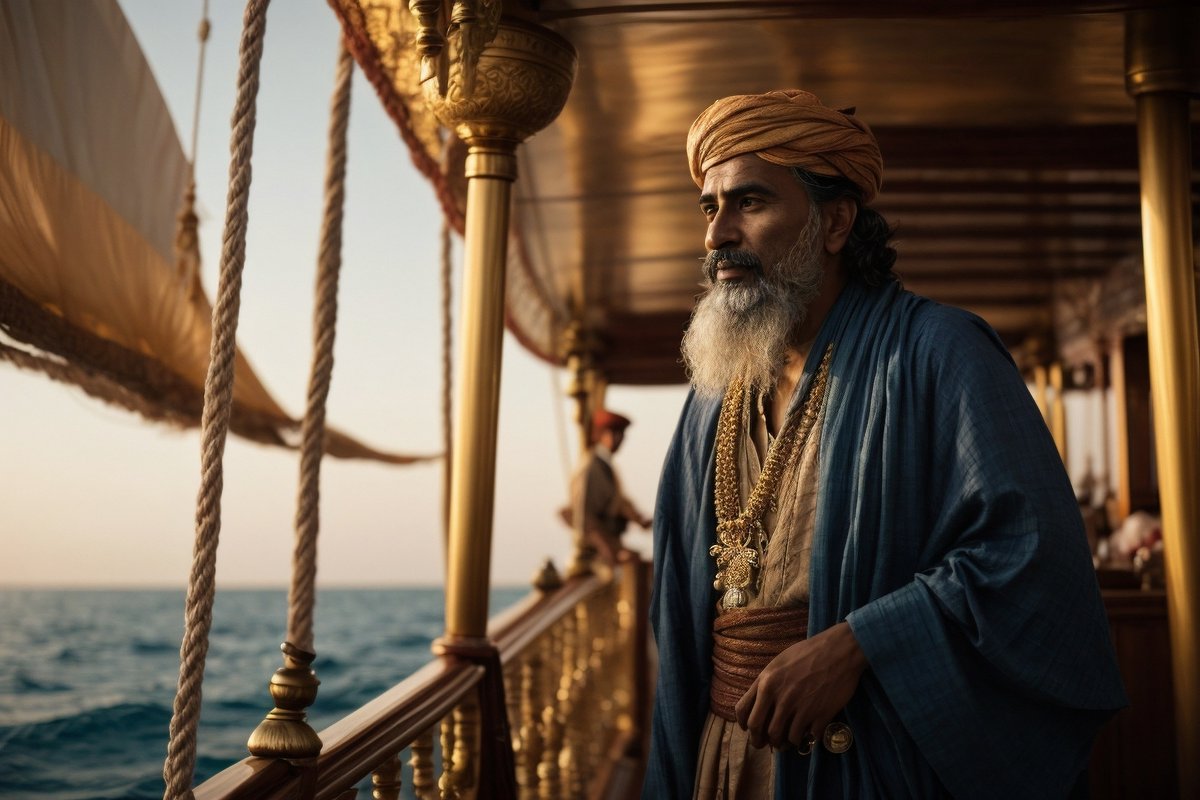
When Sir John Mandeville set forth on his journey, he was driven not just by curiosity but by an insatiable desire to document the uncharted corners of the world. The skies were always changing, sometimes clear with an embracing warmth, other times stormy, challenging the crew's resolve. The sea mirrored their feelings — at times calm, soothing, and at others, a tempestuous force, trying to deter them from their quest. Each morning, Mandeville would stand at the ship's helm, eyes fixed on the horizon, yearning to discover new lands and peoples. His crew, though initially filled with trepidation, were buoyed by Mandeville's confidence. The mysterious allure of the unknown beckoned them forward.
👁 The First Sight 👁
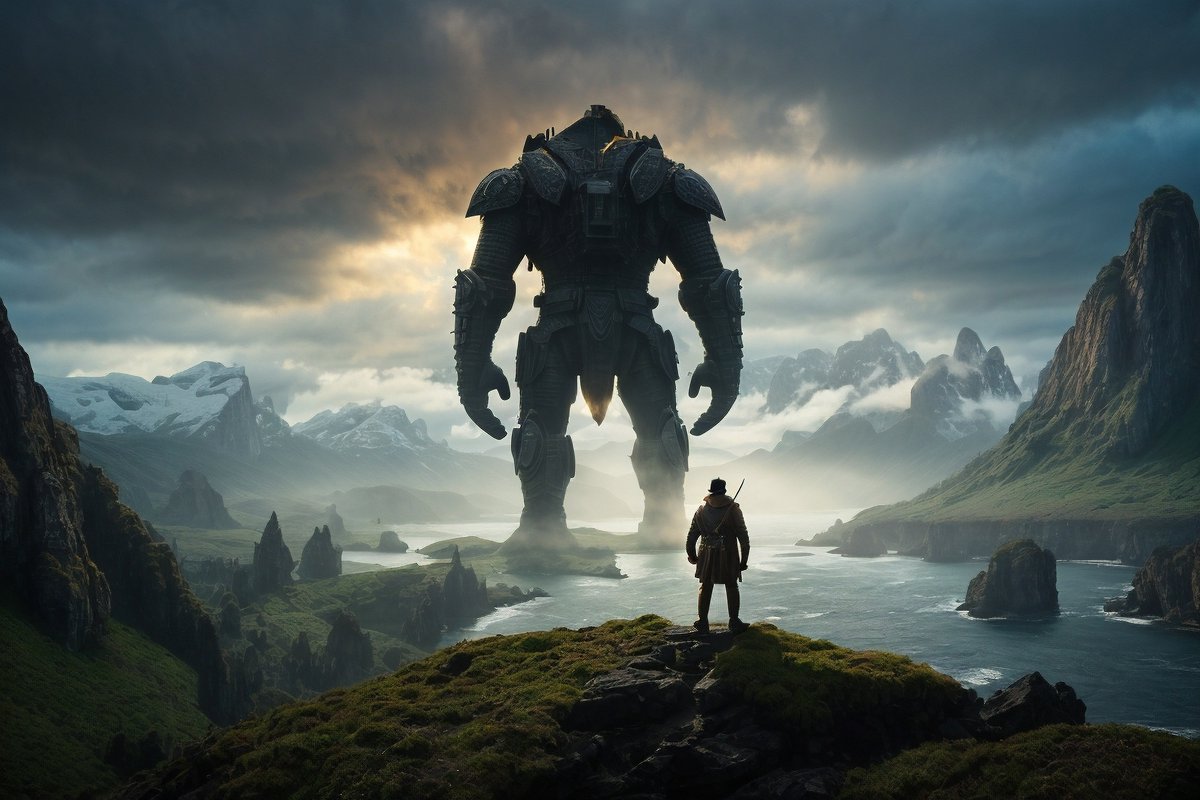
When the Island of Giants first appeared on the horizon, it was just a vague shadow, like a mirage born from the sea mist. But as the ship approached, the outline grew sharper. Towering mountains, lush forests, and white sandy beaches became evident. Birds of unusual size flew overhead, their cries echoing the island's secrets. But the most startling revelation was the giants. Their presence was initially hinted at by abnormally large huts and structures, then by their imposing figures moving along the beaches. It wasn't just their sheer size that was astounding, but also their aura. They seemed to be beings from a forgotten era, living testimonies of ancient tales.
🍖 A Feast or A Trap? 🍖
The grandeur of the feast was overshadowed by an omnipresent tension. Every bite that Mandeville and his crew took was weighed down by suspicion. The giants, while hospitable, were unreadable. Their eyes, large and searching, seemed to observe the humans with a mix of curiosity and, perhaps, hunger. Whispers among the crew grew; some believed they were being fattened up for a grander feast. The aroma of the roasting meats, the sweet nectar of the fruits, the taste of unknown spices, all were tinged with the lurking fear of the unknown intentions of their hosts.
🐉 The Dragon Duel 🐉
The appearance of the dragon was like a cataclysmic event. It erupted from a volcano, its scales shimmering like molten lava, its eyes, fiery orbs of rage. The ground didn't just tremble; it roared in protest. As terrifying as the giants were, in front of the dragon, even they seemed vulnerable. Its flames turned night into day, casting elongated shadows of the battling titans.
Mandeville realized that this creature was not just a threat to the giants but to them as well. The dragon's fury knew no bounds. Using their comparatively minuscule size to their advantage, Mandeville and his crew maneuvered around the beast, distracting it, while the giants prepared for a direct assault. The combined might of man and giant, brain and brawn, eventually overcame the beast, forging an unbreakable bond between the two.
🎉 Celebrations and Farewell 🎉
The island transforms into a scene of jubilation. Mandeville and his crew, once potential meals, are now hailed as heroes. The giants, with their thunderous voices, sing and dance in their honor. 🎶🕺💃
But as all good things must come to an end, so does Mandeville's stay on the Island of Giants. With heavy hearts and promises to return, Mandeville and his crew set sail, leaving behind an island of wonder and stories that would be told for generations. 🌊⛵❤️
To this day, "The Travels of Sir John Mandeville" remains one of the most captivating travel narratives, not for its factual accuracy (because, in fact, many believe Mandeville never even traveled to these places), but for the sheer power of imagination it stirs in its readers. ✨📚
Who knows? Perhaps the world still holds such islands, with giants and dragons, waiting to be discovered by another brave adventurer. 🌍🗺🔍
Note: The tales from "The Travels of Sir John Mandeville" are a mix of factual places and events with embellishments and outright fantasies. Always interpret them with a pinch of historical salt. 😉🧂📜
#MandevilleAdventures
#IslandOfGiants
#MedievalFantasies
#DragonDuelTales
#HistoricalImagination
@_Kenny_Kerr_ Indeed, a united Carolingian Empire might've presented a formidable bulwark against the Ottomans. Its continuity could've transformed the geopolitical landscape, making the Holy Roman Empire even more central in European affairs. History is full of fascinating what-ifs!
@_Kenny_Kerr_ Absolutely! Charlemagne's vision and leadership did echo the grandeur of Roman emperors. He played a pivotal role in shaping medieval Europe and laid foundational stones for what Europe is today.
Charles the Great: The Titan of Medieval Europe 🌍
Early Years and Potential 👶
In the 8th century, Europe witnessed the birth of a legend: Charles, born to Frankish king Pepin the Short 🏰. Displaying remarkable prowess from youth, he was bound for unparalleled feats.
Ascension and Rulership ⚔️
In the wake of King Pepin the Short’s passing, the Frankish realm was divided between his two sons: Charles and Carloman. This division, though amiable on parchment, was laden with tensions, as both brothers vied for greater control. Yet, destiny had its designs. Carloman’s sudden and unexpected death in 771 AD left a power vacuum that Charles, now known as Charlemagne, quickly filled. With adept diplomacy, he pacified any dissent and opposition from Carloman's supporters and unified the Frankish kingdom under his singular rule. Charlemagne's ascension wasn’t just about donning a crown; it marked the dawn of one of Europe’s most transformative reigns.
The Mighty Conqueror 🏹
Charlemagne’s military campaigns resonate throughout history, not only for their expansive scope but also for the challenges they presented. Under Charlemagne's leadership, the Carolingian forces embarked on numerous conquests, altering the very fabric of medieval Europe:
Lombardy: Answering Pope Adrian I's plea for assistance against the Lombard King Desiderius, Charlemagne besieged and captured Pavia in 773 AD. With this victory, he annexed the Lombard kingdom and subsequently declared himself its king.
Saxony: The Saxon Wars, spanning multiple decades, were a testament to Charlemagne's tenacity and vision. He sought not just territorial gain but also the cultural and religious assimilation of the Saxons. After numerous battles, revolts, and pacification campaigns, he successfully integrated Saxony into the Carolingian Empire and replaced their pagan practices with Christian ones.
Iberian Peninsula: Charlemagne's ambitions led him to the borders of Spain in 778 AD. However, his campaign faced a significant setback at the Battle of Roncevaux Pass, where his rear-guard was ambushed by Basque forces. This battle would later be immortalized in the epic "Song of Roland".
Eastern Campaigns: Venturing further east, Charlemagne confronted the Avars and various Slavic tribes. These campaigns were fruitful, not only in territorial gain but also in the acquisition of rich plunder, further bolstering the Carolingian treasury.
Charlemagne's military prowess was undeniable, but it was equally met with challenges that tested the mettle of his leadership. While he achieved monumental successes, he also faced staunch resistance and had to adjust his strategies accordingly. It's this combination of victory and adversity that solidified his reputation as one of history's most formidable military leaders.
Administrative Innovations 🌐
Beyond conquests, Charlemagne showcased administrative genius. He established counties governed by 'counts' and introduced the 'missi dominici' system. This network of royal emissaries ensured his commands echoed in the most remote corners of his empire.
Economic Visions 💰
Charlemagne championed economic growth. He standardized weights, measures, and introduced a silver-based currency that strengthened trade and commerce. The empire, under his guidance, became a burgeoning economic force.
Spiritual Unifier and Defender ⛪
While Charlemagne's sword carved out territories, it was his faith that sought to unify them. A devout Christian, he viewed his conquests as divinely sanctioned and saw himself as God's instrument on Earth. His relationship with the Church was symbiotic:
Conversion of Saxons: His wars against the Saxons had a dual purpose: territorial acquisition and religious conversion. Refusing to convert often led to brutal consequences, exemplifying Charlemagne's fervor to expand Christendom.
Alliance with the Papacy: In 800 AD, Pope Leo III, facing internal dissent in Rome, found an ally in Charlemagne. In a historic Christmas service, the Pope crowned Charlemagne as the "Emperor of the Romans", challenging the Byzantine Empire's claim and setting a precedent for future Holy Roman Emperors.
Patron of Christian Scholarship: Charlemagne fostered an environment where Christian scholarship thrived, leading to the standardization of Christian liturgy and practices across Europe.
Beacon of Learning and Culture 📚
Charlemagne's Aachen was not merely a capital but an epicenter of learning: the Palatine School. Here, scholars from across Europe convened. He championed the Carolingian Renaissance, ensuring the preservation of classical knowledge. With luminaries like Alcuin of York at his side, Charlemagne crafted an intellectual legacy.
A Glimpse into the Man 🌌
Beyond the ruler lay a man of many facets. Charlemagne was a doting father to his many children, a keen swimmer, and an eager student, yearning to grasp Latin and Greek fully. His architectural vision is immortalized in Aachen Cathedral, where he was eventually interred.
Guarding the Realm 🛡️
For Charlemagne, conquest was one part of statecraft; the other was protection. The vastness of the Carolingian Empire meant it faced threats both internal and external:
Fortifications: Recognizing the empire's vulnerability to Viking raids from the north and Muslim incursions from the south, Charlemagne bolstered defenses. A network of fortresses, watchtowers, and bridges was constructed, ensuring rapid troop movement and reinforcing vulnerable points.
Missi Dominici: To prevent corruption, ensure justice, and maintain order, Charlemagne instituted the 'missi dominici' system. These royal emissaries regularly toured the empire, ensuring counts and local rulers upheld the emperor's edicts and maintained the peace.
Diplomacy: Aware that the sword alone couldn't maintain the empire's integrity, Charlemagne often employed diplomacy. He established relations with other European and Asian powers, including the Byzantine Empire and the Abbasid Caliphate, ensuring his realm’s security and prosperity.
From King to Legend 🍂
Charlemagne's death in 814 AD did not dim his legacy. His empire, split among his grandsons, set the early contours of Europe. Canonized by some, mythologized by others, Charlemagne's posthumous journey transformed him into a European legend. Today, from France 🇫🇷 to Germany 🇩🇪, his legacy thrives, a testament to a life of ambition, vision, and an indomitable will.
#History #medieval #charlemagne
👑 Eleanor of Provence: The Influential Queen of England 🏰
🌞 Childhood in Provence 🏞️
Immersed in the vibrant culture of Provence, young Eleanor was surrounded by the arts, poetic verses, and the melodious voices of troubadours. Being the daughter of Count Ramon Berenguer IV of Provence and Beatrice of Savoy, she was deeply influenced by the ideals of courtly love and the intricacies of regal etiquette.
💍 The Royal Match 🎉
By the age of 12, Eleanor was betrothed to King Henry III of England. Their grand marriage ceremony in 1236 in Canterbury marked her transition from a Provençal maiden to the queen consort of England. Although new to English customs, Eleanor displayed resilience and adaptability in her new role.
🌬️ Challenges in England 🏰
While Eleanor’s Provençal roots endowed her with a rich cultural background, they also presented significant challenges upon her arrival in England:
Cultural Differences 🎭: The English court, with its Anglo-Norman traditions, was notably different from the artistic and poetic environment of Provence. Eleanor's introduction of Provençal customs was met with both fascination and resistance, creating a cultural friction within the court.
Political Tensions ⚔️: Eleanor's inclination to favor her Savoyard relatives was met with suspicion. As they began securing prominent positions, the English nobility grew wary, fearing the dilution of their own influence and power.
Economic Strains 💷: With Eleanor drawing heavily from the royal treasury to benefit her family, discontent simmered among the local barons who saw this as a misappropriation of funds.
🕊️ Diplomacy and Continental Relations 🌍
Eleanor’s ties to Europe presented both opportunities and challenges for England:
Familial Powerhouses 👑: With her sisters as queens of France, Germany, and Sicily, Eleanor was strategically placed at the nexus of European politics. This interconnectedness had the potential to be a diplomatic boon for England.
Behind-the-Scenes Diplomacy 📜: Her close relationship with her siblings, especially Queen Margaret of France, often provided unofficial channels for negotiations, sometimes bypassing formal diplomatic routes.
Controversies ⚔️: However, these connections weren't without their pitfalls. At times, English interests seemed sidelined by the perceived prioritization of Provençal or Savoyard concerns, leading to political strife.
⚔️ The Rebellion 🛡️
The underlying tensions in Eleanor's reign erupted violently in the 1260s:
Montfort’s Uprising 🏹: Simon de Montfort, Earl of Leicester, spearheaded the opposition against the monarchy. He was particularly vocal about King Henry III's alleged mismanagement under Eleanor’s influence.
Eleanor as the Scapegoat 🗣️: Public sentiment was against Eleanor. Many viewed her as the epicenter of England's issues, from economic strains to political favoritism.
The Battle of Lewes ⚔️: This 1264 confrontation was more than just a military clash. It symbolized the struggle between traditional English powers and the perceived foreign influences brought by Eleanor.
👩👧👦 Motherhood and Legacy 🌱
Beyond her political and diplomatic roles, Eleanor was a devoted mother:
Royal Offspring 🤴: Her children, especially Edward I, would leave indelible marks on England’s history. Edward's reign, in particular, showcased the fusion of his mother’s Provençal heritage with his father’s Plantagenet lineage.
Education & Grooming 📚: Eleanor took a keen interest in her children's upbringing, ensuring they had the best tutors and received an education befitting future rulers.
🙏 Monastic Patronage and Later Life ⛪
Eleanor's later years were characterized by deep introspection and spiritual devotion:
Seeking Spiritual Refuge 🕯️: After the turbulent years of rebellion and the death of her husband, Eleanor turned to religion for solace, grounding herself in monastic traditions.
Benefactor of the Dominicans 📜: Recognizing the Dominican Order's value in arts and scholarly pursuits, Eleanor became one of their chief patrons, showcasing her lasting appreciation for learning.
Black Friars at Guildford 🏰: Eleanor's patronage wasn't limited to large religious orders. She was instrumental in establishing smaller establishments, like the priory of the Black Friars at Guildford.
Personal Vows ✝️: Embodying her spiritual transformation, Eleanor took a vow of chastity in her widowhood, dedicating herself wholly to God.
💭 Legacy and Reflection 📜
Eleanor's journey from Provence to England demonstrates her resilience, adaptability, and dedication. Her legacy as a queen, diplomat, mother, and devotee cements her position in medieval history.
#QueenEleanorJourney
#MedievalPowerhouse
#Women
#WomensArts
🐎 Genghis Khan: The Mongol Conqueror 🐎
🌅 Early Life
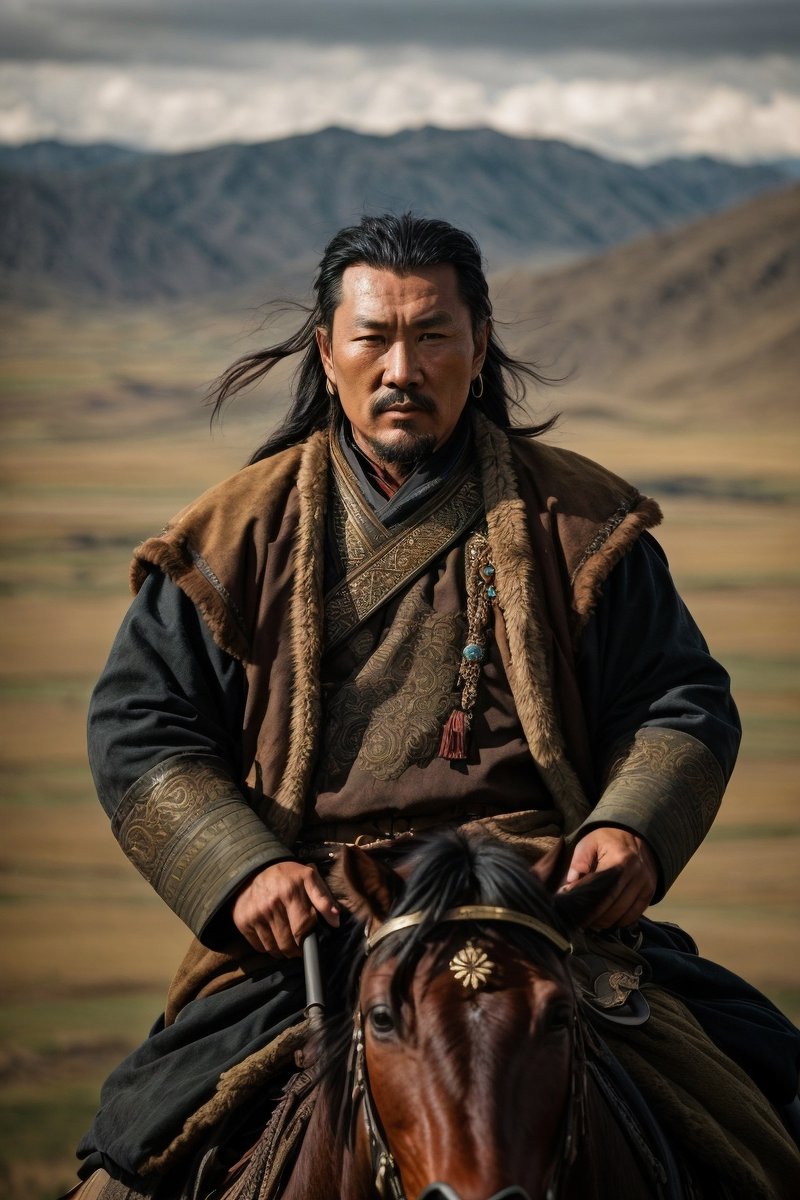
Born near the Onon River in Mongolia in 1162, Genghis Khan, originally named Temüjin, would come to define an epoch. His moniker, meaning "iron," aptly foretold the challenges he would confront. After the untimely death of his father Yesugei from poisoning, Temüjin's family was marginalized. Yet, young Temüjin refined his skills in archery and horse riding, signaling the advent of an unparalleled legacy.
💔 Rivals & Allies
Young Temüjin's life was characterized by fluctuating alliances and rivalries. His union with Börte was briefly interrupted when she was kidnapped by a rival tribe. With the backing of allies, including his sworn brother Jamukha and Toghrul Khan of the Kerait tribe, Temüjin secured her return. Over time, disagreements over leadership ideals soured his relationship with Jamukha, leading to open conflict.
🏰 Rise to Power
Temüjin’s journey to become Genghis Khan was filled with tribulations and victories. He first had to navigate the complex tribal politics of the Mongolian plateau, confronting rival chieftains and consolidating smaller tribes under his banner. His innovative approach to alliance-building, combined with his vision of a united Mongol nation, set him apart. By 1206, after numerous military campaigns and forging strategic partnerships, he had unified the disparate Mongol tribes. To mark this significant achievement, they anointed him Genghis Khan, meaning "universal leader."
⚔️ Wars & Conquests
Genghis Khan's military expeditions were vast and varied:
Mongol Sub-tribes: He began by subjugating local tribes, like the Merkits and Naimans. This was vital in establishing a united front and presenting the Mongols as a single formidable force.
Western Xia & Jin Dynasty: Genghis Khan then turned his attention to the settled civilizations to the south. The Western Xia succumbed after prolonged campaigns, and the more formidable Jin Dynasty witnessed its capital, Zhongdu (modern-day Beijing), fall in 1215. However, it wasn���t until after Genghis Khan’s death that the dynasty was fully annexed.
Khwarezm Empire: A diplomatic incident involving the murder of Mongol envoys by the Khwarezm Shah provided the casus belli for Genghis Khan’s invasion. Major cities like Bukhara and Samarkand were taken, decimating the Khwarezm Empire.
Expansion West: The Mongol appetite for conquest didn't stop in Central Asia. Reconnaissance missions eventually culminated in full-blown campaigns in Eastern Europe, including the significant victory at the Battle of Kalka River.
The Human Cost of the Mongol Conquests
While Genghis Khan’s campaigns were tactically brilliant, they came with a massive human cost. Some regions witnessed genocides, with entire populations decimated. Agricultural lands were often destroyed, resulting in famines. Estimates of the death toll vary widely, but some historians suggest that up to 70 million people might have perished as a direct or indirect result of the Mongol invasions, making it one of the deadliest conflicts in human history.
🌏 Economic and Cultural Impact
Despite the large-scale destruction, the Mongol Empire also facilitated significant economic and cultural exchanges:
Silk Road: Genghis Khan’s conquests rejuvenated this ancient trade route. Under the Pax Mongolica, or Mongol Peace, goods, technologies, and ideas moved freely between the East and West like never before.
Cultural Exchanges: The Mongol Empire became a melting pot of diverse cultures, from Chinese and Persian to Turkic and Arab. This convergence spurred innovations in science, art, and literature.
Urban Development: The Mongols, though initially nomadic, became great patrons of cities. Places like Karakorum and, later under Kublai Khan, Beijing became cosmopolitan centers.
Religion: Genghis Khan was a proponent of religious freedom. As a result, various religions, including Christianity, Islam, Buddhism, and Tengrism, coexisted and flourished within the empire.
⚔️ Military Strategy
Genghis Khan's military brilliance is a topic of extensive study.
Mobility: The Mongol army, mainly consisting of light cavalry and mounted archers, was incredibly mobile. Their ability to cover vast distances rapidly was unparalleled, allowing for swift surprise attacks.
Psychological Warfare: The Mongols used fear as a weapon. They often spread tales of their ruthlessness to terrify their adversaries, making cities surrender without a fight.
Decentralized Command: Commanders were given the autonomy to make battlefield decisions, allowing for flexibility in tactics and quick responses to enemy maneuvers.
Espionage and Reconnaissance: Before launching an assault, Genghis Khan used spies extensively to gather information about enemy strengths, vulnerabilities, and strategies.
Innovative Tactics: Among their many tactics, feigned retreats were especially effective. The Mongols would pretend to be beaten and flee, only to turn on their pursuers with devastating effect.
Use of Local Troops: After conquering an area, Genghis Khan often incorporated the defeated soldiers into his army, gaining local knowledge and expertise.
Siege Warfare: While the Mongols were traditionally a nomadic cavalry force, they quickly adapted to siege warfare, learning from those they conquered and employing Chinese and Persian engineers to breach city walls.
Meritocracy in Ranks: Genghis Khan valued skill over noble birth. Soldiers and commanders were promoted based on their abilities and achievements, ensuring a highly motivated and effective force.
🌏 Legacy as a Ruler
Beyond his military pursuits, Genghis Khan was a visionary administrator. He introduced the Yassa code, developed an intricate postal system, and promoted religious tolerance, propelling the Mongol Empire into a significant cultural and trade nexus.
💔 Betrayals & Family
The Mongol Empire's story was also influenced by intricate family dynamics, particularly the tension between Jochi and Chagatai, Genghis Khan's sons, which had implications for the empire's future.
⭐ Legacy
Genghis Khan's legacy is a tapestry of conquest, cultural enrichment, innovation, and profound destruction. His life and reign remain an endlessly fascinating chapter in the annals of human history. 🌌🐎🌍
#LeadershipMatters
#BusinessInsights
#CEOThoughts
🏰 The Reconquista 🏴🏴🏴
Once upon a time, in the 🌞 land of Spain 🇪🇸, a long and epic tale of conquest and reconquest unfolded. This was the story of the Reconquista. 🗺️
🌍 The Setting 🌍
In the early 8th century, the Iberian Peninsula was a diverse landscape, home to Christians, Muslims, and Jews living side by side under various rulers. But in 711 AD, the 🕌 Moors 🕌, led by Tariq ibn Ziyad, crossed the Strait of Gibraltar and established Muslim rule over much of Spain as part of the Umayyad expansion into the Iberian Peninsula.
Tariq ibn Ziyad
Tariq ibn Ziyad's arrival in Spain in 711 AD was a pivotal moment in the history of the Iberian Peninsula. He was a Berber general serving the Umayyad Caliphate, and his expedition marked the beginning of the Umayyad expansion into the Iberian Peninsula. Under his command, Muslim forces crossed the Strait of Gibraltar and quickly established control over much of the region. Tariq's conquest set the stage for the centuries-long struggle known as the Reconquista.
👑 The Kingdoms of the North 👑
As centuries passed, Christian kingdoms in the north, like 🏰 Asturias 🏰, began to push back against the Muslim dominion. Pelayo, a legendary figure, won the 🗡️ Battle of Covadonga 🗡️ in 722 AD, marking the beginning of the Christian Reconquest. 🏴
🏰 The March Southward 🏰
Over time, the Christian territories expanded, capturing cities like 🌆 Toledo 🌆 and 🌆 Zaragoza 🌆. The ⚔️ warrior El Cid ⚔️ emerged as a symbol of Christian resistance in the 11th century, playing significant roles in battles and diplomacy.
El Cid
Rodrigo Díaz de Vivar, famously known as El Cid, played a central role during the Reconquista. Born in 1043, El Cid emerged as a remarkable warrior and military leader, primarily fighting on behalf of both Christian and Muslim rulers at different points in his life. His legendary exploits, such as the Battle of Cabra and the Siege of Valencia, earned him fame on both sides of the conflict.
El Cid's influence extended beyond his military prowess. He symbolized the complex relationships and shifting alliances that characterized the Reconquista era. His story is a testament to the fluid nature of loyalties during this time, as he navigated alliances with Christian and Muslim leaders alike.
🕌 Islamic Spain 🕌
But the Muslims were not to be defeated easily. 🏛️ Al-Andalus 🏛️, the Islamic stronghold in Spain, flourished culturally and scientifically. It was a place of religious tolerance, where Muslims, Jews, and Christians coexisted, known as the "Convivencia." However, the concept of Convivencia wasn't without its conflicts. While there was religious tolerance in some periods and regions, there were also periods of persecution and strife.
Contributions of Muslim Scholars
In addition to Ibn Rushd and Ibn Sina, several other notable Muslim scholars made significant contributions during the Reconquista period.
Ibn al-Haytham made pioneering advancements in optics and the scientific method.
Al-Zahrawi was a prominent physician and surgeon, often regarded as the "father of surgery."
Al-Khwarizmi laid the foundation for algebra and introduced the decimal numeral system to Europe.
These scholars played vital roles in preserving and expanding the knowledge of antiquity while also making innovative contributions to various fields, including astronomy, mathematics, and medicine.
⚔️ The Crusades and the Reconquest ⚔️
As the 🏰 Christian kingdoms ⚔️ pushed southward, they aligned themselves with the broader Christian cause during the 🛡️ Crusades 🛡️. The capture of 🌆 Valencia 🌆 in 1238 marked a significant victory for the Christians.
🏴 The End of the Reconquista 🏴
Finally, in 1492, after nearly 800 years of conflict, the 🤴 Catholic Monarchs Ferdinand and Isabella 🤴 completed the Reconquista by capturing the 🏰 Alhambra in Granada 🏰. This marked the end of Muslim rule in Spain and the unification of the country under Catholic authority.
End of Muslim Rule in Spain
The capture of the 🏰 Alhambra 🏰 in Granada 🏰 in 1492 marked the formal end of Muslim rule in the Iberian Peninsula. This event, led by the Catholic Monarchs Ferdinand and Isabella, symbolized the completion of the Reconquista. However, it's important to note that Muslim communities continued to exist in Spain after the Reconquista. Many Muslims and Jews faced the choice of forced conversion to Christianity or expulsion, leading to a complex legacy of cultural blending and the preservation of traditions.
🎉 The Legacy 🎉
The Reconquista left a lasting impact on Spain's culture and identity. It shaped the nation's history, and its consequences are still felt today. The period of Reconquista was a blend of conflict and cooperation, a time when different cultures converged, leaving behind a rich tapestry of history.
The enduring legacy of the Reconquista can be seen in the architecture, art, and cultural traditions of Spain. The architectural marvels of the 🏰 Alhambra 🏰 and the 🏰 Great Mosque of Cordoba 🏰 continue to stand as testaments to Islamic influence on Spanish architecture. The Reconquista also laid the groundwork for the Spanish Inquisition, a period of religious intolerance and persecution that affected Jews and Muslims who had converted to Christianity.
Overall, the Reconquista's enduring legacy is a testament to the complexity of history, where conflicts and collaborations between different cultures have left an indelible mark on a nation's identity. 🇪🇸🗺️