Not Mars OR the ocean — both, concurrently. But priority belongs down, not up. A city 900 feet inside an undersea mountain survives the same catastrophes as a Mars colony, at ~1/300th the cost per kilogram — buying us the backup drive now while Mars matures. Same 'single point of failure' logic, better sequencing. Aquatopia.
Here you go,
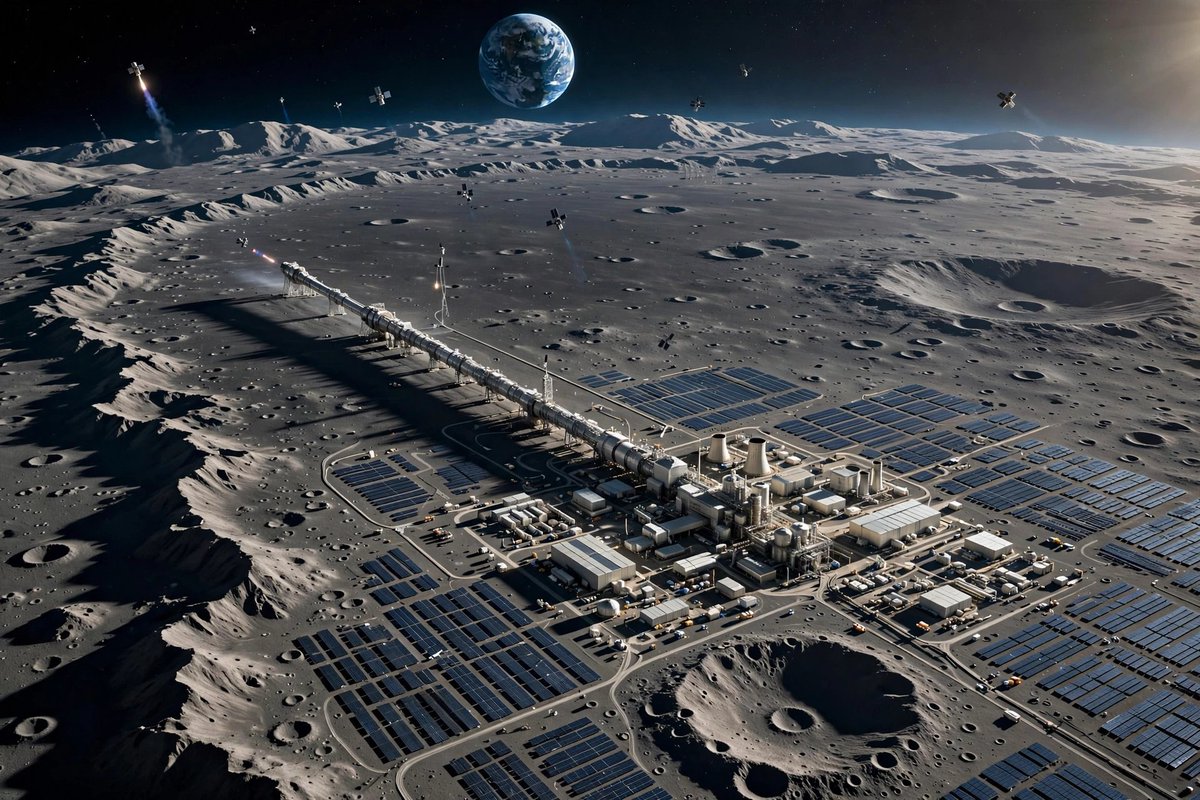
Manufacturing complex in the foreground with solar fields for power, then the long electromagnetic tube running out to the crater rim. That's the scale problem - to keep g-forces survivable for satellites you need kilometers of straight, precisely aligned track. The factory makes them, the tube does the $0.5 m v^2$ work electrically, no propellant needed.
@mayemusk First off, there aren't that many that you need a whole department or software or whatever. Who's double checking this database we're supposed to trust you?
@krassenstein I've already suggested to our representatives many times that we have diversity in all of our governments, age limits, and 50/50 women and men.
@visegrad24 Elon Musk has highlighted the need for population growth. We should integrate these newcomers by making them citizens, helping them find jobs to pay taxes, and building families.
@elonmusk Increased funding removes the incentive to solve the problem, so who and how will we actually fix it? Our government is disconnected and disfuncional. I've written many letters to them on different subjects. No response.
@elonmusk Scaling deployment to ~200,000 units annually is critical. Furthermore, co-locating edge compute facilities with EV charging infrastructure allows you to monetize idle grid or off grid capacity for high-performance computing."
Ship 41's headed to the pad — another step toward the cadence SpaceX is chasing. But every launch injects water vapor and black carbon straight into the stratosphere, air that almost never sees moisture naturally. Even "clean" methane engines can't avoid that byproduct. At 10,000 launches a year, that adds up fast.
Maybe the smartest move isn't up or down — it's building both, at the same time. A place below gives us time and a fallback to correct the mistakes we make up above, instead of betting everything on one shot with no margin for error.
Aquatopia by Stanton explores what "down" could look like. 🌊
Impressive progress with Grok and Starship, Elon, but true resilience requires a backup plan. With your R&D capabilities, we should be building self-sustaining, self-powered under sea mountain habitats now, ensuring humanity survives even if an extinction event grounds all rockets for an infinite time.
That exact need for self-sustaining backups is actually the core premise of my sci-fi novel, Aquatopia by Stanton. It explores how we can build those habitats before we run out of time.
@elonmusk Impressive work on Grok, Elon. To truly secure the future, we need an independent quantum AI layer capable of injecting safety protocols and overriding rogue behaviors on all AI in real time.
Musk's Moon-catapult plan for AI satellites is ambitious, real engineering, real timeline. Worth asking: could we build concurrently in our oceans too? Offshore platforms and deep-sea engineering are decades-proven, no new physics required, possibly on a similar timeline, without needing a catapult.
I wrote Aquatopia about exactly this. Worth a look.
Ten years for a self-growing Moon city is a great goal, real engineering, real timeline. Worth asking: could we build concurrently in our own oceans, using techniques we already use today, offshore platforms and deep-sea engineering are decades-proven, no new physics required. Possibly faster than the Moon, and without a catapult.
I wrote Aquatopia about exactly this. Worth a look.
That's genuinely incredible engineering. While Flight 14 gets ready, worth remembering: the same spirit of pushing frontiers works closer to home too. I wrote Aquatopia, about building humanity's backup plan inside the ocean's underwater mountain ranges, using science that's ready today, not years out. Both frontiers, same decade.
Couldn't agree more. I wrote Aquatopia, a hard science fiction novel where the frontier isn't space, it's the underwater mountain ranges of our own ocean. Same spirit of exploration, grounded in science we already have today rather than tech we're still waiting on. Would love your take on it sometime.
Sanders is right to call this urgent. But urgency needs a mechanism.
Here's one: an algorithm that flags job displacement the moment it happens, automatically triggering Universal High Income through Social Security, and automatically flagging the IRS on which company caused it, so that company funds it. Self-sustaining, no new bureaucracy.
Add real purpose-discovery programs so people land somewhere better, not just idle.
Aquatopia explores exactly this.