Mercury goes retrograde on October 24 ↩️
From October 24 to November 13, Mercury will appear to move backward against the stars — but no, Mercury isn’t actually reversing its orbit. What’s really happening is a change in perspective: as Earth and Mercury move around the Sun at different speeds, Mercury appears to drift backward against the background stars for a while. This happens 3–4 times a year, so astronomically, Mercury retrograde is actually pretty normal.
The tricky part is seeing it. You can’t watch the planet “turn around” in real time — you’d need to compare its position over several nights to notice the shift.
Learn how this optical effect works:
🌌 https://t.co/benUWe0pJM
Why is the Moon out during the day? 🌙☀️
Because she can appear whenever she wants!
But seriously: the Moon orbits Earth, and for much of the month, it spends part of the daytime above our horizon. It’s also bright enough to show up against the blue sky because it reflects sunlight back toward us.
When you spot it depends on the Moon’s phase and position:
🌒 Crescent Moon — often hangs around in the daytime, either in the morning or afternoon.
🌓 First Quarter — perfect for afternoon Moon-spotting.
🌗 Last Quarter — your morning-sky companion.
🌕 Full Moon — mostly saves its appearance for nighttime, rising around sunset.
So no, a daytime Moon is not confused, lost, or breaking the rules. It’s just orbital geometry doing exactly what it should. 😌✨
Be honest: does seeing the Moon in broad daylight still feel a little wrong?
There's a grain of truth in every joke. 😏🌍
But seriously, this is a real photo of power lines stretching across Lake Pontchartrain in Louisiana, USA.
So why do the towers seem to disappear below the horizon?
The answer is Earth's curvature. As the towers get farther away, the curved surface of the lake gradually hides their lower sections from view.
If Earth were flat, the towers would still appear smaller with distance due to perspective, but their bases wouldn't progressively disappear behind the water. Instead, the entire structures would simply shrink toward the horizon.
And that's the key difference: perspective makes distant objects look smaller, while curvature actually hides parts of them.
Of course, atmospheric refraction can also affect what we see over long distances. But the overall pattern here is exactly what we'd expect on a spherical Earth.
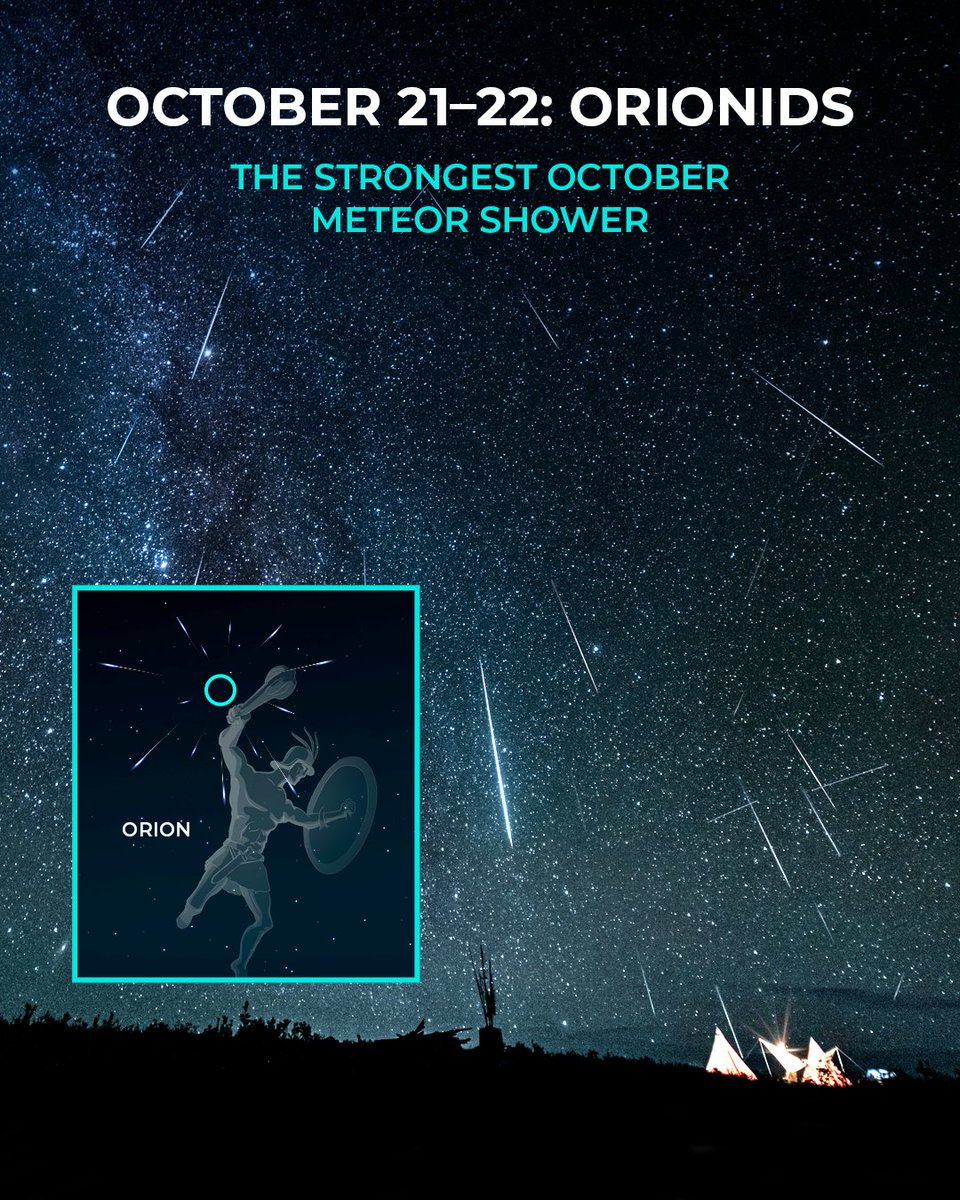
The Orionids peak October 21–22 🌠
Expect up to 20 meteors/hour under ideal conditions. These fast meteors come from debris left by Halley’s Comet and can leave bright trails behind them. ☄️
The shower is visible from both hemispheres and is best watched from midnight until dawn. This year, moonlight may interfere earlier in the night, so start observing when the Moon is already setting in your location.
No telescope needed — just find a dark spot and look up.
Learn more:
🌠 https://t.co/8XPSp3SOZQ
❗️A new Moon crater nobody noticed
During a routine check of images from NASA’s Lunar Reconnaissance Orbiter, scientist Robert Wagner noticed a bright spot surrounded by a dark halo. Comparing older and newer images revealed McGetchin — a fresh impact crater about 222 meters wide and 43 meters deep. 🔍
📅 The crater formed between April 11 and May 22, 2024, but wasn’t identified until October 2025. The findings were published just recently — in September 2026.
Scientists estimate that an impact capable of creating a crater this size happens on the Moon only about once a century or longer! 💯
The wildest part? Nobody actually saw the collision. 👀 We only discovered the scar it left behind.
Missing an impact on the Moon is one thing. But what if an asteroid were heading straight for Earth? Would we spot it in time? ☄️🌍
Image credits: NASA Goddard/Intuitive Machines
#StarWalk #Moon #Astronomy #Space #NASA
☄️ 7 Largest Meteorites Ever Found on Earth! 🌍
These cosmic giants have spent millions of years traveling through space — and their stories on Earth are just as fascinating! 🤯
🇳🇦 1. Hoba — The largest known intact meteorite on Earth! It was discovered in 1920 by a farmer plowing his field. 🚜
🇬🇱 2. Ahnighito — The largest fragment of the Cape York meteorite. Inuit people used its iron to make tools for centuries before explorer Robert Peary reached it in 1894. 🔨
🇦🇷 3. Gancedo — The largest fragment of the Campo del Cielo meteorite group, discovered underground by a team of exploers in 2016. 🔎
🇦🇷 4. El Chaco — Another giant from Campo del Cielo! Found in 1969, it was buried 5 meters underground and wasn't excavated until 1980. ⛏️
🇲🇽 5. Bacubirito — Discovered in 1863 by geologist Gilbert Ellis Bailey, this meteorite has become one of Mexico's famous tourist attractions. 🌵
🇹🇿 6. Mbozi — Known to local communities for centuries as Kimwondo, this meteorite was documented by scientists only in the 1930s. 🌍
🇺🇸 7. Willamette — Sacred to Native American peoples, this meteorite came to the attention of European settlers in 1902 when Ellis Hughes found it. ✨
💬 Which of these incredible space rocks would you love to see in person?
🌔🔺 A giant triangle in the night sky!
From October 19 to 25, 2026, the Moon will pass through Sagittarius, Capricornus, Aquarius, and Pisces.
On October 24–25, the nearly full Moon will shine near Saturn. Together with Algenib, a star in Pegasus, they’ll form a large triangle. Depending on your location, look for the pattern that night or the following night.
📏 Each side will span about 15° — roughly one and a half fists held at arm’s length.
📍 From New Zealand and parts of the South Pacific, the triangle will look almost perfectly equilateral. Elsewhere, its shape will vary with your location and viewing time.
👀 All three objects are visible to the naked eye, though Algenib may be tricky to spot in the Moon’s glare.
📱 Use Star Walk 2 to identify Saturn and Algenib and check the view from your location.
#Moon #Saturn #Stargazing #StarWalk
On October 18, 1963, a cat went to space 🐈⬛🚀
Her name was Félicette, and she became the first and only cat ever to travel into space. She flew aboard a French Véronique AG1 rocket, reached an altitude of about 157 km, spent several minutes in weightlessness, and returned safely to Earth after a 13-minute suborbital flight.
Before launch, Félicette was known simply as C341. Scientists selected her for the mission because of her calm temperament and trained her for two months to study how a cat’s vestibular system and brain would react to spaceflight.
After the flight, the press nicknamed her Felix, after the cartoon character Felix the Cat, apparently assuming the first feline astronaut was male. For decades, Félicette received far less recognition than other famous animal space travelers. That finally began to change in 2017, when a crowdfunding campaign raised more than $57,000 for a memorial in her honor.
In 2019, the International Space University near Strasbourg, France, unveiled a 1.5-meter bronze statue of Félicette. It shows her sitting on top of Earth, looking up toward the sky she once traveled through.
Nearly six decades after her flight, the first feline astronaut finally got a memorial of her own. 🐾✨
Did you know Félicette’s story before today?
A truly starry sky is becoming a rare sight 🌌
In many cities, light pollution washes out all but the brightest stars — and sometimes you have to travel far from home just to see the Milky Way properly.
How dark is the sky above your hometown? ✨
A passing star could steal Neptune.
In this simulation, a star with the Sun’s mass passes through the outer Solar System. Planetary orbits change, icy objects in the Kuiper Belt scatter, and Neptune ends up orbiting the visitor.
The star leaves. Neptune goes with it.
This is a hypothetical encounter with calculated trajectories. Planet sizes are exaggerated and time is sped up.
Send this to someone who loves space, and follow Star Walk for more astronomy.
✨ Follow a W to another galaxy!
October evenings are a great time to find the Andromeda Galaxy, especially from the Northern Hemisphere. Here’s how:
1️⃣ Find Cassiopeia’s five bright stars, which form a W.
2️⃣ Look for the deeper V within that W. Imagine it as an arrow pointing toward Andromeda.
3️⃣ Follow that direction and look for a faint, fuzzy oval. Under a dark sky, you may spot it with your naked eyes. Binoculars make it easier!
Choose a night with little moonlight and a spot away from city lights. Open Star Walk 2 and search for “Andromeda Galaxy” to check where to look. 🌌
Note: The video shows the star pattern, not its actual orientation relative to the horizon. The real view depends on your location and observing time.
🌙 The Moon meets Antares in the evening sky! ✨
On October 14, a thin crescent Moon will appear very close to Antares, the bright reddish star marking the heart of Scorpius. The two will form a beautiful pairing in the evening sky, visible to the naked eye. Mercury and Venus will also be nearby, adding even more bright dots to the twilight scene!
📅 Conjunction: October 14, 2026, at 21:09 GMT
🔭 Closest approach: October 14, 2026, at 21:02 GMT
🌅 Best time to look: shortly after sunset, toward the western sky
🌟 In some locations, the Moon will even pass directly in front of Antares, briefly hiding the star from view! This lunar occultation will be visible from parts of Uruguay, southern Brazil, and the South Atlantic.
The best views will be from the Southern Hemisphere, where the Moon and Antares will appear higher in the sky. Northern observers will need a clear view of the southwestern horizon.
You can see an asteroid tonight 🪨
On October 13, asteroid Vesta (mag 6.3) reaches opposition, making it the best night of the year to look for it. 🔭✨
Here’s how to spot it:
🕗 Time: visible all night; highest in the sky around midnight
🧭 Direction: east-southeast after dark, moving across the southern sky later
🐳 Location: constellation Cetus
🪐 Landmark: bright Saturn is nearby, which makes the area easier to find
🔭 Equipment: binoculars are recommended; under very dark skies, Vesta may appear almost bright enough for naked-eye visibility, but for most observers binoculars are the safer bet.
Vesta will look like a faint star, not a tiny disk. ✨ The challenge is knowing exactly where to point your binoculars.
📱 Use the Star Walk 2 app to pinpoint Vesta from your location. Bright Saturn will also help you find it.
💬 Have you ever seen an asteroid? Will you try to spot Vesta tonight? 👀
#StarWalk #Astronomy #Stargazing #Asteroid #Saturn
The Southern Taurids reach an early peak on October 12–13 🌠
They’re visible from both hemispheres, and this year the waxing crescent Moon shouldn’t interfere much. Expect up to 5 meteors/hour. The meteors come from debris left by Comet 2P/Encke. And this is just the first highlight — the Southern Taurids peak again on November 4–5.
Learn how to catch them:
☄️ https://t.co/1Zcu7dJMQj
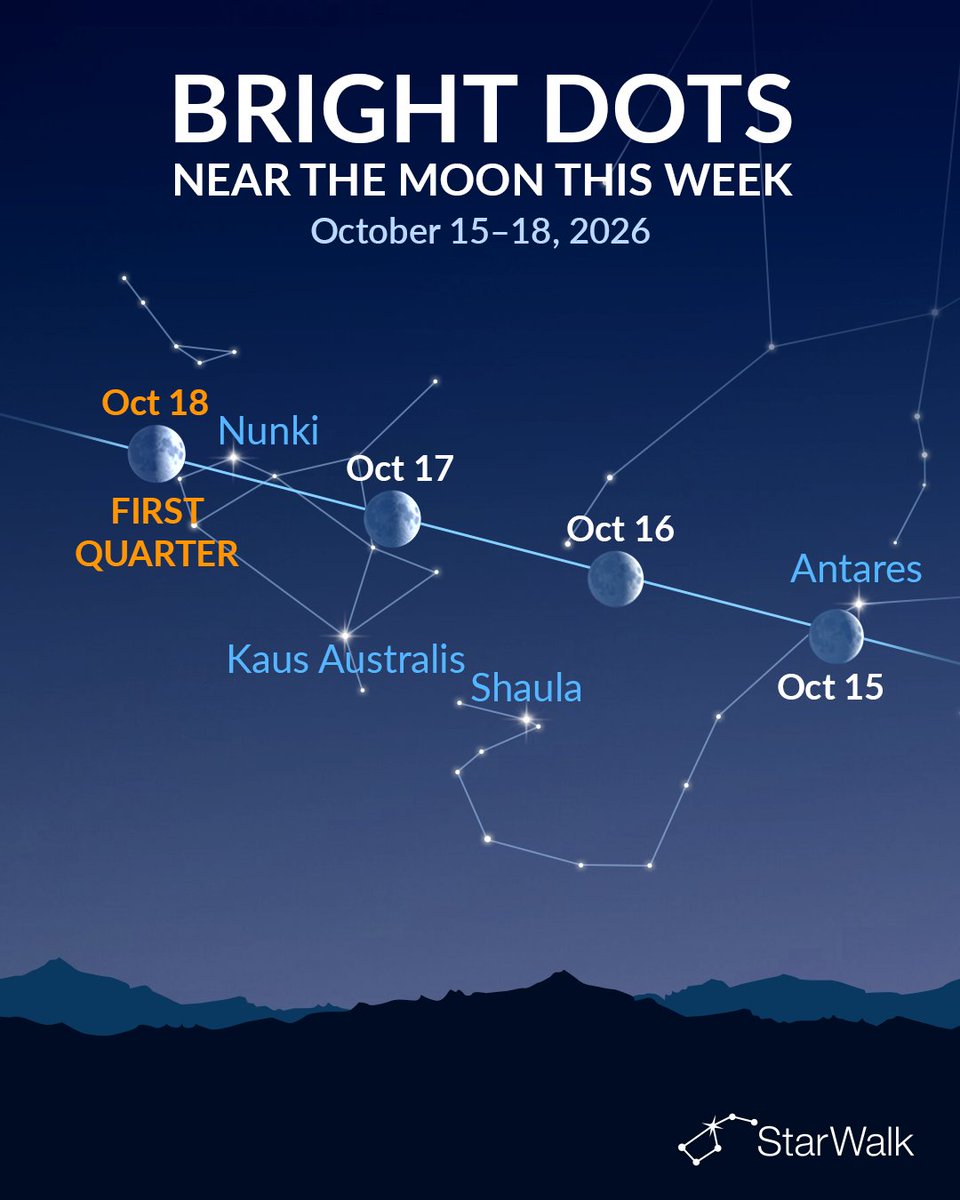
🌙 What’s that bright dot near the Moon?
On October 12–18, follow the Moon through the evening sky, from Mercury and Venus toward Antares and the stars of Sagittarius.
The early-week views of Mercury and Venus favor southern latitudes. Your location will affect what you can see!
Swipe for the daily guide, then open Star Walk 2 to identify the bright dots and check their positions in your sky. ✨
Note: The Moon’s positions are shown for London at 00:00 GMT on each date. The illustrated horizon is decorative and does not represent the actual local horizon.
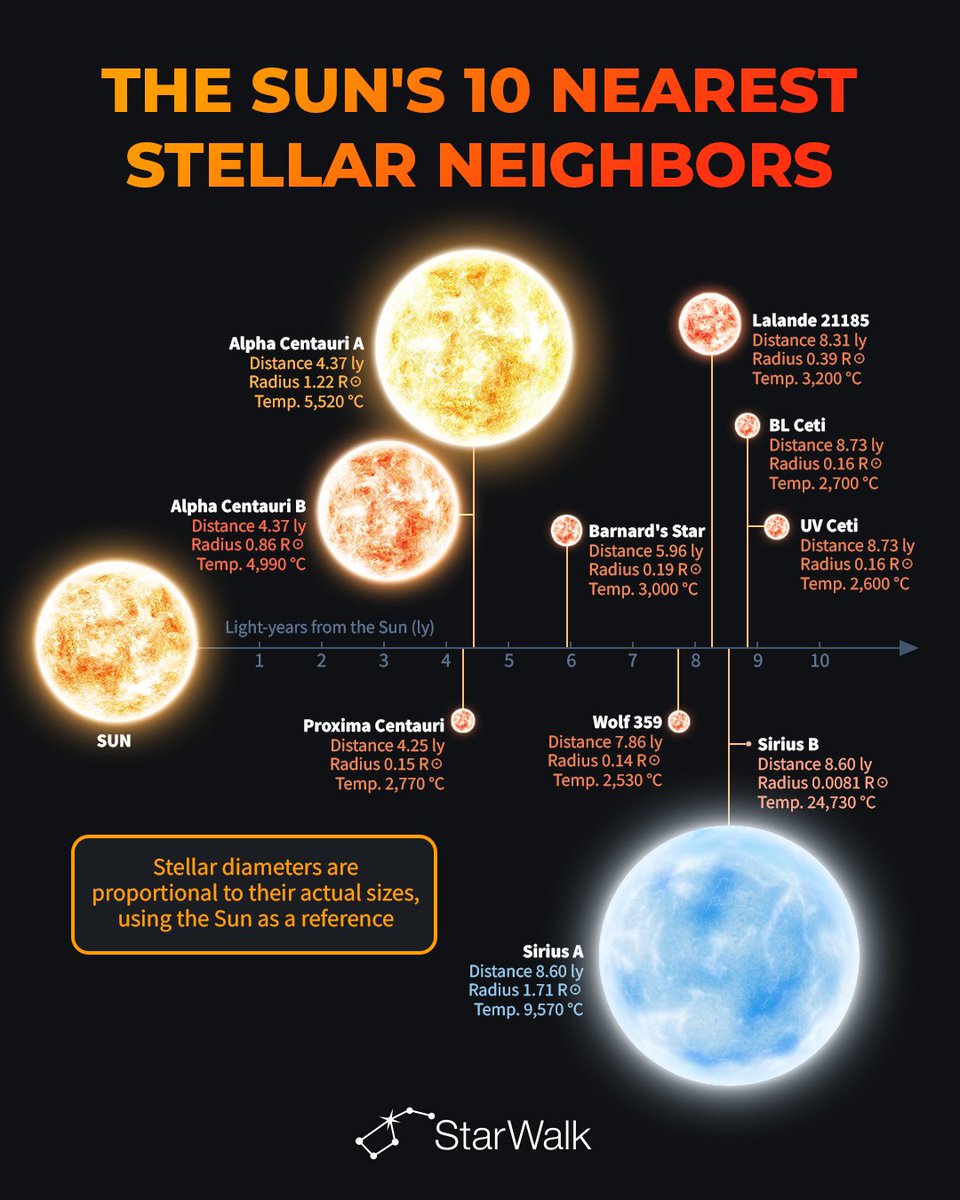
🌟 Meet the Sun’s 10 nearest stellar neighbors!
Our cosmic neighborhood is full of surprises! 🌌
🔴 Proxima Centauri is our closest stellar neighbor, just 4.25 light-years away. Along with Alpha Centauri A and B, it belongs to the nearest star system to the Sun.
✨ Barnard’s Star is famous for its rapid motion across the sky, while Wolf 359 and Lalande 21185 are faint red dwarfs invisible to the naked eye.
💙 Sirius A is the brightest star in our night sky, while its tiny companion, Sirius B, is a white dwarf — much smaller than the Sun but incredibly hot!
🔥 BL Ceti and UV Ceti are flare stars that can suddenly increase in brightness.
☀️ Fun fact: Most of our closest stellar neighbors are small, cool red dwarfs, not bright stars like the Sun!
📏 All stars in the infographic are shown to scale, with their sizes relative to the Sun.
🌙 Venus meets the Moon in the evening sky! ✨
On October 12, a thin crescent Moon will appear close to brilliant Venus, creating a beautiful pairing low above the western horizon after sunset. Mercury will also be nearby, making the evening sky even more interesting.
📅 Conjunction: October 12, 2026, at 02:31 GMT
🔭 Closest approach: October 12, 2026, at 04:37 GMT
🌅 Best time to look: shortly after sunset, low in the western sky
Please note: Mercury is shown brighter in the illustration for clarity — in reality, it will be much fainter than Venus.
The best views will be from the Southern Hemisphere, where Venus and the Moon will remain higher above the horizon after sunset. From northern latitudes, the pair may be much harder to catch.
Save the date and look west after sunset! 🌙✨
🌅 Catch Mercury at its evening best!
On October 12, Mercury reaches greatest eastern elongation: its widest apparent separation from the Sun in the evening sky. It’s a great opportunity to spot this elusive planet, especially from the Southern Hemisphere.
🌍 Where is the best view?
Observers at southern mid-latitudes get Mercury’s best evening appearance of 2026. The planet stays higher as twilight fades. At mid-northern latitudes, it remains low and can be difficult to see.
🌙 What should you look for?
Look above the western horizon after sunset for Mercury near a very thin crescent Moon. From around or south of the equator, you may also catch brilliant Venus lower in the twilight.
🔭 How can you spot it?
Choose a clear view toward the sunset. Try several evenings around October 12; you don’t need to catch the exact moment.
Binoculars can help, but wait until the Sun has completely set before using them.
Use Star Walk 2 to find Mercury in your sky. ✨
#Mercury #Moon #Venus #Stargazing #StarWalk
Could the iPhone 25 come from an asteroid? 📱
Some asteroids contain metals used in electronics. In theory, those materials could end up in a future phone. The hard part? Extracting them and bringing them back to Earth at an affordable cost.
🚀 What could we mine in space?
• Asteroids: iron, nickel, cobalt, and platinum-group metals.
• The Moon: water ice in permanently shadowed polar regions and oxygen bound in soil minerals.
• Mars: water ice beneath the surface.
💧 Why go after water?
Water could support astronauts and be split into hydrogen and oxygen to make rocket propellant. Using resources already in space could reduce the amount of cargo launched from Earth.
🔬 How close are we?
Spacecraft have brought asteroid samples home for research. But collecting small samples is very different from running a profitable mine. Finding resources is only the beginning.
🌍 Earth Science Week, October 11–17, explores “Critical Minerals for a Thriving Society.” We’re marking it by looking at what lies beyond our planet.
Explore the possibilities in our updated space mining infographic: https://t.co/ZLO1kFVmY6