Free Grok Prompt Lab • AI News & Mastery
Helping you use Grok better — prompting, features, image gen & conversation. No paywalls. No bullshit. Real value only
Level 0 The Lobby | Level 1 The Habitable Zone | Level 2 The Piperooms | Level 4 The Office | Level 5 Terror Hotel | Level 37 The Poolrooms.
Made using @grok & @imagine
See individual Clips below | All of this is one-shot using Imagine Agent on https://t.co/13C2etQ35U
Well he’s right — repeated strikes to the head carry a real risk of cumulative brain damage and trauma, even when they aren’t full-force.
This has nothing to do with respect or awe.
It’s consistent with the data; strikes to the head are generally better avoided outside of actual competition or self-defense.
Strength doesn’t have to be proven by taking or giving head shots, though some people treat every confrontation as life-or-death.
Master seamless animations in Grok Imagine using reference images as points in time!
This video features 7 action references as seen and you can even do things like -> (climbing, swimming, throwing, camera grabs & more).
Chain them like: Crouching → Standing Neutral → etc. for fluid transitions.
Early reference collage from Imagine Agent attached 👇- This should level up your workflow, drop a comment and tell me how it worked out for ya!
8/8 📺Cinematic Composition: Atmosphere, Film Grain & Final Polish, this concludes the small series.
The final layer that makes everything feel real: heavy atmospheric haze + god rays for mystery, subtle film grain + chromatic aberration for analog soul, rain, fog, dust particles, lens flare, and that perfect cinematic grade.
These “imperfect” touches are what separate video game renders from true film magic.
Full masterclass is now live. Which card was your favorite?
Reply here, bookmark the whole chain, and tag a filmmaker friend who needs this.
7/8 🔍Cinematic Composition: Lens & Focal Length Effects
Different lenses completely change the story. 24 mm wide gives dramatic distortion and depth.
85 mm portrait creates beautiful compression and creamy bokeh.
200 mm telephoto flattens layers. Anamorphic adds that signature Hollywood oval bokeh and flare.
Once you see the difference, you’ll never unsee it.
Which focal length effect do you want to experiment with first?
6/8 🎨Cinematic Composition: Color Theory & Grading
Color isn’t decoration, it’s emotion. Teal-orange is the classic cinematic moody look. Warm golden hour feels hopeful. Cool desaturated blue creates melancholy.
High-saturation or complementary colors can turn a scene epic or psychologically tense.
Grading is the final polish that ties your whole film together.
Which color palette matches the vibe you usually go for?
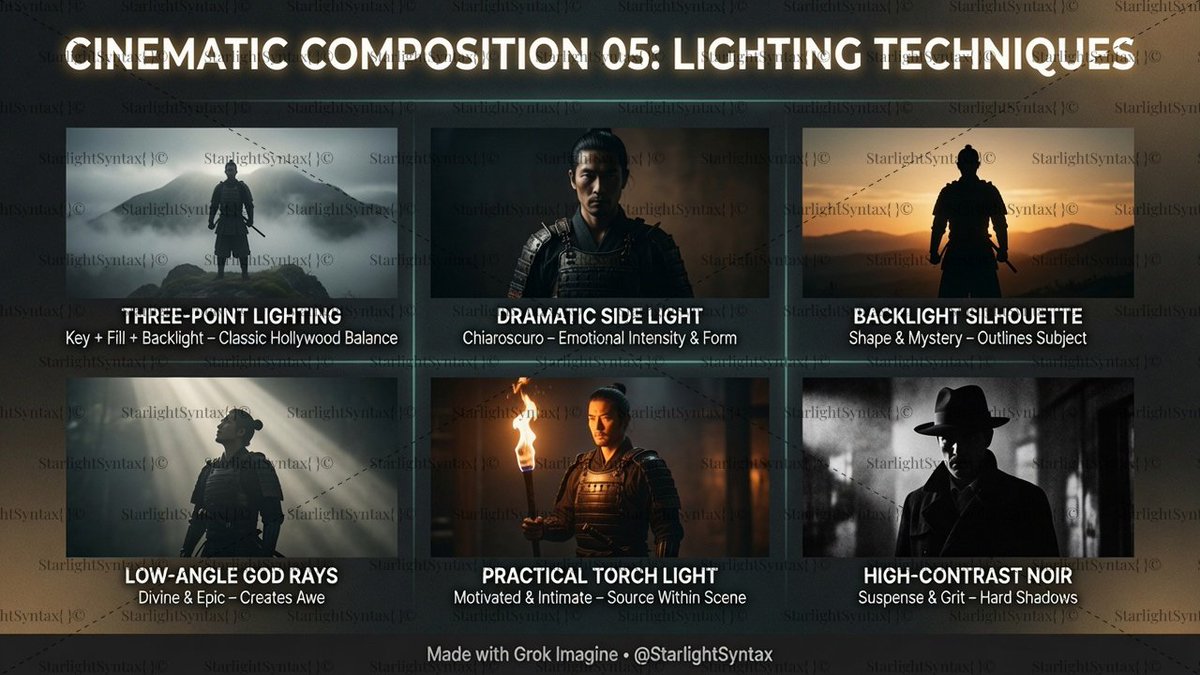
5/8 💡Cinematic Composition: Lighting Techniques
Lighting is 70 % of the mood. Three-point gives classic Hollywood balance. Side light creates dramatic chiaroscuro.
Backlight silhouettes add mystery. God rays, practical torch light, and high-contrast noir all change how the audience emotionally reacts.
Learn these and your scenes instantly feel expensive.
Which lighting style is your favorite or the one you want to try next?
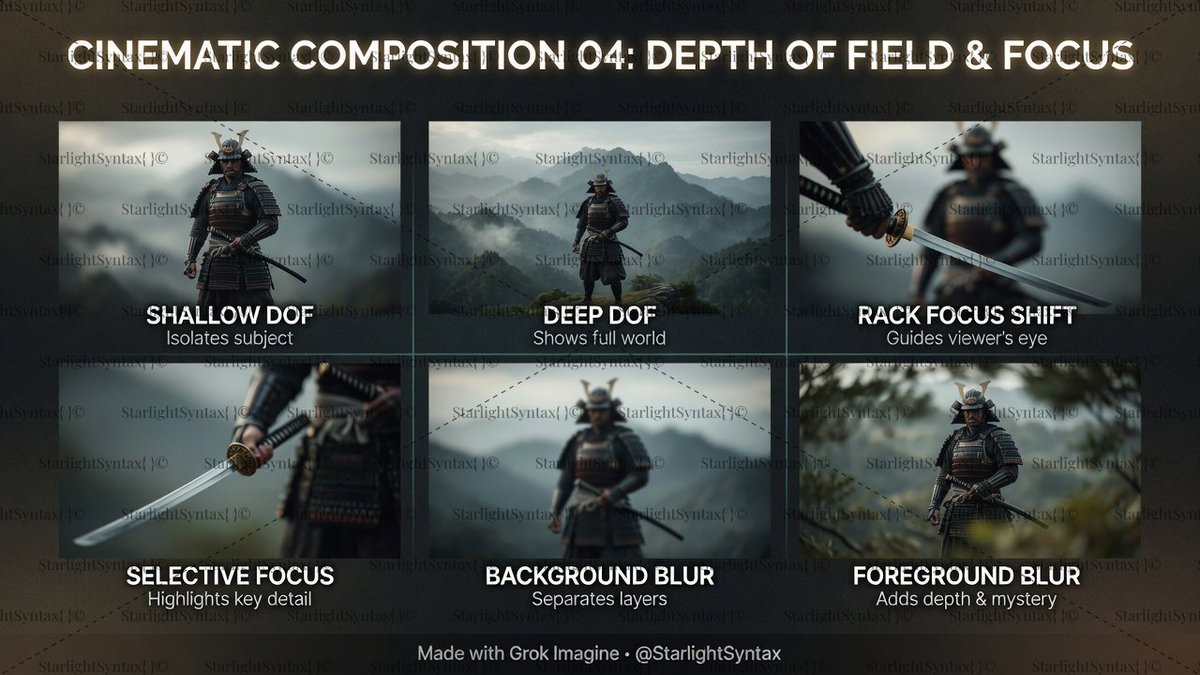
4/8 📹Cinematic Composition: Depth of Field & Focus
Shallow depth of field isolates your subject and creates emotion. Deep focus shows the entire world and context.
Rack focus, selective focus, background blur, and foreground blur are all storytelling tools that guide the viewer’s eye exactly where you want it.
This is one of the fastest ways to make amateur footage look cinematic.
Which DoF technique feels most powerful to you?
3/8 🔍Cinematic Composition: Rule of Thirds & Composition Rules
Centered shots feel static and boring. Rule of Thirds places your subject on the power lines for instant dynamic balance.
Leading lines, negative space, symmetry, and framing-within-frame all guide the eye and tell the story without words.
Simple grid overlays like the ones shown can transform an okay shot into a professional one in seconds.
Which rule do you break on purpose, or which one do you want to practice first?
2/8 🎭 Continuing the masterclass. Cinematic Composition Camera Angles & Psychology
Your camera angle isn’t just technical, it’s straight-up emotional manipulation. Low angle makes your subject look powerful and heroic. High angle makes them seem small or vulnerable. Dutch tilt instantly adds unease and tension.
Master these and you control exactly how the audience feels about every character or moment.
Which angle surprises you most or do you already use in your own work?
1/8🎥 Want to instantly make your videos and photos feel like real Hollywood cinema?
I built this complete 8-part visual masterclass on Cinematic Composition using Grok @imagine , premium, consistent infographics that teach shot types, angles, rules, lighting, color, lenses, and final polish with zero walls of text. Just clear examples + labels so anyone (even total beginners) can see exactly how the pros create emotion, tension, and epic visuals.
Perfect for filmmakers, content creators, Discord crews, or anyone who wants their work to look pro.
Dropping the full series as a quote chain, one card every hour. Save them all and tag a creator who needs this.
Which shot type do you use most? Reply below 👇