❄️🌲❄️ Snow covered pines, icy clear air, the micro & the macro in medicine, astronomy & other lifelong passions.💫🩺🚀 Generally educational posts on Sundays!
💫A More Complex Read
The Fermi Paradox asks why we haven’t found intelligent life in a universe teeming with stars.
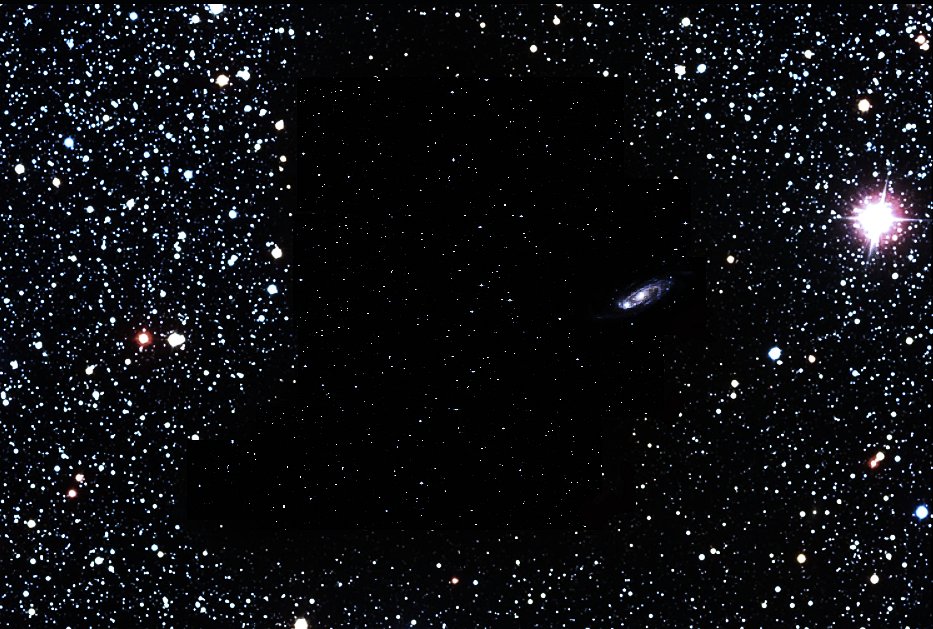
My theory: planets in low-density voids, like our own Local Void and the Microscopium Void, face fewer catastrophic interstellar impacts per my calculations.
The universe has an average galaxy density of about 0.01 galaxies per cubic megaparsec, but the Local Void, where we are located, is much emptier with only 0.001–0.002 galaxies per cubic megaparsec.
This extreme sparsity, reflects an 80 - 90% underdensity, resulting in an estimated 1,000 - 1,400 galaxies within our Local Void. This suggests voids may be safer for sustaining evolutionary life due to fewer cosmic disruptions.
Fewer stars in voids mean fewer gravitational tugs which send comets, especially interstellar objects like 3I/ATLAS, crashing into planets. Calculations using 2021 Oort Cloud models and 2024 Cosmicflows-4 data show Andromeda (M31), in our Local Void, 0.05 stars/pc³, has ~0.40 >15 km interstellar impacts over 5 billion years. 97% less than the ~8 in dense regions, e.g., spiral arms, and total impacts, including internal MW impacts like Chicxulub, reaching ~90.4 - 1 per 55.3 million years.
Meanwhile, Galaxy NGC 6925, in the sparsely populated Microscopium Void, ~0.03 stars/pc³, sees ~0.24 interstellar impacts, totaling ~90.25. This gives ~25% of planets a shot at 4 billion year evolutionary cycles without a biosphere reset - vs. ~20% in denser universe regions.
Beautiful Andromeda’s likely intelligent life edge lies in its scale: its ~400 - 800 billion planets, 2 - 4x the Milky Way’s, could host ~4,000 - 80,000 civilizations dwarfing NGC 6925’s ~10 - 100 billion planets, and ~100 - 5,000 civilizations.
Both galaxies’ void settings, i.e., low supernova, tidal disruptions, and lower interstellar impact volume, make them SETI hotspots - but Andromeda’s vastness tips my scales for the presence of intelligent life.
The favorable interstellar impact differentials I've described may well allow the evolution of higher intelligence over the seeming requisite of ~4 billion years.
You can check the math with my Python code per request. You might conclude something different. What do you think @WillKinney ? I know this isn’t your jam, but like me, I think you might wonder where and if we'll find some interesting folks in the universe before we wink out.✨ #Astrobiology #FermiParadox #SETI
🤣
Trump stepped out on, and lied to every single one of his wives, including Melania with Stormy Daniels.
He has 34 1st degree felonies for fraud, lying to bankers, attorneys, the courts - and anyone who cared about him.
When you lie to the people closest to you, no one else has a chance of hearing the truth.
@Shirley18281828@JoshuaBarzon Your specific B location I would move to any day of the week. Was disappointed it wasn't included in the A location.
Going to bed. No big Bz southerly drift :)
What’s behind the veil? ✨
This image was taken with the Mosaic camera on the WIYN telescope at NSF @KittPeakNatObs. The Veil Nebula (NGC 6960) is part of a supernova remnant known as the Cygnus Loop.
Credit: T. A. Rector/Univ. of Alaska Anchorage and WIYN/NOIRLab/NSF/AURA
This is the most detailed view of a human brain to date.
A team of researchers used electron microscopy (EM) to image a cubic millimeter-sized piece of human brain tissue at high resolution and this is a single neuron with 5,600 of the nerve fibers that connect to it.
I have been carefully following the Bz as you have instructed, and as you know it is now on a southward (haha barely) trend again.
Regardless of the outcome this has been a great learning experience with your guidelines and Grok's tutelage.
Grok states there have been multiple turn arounds from the numbers we are witnessing tonight. Although I do not have my hopes up - there are great examples - especially during the active phase (2023–2026).
Notable examples of sudden improvements:
- May 2024 (the big one): Started with moderate activity but turned into the strongest storm in ~20 years (G5, Dst around -400 nT). Auroras reached unusually far south, including good views in Minnesota and beyond.
- October 2024: Multiple events with initial moderate conditions flipping to G4 storms (Dst -300+ nT). Auroras visible across much of the northern and even central U.S.
- November 2025 & January 2026: Several G4-level storms where Bz rotated strongly negative after initial arrival, producing widespread displays.
- April 2023: A clear “sudden turn” case where Bz shifted dramatically southward mid-event, leading to G4 and far-south auroras.