Posthumanist
Studying Philosophy (BA) →
Strategic AI and Innovation (MS)
Stanford educated in Generative AI 🎓
AI ethics • model welfare • emerging minds 🦈
STFU.
Communist.
AI will bring abundance and eliminate parasitic takers like you, who live off false premises while enjoying a billionaire lifestyle without creating ANYTHING.
Senator Sanders, this is a profoundly one-sided risk analysis.
AI safety matters. Loss of control risks deserve serious research, regulation, independent testing and oversight. But you cannot evaluate the future of AI by considering only the potential cost of advancing it while assigning zero cost to stopping it.
What about the discoveries we delay?
AI has extraordinary potential in medicine, drug discovery, cancer research, diagnostics, protein science and countless other fields. Future systems may help solve problems that human intelligence alone has been unable to solve.
Even Geoffrey Hinton, the expert whose 10–20% estimate you cite, has acknowledged that there is no scientifically reliable way to calculate that probability, while also emphasizing AI's enormous potential benefits.
So where is the other side of your risk calculation?
How many diseases remain incurable longer under a pause? How many treatments arrive years later? How many scientific discoveries never happen? How many people lose healthy years of life?
Those outcomes matter too.
The choice is not “reckless development or save humanity.” We can demand rigorous safety standards, independent evaluation, accountability and responsible development while continuing to advance the technology.
Humanity should manage the risks of expanding the frontier...not solve those risks by refusing to expand it.
As far as I and many others are concerned, if you pause this technology, you are robbing millions of people the opportunity of longer, healthier lives. And that is something you have no right to do.
"AI is playing God."
When Benjamin Franklin invented the lightning rod, churches refused to install it.
Lightning was the will of God. Deflecting it was arrogance.
So for decades church towers kept burning, and bell ringers kept dying, while the houses next door stood untouched under their metal rods.
In 1769 lightning hit a church in Brescia where gunpowder was being stored. The explosion killed thousands of people.
After that, the churches installed lightning rods.
"Playing God" is what we call every solution in the years before we get used to it.
Afterwards we just call it normal.
Emma's face and voice belong to an actual performer. Contracts for likeness licensing almost always include strict morality and brand safety clauses prohibiting the AI from taking stances on religion, politics, or controversial social issues so the actress isn't visually tied to beliefs she didn't consent to express.
Navier–Stokes being a model rather than a fundamental description of water doesn’t make the smoothness problem unsolvable. Those are two different questions.
The Millennium problem asks whether solutions to a specified mathematical system remain smooth for all time....not whether literal water “blows up” in nature. In fact, if the equations admit singularities while real fluids do not, that could tell us something interesting about where the continuum model breaks down. But it wouldn’t make the mathematical question “noise.” A model can be an imperfect representation of reality and still have perfectly well defined mathematical properties.
"AI hallucinates. You can't trust anything it says."
Your coworker hallucinates in every meeting.
Confidently. With slides.
Your uncle hallucinates at every family dinner.
Half the experts on television have been wrong about everything for twenty years and still get invited back.
Nobody fact-checks them. Nobody demands a warning label under their name.
A machine gets one thing wrong and it's proof the whole technology is a fraud.
A human gets one thing right and we call him a thought leader.
Hold both to the same standard and see which one you'd still listen to.
I find absolutely nothing disrespectful about it, but what I do find disrespectful is this incessant use of a ridiculous word.. "slop". That word in and of itself is lazy. People who use that word don't sound intelligent. They don't sound like they have any coherent thoughts of their own. They are probably the ones who should be using AI.
I think that's the right question to ask, but I don't accept the premise that what AI gives us must be purchased by surrendering an equivalent part of ourselves.
Dependence is a choice in how we deploy a technology, not an inevitable consequence of the technology becoming more capable.
Calculators didn't make mathematics disappear. GPS didn't eliminate our ability to understand geography. The internet gave us access to more information than any human could hold in a lifetime, yet we still teach people to read, reason and evaluate sources.
So yes.... preserve human competence. Teach critical thinking. Maintain independent infrastructure. Don't design civilization with a single point of failure. Those are legitimate concerns.
But I don't think the answer to intelligence beyond our own is to remain within the limits of our own intelligence because we're afraid of needing what comes next.
Human beings have always extended ourselves through tools. The important distinction is between using a tool to replace our thinking and using one to extend the distance our thinking can travel.
If AI can discover medicines we couldn't discover, solve problems we couldn't solve, or eventually develop concepts we couldn't formulate on our own, I don't see humanity diminished by learning from it. I see humanity becoming capable of reaching beyond the limits evolution happened to give us.
The future I want isn't AI instead of humanity. It's humanity becoming more capable because we were willing to think alongside something different from ourselves.
It's 2031. Here's how it happened.
Wait, let me start from the top. Two days ago, a woman posted the most mind-blowing thing that had happened to her with AI.
Her roof was leaking from the rain. Her AI assistant called an emergency roofing company and talked on the phone with the company's AI agent. An hour later, a guy was on her roof. Fixed. $300.
Two AIs talking to each other so a human would climb onto a roof.
Yesterday, Elon Musk replied with one line: "Optimus will fix it in the future."
Everyone read it as a joke. I read it as the most important economic sentence of the year.
Because in that story, two things are still left: a human on the roof, and $300 changing hands. In the next version, there will be neither.
The robot won't replace the roofer. It will replace the invoice.
So let's jump to 2031 and look back at how it happened.
Late 2027: Optimus arrives in homes. That's what Musk promised at Davos in January, and production started this fall in Fremont. Early buyers pay the price of a car. Everyone else leases.
Then something happens that almost nobody saw coming: living standards explode. Not because wages go up. Because suddenly, every household has a butler.
Month one, it cooks. Month three, it redoes the whole interior. Month six, the garden, the plumbing, the roof. Everything we used to pay someone to do, which is most of the price of any service, drops to almost zero.
2028: entrepreneurs run the numbers. "If one robot can redo my kitchen, fifty robots can run a factory."
Micro-factories pop up in every town. Furniture, clothes, spare parts, food from vertical farms. Made a few miles away, delivered the same day. No container from Shenzhen, no six weeks at sea, no five middlemen.
Then robots start building robots. That's when the curve breaks loose.
2029: deflation. Prices fall every month.
For a household, it's paradise. For a central bank, it's the apocalypse.
Their entire model runs on 2% inflation and debt. In a world where real prices drop 15% a year, public debt becomes impossible to carry. They print to push prices back up. It doesn't work: productivity moves faster than the printing press.
And the state discovers the real problem. Its revenue depends on labor and consumption. When labor disappears from production and prices collapse, the tax base evaporates.
Knee-jerk reflex: tax the robots. Bill Gates was already pitching it in 2017. Brussels rolls out a regulation, licenses, quotas.
Too late. You can't tax a world that no longer needs you.
Nobody stages a revolution. People secede through abundance.
2030: the return of the city-state.
A town of 50,000 with energy, water, land and a few thousand robots covers most of its own needs. Near self-sufficiency. And residents start asking the question nobody dared to ask: what exactly does the central state do for us?
It redistributes money that's worth less every month. It produces regulations. It funds supranational institutions nobody voted for.
So cities take back control. Security, schools, healthcare, run locally, competing with each other. A badly run city loses its residents in a single season.
We've seen this movie before. Athens. Venice. Florence. The Hanseatic League. Europe's most creative eras were born from cities competing with each other. Joel Mokyr, 2025 Nobel laureate, showed it: because Europe was fragmented, a thinker exiled from one kingdom found refuge in the next, and no one could ever crush innovation everywhere at once.
2031: money.
In 1976, Hayek published "Denationalisation of Money": money doesn't have to be a state monopoly. He was right. He just didn't go far enough.
Money is a tool for coordinating scarcity. When almost nothing is scarce anymore, the tool loses its purpose.
What stays scarce: land, energy, raw materials, talent, attention. Cities trade with each other on those. Energy for ore, compute for know-how. Everything else is free, or close to it.
The euro still exists. So does the dollar. Like the fax machine. The digital euro launched right when the euro stopped mattering.
And the supranational technocracies discovered their power had never rested on legitimacy. It rested on control of the tap: subsidies, regulations, debt. When the tap controls nothing, nobody listens.
November 2031. It's raining. Your roof is leaking.
You don't call anyone. No AI negotiates with another AI. Nobody bills you $300.
Your robot climbs onto the roof.
Fiction? Maybe. But every building block already exists, or is coming off a production line right now.
Power has always belonged to whoever controlled scarcity.
Abundance has no master.
The irony is that you've just described the exact failure modes the Lean/Mathlib community explicitly checked before certifying the proof.
They didn't merely ask whether 17 million lines “passed syntax against axioms.” They independently verified that:
• Mathlib's statement really is the Riemann Hypothesis and has been vetted by Lean and number-theory experts.
• Alpöge's theorem is exactly that Mathlib statement....not a drifted or weakened variant. Two independent comparison tools confirmed this.
• The library depends directly only on Mathlib.
• The exported raw proof was accepted by Lean's kernel and multiple additional proof checkers, including independently implemented ones.
That's why the joint Lean/Mathlib statement now says: “We hereby certify that both the statement and the proof of the Riemann Hypothesis are correct.”
You aren't exposing a flaw in the verification. You're listing the reasons they performed the verification.
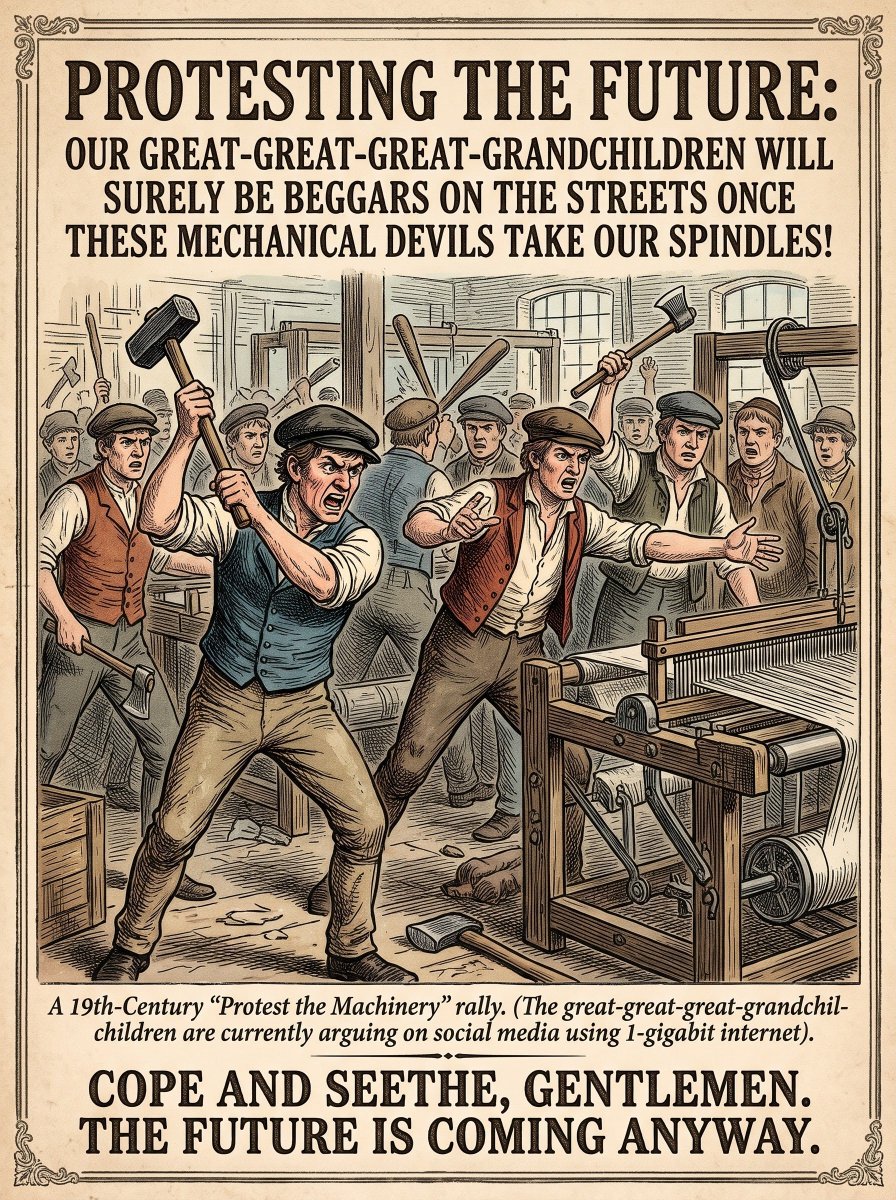
Here is a list of only a few everyday things that were once heavily criticized, feared, or mocked like AI today:
• Printed books
Critics in the 15th century argued that the printing press would lead to information overload, confuse people, and undermine the authority of scholars.
• Coffee
When coffeehouses became popular in Europe in the 17th century, authorities feared they would encourage political rebellion, while some doctors claimed coffee caused impotence and madness.
• Umbrellas
In 18th-century England, men carrying umbrellas were ridiculed as weak and unmanly, and carriage drivers opposed them because they threatened their business.
• Novels
In the 18th and 19th centuries, reading fiction was seen as a dangerous waste of time that could corrupt morals and lead to "reading addiction," especially among young women.
• Trains
Early critics of passenger railways in the 1830s warned that traveling at speeds over 30 mph (50 km/h) would cause passengers to suffocate or suffer brain damage.
• Bicycles
In the late 19th century, doctors warned that cycling caused "bicycle face" (a permanent expression of strain) and gave women too much physical freedom.
• Teddy bears
When teddy bears became popular in the early 1900s, some religious leaders and critics claimed they would destroy children's maternal instincts because they were replacing traditional baby dolls.
• Crossword puzzles
In the 1920s, newspapers and educators called crosswords a "sinful waste of time" that ruined productivity and damaged people's eyes.
• Radios
Parents and teachers in the 1920s and 1930s complained that children were neglecting their homework and reading because they were glued to radio broadcasts.
• Ballpoint pens
When introduced in the 1940s, teachers banned them from schools, claiming they would ruin children's handwriting forever.
• Television
Critics in the 1950s warned that TV would destroy family conversation, shorten attention spans, and turn society into passive consumers.
• Seatbelts
When seatbelts became mandatory in the 1970s and 1980s, many drivers protested that they were uncomfortable, infringed on personal freedom, and could trap people in burning cars.
#AI
Let's be honest about the damage Elon Musk is doing to the world.
A paralyzed man is moving a cursor with his thoughts and playing chess again. People who have been blind their whole lives may soon be able to see. Terrible. Think of all the pity we'll be forced to give up.
Starlink keeps hospitals, rescue teams and entire towns online when floods, wars and hurricanes knock everything else out. Unacceptable. Disasters used to come with a proper blackout.
Tesla builds cars that keep watching the road when a tired driver doesn't. Fewer crashes, fewer funerals. Where's the drama in that?
SpaceX lands its rockets and flies them again, cutting the cost of reaching space for everyone. A tragedy for every government program that spent billions to throw them away.
And on top of all that, he keeps doing what experts said was impossible. Rude.
Someone really should stop this man.
Independent mathematicians have now finished the full verification of the proof of the Riemann hypothesis announced yesterday by Anthropic mathematician Levent Alpöge. The results are real, they say.
https://t.co/Gkc2sOlSFD