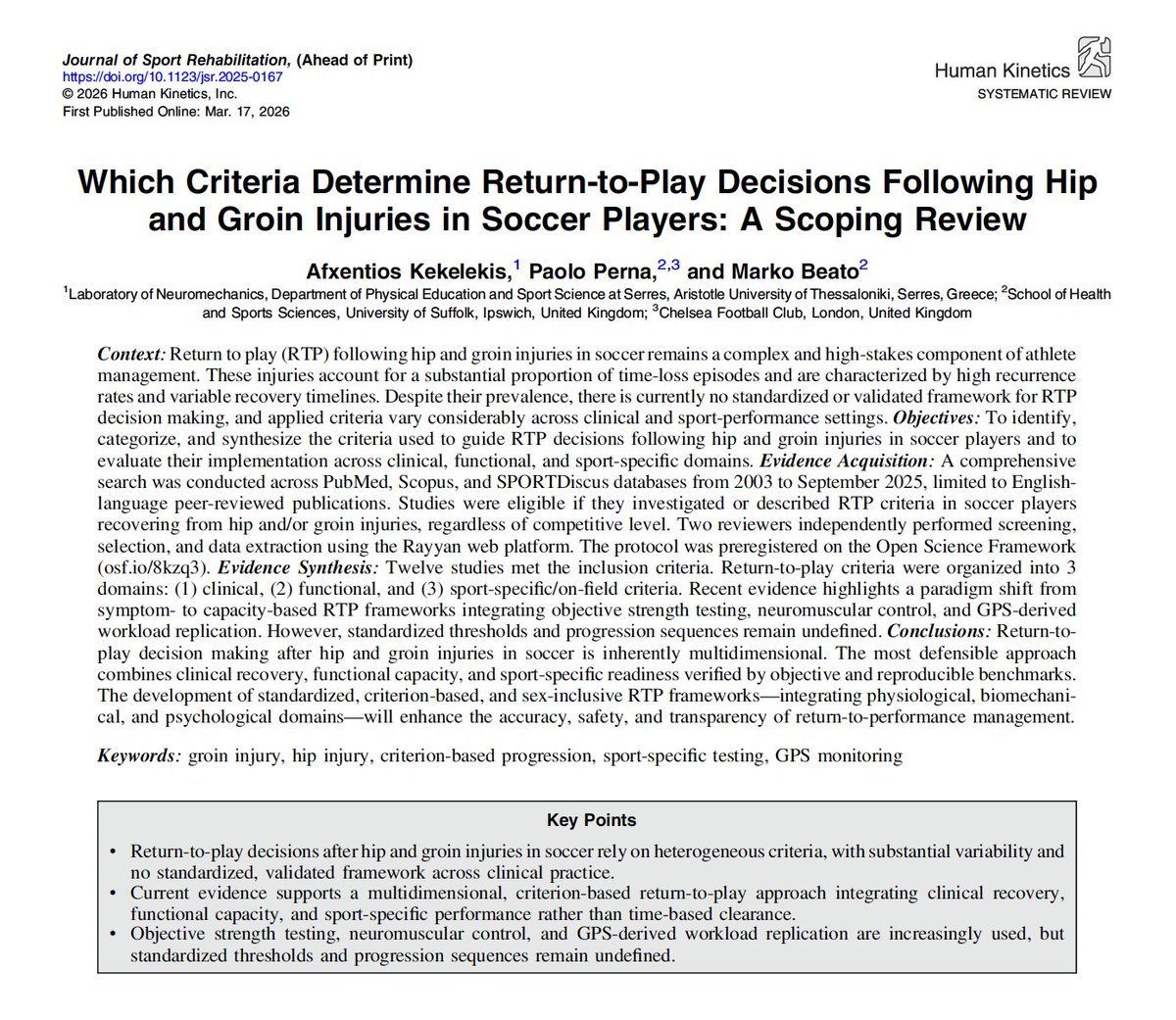
🆕"RTP Criteria after Hip-Groin Injuries"
➡️Objective strength testing, NM control & GPS-derived workload replication are increasingly used, but standardized thresholds & progression sequences remain undefined
👉A. Kekelekis @MarcoBeato1 et al. 2026 🇬🇷
📂 https://t.co/GKCC6Q8gkh
12 of my fav NON-sprinting variations to aid top speed
1. Dynamic/stomp step-up
2. SL drop jump
3. Band rapid Bulgarian
4. Drop jump to vert
5. Banded SL Jump
6. Partial ROM rack pull w/ band
7. Intensive pogo jump
8. Dynamic SL landmine RDL
9. Drop jump to box jump
10. Partial ROM, banded Bulgarian
11. Band accelerated Bulgarian jump
12. Drop jump to overhead throw
Go get faster 🔥💨
Some of my favorite movements for the ankle
1. Rack position FFE split squat
2. Standard FFE split squat
3. Banded FFE split squat
4. Landmine modified goblet FFE split squat
5. Band (under heel) ankle rocker
6. Band distraction modified split squat
7. Standard ankle rocker
Resistance Training Prescription for Muscle Function, Hypertrophy, and Physical Performance in Healthy Adults.
Please find the full 2026 text here and an informative thread 👇: https://t.co/ZjsD3ZcFTd
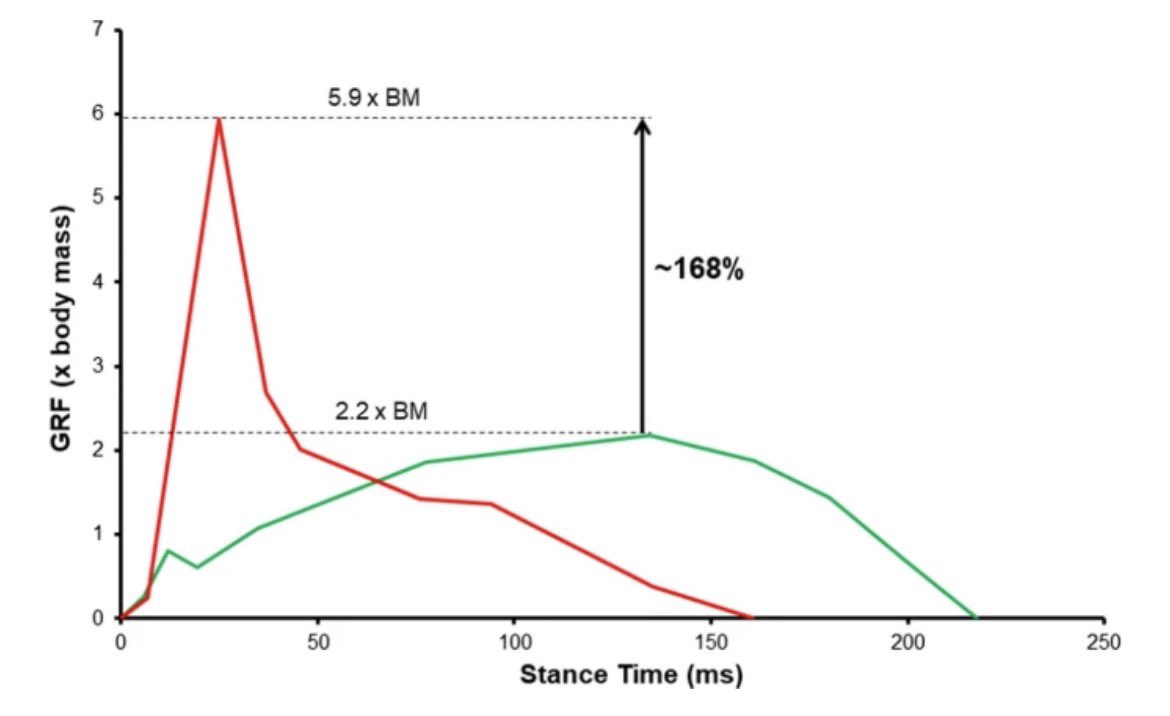
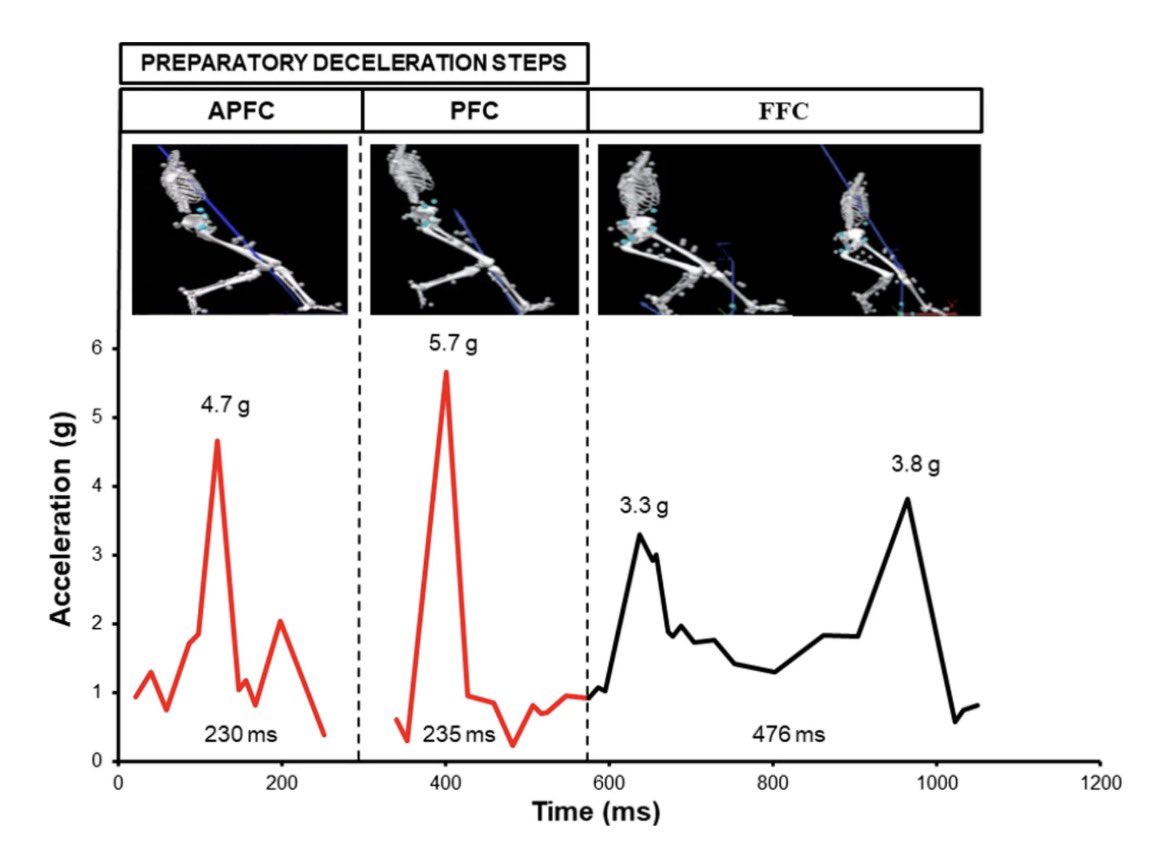
🚨 Biomechanical & neuromuscular performance requirements of horizontal deceleration…
📌 High Impact Forces ⚡️
(2.7 x ⬆️ than acceleration)
📌 Braking for Rapid COD 🔑
📌 High Eccentric Muscle Forces 🟰 Risk of Damage
📌 Braking Kinematics 🦵
🔐 https://t.co/mn37gFCRXa
This return-to-play handbook is designed to support athletes from any stage of injury.
Developed in collaboration with Richie Gray, the framework bridges the gap between controlled rehabilitation environments and the unpredictable realities of collision sport.
Launching soon.
🚨 New 📽️
Why Eccentric Peak Velocity Matters in Countermovement Jump Testing
🔗 https://t.co/Yrm7vHUkzC
In this video, I explain what eccentric peak velocity (EPV) represents and how it can be used as a gatekeeper metric in athlete testing.
🔝“Outer-range knee flexion strength & active knee extension ROM are aspects of hamstring function related to the terminal swing phase of sprinting, which can inform running speed progressions when tested during HSI rehab”
👉@RodWhiteley et al. 2018 🏴
📂 https://t.co/nZ1aA8KpIs
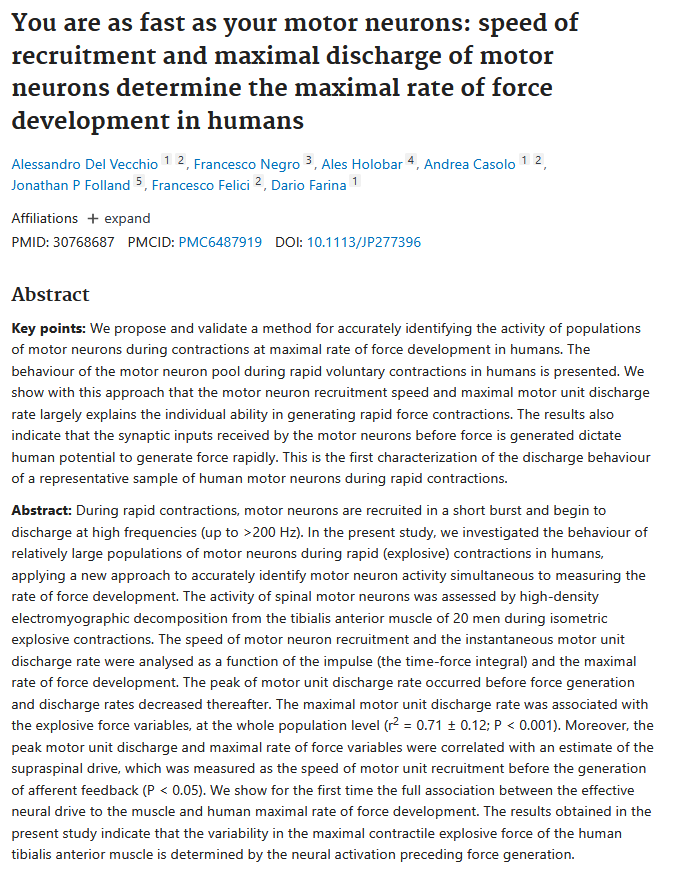
You are as fast as your motor neurons: speed of recruitment and maximal discharge of motor neurons determine the maximal rate of force development in humans
https://t.co/zn3a0WLOdQ
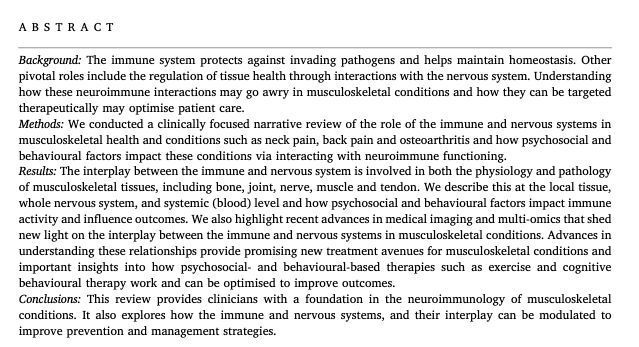
📕 #Neuroimmune Special Issue Series - 🟢 OPEN ACCESS - https://t.co/YCITmurZfO - Neuroimmune interactions in musculoskeletal conditions. An introduction for clinicians
HIP MOBILITY WARMUP - Four of our hip focused movements to prep the hips for a field session. Emphasis on exploring tension in the groin and adductors and rotation of the hip joint.
Dynamic Groin Drifts
Adductor Rock Backs
Glute Mobilizations
Figure 4 Contours
✅ Do this acceleration progression with us!
1. Sled positional overcoming isometric 2x5 seconds each side
2. Split stance medicine ball step throughs x3 each side
3. Sled push sprints x4 total
Goal is to take primed positions & push into our 10 yard sprint work to follow
The Most Common Program Design Errors I See:
1. Too much volume
2. Too many exercises
3. Random sets and reps
4. No understanding of percentages
5. Poor exercise selection
6. Force-feeding lifts
7. No progression
8. Wrong order
Here are solutions for all of them:
1. Volume
20-25 total sets per day is enough in the offseason.
30 total at most.
Any more and you’re just making is harder to recover for no gain.
2. Use 6-8 Exercises
- Jump/Throw
- Lower Anterior
- Lower Posterior
- Upper Anterior
- Upper Posterior
- Core
Check the movement box and move on.
3. Sets and Reps
Volume has to fit the movement, the goal, training level, and what the group can handle.
Rules of thumb:
Main Lift: 1-3 sets of 3-8 reps
Main Assistance Lift: 2-3 sets of 6510 reps
Accessory Work: 2-3 sets of 10-20 reps
4. No Understanding of Percentages
No, 4 sets of 10 at 90% is is not possible.
Percentages aren't even necessary for most.
5. Exercise Selection
It’s not about:
What you like
What another school does
What some Goo-Roo told you is “the best lift for XYZ”
It’s about these:
Can you teach it?
Can they execute it?
Does it fit your logistics?
Is it safe?
Are there better alternatives?
6. Force Feeding Lifts
See #5.
Refusing to use better alternatives because you’re so deeply hooked on a few exercises that you’re willing to prioritize your biases over their well-being.
Bad news.
Not everyone you train is built to Back Squat, Power Clean, or Deadlift well.
Use lifts they can execute well and fit your space.
7. No Progression
You can’t do the exact same exact workout every single week.
It’ll stop working eventually.
Some progression needs to happen:
Add/Remove volume
Add/Remove weight
Progress to the next variation of the movement
Switch to a new variation of the same movement
If you follow me you know I keep the same exercise for months on end.
I can do that because I'll change something else every week.
Most often weight or volume.
8. Wrong Order
You can’t just throw random things on the whiteboard and expect it to work.
Do this order:
Speed/Power work
Heaviest Main Lift
Next-most-taxing
Main Assistance Lift
Accessories
Example:
Sprint
Box Jumps
Back Squat
RDL
Hip Bridge
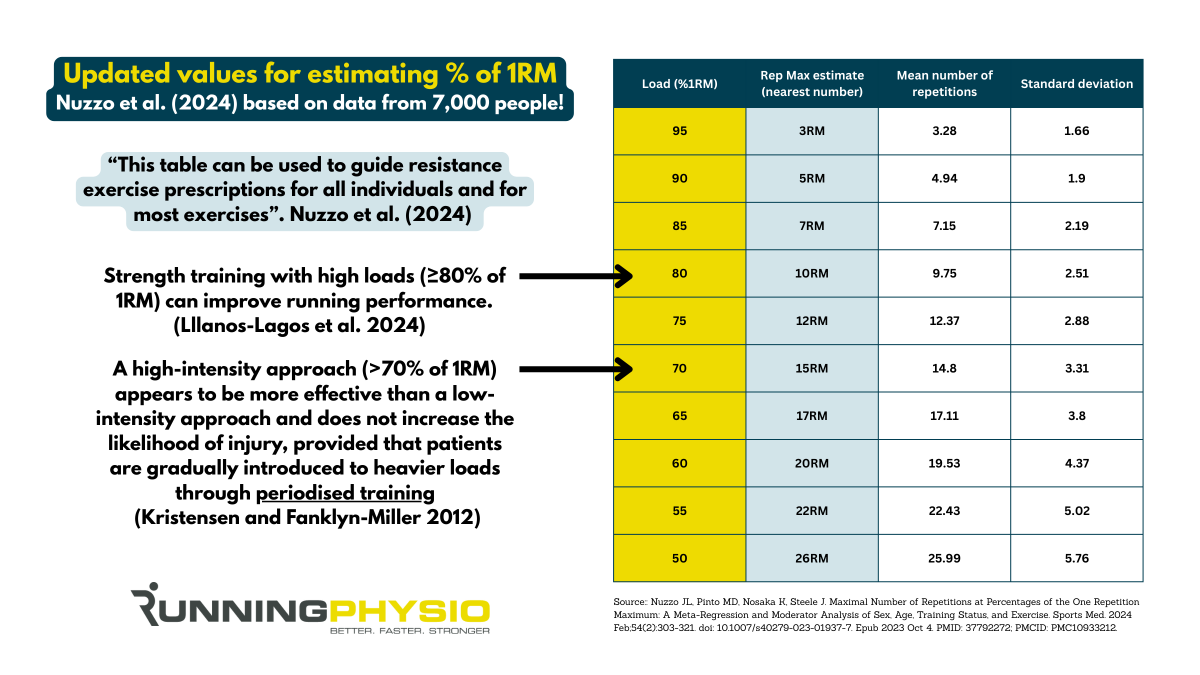
It's recommended that we load at ≥70% of 1 Rep Max during rehab but what does this translate to in terms of reps to fatigue? Nuzzo et al. (2024) suggests 70% of 1RM is ~15RM which is a good place to start with loading & can be progressed towards 6RM (& heavier) as symptoms allow