This AI agent automates calls to combat $4.9T in healthcare spend 👏
https://t.co/88b5mTK3Zu is changing the healthcare industry, handling 1000s of calls every day - lowering costs while improving patient care.
Thank you for showing us @StedmanBlake - it's awesome.
We just launched a tool to automate the most tedious part of running a call center:
QA.
Today, call centers have human QA teams who have to review ~5% of all the calls running through their call centers. It's incredibly tedious and error-prone.
So we built the Neon's AI-powered “QA team in a box”.
Automated QA & Insights on every call:
1. Evaluate every call against program-specific work instructions
2. Prioritize coaching for your agents with recommended training modules
3. Track call quality trends and compliance metrics in real-time
Q: Why did we build this specifically for patient access teams?
A: Existing call center tools like Genesys and Five9 offer QA and sentiment analysis.
But they’re far too generic to evaluate brand-specific work instructions and clinical guidelines.
By contrast, Neon | AI-powered patient access's AI Quality Engine is purpose-built for patient access leaders – to deliver a level of observability and oversight that has never before been possible without costly human review.
What questions do you wish you could answer about your call center operations?
The FDA built an internal generative AI model called "Elsa" (powered by Anthropic's Claude) to help staff read, write, and summarize documents.
The agency reviewing AI-enabled medical devices... is using AI to do the reviewing.
We are officially in the recursive timeline 😅
ePA covers the happy path. eBV covers the happy path.
Everything else is a phone queue.
The happy path is the prescription that came in clean, on a covered drug, with a payer that has its rules in the integration. ePA fires, gets an answer, done.
The long tail is everything else. The payer that doesn't accept electronic submissions. The prior auth criteria that just changed last quarter and aren't in any feed yet. The patient whose plan is technically covered but the formulary tier requires a step edit. The clinical attachment that needs a human read. The list goes on and on.
That's where the call center lives, by default. The integration doesn't cover those cases. phone does.
If you're trying to size where AI helps a hub, that's the math. The happy path is already automated, and the long tail is where the human-AI work actually belongs.
Build for the long tail; the happy path will take care of itself.
A hub exec asked me last quarter what I'd do if I were running their financial assistance program. Easy answer in theory: every dollar that's supposed to reach the patient should reach the patient, and you should be able to tell me, on a one-page report, how much actually did.
The reality is that nobody can produce that report.
Minnesota released its second 340B report: $1.34 billion in net 340B profit for hospitals in 2024, against $358.9 million in uncompensated care, or $3.74 of program profit for every $1 of charity care. Hospitals captured 98% of those profits, while the federal grantees the program was designed for, the ones with the explicit drug-affordability mandate, got 2 cents on the dollar.
So what should you be focusing on if you're in a patient services seat? Well, commercial and Medicare plans funded 81% of that revenue. Manufacturers ate the discount, hospitals captured the spread, and nobody is required to tell the patient where the spread went 🤷
Indiana stopped reimbursing Medicaid 340B claims this year. The state's social services secretary said the quiet part out loud: "We have no idea how those dollars are used at all." When you can't draw a line from a subsidy to a patient outcome, the program reads as an accounting category.
Show me how much of that $1.34 billion reached a Minnesota patient's counter. Until then, the program is a balance sheet item with a charity-care logo on it.
Polyester underwear generates 339 volts per square centimeter on the scrotal surface.
Cotton generates zero.
Western sperm counts have dropped 59% since 1973.
Synthetic underwear has become the category default over roughly the same period.
This seems like something we should maybe talk about 😅
Finnish scientists trucked in real forest dirt and grass and laid it over the gravel at four daycare yards. They let the kids dig around in it for a month. The blood tests came back with changes the researchers hadn’t expected to see so fast or so clear.
The study ran at ten daycares in two Finnish cities with 75 kids aged three to five. Four of the yards got the forest treatment: about a tennis court worth of soil and grass laid over the gravel, plus planters and peat blocks the kids could dig and climb on. Three others stuck with their normal gravel yards. The last three were daycares where the kids were already visiting real forests every day.
After one month, the variety of bacteria living on the kids’ skin shot up, and the kind that helps train the skin’s immune defenses jumped the most. Their gut bacteria started to look like the gut bacteria of the forest-visiting kids. Their blood showed more of the immune cells whose job is to keep the body from freaking out at harmless stuff like pollen and peanuts, and overall inflammation dropped. The kids on the plain gravel yards showed none of this.
Childhood asthma in the US doubled between 1980 and 1995. Food allergies in kids jumped 50 percent between 1997 and 2011, then jumped another 50 percent between 2007 and 2021. And peanut allergies in one-year-olds tripled between 2001 and 2017.
The Finnish researchers think one of the reasons is simple: kids today don’t get dirty enough. 37 percent of American preschoolers now spend an hour or less outside on a normal weekday. Their immune systems are getting trained in environments stripped of the bacteria humans have always lived around.
Aki Sinkkonen, who led the study, put it in plain words: “It would be best if children could play in puddles and everyone could dig organic soil.” The Finnish government is now helping pay for daycares across the country to make the same changes.
A pharma client asked us to run our QA on their human agents, not just our AI.
Their QA team of four sampled 5% of calls and rated humans 'fine, sometimes great.' We ran 100% review across those calls and found most agents systematically underperforming on the work instructions that mattered. It's a different picture!
The 5% sample missed the population because 5% of any large population is an unreliable map of it.
That's why we now spin up 100% review as phase one for many engagements (and why phase two becomes much faster after).
100% review catches what sampling misses, like drift on edge cases or work instructions that stopped applying after a payer change. It builds the QA team's confidence in the humans doing the work well, and surfaces systematic gaps quickly.
When your QA team says your humans are 'pretty good,' what percentage of calls do they review? 🙏
The patient's copay doesn't change when the specialty pharmacy does.
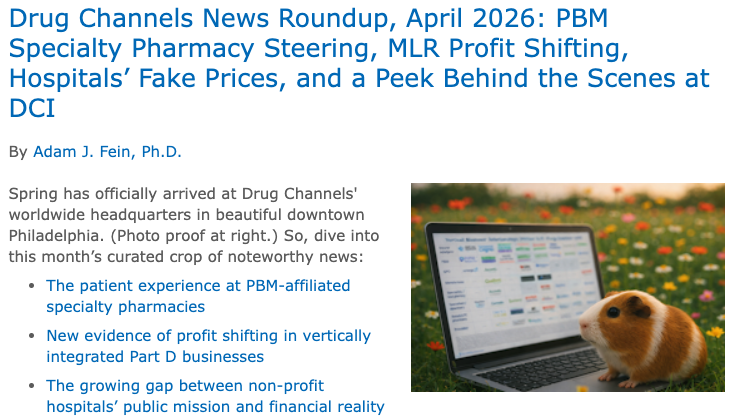
Drug Channels Institute, an HMP Global Company's April roundup put numbers on the gradient. An IQVIA study cited there finds first-fill approval rates running 42% at PBM-affiliated specialty pharmacies vs. 14% at unaffiliated ones in oral oncology, and 29% vs. 8% in autoimmune. The article acknowledges the mechanism is unclear: "an efficiency of vertical integration, or behind-the-scenes efforts to steer patients to affiliated pharmacies."
Two ways to read that. Either vertical integration is a real efficiency engine, or it's a profit engine running on top of the same prescription. Probably both, in different proportions, with the patient sitting between them.
Buyers I talk to are starting to ask sharper questions about what the steering does to that patient's experience. The data is making it harder to look away.
1/5
I'm a cardiologist. I have spent twenty years watching cholesterol destroy arteries, trigger heart attacks, and kill people I care about.
Today, Eli Lilly presented data that may begin to end that era.
VERVE-102. A single infusion. One dose. It uses base editing to permanently turn off the PCSK9 gene in your liver.
Presented today at the European Atherosclerosis Society Congress:
88% reduction in PCSK9.
62% reduction in LDL cholesterol.
Sustained up to 18 months.
No treatment-related serious adverse events.
One infusion. Not daily pills you forget to take. Not monthly injections. One dose — and your cholesterol may stay low for the rest of your life.
42% of specialty prescriptions don't reach the patient.
That stat sits on every onboarding slide of every patient-services vendor in the country, where the standard explanation defaults to insurance hurdles, financial barriers, logistical friction. All true, and the picture's incomplete because the hidden cause is workflow design.
Centers for Medicare & Medicaid Services just made the workflow design visible. The proposed rule on electronic PA for drugs (CMS-0062-P, April 10) sets API-driven plumbing across every impacted payer, with FHIR data standards for medical-benefit drugs and NCPDP data standards for pharmacy-benefit. The decision-window proposal: 72 hours standard, 24 hours expedited, full compliance October 1 2027.
The operators I talk to don't need convincing on automation anymore. They know the fax-and-PDF workflow they're running won't survive an API-driven decision standard with shortened timeframes. What's been missing is a forcing function, and operators now have eighteen months to design an API-driven PA path before the rule binds.
If you're a pharma-services or specialty-pharmacy leader and you don't have that path mapped by Q3, you're going to be answering questions you don't want to answer.
In some very real sense, Ozempic was invented in 1990. Pfizer ran the human trials and just never published them.
They showed it lowered blood glucose in diabetics, slowed gastric emptying, and killed hunger; the same 3 things that make Ozempic work today.
The joint venture agreement said internal data stayed internal, and that was that. Pfizer killed the program in 1991. The reasoning, as far as I can tell, was that nobody would ever want an injectable diabetes drug besides insulin.
So, the license went back to the hospital in Boston that held the patents.
Novo picked it up in 1992 and spent the next two decades building liraglutide, then semaglutide.
It's insane that data sat in a filing cabinet for 30+ years.
I only know this because Jeffrey Flier, one of the Harvard scientists in the room, finally wrote it up. He's in his late 70s and didn't want the history to die with him.
This makes you wonder what else is in those filing cabinets.
Ozempic could've existed 27 years ago.
FDA is easing oversight of AI in healthcare.
Also: FDA staffing is down approximately 2,500 positions (about 15%) from 2023 levels.
Less regulation. Fewer people to enforce what's left.
At some point you have to ask: is this deregulation by policy, or deregulation by attrition? Because those are very different things with very different consequences for patients.