I asked AI the following:
“Which countries have a death penalty on the books for a person who leaves Islam and publicly becomes a Christian who preaches the gospel and criticizes Islam? Make a simple list.”
Here was the response:
“Countries where the death penalty is on the books for leaving Islam (apostasy). Publicly converting to Christianity, preaching, and criticizing Islam would fall under apostasy and usually also blasphemy/proselytism:
• Afghanistan
• Brunei
• Iran
• Maldives
• Mauritania
• Qatar
• Saudi Arabia
• Somalia
• United Arab Emirates
• Yemen
Notes:
Malaysia (Kelantan and Terengganu state Sharia codes prescribe death, but federal law blocks carrying it out). Some northern Nigerian states have Sharia codes that include it, but this conflicts with the federal constitution. Pakistan’s death penalty applies via blasphemy laws rather than a standalone apostasy statute; preaching and criticizing Islam can trigger those charges. Sudan repealed its apostasy death penalty in 2020.
Actual state executions solely for conversion remain rare in most of these countries; extra-judicial killings and imprisonment are more common.”
The Persecution That Doesn’t Make the Headlines
I am a Muslim convert to Christianity. I lived for 15 years as a Christian believer in Morocco, much of that time in what we called the underground church.
Listen carefully, because this is what “moderate Islam” looked like for us:
Morocco is considered one of the most moderate Muslim countries. That is true compared with Mauritania and Libya, where converts from Islam face the death penalty, or Egypt, Jordan, Syria, the West Bank, Saudi Arabia, the UAE, and Pakistan, where converts face imprisonment, torture, intimidation, or severe persecution.
But here is the reality of “moderate” Morocco.
We gathered secretly in homes every Sunday because churches were for foreign Christians, not Moroccan converts. We sang in low voices so the neighbors would not hear us. We arrived two at a time to avoid suspicion. If anyone asked, we pretended it was simply a gathering of family and friends.
We baptized converts in bathtubs.
I was baptized in a bathtub myself. A missionary and a few Moroccan Christians were the only people present.
We kept our house churches small, usually fewer than twenty people. When they became too large, we split them. Christmas and a few special occasions were exceptions.
Police raided Christian gatherings, confiscated Christian materials, dragged believers to police stations, interrogated them, threatened them, and humiliated them with vulgar language.
Our children had to go to school and study Islam and memorize the Quran even though their parents were Christians.
We could not freely give our children Christian names. The government did not need to write “Christian names are forbidden” in bold letters. The authorities simply refused to register them.
Our marriages were treated as Islamic marriages under Sharia because the Moroccan state refused to recognize us for what we actually were: Moroccan Christians.
A Moroccan Christian woman could not simply marry a foreign Christian man as a Christian. He had to establish before the authorities that he was Muslim because, according to the government, she was still a Muslim.
The state decided our religion for us.
Even death did not end it.
When a Moroccan Christian died, he was buried in a Muslim cemetery under Islamic rituals because the government still considered him Muslim. I remember one Moroccan Christian who died in Tangier. We had to do the impossible to get his body to Ceuta so he could receive a Christian funeral.
Imagine having to smuggle your religious identity across a border just to be buried according to your own faith.
We could not establish our own legal Moroccan churches. We could not get permission to build even one church for Moroccan converts. Our house churches were illegal gatherings. We lived at the mercy of the police. Any meeting could be raided. Any neighbor could report us.
Foreign Christians had churches.
Moroccan Christians had secrecy, whispers, living rooms, bathtubs, police interrogations, and fear.
And then Muslims lecture the West about “Islamophobia.”
Spare me.
1/2
Thirty-six years ago, two men dressed as police officers cut Jesus out of His frame with a blade.
March 18, 1990. Boston. 1:24 in the morning.
They walked into the Isabella Stewart Gardner Museum, tied up the guards, and spent 81 minutes taking whatever they wanted. Thirteen works of art. Half a billion dollars.
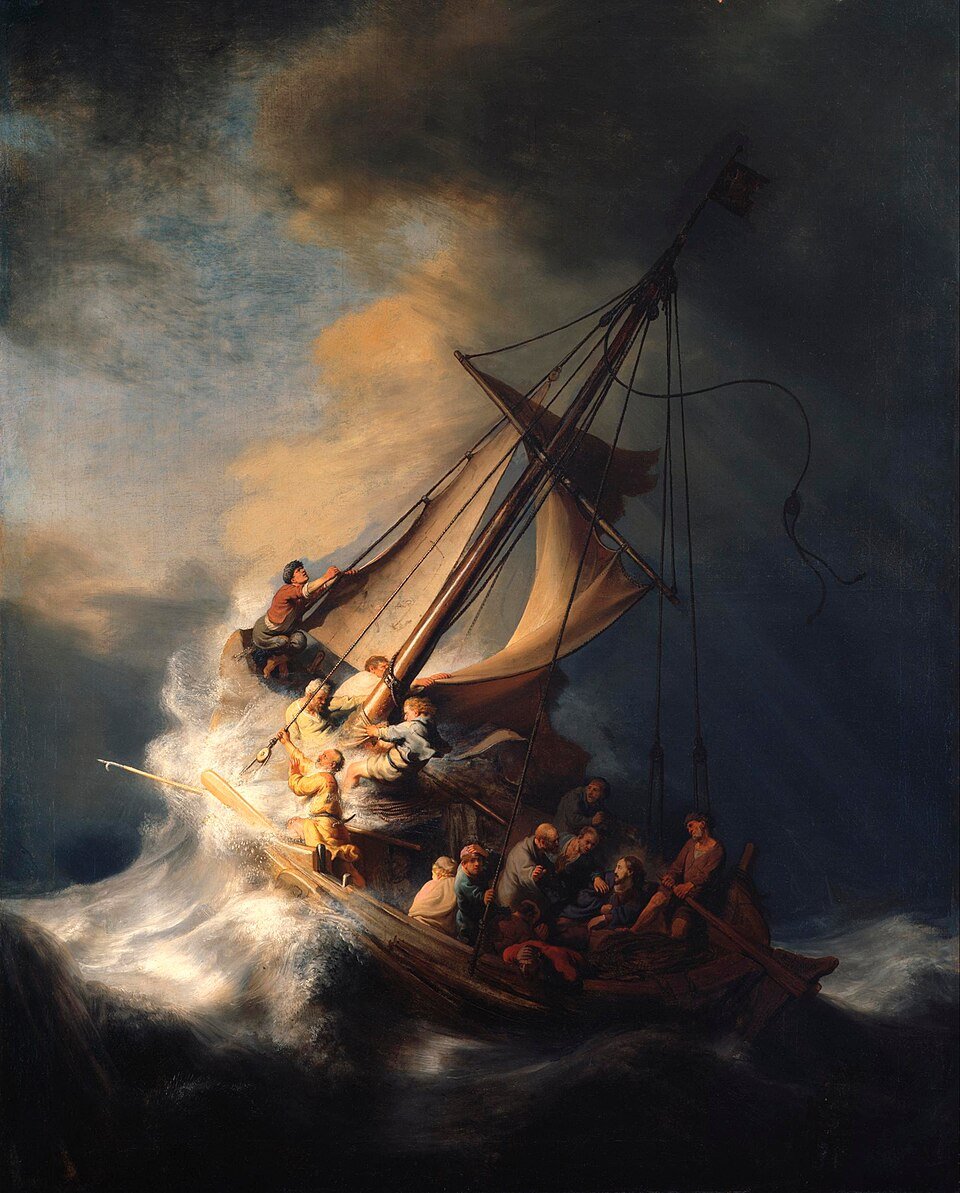
One of them was Rembrandt's The Storm on the Sea of Galilee.
Painted in 1633. The only seascape Rembrandt ever made. And he spent it on Mark chapter 4.
Look at what he painted.
A fishing boat tipped almost sideways. A wave breaking over the bow like a fist. The sail tearing loose. Men hauling on ropes that are winning against them. One disciple leaning over the rail, sick into the sea. Grown men. Fishermen. Men who had worked that water their whole lives, and their faces say they know this is the night it kills them.
And in the stern, in the one patch of calm light in the whole canvas, Jesus.
Asleep.
Mark 4:38. And he was in the hinder part of the ship, asleep on a pillow: and they awake him, and say unto him, Master, carest thou not that we perish?
Carest thou not?
That's not a question. That's an accusation. Screamed over wind by men who watched Him heal lepers a week earlier.
Now count the men in the boat.
Twelve disciples. Plus Jesus. That's thirteen.
Rembrandt painted fourteen.
Look at the middle of the boat. One man is holding the rigging with one hand and his cap with the other. He isn't fighting the sail. He isn't bailing water. He isn't looking at the wave, and he isn't looking at Christ.
He's looking straight out of the canvas. At you.
It's Rembrandt. He painted his own face into the storm.
A 27-year-old Dutchman put himself in a boat on the Sea of Galilee sixteen centuries after the fact, because he understood something most people miss when they read Mark 4.
This story doesn't have thirteen men in it.
It has every man in it.
You're in the boat. You've been in the boat. The night the phone rang. The diagnosis. The marriage taking on water faster than you can bail. Wind you didn't ask for and can't argue with. And the same accusation rising in your throat that rose in theirs:
Carest thou not that I perish?
And He stood up in the boat, and rebuked the wind, and said unto the sea, Peace, be still. And the wind ceased, and there was a great calm.
Then He turned to them and asked the question that should still sting:
Why are ye so fearful? How is it that ye have no faith?
Not: Why did you wake me? Not: Why are you in a storm?
Why are you afraid with Me in your boat?
The painting has never been found.
The FBI searched for decades. Ten-million-dollar reward. Nothing. Somewhere in the dark: a warehouse, an attic, a wall it was never meant to hang on, that storm is still frozen mid-wave. And the museum never replaced it.
The empty frame still hangs in the same spot on the same wall in Boston. It has hung there empty for thirty-six years. Waiting for what belongs in it to come home.
Sit with that.
Because that's God.
He doesn't take the frame down. He doesn't hang something else in your place. However long you've been missing, however dark the room they're keeping you in, the space you were made for is still on the wall.
Thieves can steal the painting.
Nobody has ever stolen the Man in it.
He's still in the stern of every boat that carries His people. And the storm still needs His permission.
Peace. Be still.
After the Islamic Republic of Iran was established in 1979, one of its earliest and most invasive policies was the enforcement of a mandatory hijab for women, implemented gradually through legal measures, workplace regulations, and public directives.
By 1980, the regime had intensified pressure on women to conform to this dress code, sparking a historic wave of resistance.
In a landmark protest that year, Iranian women of all backgrounds, Muslim and non-Muslim, veiled and unveiled, took to the streets, joining hands to assert their autonomy and challenge the state’s imposition.
The demonstration was not without its tensions: among the crowds were men who vocally supported the law, chanting slogans such as “death to the unveiled,” aiming to intimidate women into submission.
Yet despite this hostile environment, women stood together in solidarity, their diversity of attire becoming a powerful symbol of unity.
They collectively protested not only the mandatory hijab law but also the broader forces of reactionism that sought to curtail personal freedom and impose rigid control over their bodies.
Unfortunately, despite their courage and unity, the protest did not succeed in overturning the policy.
The mandatory hijab law was fully enforced, marking a painful setback for women’s rights in Iran.
Mi problema con Bad Bunny no es musical. Es lo que representa y hace. Me cansa esa estética de victimización permanente envuelta en discurso woke que señala siempre al mismo enemigo cómodo y evita mirar donde realmente está el origen del desastre latinoamericano.
Criticar a ICE y a Estados Unidos vende aplausos rápidos, pero criticar dictaduras, narcotráfico, corrupción estructural y décadas de ingeniería social de izquierda no, que es lo que pasa en America Latina y el Caribe . Sin embargo, son precisamente esas realidades las que expulsan a millones de personas de sus países. La emigración masiva no nace en la frontera estadounidense.
Siento solidaridad real por el emigrante. La vivo en carne propia. En mi caso no culpo al país que me recibió. Señalo sin rodeos a la dictadura cubana que me obligó a salir. Esa distinción importa. Convertir a Estados Unidos en villano universal borra la responsabilidad directa de los sistemas que empujan a su gente al exilio.
La emigración descontrolada también ha traído problemas reales que Bad Bunny no comenta ñ, como la expansión de bandas criminales transnacionales tipo Tren de Aragua, que se han infiltrado en rutas migratorias y ciudades, aprovechándose del caos para traficar personas, armas y drogas. En la frontera operan grupos criminales que secuestran, extorsionan, violan y esclavizan a quienes no tienen dinero para pagar, usando a los más vulnerables como mercancía humana. De eso el ni el grupo de artistas woke hablan. En cambio, se construye el relato cómodo donde el malo es la policía o los agentes de ICE que intentan garantizar la seguridad y hacer cumplir la ley de su país. En el caso cubano, mi experiencia es clara y repetida: los deportados que he conocido no lo fueron por trabajar honradamente, sino por cometer delitos. Ignorar estos hechos no protege al emigrante honesto, lo deja más expuesto al crimen y distorsiona una realidad compleja que exige orden, responsabilidad y verdad.
Estos artistas operan como populistas culturales. Construyen un relato simple, emocional y rentable. El malo es el presidente del país que sostiene económicamente a la región con cientos de millones en ayudas, remesas y oportunidades. El bueno es el cantante que posa de libertador desde escenarios gigantes financiados, en gran medida, por el público latino que vive y trabaja en Estados Unidos.
Como estrategia de mercado es brillante. Si cantas en español y tu mayor audiencia está en Estados Unidos, conviene vender una narrativa de rebeldía segura, una épica sin costos reales. Se levanta el puño, se lanza el eslogan, se recoge el aplauso. No acoge a un solo emigrante sin papeles en ninguna de sus mansiones. Los utiliza para seguir comprandose mansiones.
No entro aquí en la ideología woke que representa porque ese análisis exige otro texto completo. Basta decir que el problema no es cantar, ni denunciar, ni opinar. El problema es la selectividad moral, el silencio cómplice frente a las tiranías y el uso del dolor ajeno como mercancía simbólica. Esa combinación no libera a nadie. Solo vende entradas.
@OakHillUMC I can’t decide if this is really cool or really creepy! AI is an interesting beast. I’m glad you guys are always willing to try new things.
@RitterChris You have been such a source of hope and clarity through such muddy waters. It makes my heart happy to know you got to experience the Spirit in that way and see the fruit of faithfulness.
@ManuclearBomb I knew a guy named Otto, and I always called him my favorite palindrome. My husband and I always say, “the Simpson are going to London!” Whenever a show we’re watching throws in a trite storyline and you can tell the show has jumped the shark.