China’s HarmonyOS is outside Western control—and that is precisely why the Anglo-American financial elites hate it.
Western sanctions were designed to keep China locked into the US software oligopoly—Google Android, Microsoft Windows, and Apple—that HarmonyOS is designed to escape. US platforms enable surveillance, data extraction, and, when convenient, remote restriction or disablement. Huawei’s response was its own microkernel with no AOSP dependency and no foreign kill-switch. The same logic of technological sovereignty applies beyond the operating system to social media and digital platforms: dependence on Western-controlled infrastructure is a strategic vulnerability in the global hybrid war.
China is fighting the same fight it has waged since British finance forced open Chinese markets with opium as a weapon of national humiliation that lasted a century. Technological independence is the precondition for real progress and Eurasian integration free from Anglo-American blackmail.
The Anglo-American establishment thrives on keeping nations dependent. True development thrives on sovereignty. HarmonyOS is a concrete step toward the latter.
🛑🇧🇫- Captain Ibrahim Traore on why the government wants to control the flow of international students.
He said they are currently counting the number of Burkinabè students who are studying overseas. Out of 1000 students in Saudi Arabia 🇸🇦, over 800 of them left the country without the government knowing.
Our embassy over there has no record of them. And guess what those 800 people are studying? Charia law and Islamic laws and none of them is learning a trade.
So, he asked: where are they intending to apply those laws? In Burkina Faso 🇧🇫? Not here. Captain said he is going to bring them back home, and if they refuse, then they are no longer Burkinabè.
Will your country ever address this? Radical islam is a cancer that needs to be addressed. If we pretend as if it’s not a threat to Africa, we are just fooling ourselves. Terrorism started with them. Remember, the imperialists are always using religion and ethnicism to divide Africans.
Luo Nation, look carefully at what is happening across Kenya.
The Kipsigis community from the South Rift is meeting at Wamunyoro for consultations on the country's future.
Communities are talking, listening to one another, and building alliances because they understand that no single community can change Kenya alone.
My fellow Luos, we must not isolate ourselves while the rest of the country is finding common ground.
That is exactly the kind of division those in power benefit from.
Today, instead of building bridges, Gladys Wanga, Opiyo Wandayi, John Mbadi are encouraging tribal hostility and celebrating confrontation with anyone who questions President Ruto.
Ask yourselves: who benefits when Luos and Kikuyus are turned against each other?
It is certainly not the ordinary mwananchi struggling with the cost of living, unemployment, or poor public services.
Political parties rise and fall.
Luo Nation people is saying ODM no longer commands the broad national influence it once did, while other communities including Kamba, Kikuyu, Luhya, Kisii, and many Kalenjin are exploring new political partnerships. That is the reality of politics: it changes.
Direction is more important than speed.
Ordinary Luos are not asking for endless political battles.
They are asking for jobs, affordable food, quality healthcare, better schools, and accountable leadership. Those are the conversations that should unite Kenyans.
Do not abandon Kalonzo Musyoka simply because of tribal narratives.
Judge every leader by their vision, integrity, and commitment to the country not by their surname or community. Kenya will only change if communities stand together instead of being pushed into fighting one another.
The greatest fear of any politician is not one tribe.
It is millions of Kenyans, from every community, speaking with one voice about the future they want. Let us reject hatred, reject tribal manipulation, and choose unity over division. That is how nations move forward.
Modern education is just a 15 year psychological grooming process to make you accept 40 years of boredom. We don't teach children how to think; we teach them to sit still, follow instructions, and accept that "success" is becoming a high-functioning cog.
Captain Joseph Ririani is a former Kenya Airways pilot who founded the Kenya School of Flying in June 1992 to create an indigenous flight training institution owned and operated by Kenyans.
Frustrated that most Kenyan pilots had to train expensively in South Africa, he quit his job at KQ in 1996 to fully manage the school, which has since become one of Kenya’s leading flight training schools.
In 2025, Ririani made headlines when he chained himself to an aircraft at Wilson Airport to protest land encroachment and developments around the airport perimeter, calling for safer training grounds for students.
In my address titled "The Political Economy of Obedience," delivered last month at the Josef Korbel School of Global Affairs at the University of Denver, I identified five key mechanisms through which African populations have been trained into political compliance. I am sharing a summary here because they explain precisely what we are watching play out in real time every day on this continent.
The first is colonial education. The curriculum inherited from the French, the Brits or the Portugese administration was not designed to produce critical citizens. It was designed to produce a particular kind of political subject. one who understood authority as something to be respected rather than questioned, and who experienced his own political traditions as a source of shame rather than institutional possibility. As I said in Denver, the most effective political prisons are not made of concrete. They are made of curriculum. The Togolese school I attended taught us the genealogy of French kings with more precision than the history of the governance systems that predated French colonial presence on our territory.
The second is the economy of obedience itself. Authoritarian systems endure not primarily through permanent terror but because they structure the relationship between political compliance and material survival so that obedience becomes, for most people most of the time, the rational choice. Access to employment, scholarships, market licenses, import authorizations, health clinic access: none of it politically neutral, all of it conditioned on loyalty. People in these systems do not collaborate with power because they are morally deficient. They collaborate because the scaffolding of their daily lives has been designed to make non-collaboration economically catastrophic.
The third is the family as a site of control. In conditions of economic precarity, the individual who considers a dissident act must calculate not only her own risk but the risk she imposes on her parents, her siblings, her children, her cousins etc. I have watched people of intelligence and moral clarity retreat from political engagement not because they were afraid for themselves but because they could not justify the devastating exposure their activism would bring to their families. The authoritarian state does not need to threaten everyone. It only needs to ensure that the threat to one is visible and comprehensible to all.
The fourth is religion. In many parts of Africa, religious institutions have been deployed, not by their most honest practitioners but by their most politically convenient ones, to transmit a theology of earthly resignation and otherworldly reward that discourages political engagement. The pastoral instruction to render unto Caesar what is Caesar's sits very comfortably with the interests of Caesars who have no intention of rendering anything to anyone. Liberation theology, which in Latin America produced an extraordinary tradition of religiously grounded political resistance, has had a far more contested reception in much of African Christianity and Islam, partly because of the direct entanglement of many religious institutions with state power, which has made spiritual authority and political compliance structurally allied.
The fifth is media. In authoritarian African contexts, state and privately owned media aligned with power do not typically practice crude propaganda. They practice something more subtle and more durable: the selection of what is visible and what is invisible; the framing of social problems as natural phenomena rather than political choices; and the treatment of opposition voices as marginal or foreign-funded. The film industry participates in this discipline in its own way, through the systematic promotion of narratives that depict poverty and wealth as conditions of fate or personal failure, stories in which the distance between the poor and the rich has everything to do with luck, talent or divine favour and nothing to do with power, policy or the deliberate engineering of inequality.
The cumulative effect, over decades, is a population whose political imagination has been narrowed to the point where alternatives are genuinely difficult to conceive, not because the alternatives do not exist, but because the political ecosystem has ensured they remain invisible.
These are the operating manual of authoritarian systems on this continent. And authoritarianism today is not limited to regimes with a known dictator who has held power for decades. It extends equally to regimes that perform a change of leadership through placebo elections conducted every four to five years, producing a new face every eight to ten years while the same system of impunity, patronage and repression remains structurally intact.
I would argue that these are in fact the more dangerous form of authoritarianism because their citizens are deceived into believing they are living under a democracy when they are in reality governed by plutocrats. The citizen under an obvious dictatorship at least knows what he is fighting. The citizen under a rotating plutocracy has been convinced there is nothing to fight at all. He votes, he watches a new face take the oath, and he mistakes the performance of transition for the substance of change. He ends up with no voice, no justice, no agency, and worse, no drive to fight for his own dignity. For one can only fight for liberation after acknowledging one's condition of oppression.
Pro-sovereign media like The Spearhead can only do so much in raising the mental level of our people.
The real magic bullet is the primary and secondary education syllabus. If I ever hold state power, there will be a once-in-a-century earthquake at the Ministry of Education. The new syllabus will not be an updated version of the current one. It will be a completely different one that nobody is familiar with. A syllabus designed to prepare children to understand their developing country and grow up to take control of its destiny, not one designed to prepare them to pass anstract exams so that they can be plucked and harvested by oyibo people.
When I get my way, by the time a Nigerian kid writes their junior WAEC, they will know exactly who they are, where they come from, their place in the world, and where they are going. That's the only way to sweep out the decrepit millennial and Gen X generations who are already beyond redemption, and replace them with younger Gen Z's, Alphas and Betas who understand how the world works and know how to be useful to themselves within it.
John Taylor Gatto was named New York State Teacher of the Year. Upon receiving the award, he quit and spent the rest of his life writing devastating critiques of the educational system he had mastered.
Gatto argued that regardless of the official curriculum, schools actually teach seven hidden lessons. The first is confusion. Students learn disconnected facts across dozens of subjects with no integration or meaning. The second is class position. Students learn their place in the social hierarchy. The third is indifference. Students learn that nothing is worth finishing because the bell always rings. The fourth is emotional dependency. Students learn to surrender their will to a chain of command. The fifth is intellectual dependency. Students learn to wait for experts to tell them what to think. The sixth is provisional self-esteem. Students learn that their worth depends on expert evaluation. The seventh is that they are always being watched and have no privacy.
These lessons, Gatto argued, are the actual function of schooling. The explicit curriculum of reading, writing, and arithmetic is almost incidental. The real purpose is to produce passive, dependent, compliant citizens who wait for authorities to tell them what to do and think.
Trad schooling amounts to thirteen years of training in being passive and dependent.
I have seen this play out with hundreds of students. When I created Montessori middle schools in the San Francisco Bay Area, about half the students came up through Montessori elementary and about half came from public schools. When we opened, the Montessori kids immediately began doing their work, taking initiative, choosing what to tackle first. The public school students were lost. They would stare at their desks until we walked over and helped them plan their morning. It took at least a semester, sometimes a full year, before they could function in an environment that asked them to direct their own learning.
These were not less intelligent children. They had simply been trained differently. For years, someone else had made all the decisions about what they would do, when they would do it, and how they would do it. When that structure was removed, they did not know how to operate.
Agency is natural to children unless we train it out of them.
When I coach parents on evaluating their children's education, I tell them to ignore grades entirely. The question is whether their children are taking initiative, being responsible, and becoming empowered moral beings. If a child is getting straight A's but has no initiative and no sense of personal responsibility, that child is being damaged by their education regardless of how it looks on paper.
Religion... Religion, this thing called Religion, when we are ready, we will address it.
The Chinese understood the game.
In the 1950s, Mao's government and the Church in China
established, The Chinese Patriotic Catholic Association (CPCA) which aimed to create a "self-governing" church independent of the Vatican and foreign influence.
Mao persecuted christians loyal to Rome,as he viewed papal authority as a form of foreign imperialism and infiltration.
He said: I won't be here as the leader of this country while some man in Rome will issue instructions that will shape the thoughts and opinions of my people.
For better context, read: Mao, The Unknown Story, by Jung Chang and Jon Halliday.
Thank you once again @DavidHundeyin
We are grateful for the work you do.
🇷🇺 Alexander Babakov Dismantles the Club of Rome’s Dogma of Scarcity
World Resources Are Limitless. We Can Feed Everyone. We Can Clothe Everyone. We Can Create Favorable Conditions For All
Alexander Babakov: What does the well-known Club of Rome tell us? There is a shortage of resources, there is a shortage of food, the population is too big, etc., and these are the principles that they built their forecasts on. And these forecasts are not true to life. What does Chairman Xi say? What does our president say? World resources are limitless. We can feed everyone, we can clothe everyone, we can create favorable conditions for all.
What do we need? We need goal setting. And Chinese goal setting is not generating profit or making more money today than yesterday. No—the goal is to create the right environment for human development, for collective development, for the country as a whole. It is the upside potential that guarantees achieving the highest dreamed-for goals, and it relates to everything, including technological solutions. You’ve seen mind-blowing technological solutions that are aimed at improving the quality of life of the Chinese people. But it is not only that—China can export that.
But the key thing is that China started with finance. China created an independent system from those conditions that were set by the West for other countries. For China, or even for Russia of the 1990s, the West was writing rules under which countries could develop only by relying on the amount of money that the metropolis left for that country. Well, you will have as much money as how much oil you have sold. This is how it was in ancient times, when there were real colonies, and the same thing is happening in the modern world.
China closed this down and said: in terms of money to develop China, we have sufficient money for our projects. The money mass in the Chinese economy is higher than that of the United States, Europe, and Japan taken together. And China made numerous elements of the economy move together. They armed their people with resources to push development forward. And China does not have any tasks that are not achievable.
For any country, there are certain constraints. There are constraints that can be described as the number of projects that can be implemented. This freedom of decision-making and setting a new goal—the quality of life—is something that the West has not yet understood, and it will have to accept that China will lead the world, and then other countries will follow China: Pakistan, which has the same mindset; India thinks the same; now Russia has its own vision.
And our principal goal today is not profit-making, not increasing GDP, but a positive resolution of demographic problems—not only maintaining the population, but increasing the population. And it is not a quantitative but a qualitative goal.
Facts we can't ignore , Conversation many are not ready for.
1. DCP has won 3 seats, ODM 4, & UDA combined 11
2. DCP is 6 months old, UDA 59, & ODM 240
3. DCP had nothing, ODM & UDA had the state,Cs ,Ps,Head of Parastatals.
4. DCP secured seats in 3 provinces, ODM 2 & UDA combined 4
5. DCP won outside its strongholds, UDA & ODM won within their strongholds.
Bwana , fear this man Riggy G ,he is a Chess Master and a political monster.
THE CHURCH NEVER “BUILT” KENYA’S SCHOOLS – LET’S BURY THAT MYTH ONCE AND FOR ALL
Every time someone wants to defend ecclesiastical privilege, they trot out the tired line: “The church built our schools.” It is a lie dressed in missionary nostalgia.
Here is what actually happened:
The colonial project rested on a calculated trinity:
Church → School → Dispensary/Hospital
This triad was never charity. It was a deliberate strategy of manufactured consent.
To pacify communities, justify land theft, and sell the narrative of “civilisation”, the colonial administration and missionaries planted these three institutions side-by-side in every major settlement:
• Consolata Mission & Mathari (Nyeri)
• Tumu Tumu (Nyeri)
• Church of Scotland Mission & Tumutumu School
• Kijabe Mission & Kijabe School
• PCEA Kikuyu Mission & Alliance High School
The pattern was repeated across the country.
The school was never the primary objective; it was the bait.
The real goal was conversion, control, and the creation of a compliant African elite who would police their own people.
Once the colonial state seized the land, the missionaries were handed prime plots and forced labour to erect their compounds.
The “school” was built with African sweat under the guise of “teaching civilisation”.
At independence, the colonial masters did not walk away empty-handed. They executed the final sleight: handing over the keys of these mission compounds to African clergy and church administrators they had groomed.
The land, the buildings, the prestige - all transferred to denominational trusts and boards dominated by the church.
No compensation to communities.
No reversion to public ownership.
Since 1963, every single classroom block, laboratory, dormitory, or dining hall added to these “mission schools” has been funded by:
• Parents (via ever-rising “development levies”)
• Harambee fundraisers (Moi perfected the art of forcing his cronies to cough up stolen money in exchange for political cover)
• Alumni goodwill
• Government capitation (taxpayers’ money)
The church itself?
It has poured billions into marble-floored cathedrals, bishop palaces, and private universities, while the original school buildings crumble, roofs leak, and pit latrines overflow.
Walk into any “famous mission school” today and ask: Which new building did the church pay for in the last 30 years?
The honest answer is almost always none.
The church did not build our schools. It inherited them through colonial theft, then monetised the myth ever since.
It is time we stopped genuflecting every time someone says “church school” and started asking the real question: When will the stolen land and assets be returned to the public that has maintained them for six decades?
The halo is borrowed. The bill has always been ours.
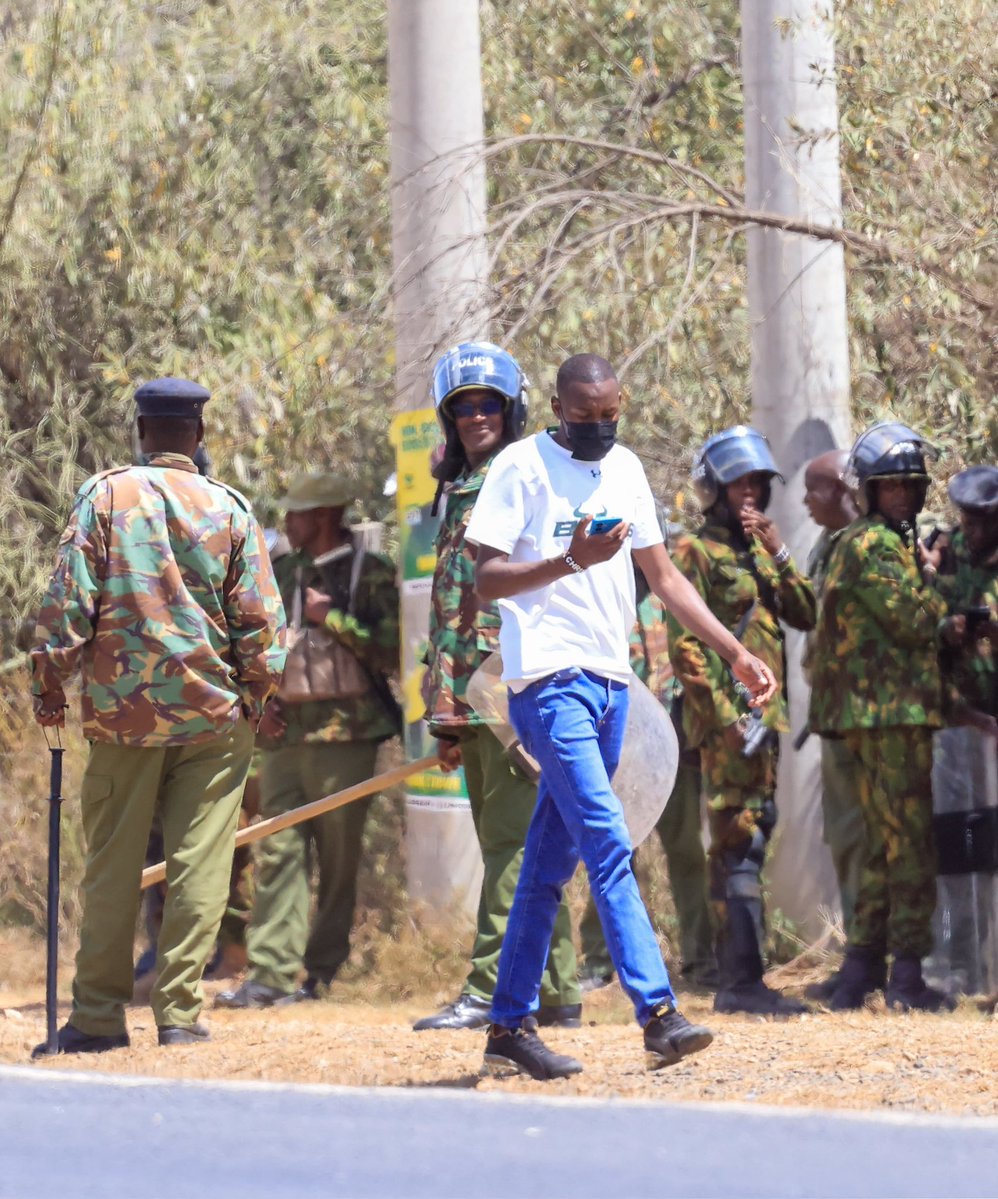
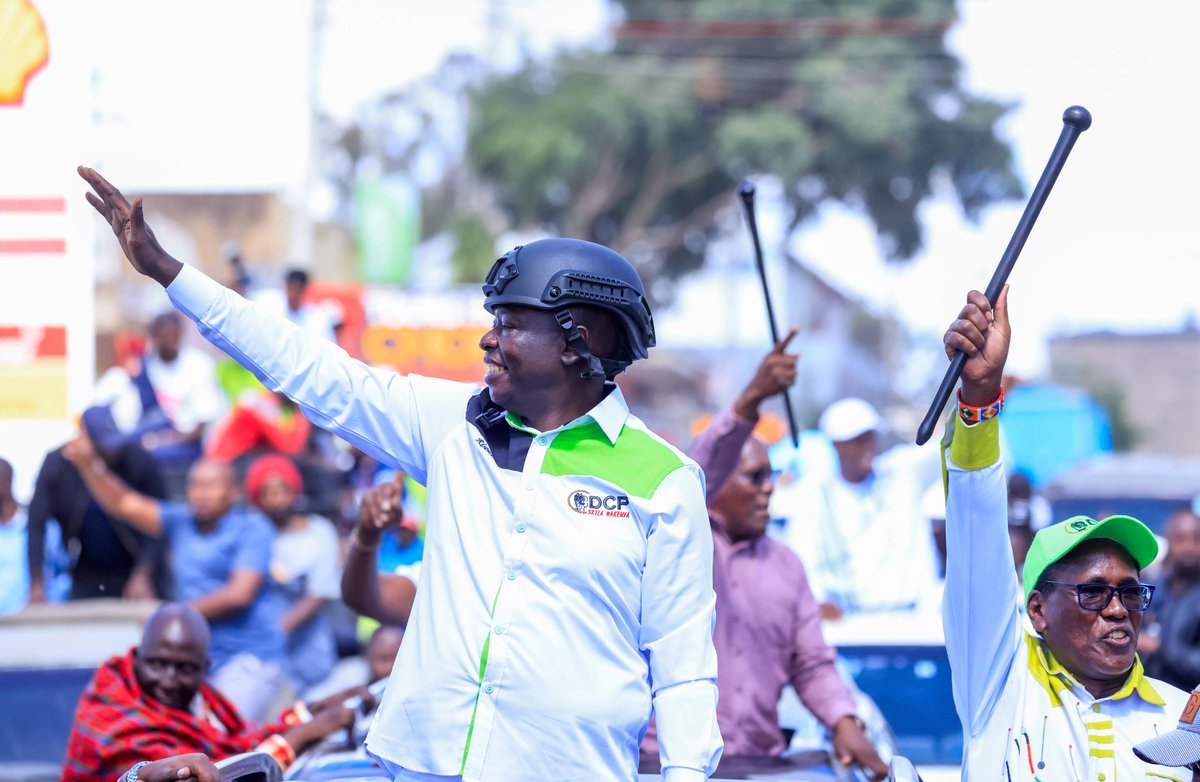
Clear instructions had been issued by this cowardly and brutal regime to block me and my entorouge from accessing Narok Town to campaign for the @DCP_Democracy Candidate for Narok Ward Hon. Douglas Masikonde.
The people, a people united are stronger than all roadblocks, than all bullets, than all stones, than all teargas you have in store and high seas and than any dictator in the world!
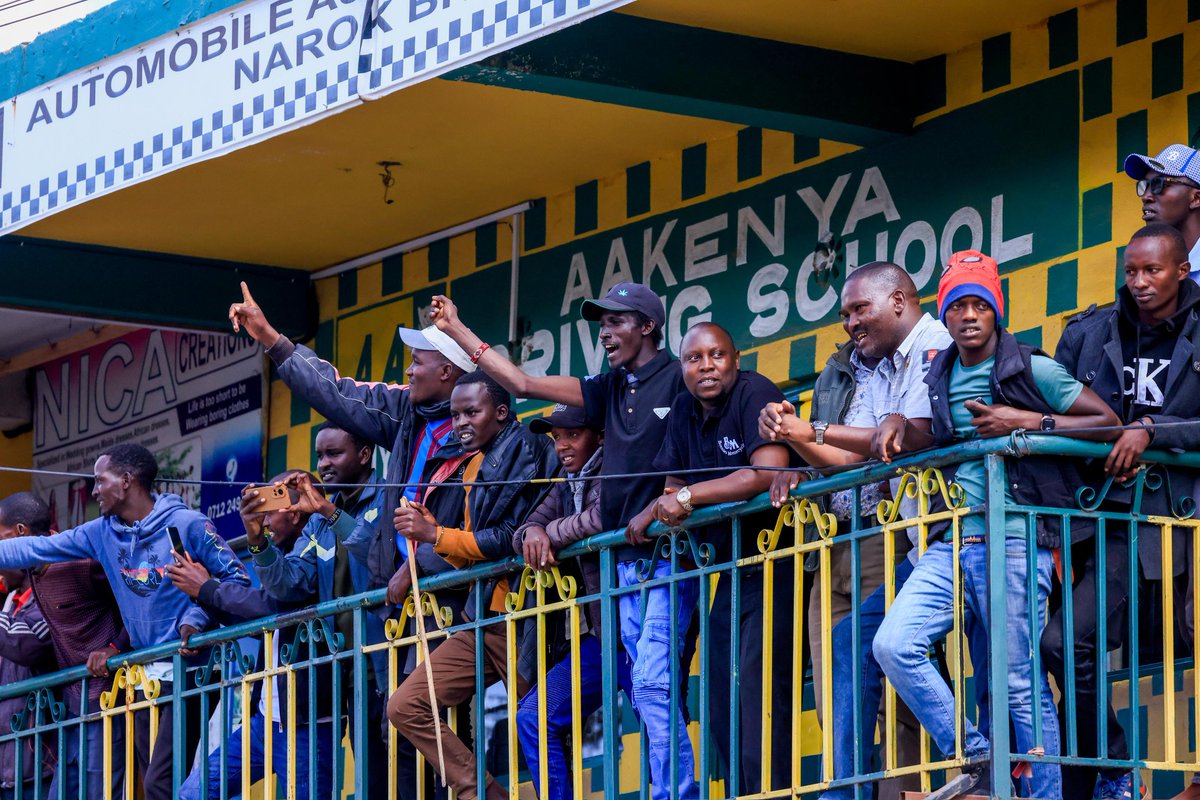
Being a villager, I engaged my fellow villagers in Narok who guided through village paths unknown to the police and made a triumphant entry in Narok town and received by thousands of jubilant DCP supporters.
How can you beat me in my game?
The villagers triumphed and we have affirmed that the will of the people is supreme and the 27th November 2025 by-elections will spell this out clearly.
No amount of blood money, police brutality or police excessive force will cow or intimidate the people of the Republic of Kenya.
Thank you to the great people of Narok especially the young people for standing firm for us today.
The will of the people shall never be subverted at any given moment.
Kenya is not your ordinary African Country turned into a monarch!
ECON101 is fully wrong.
No firm calculates marginal revenue and cost.
Firms dont hire when wages fall.
Markets are never in equilibrium and never full competitive.
Inflation is supply-driven, not demand-driven.
Banks dont lend out of deposits.
Taxes dont finance gov spending.
Rigathi Gachagua didn’t even set foot in Malava a phone call was enough. One brief address, and suddenly the entire landscape shifted. The Luhya crowd walked away saying, “Tumekula… sasa tunapiga kura kwa mwana wetu, si project ya serikali.”
That’s not luck. That’s tactical precision. The kind that rattles any system relying on handouts instead of loyalty.
While State House machinery was sweating bullets in Mbeere North, Gachagua pitched camp like a seasoned field commander. And the moment he arrived, you could almost hear DP Kithure Kindiki’s lungs tighten. Pressure changed. Calculations changed. The ground moved.
And then the shocker Farouk (the untouchable operator) suddenly found himself politically flattened, tucked away like luggage under the bed. Not by a brigade. Not by a coalition. By one man whose only weapon is his ability to read a crowd and flip it in minutes.
Tell me who else in Kenyan politics can make people take your money with a smile, say “asante,” then walk straight to the ballot and reject you anyway simply because he told them the truth?
That’s not ordinary influence.
That’s not charisma.
That’s political wizardry.
If politics is chess, then Gachagua plays blindfolded and still checks the board better than the so-called grandmasters in Nairobi.
One People
One Purpose
One Term
One phone call.
And whole strategies crumble.
That’s the difference between a state project and a man with real ground power. Ahsanteni Malava
In my original post, I argued that economics is not an objective science. I used Econ 101 as an example, pointing out its default bias in favour of free, capitalist markets.
This claim clearly struck a nerve. A number of economists are now responding, insisting that Econ 101 does *not* teach that liberalisation and minimal state intervention are inherently good for the economy — and therefore that the course is not politically biased.
As someone who endured a mainstream economics degree for three long years, I’m well aware that Econ 101 acknowledges market failures and concedes that government intervention can be useful in certain cases.
However, the default framing of Econ 101 remains politically biased in favour of capitalist markets. The state is not presented as an institution that actively shapes markets — which it does in reality — but as an external actor that should intervene only when markets “fail.” Capitalist markets (rebranded as “free markets” in Econ 101, since the curriculum doesn't address the political economy of capitalism) are treated as the natural, neutral baseline rather than a historically contingent system.
When it comes to trade liberalisation, Econ 101 almost always starts by introducing Ricardo’s theory of comparative advantage or the Heckscher–Ohlin–Samuelson (HOS) model. Both frameworks conclude that trade liberalisation raises aggregate welfare. The HOS model notes that there will be domestic winners and losers, but it says nothing about uneven outcomes internationally due to differences in export composition or about power asymmetries between nation states — a central feature of real-world trade dynamics.
In short, Econ 101 offers a highly idealised and politically sanitised picture of markets and trade. By treating capitalist market structures as natural, it sidelines questions of power, history, and institutional design.
I therefore very much maintain my claim: it's dangerous and intellectually shallow to present economics as an objective science, free from politics.
What does it mean, concretely, for the Communist Party of China to seek to build a “modern socialist society” by 2049?
Today, I saw one example of that vision in Dongyue, a small village in Henan Province — a model in the processes of poverty reduction and common prosperity.
This man
He doesn’t get enough recognition
Its by design
There is a reason his tracks never made it to mainstream media
If they did,if Radios played two songs of his every morning for two months
Kenya would be in flames.
He is a danger,not to us,But the government