Last year, we took stock of resident confidence and competence with surgical ethics topics at our program, and designed a longitudinal curriculum to address those needs. Here’s what we found:
cc: @MSHSSurgery
(1/9)
If you’re interested in learning more, or in building a similar curriculum at your program, DM me!!
Thanks to @JSE for sharing our work. Full paper here:
https://t.co/C20LOJyS8F
(9/end)
Last year, we took stock of resident confidence and competence with surgical ethics topics at our program, and designed a longitudinal curriculum to address those needs. Here’s what we found:
cc: @MSHSSurgery
(1/9)
Residents at our program found the curriculum relevant, efficient, and useful, and it demonstrably increased resident confidence in 10/10 of the surgical ethics domains covered!
(8/9)
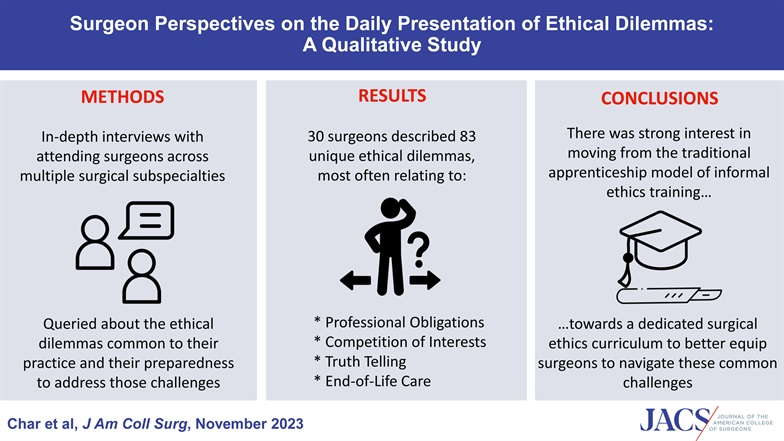
The findings of this study may serve as a useful starting point for the development of a dedicated surgical ethics curriculum aimed at better equipping surgeons to navigate the dilemmas they are likely to face in practice.
Read more at: https://t.co/Bh3tqYrUrS
It’s our hope that our findings may help as a useful starting point in designing such a curriculum 📚.
Many thanks to the @ColumbiaSurgery surgeons who took the time to discuss some very challenging topics with us, and to @acsJACS for sharing our work
(end)
We asked 30 attending surgeons about the common ethical dilemmas they encounter in their day-to-day practice, and how well equipped they feel to face them.
Here’s what they said, and more on why we asked:
cc: @columbia_ccme@ColumbiaSurgery
(1/8)
Overall there was strong support for a dedicated, surgery specific ethics curriculum—by surgeons, for surgeons—involving a blend of lectures 📖 and sim 🔪, to help better equip surgeons to navigate the ethical challenges unique to our field.
(7/8)