Excited to share our new perspective in @JSurgEduc on design thinking - a problem solving framework based on understanding people's pain points, not rejecting early ideas, and using experimentation over intuition to advance them.
Such a framework has the potential to significantly advance surgical research and QI - especially in fields such as education where the risk of trying new things is relatively low.
This technique is already being practiced at a handful of Surgical Innovations programs across the country like @UCSFSurgInnov. By incorporating it into General Surgery training, we can turn every resident who is frustrated with the challenges of modern surgical training into a potential innovator who can solve them.
https://t.co/74CX6zDNWH
Ossoff: This is what small men like Donald Trump and JD Vance and Stephen Miller will never understand—that our national greatness flows not through our blood or our genes, but through our ideas.
Americans are not a race, we're a people united not by ethnicity, but by our shared convictions, and that is what makes us exceptional
.@ezraklein: “What is, to you, the ‘rage economy’?”
@JamesTalarico: “The billionaires own the algorithms and the news networks. They have created for-profit platforms that divide us on an hourly basis — by party, by race, by gender, by religion. They elevate the most extreme voices very strategically to provoke our outrage, because that leads to more clicks, which leads to more money for them.
They are selling us conflict right into our bloodstream, and they’re calling it connection.
And I think it’s left people starving for actual community.”
"I was very fortunate to do my PhD research with Dr. Shirley Tilghman who is an extraordinary scientist and a fabulous role model, both for women and science, but really anybody who’s in her orbit.
Working in Shirley’s lab really taught me how to think critically, but also keep an open mind in science and in life."
Mary Brunkow *91 gives thanks to her mentor and Ph.D. adviser Shirley Tilghman in her @NobelPrize lecture: https://t.co/RByZUu15aa
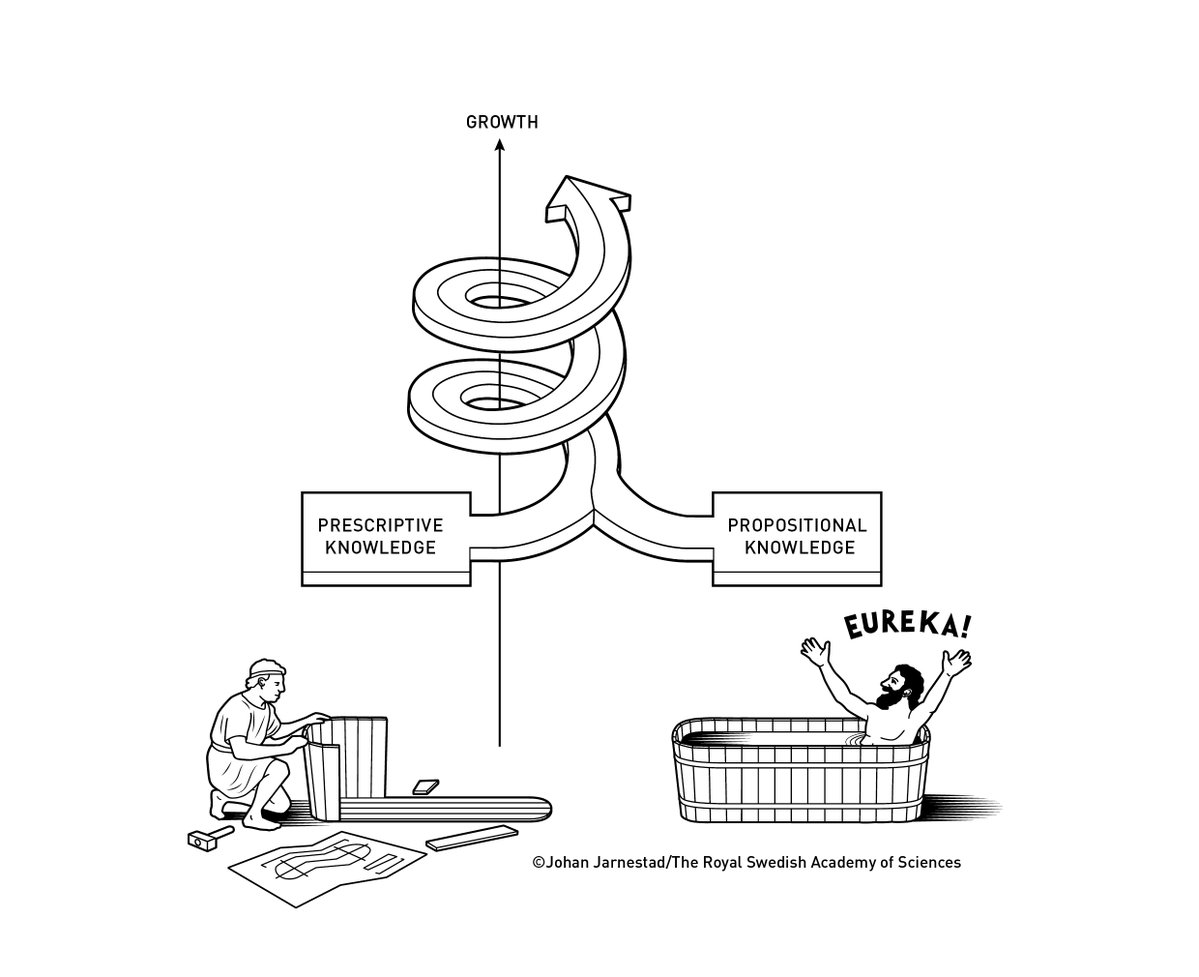
What creates sustained economic growth? This year’s laureates used different methods to answer this question. Through his research in economic history, Joel Mokyr – awarded the 2025 prize in economic sciences – has demonstrated that a continual flow of useful knowledge is necessary.
This useful knowledge has two parts: the first is what Mokyr refers to as propositional knowledge, a systematic description of regularities in the natural world that demonstrate why something works; the second is prescriptive knowledge, such as practical instructions, drawings or recipes that describe what is necessary for something to work.
Mokyr used historical sources as one means to uncover the causes of sustained growth becoming the new normal. He demonstrated that if innovations are to succeed one another in a self-generating process, we not only need to know that something works, but we also need to have scientific explanations for why. The latter was often lacking prior to the industrial revolution, which made it difficult to build upon new discoveries and inventions. He also emphasised the importance of society being open to new ideas and allowing change.
#NobelPrize
what an incredible dilemma for a Disney CEO: stand up for principles or make a lot of money that will have no impact on your lifestyle as an already-rich person. if only there was a series of children's movies that could help with this decision
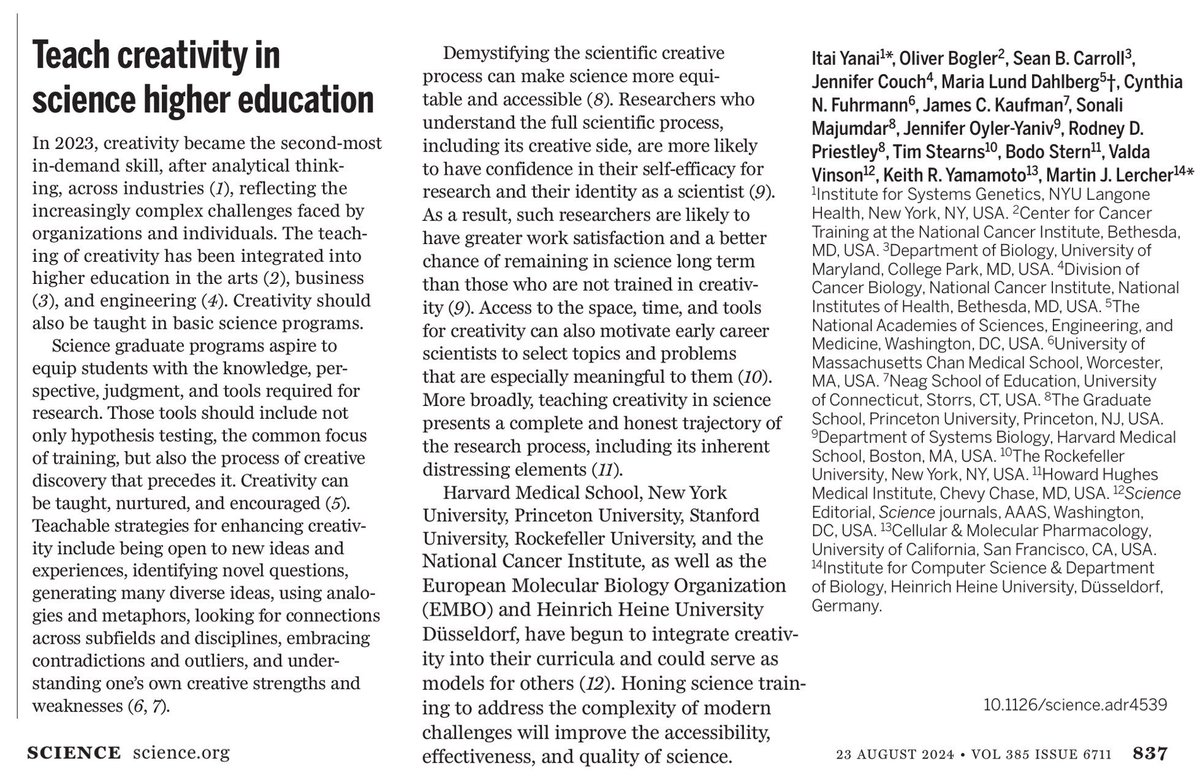
Scientists in training should be taught the creative scientific process, to gain confidence in their self-efficacy for research and identity as a scientist, & also for greater work satisfaction and a chance of staying in science. Join our community at https://t.co/S3mw9Kz1U6
You ran some cool regression analysis OK great. Make some nice graphics and put it on a Substack. Engaging headline, 1500-2500 well-written words. That's literally 100x faster than trying to publish in a journal and it's better peer review anyway.
Thanks for the suggestion. That article was very interesting. Dr. Bell was kind enough to provide feedback on a study I did related to this topic:
https://t.co/2YSISjyJOJ
Regarding the 10K hours, I wonder how we could make improvements there. We are not going back to an era without duty hours and even if we did, a lot of operations aren't being done overnight anymore.
If there was concerted effort to cut down on non-educational tasks, then at least we could get closer to the goal of 10K within the current hours framework.