@BM_Visser Klopt. Maar er is wellicht een keerzijde. Bij gelijke brandstofbelasting als de buurlanden zou het verschil aan belasting (aanzienlijk minder dan nu) op de grote binnenlandse markt wellicht zwaarder wegen dan het relatief kleine bedrag dat nu over de grens gaat.
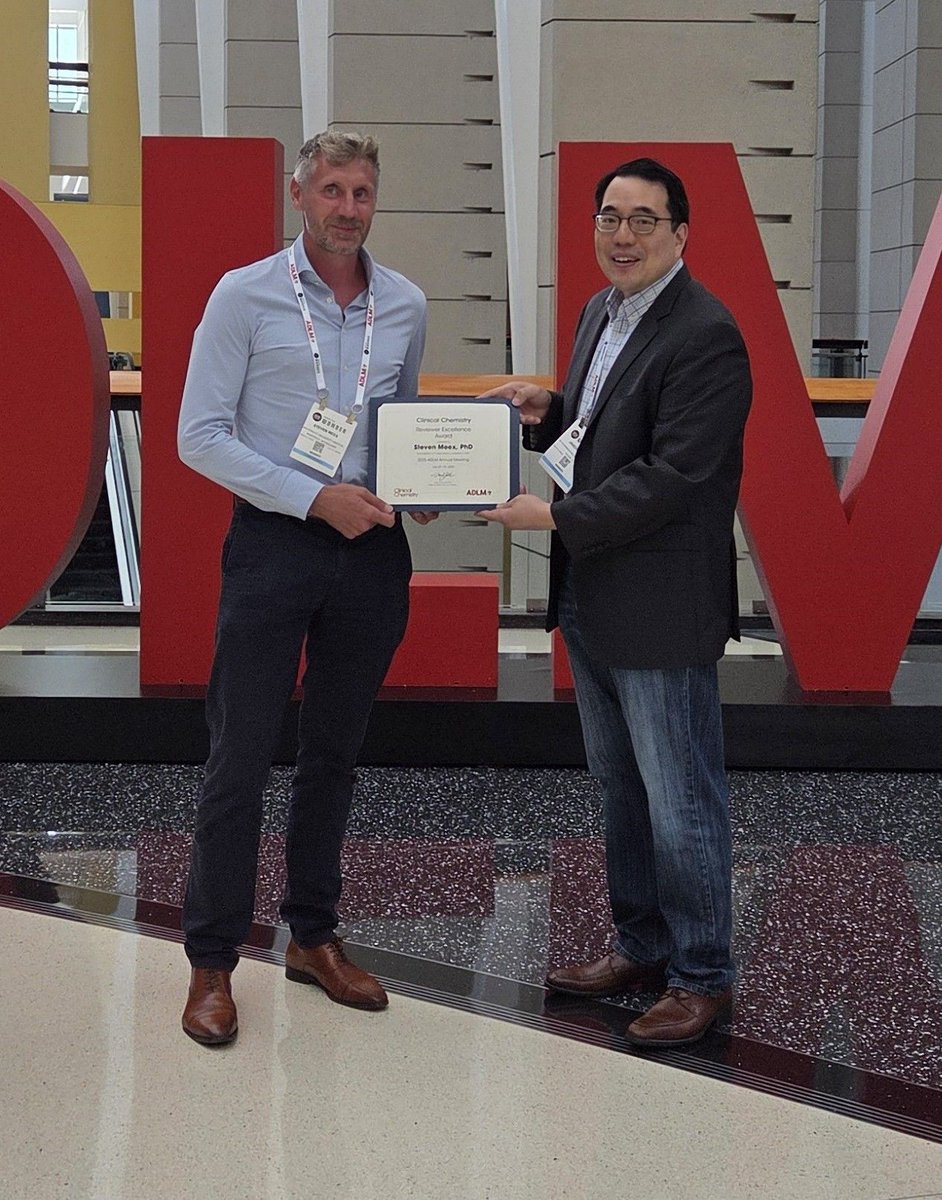
This year's Clinical Chemistry Reviewer Excellence Award went to Dr. Steven Meex for completing 10 peer reviews in 2024. Editor-in-Chief Jason Park presented the award at #ADLM2025.
@nntaleb I’d advise against it. Physiological ketone levels are in micromolar range. Point-of-care devices are designed to measure millimolar concentrations to detect diabetic ketoacidosis. These devices lack precision for accurate measurements of physiological levels.
Normal ranges for blood tests can be more personal!
New study @foy_brody in @Nature
Personal reference values = more precise diagnostics, better prediction & earlier detection
https://t.co/Gm4yfphBmD
summary and commentary in my editorial: https://t.co/aiMTW9sKPD
@NatureNV
@EricTopol@foy_brody@uwlabmedpath @AakreMoberg Blood tests need a rethink 🩸
Population-based “normal” ranges miss a key insight: biomarkers are highly individualized, tightly regulated around personal setpoints.
A new study in Nature shows:
*Personal ranges = more precise diagnostics
*Better prediction & earlier detection
@MichaelAArouet Not so much happened in 1980, but in the book “freakonomics” by Steven D Levitt, the suddenly falling crime rates in the eighties is linked to Roe vs Wade in 1973. Not unlikely…
@nntaleb While your reasoning suggests high activity at a later age might be unrelated to youthful activity, there could be a correlation. It’s possible that some benefits observed in training at an older age stem from earlier active patterns. Interesting perspective!
#OriginalResearch: In non-inflammatory myopathies and myositis, ⬆️ in #hs-cTnT was common even in the absence of cardiac disease, in part due to TNNT2 upregulation in diseased skeletal muscle @christian_puel
@J_Boeddinghaus @LopezAyalaP@s_piscuoglio https://t.co/1EAZZBm8Bj
🚨 Check out our latest Publication ahead of print, #openaccess in @CircAHA: Skeletal Muscle Disorders: A Non-cardiac Source of Cardiac Troponin T
Big shout out to first authors @JDFDLz, #Prepoudis and the whole #BASELXII_Investigators
https://t.co/zzyEBfu5mm
@KrishnaAragam Great work! Could it be possible that there is in fact a small protective effect with moderate drinking (~5 units), as suggested in this graph, an effect that may be statistically attenuated when depicted in a linear or even quadratic equation (in the next graphs)?
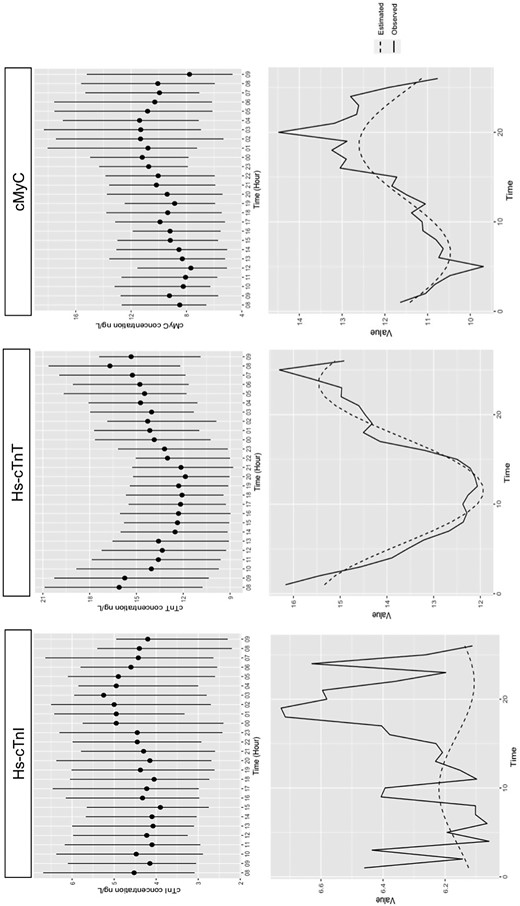
Cardiac troponin release kinetics: levels at presentation cannot distinguish type 1 MI from other causes of injury or infarction. Results now online @CircAHA https://t.co/8cjyl6SGai
@HighSTEACS@chapdoc1@djlmed @DorienKimenai @EdinUniCVS
@richardbody So by taking the test your probability of being negative went down from ~99.5% to 99.9%. 😊
Does that “improvement” outweighs the consequences of a false positive test, which may be substantial when conducted at large scale in an asymptomatic population?
Impressive study on troponin release after very brief episodes of coronary artery balloon occlusion by dr Iversen’s research group
Possibly the best evidence thus far in support of the hypothesis of troponin release without necrosis.
https://t.co/XE72OU4EXs