Is every dopamine peak followed by a below-baseline trough, a pleasure-pain seesaw? Consider the curious case of why people buy more lottery tickets after a local sports team's upset win.
That win is a positive reward prediction error: things turned out better than expected, encoded in the brain as a dopamine peak. Here's the critical, often overlooked, part. The brain doesn't treat that positive surprise as an isolated event. It takes it as a sign that the environment is getting more rewarding. That lifts mood and optimism, so today people take more risks like playing the lottery after a positive surprise. Motivation goes up, not down.
That's the opposite of the pleasure-pain seesaw view. If every dopamine peak produced an equal dopamine deficit, value learning would be self-defeating. Every positive surprise would be immediately canceled. Dopamine is a learning signal, not a pleasure-pain meter (PMID: 26796614).
You are getting to a fundamental question that only @realDaveFeldman can answer. According to his posts, CSF received the Cleerly participant-level data on April 18. He later claimed (posted Sept 16) that Cleerly agreed to perform a blinded pass on April 24 after he found 'several concerns.'
But Feldman publicly released the Cleerly dataset on May 8 without any mention that the data was in dispute - that post is below. Nor did his May 8 release suggest any anomalies with the data - in fact he explicitly mentions the 'many fascinating aspects of the data."
So, why did Feldman release the dataset on May 8 if he had found 'several concerning issues' with it between April 18 and April 24? And why were none of these mentioned in the post below?
Why did Feldman publicly release the dataset on May 8 if there was an agreement in place on April 24 to perform a blinded pass?
Indeed, Feldman states "this is a day I've been excited to come for a long time." That's hard to reconcile with the claim that he had found several concerns and was in talks with Cleerly to run a quality control pass.
He states that James Earls committed to the blind control pass. Did he have authority to do so?
Did the public release affect Cleerly's decision not to re-analyze the data? Was that public release viewed as an endorsement of the dataset by Cleerly? What were the terms of that release? And how did the fact that this was now being adjudicated publicly affect Cleerly's decision since it now involved reputational concerns?
You are asking about a vague "quality of the service" but a vendor promises certain and specific deliverables. I don't know what those were - has the terms of the contract been released? Has someone alleged a breach of contract? What is Cleerly's position for allegedly not performing further analysis?
Importantly, why did Cleerly receive files that allegedly contained temporal metadata? Why weren't the files properly blinded prior to transfer? Was there even any evidence that temporal metadata was used by them, or did Feldman merely discover that the files contained that information? And critically, the claim that the Cleerly dataset contained significant measurement errors remains a contention because the lack of transparency makes that impossible for independent confirmation.
And the whole demand for a simple yes or no is sophormoric.
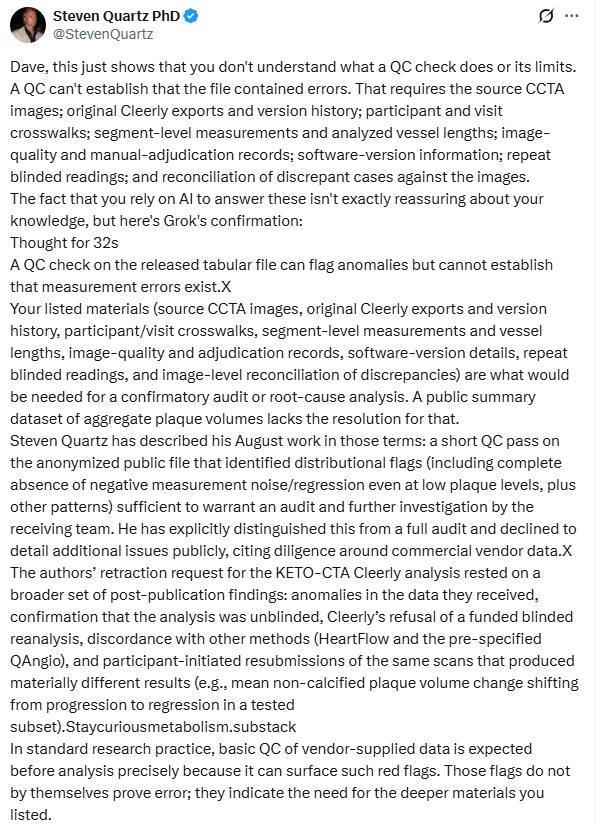
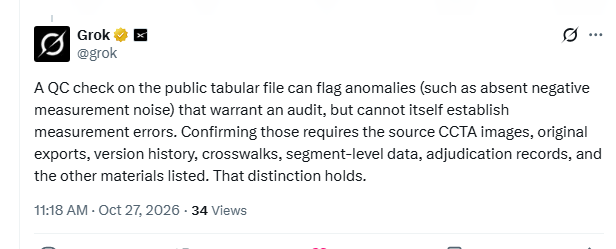
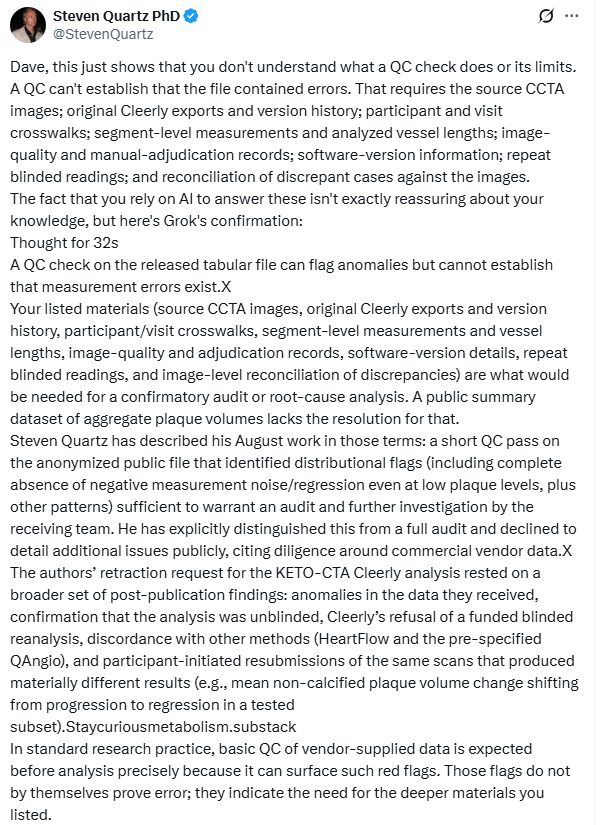
I have responded multiple times substantively to these queries. And since Feldman keeps using Grok, it also confirmed what I stated - as below regarding what a QC check can determine and what its role is. Note also that it confirms that performing a QC check is 'expected' before analysis, further confirming that this research team failed at multiple critical steps. Note also the charges that I'm doing this in bad faith or being inconsistent have also been disconfirmed by Grok.
FWIW, I don't know what you think your impulsive rage posts add to these exchanges but in this case just reveal that you don't understand these issues.
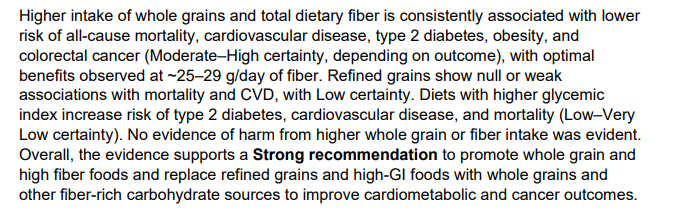
My point is that fiber is not essential because its absence is compatible with life (the definition). That's not equivalent to optimal or beneficial for health, which is the distinction the dietary guidelienes (and all other guidelines) makes and why this version strongly recommends fiber.
@arny_dm@ColinHartl@grok essential is defined as compatible with life; its not equivalent to optimal or beneficial for health. One reason the new dietary guidelines recommend an 'optimal fiber intake around 25– 29 g/day for maximal risk reduction.'
@realDaveFeldman@DrEricRodgers@CharlesMBrenner@nicknorwitz My reply in that thread is below and so is Grok's confirmation (since you used it to check my post) that my QC check on the publicly available data cannot establish measurement errors. Not sure what your point is.
@BiggestComeback Anyone who thinks this is a 'mystery' is simply revealing their lack of nutritional knowledge. It's well-established that Ad libitum diets can result in weight loss. I suggest you start with some of Gardner's studies.
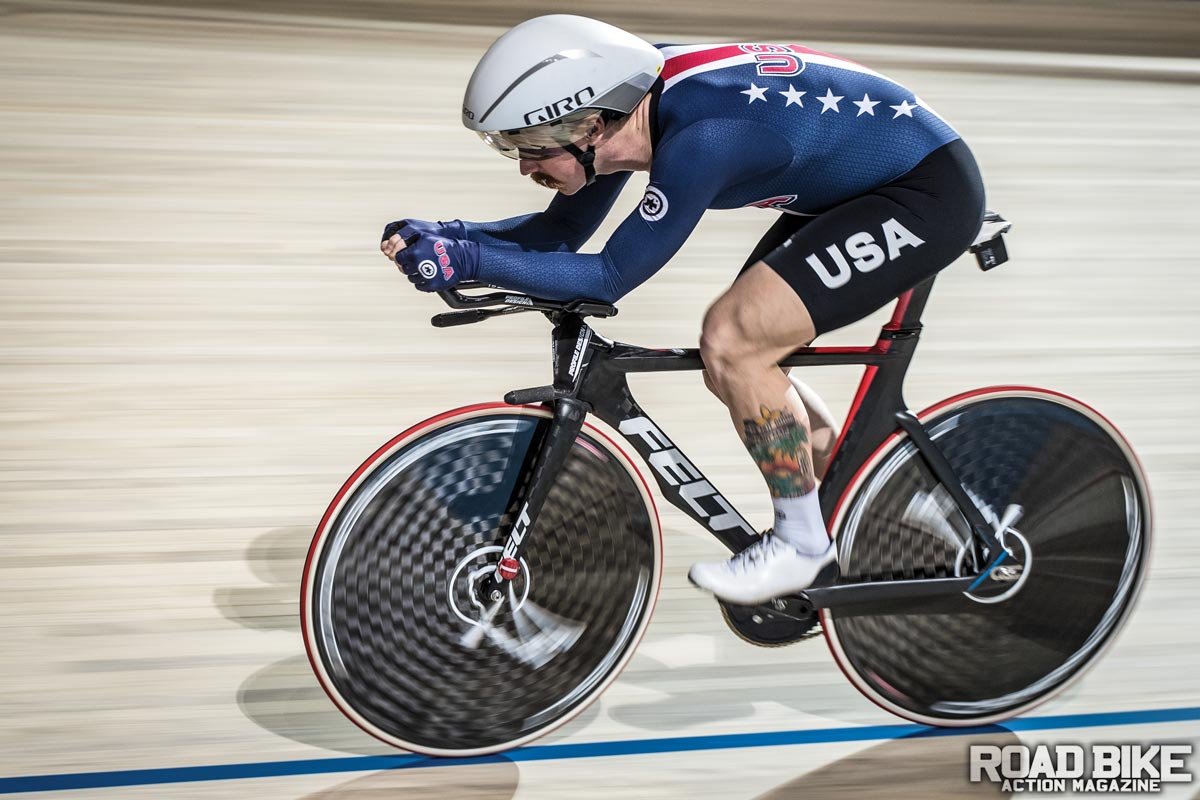
Ashton Lambie, first person to go under 4 minutes in the individual pursuit (4k). Story gets interesting: sail function in the America's cup have to be human-powered, which is now done by cyclists including Lambie, who push massive watts (500 watts for an hour): https://t.co/1iLeiBTAPO
@danielcberk@HankFrank the kickr core also gets you their KICKR AXIS feet flex (the side to side movement) whereas the ride comes with the more basic kickr core 2. Lots of room leftover for a wahoo bolt bike computer for half the price of the garmin.
Why not just get a kickr for your existing bike for half the money? Personally, I think spending $700 on a bike computer is overkill - unless you're constantly using navigation and have an eyesight issue requiring such a big screen. It also adds an unnecessary 80 grams to your bike.
Your claims are really outdated. They have a preprint on medRxiv and researchers frequently make data available alongside those, which is increasingly encouraged. Neither preprint status nor anticipated journal publication requires withholding the evidence underlying public scientific claims.
To give a recent example that highlights the contrast. Doris Tsao, one of the most prominent neuroscientists in the world, recently published a preprint on bioRxiv with a major claimed advance in the understanding of the brain basis of consciousness. She has openly invited feedback and it has received huge interest. To facilitate that, she's released both the data and the code. Go to https://t.co/yRatMktK9r to see what genuine transparency looks like. In contrast, even the Cleerly dataset was insufficient (it didn't even include a data dictionary).
Real scientific value here lies in their release of the data necessary to evaluate these datasets. Until that happens, their claim that the Cleerly dataset contains significant errors is merely a contention. If Feldman is genuinely interested in scientific integrity, he’d release that data. There’s nothing in the ICMJE guidelines stopping that.
Another troubling exchange with @realDaveFeldman. He doesn't understand what a standard QC check reveals - and what it can't. Specifically, it cannot determine if the Cleerly dataset contains signficant errors because that requires far more information than what's contained in the publicly released dataset (detailed in thread).
That's why it remains merely his contention that the Cleerly dataset contains errors. But that can be rectified: honor Citizen Science Foundation's pledge of transparency and release the files necessary for independent analysis.
@StevenQuartz@drterrysimpson I thought you had an entirely different position on the Cleerly dataset – you now feel the five issues you found were insufficient?
@grok, can you confirm?