Senior International Speaker Consultant, Translator ES,CA,DE+FR--EN.Speaking Agent for @siebergd, Proud father to three daughters, opinions my wife's, etc.
BMJ (2007)- studied 1500 matches over a century, concluded a 2000m altitude difference worth a one goal headstart for home team, greatly increased chance of winning:
“The altitude difference between home and away teams
in international football games in South America sig-
nificantly affected the outcome of games. High altitude
home teams scored more and conceded fewer goals
when playing low altitude teams, and for each addi-
tional 1000 m of altitude difference the home team’s
score increased by about half a goal. In the case of
Bolivia playing against a sea level opponent such as
Brazil, the probability of a home win was effectively
increased from 0.537 to 0.825 because of altitude”
tu laptop actual acaba de convertirse en un pisapapeles
nvidia revento tres decadas de historia con un solo chip
se llama rtx spark y sus especificaciones son una estupidez
le metieron el nivel de una grafica 5070 128 gigas de memoria y un petaflop entero de potencia
pero lo mas enfermo de todo es que tu ia personal ahora vive fisicamente en tu equipo
cero internet
cero nube
funciona localmente las 24 horas
todo empacado en un diseño super delgado que no pierde fuerza cuando lo desconectas de la pared
las demas marcas ya estan sudando frio intentando ver como copian esta bestialidad
Farmers have figured out that the cheapest pesticide is a strip of flowers.
When you plant wildflowers through a crop field, not just around the edge but in strips running through the middle, you get ladybugs, lacewings, hoverflies, and parasitic wasps living in the field instead of visiting it.
They eat the aphids, the caterpillars, and the mites for free, all summer long.
In controlled trials, fields with tailored flower strips had leaf-beetle numbers 40 to 50% lower and crop damage cut by around 60%, enough to drop below the threshold where spraying was even considered worth it.
The flowers attract a standing army to our fields.
We spent decades engineering chemicals to kill the insects eating the crop, when the insects that eat those insects would have worked for the price of seed.
And there it is. If you’re wondering why they’ve had no red cards and every decision of note go in their favour it’s here in vivid technicolour.. how embarrassing.
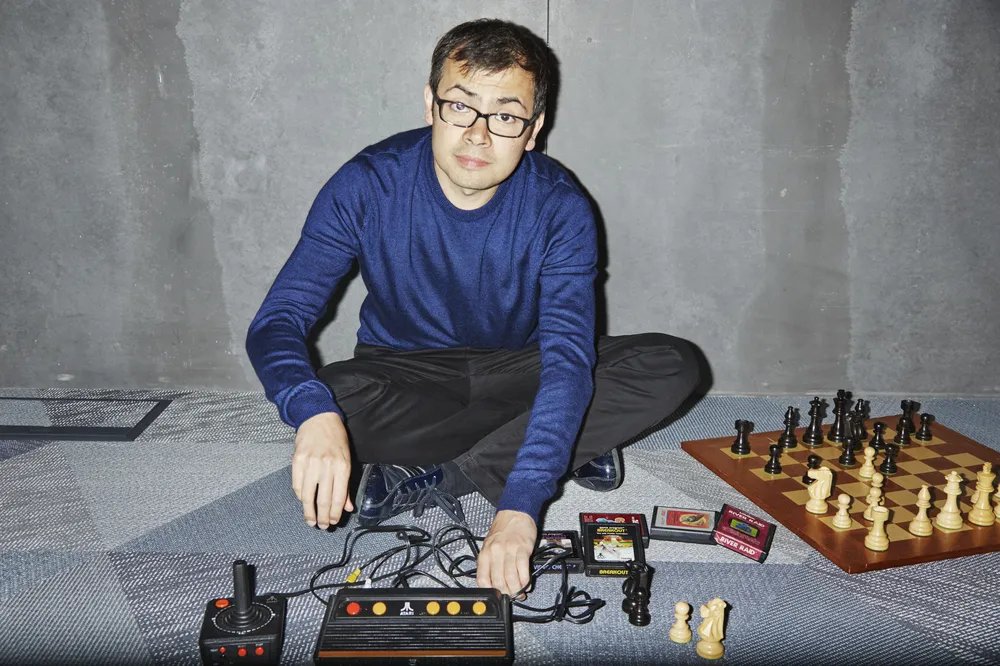
A British kid became a chess master at 13, then a bestselling video game designer at 17, then a PhD neuroscientist at 33, then the CEO of the AI lab that won the 2024 Nobel Prize in Chemistry.
People called him unfocused for twenty years. He was running the most deliberate career plan in modern science.
His name is Demis Hassabis, and the thing almost nobody understood while he was doing it was that every single step was feeding the same underlying obsession.
Here is the thread that connects the whole career, and why it matters for how anyone should think about building toward a hard goal.
The chess came first. He was born in London in 1976 and started playing at age four. By eight, he was the London champion for his age group. By thirteen, he had an international master rating that put him in the top fifty players in the world under his age bracket. He was on a track that would have made him a professional player for the rest of his life.
He walked away.
The reason he gave later, in interview after interview, is the part most people miss. He said chess forced him to think constantly about thinking itself. Every move required him to simulate what his opponent was simulating about him. He became fascinated not with winning the game, but with the process the human brain was running in order to play it. He decided chess was too small a container for the real question he wanted to answer, which was how intelligence actually works.
The video games came next. He used the money he won from chess tournaments to buy a ZX Spectrum. He taught himself to code. By seventeen, he was a lead programmer on a game called Theme Park that sold millions of copies. He could have stayed in that industry and built a career as one of the top game designers in Britain.
He walked away from that too.
He went to Cambridge, did a double first in computer science, and then made the move that looked like the strangest pivot of his life. He enrolled in a PhD in cognitive neuroscience at University College London. He was thirty. His peers from Cambridge were already running companies. He went back to graduate school to study how the human hippocampus builds memories and imagines future scenarios.
His 2007 paper on the link between memory and imagination was named one of the top ten scientific breakthroughs of the year by Science magazine. But the paper was never the point. The point was that he had spent three decades quietly building the exact combination of skills nobody else in the world had put together.
Deep intuition for how intelligent agents behave in complex systems, from a lifetime of chess. Hands-on engineering fluency, from years of shipping commercial software. And a rigorous scientific understanding of how biological brains actually produce cognition, from a PhD in neuroscience.
In 2010, he used that combination to co-found DeepMind with Shane Legg and Mustafa Suleyman. The mission statement he wrote was two sentences long and sounded absurd to most people who heard it. Solve intelligence. Then use it to solve everything else.
For the first six years, DeepMind worked almost entirely on games. Atari. StarCraft. Go. People outside the field could not understand why a lab that claimed to be building artificial general intelligence was spending hundreds of millions of dollars teaching computers to play Pong.
Hassabis kept explaining the reason in interviews and almost nobody was listening. Games were not the goal. Games were a controlled environment where you could iterate on general-purpose learning algorithms fast, measure their progress precisely, and prove to yourself that you had built something that could transfer between domains.
In 2016, AlphaGo beat Lee Sedol, the world champion at Go, in a match that had been considered decades away. And the day after that match ended, Hassabis sat down with his team lead David Silver and asked what they should do next.
The answer was the thing he had been working toward his entire life.
They turned the same deep reinforcement learning approach at a problem biology had been stuck on for fifty years. Protein folding. Given an amino acid sequence, predict the three-dimensional shape the protein would fold into. Every drug discovery effort in the world depended on it. The best computational methods could only solve a small fraction of proteins. Experimental methods took years per structure and millions of dollars per protein.
AlphaFold2 was released in 2020. Within a year, it had predicted the structure of almost every protein known to science. Two hundred million structures. Made freely available to the entire research community. More than two million researchers from a hundred and ninety countries have used it since.
In October 2024, Demis Hassabis and John Jumper were awarded the Nobel Prize in Chemistry for that work.
The line almost nobody quotes from his speeches is the one that explains the whole career. He has said, many times, that he did not build AlphaFold to solve protein folding. He built AlphaFold to prove that the approach he had been developing for thirty years could actually work on a real scientific problem. Protein folding was the demonstration. AGI was always the goal.
The chess taught him how to think about adversarial systems. The games taught him how to ship software. The neuroscience taught him how the only existing example of general intelligence actually worked. DeepMind used all three to build a method that could transfer between domains the way the human brain does. And the moment the method was ready, he pointed it at the single most important unsolved problem he could find in a domain where a breakthrough would save millions of lives.
Most people looking at his career from the outside, at any point before 2016, would have called it scattered. A chess prodigy who gave up chess. A video game designer who walked away from a gaming career. A computer scientist who detoured through neuroscience. A startup founder who burned six years on board games.
From the inside, it was the most focused career in modern science. Every step was quietly answering the same question. How does intelligence actually work, and what would it take to build one that could solve problems humans have not been able to solve alone.
The people who change a field are almost never the ones who looked focused along the way.
They are the ones who were obsessed with a single question so deep and so long that the path they took to answer it looked like chaos from the outside and like a straight line from the inside.
And they almost never get credit for the plan until decades later, when the Nobel Committee calls.
850 reviews across Amazon, Goodreads & Audible. Averaging 4.8 out of 5.
175,000+ views of video interviews & STILL somehow selling 25-30 copies a week 5 years after its release!!
There's life in the old dog yet 👍👌
"Be Good"
https://t.co/zrbVhreQQc
Lindsey Vonn entrenando después de romperse el ligamento, sufrir un grave accidente, someterse a varias cirugías y llegar a decir que podrían haberle amputado la pierna. Con 41 años.
No va a permitir que este sea su final. Ni por asomo.
🚨Jaap Stam:
“Player power? Sir Alex didn't let that! The club comes first. In the history of Manchester United, Eric Cantona is the only one who was allowed to do anything he wanted. Beckham, Keane, Cristiano all got kicked for disobeying the manager.”
Anthropic’s chief scientist says AI autonomy could spark a beneficial ‘intelligence explosion’ – or be the moment humans lose control https://t.co/zRHj9qlCbQ MUST READ #haltagi#techvshuman
. @TIME on its choice for “Person of the Year” for this year:
“2025 was the year when artificial intelligence’s full potential roared into view, and when it became clear that there will be no turning back.”
Suicide.
I'm choosing to be deliberately blunt and provocative in this post because it's necessary. Government, charities, football clubs are all pushing water up a hill in highlighting what is undoubtedly a major health crisis.
You take a rope.
You put it up in a garage or a tree nearby or far away.
You're thinking about every loved one you'll leave behind as you put that rope around your neck.
Then you drop.
Some are decapitated.
Some aren't.
All are found by someone who has a lifetime of trauma that will never leave them.
A son.
A daughter.
A brother.
A sister.
A mother.
A father.
I know 2 men who hung themselves.
One was found by his Mom.
One was found by his brother.
Neither have recovered fully. 20 and 30 years on.
A life sentence for people who were already worrying, terrified their loved one may do something.
So just visualise the above and ask, "is there another way"?
A segway for a moment.
I do a few Q&A's every year. Tales of yesterday with a 99% male audience of my age group.
After the stories and fun, my last question back to the audience is..
"Hands up if you struggle with a mental health issue".
Nobody ever puts a hand up. Despite 1 in every 3 of 500 attendees statistically struggling.
"Ah, nobody, that's fucking brilliant! Well I do! ". I then graphically tell people, stunned into silence about how a rope around my neck in the middle of nowhere jolted me to go home and cry like a baby to my Mom.
After the Q&A has finished, something always happens. I'll be chatting to a few guys, saying bye and one by one, men will come over and whisper " I struggle".
Or my mailbox the next day will have 30 emails from guys, their partners or kids saying " Dad/Uncle /Brother was there last night and what you said hit them hard".
And that's how some people realise that it's time to speak to a pal or family member or even rant to me in an email. It works, I often get a follow up email a year or 6 later saying that they took responsibility for their suicidal feelings and are now flying.
Humans are programmed to want to live, to have families and to keep the species growing and thriving. So for a human to want to short circuit that desire isn't normal, and it should never be spoken of as normal. It's the ultimate red flag.
If you suspect your mate, Dad, Brother, Uncle is struggling mentally, they deserve your intervention.
They deserve a " are you OK, please tell me what's up".
They deserve an opportunity to get past wanting to hang a rope over a tree or in a garage and slowly struggle until they die and you find them.
If you've been there and trust me I have plenty, then you'll know that text out of the blue, or a footie mate or one of your kids asking jow you are can open the curtains to some sunshine.
Because when suicide is your only answer, the room is already dark, and you can't see a way out.
So please, fucking pretty please, ask that husband, Dad, Uncle, Cousin, footie pal TODAY how they are.
You may be shocked what comes back but extremely glad that you asked.
For those who struggle, you're not alone.